As the United States expanded from thirteen coastal colonies into a continental republic, the post office stood at the core of American governance. Postal networks circulated political newspapers, coordinated elections, and funded transportation routes across vast distances.
Between 1775 and 1902, federal postal statutes determined how citizens accessed news and how political parties organized voters. These early legislative battles established federal authority and privacy protections that continue to govern public communications, universal service mandates, and mail-in voting.
How Postal Policy Shaped Governance From the Revolution to the Modern Era
This list tracks nine milestones where federal postal legislation and executive actions reshaped the American political system between 1775 and 1902.
Each entry is drawn from statutes at large, congressional committee reports, and executive orders preserved in the National Archives and congressional records.
Establishing the Constitutional Post
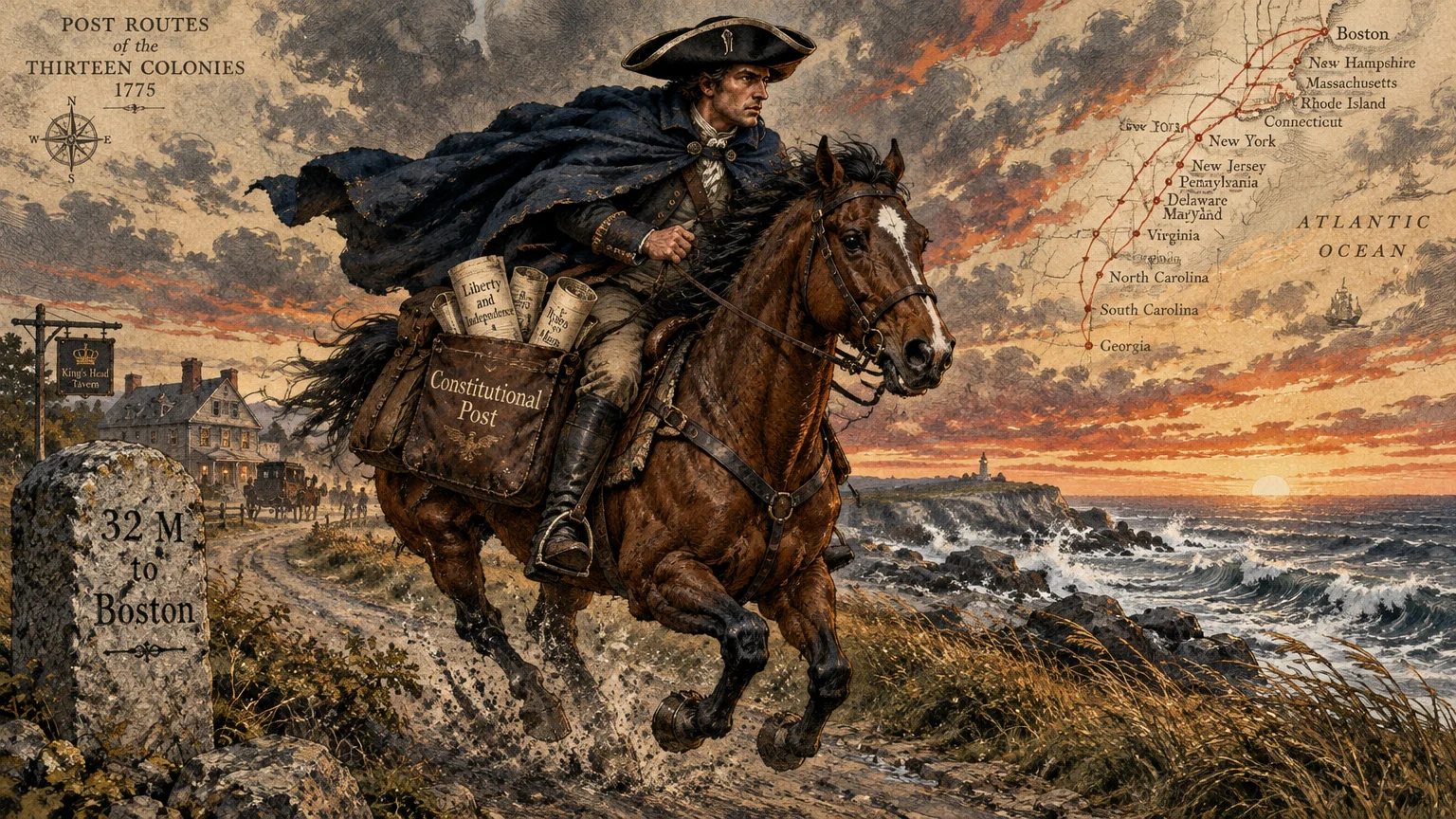
On October 5, 1774, patriot printer William Goddard presented his plan for a “Constitutional Post” to the Continental Congress. British colonial authorities had routinely inspected, delayed, and suppressed his newspaper, the Pennsylvania Chronicle.
Goddard designed an independent postal network funded by private subscriptions to bypass the Crown’s postal monopoly. On July 26, 1775, the Second Continental Congress formally established the American postal system, nearly a year before approving the Declaration of Independence.
Delegates appointed Benjamin Franklin as the first Postmaster General with an annual salary of $1,000. Franklin used this network to route revolutionary dispatches and military intelligence among the thirteen rebellious colonies.
Subsidizing the Free Press Through the Post Office Act of 1792
President George Washington signed the Postal Service Act of 1792 into law on February 20, 1792. The statute, recorded at 1 Stat.
232, created a comprehensive legal framework for American communications.
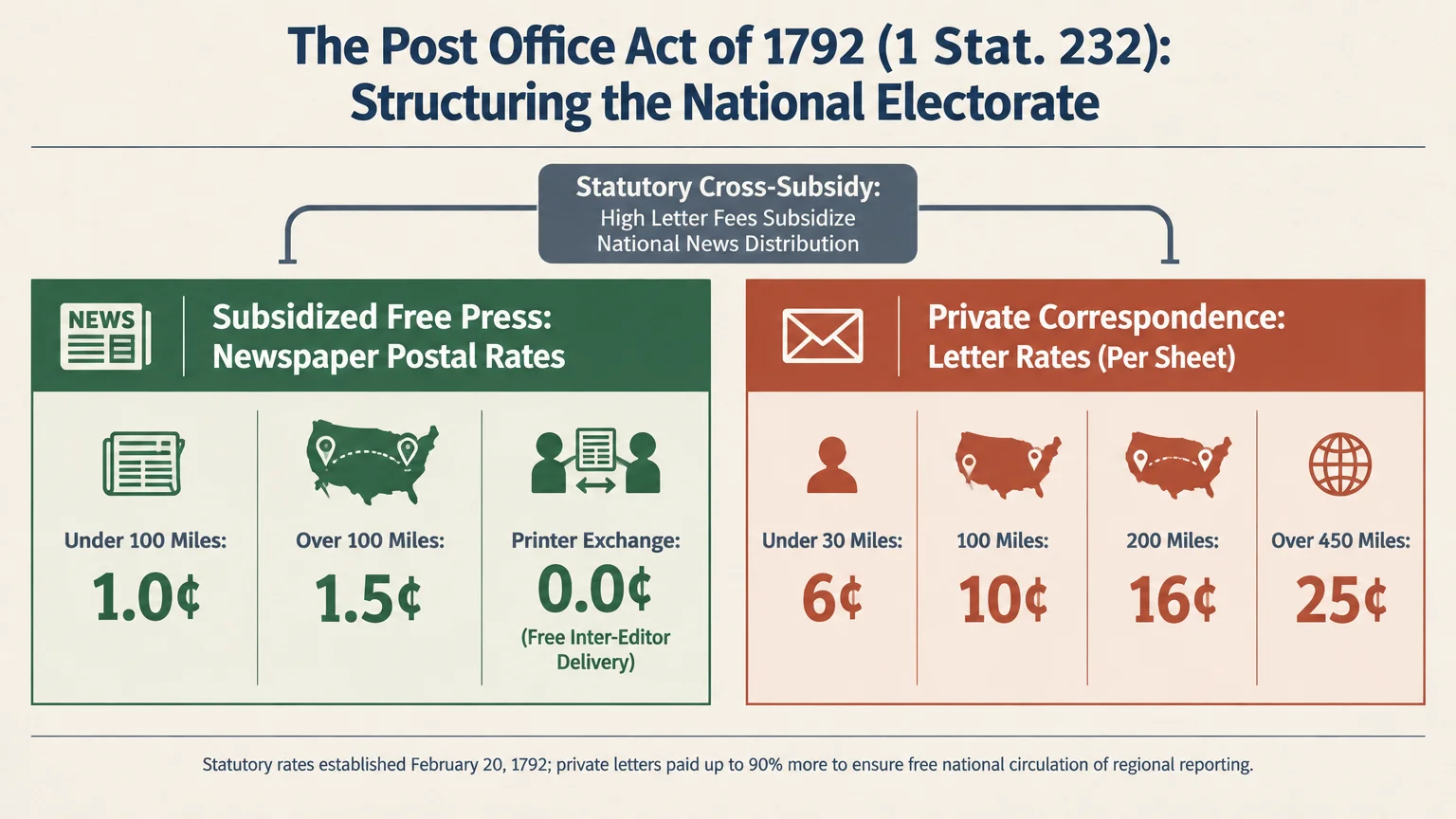
Congress intentionally structured postal rates to build an informed electorate, as documented in the Library of Congress historical collections. The law charged 1 cent to deliver newspapers up to 100 miles and 1.5 cents beyond.
Meanwhile, personal letters cost between 6 cents and 25 cents per sheet, making private correspondence subsidize political news. The act also permitted newspaper editors to mail copies to other printers free of charge, creating America’s first national news exchange.
Codifying Mail Privacy and Congressional Route Monopolies
The Post Office Act of 1792 established the first federal protections for mail privacy to prevent political surveillance. Section 16 imposed a $300 fine and up to six months in prison for postal workers who unlawfully opened letters.
Under Section 17 of the act, robbing a mail carrier carried the death penalty. These statutory penalties protected private correspondence and political communications from warrantless government inspection.
Congress also exercised its authority under Article I, Section 8, Clause 7 of the U.S. Constitution. As documented in the Constitution Annotated, lawmakers rejected executive route planning and reserved the sole power to designate post offices and post roads.
Expanding the Civilian Federal Footprint Across the Frontier
The postal network grew rapidly during the early decades of the republic. The total number of post offices surged from 75 in 1790 to 7,530 in 1828, reaching 8,764 by 1831.
By 1831, postal workers accounted for 76 percent of the entire civilian federal workforce. The 8,764 postmasters outnumbered the active U.S. Army, which had 6,332 soldiers.
For most citizens, the neighborhood postmaster was the only federal official they regularly encountered. During his 1831 tour, Alexis de Tocqueville observed that the United States operated twice as many post offices as Great Britain and five times as many as France.
Enforcing Church-State Separation in the Sunday Mail Controversy
Section 9 of the Post Office Act of April 30, 1810, required postmasters to open offices on Sundays if mail arrived. This mandate sparked America’s first national petition campaign over religious observance and federal authority.
Between 1828 and 1830, Christian Sabbatarians petitioned Congress to end Sunday mail transit. Senator Richard Mentor Johnson authored committee reports in 1829 and 1830 rejecting the proposed bans.
Legislative records preserved by the U.S. Senate Historical Office show that Johnson argued the federal government could not enforce religious observances under the Constitution. Johnson’s reports affirmed that federal public services operate under civil law for Christians, Jews, and nonbelievers alike.
Institutionalizing the Spoils System in the Presidential Cabinet
In 1829, President Andrew Jackson elevated Postmaster General William T. Barry to full Cabinet status.
Previous administrations had treated the post office as a subordinate bureau rather than an executive policy organ.
Congress later codified the Post Office Department as an executive department on June 8, 1872, under 17 Stat. 283.
Jackson used the department’s employment power to reward political supporters across the states.
In 1829 alone, Jackson and Barry removed 423 postmasters for partisan reasons. They routinely appointed Jacksonian newspaper editors to manage local post offices, providing party organizers with federal salaries and franking privileges.
Censoring Abolitionist Mailings and Sectional Dissent
In 1835, the American Anti-Slavery Society launched a mass direct-mail campaign across the South. The society mailed over 100,000 anti-slavery pamphlets directly to southern political leaders, clergy, and prominent citizens.
On July 29, 1835, a mob broke into the Charleston, South Carolina post office, seized the abolitionist mailbags, and burned them in public. Charleston postmaster Alfred Huger asked Postmaster General Amos Kendall for instructions.
In an August 1835 letter, Kendall told Huger that while he had no legal authority to ban the publications, he would not order southern postmasters to deliver them. Southern postmasters used Kendall’s reply to withhold anti-slavery literature throughout the region.
Transforming Civil War Communications and Civil Service Standards
On July 1, 1863, President Abraham Lincoln’s Postmaster General Montgomery Blair launched Free City Delivery in 49 cities with 449 carriers. The program delivered war correspondence and casualty notifications directly to urban homes.
During the 1864 presidential election, nineteen northern states authorized absentee voting for Union troops, who cast roughly 150,000 ballots heavily favoring Lincoln. After the war, patronage scandals prompted Congress to reform federal hiring.
On January 16, 1883, President Chester A. Arthur signed the Pendleton Act (22 Stat.
403), preserved at the National Archives, introducing competitive merit exams. The law initially covered postal offices with 50 or more employees, leaving fourth-class rural postmasters accounting for nearly 70 percent of unclassified patronage jobs through 1888.
Connecting Farm Communities Through Rural Free Delivery
The 1890 census showed that nearly 41 million Americans, or 65 percent of the population, lived in rural areas without home mail delivery. Farm families had to travel to town post offices to collect mail and newspapers.
On March 3, 1893, Representative Tom Watson of Georgia secured a $10,000 congressional appropriation to test rural delivery. Postmaster General William L.
Wilson launched five pilot routes on October 1, 1896, in Jefferson County, West Virginia.
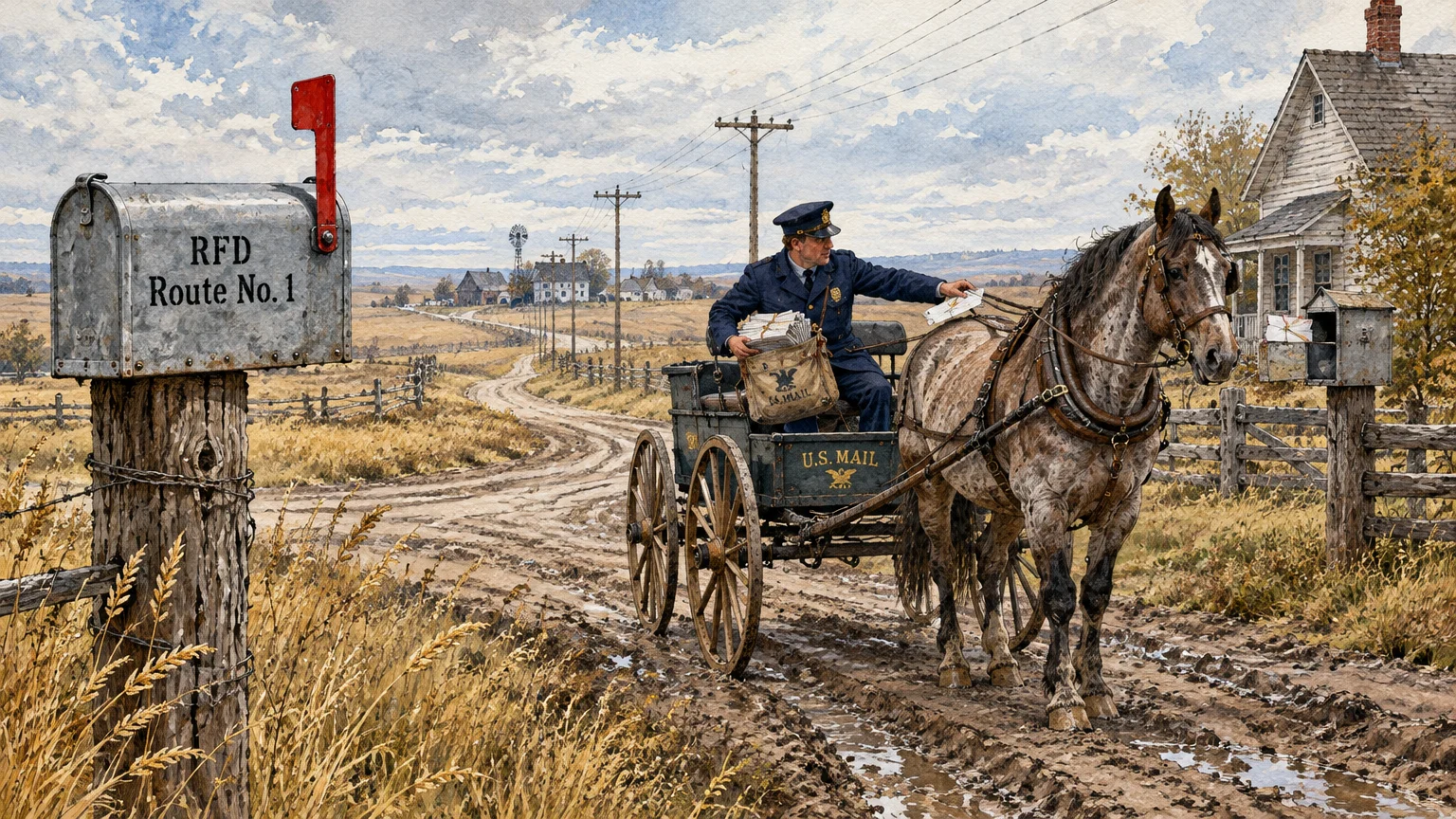
As documented by the House Historical Office, Congress made Rural Free Delivery a permanent nationwide service on July 1, 1902. The program replaced thousands of patronage-appointed fourth-class postmasters and required counties to maintain passable roads and bridges to qualify for routes.
| Year | Landmark Milestone | Key Official or Statute | Major Political Impact |
|---|---|---|---|
| 1775 | Constitutional Post | Benjamin Franklin | Protected revolutionary dispatches from British crown inspection. |
| 1792 | Post Office Act of 1792 | 1 Stat. 232 | Subsidized newspapers and codified mail privacy protections. |
| 1792 | Postal Clause Authority | Article I, Section 8 | Granted Congress control over national post road construction. |
| 1831 | Frontier Bureaucracy | 8,764 Postmasters | Comprised 76 percent of civilian federal employment. |
| 1830 | Sunday Mail Defense | Sen. Richard M. Johnson | Rebuffed religious petitions to preserve secular governance. |
| 1829 | Cabinet Elevation | William T. Barry | Integrated postal appointments directly into presidential patronage. |
| 1835 | Charleston Censorship | Amos Kendall | Allowed southern postmasters to suppress anti-slavery pamphlets. |
| 1863 | Free City Delivery | Montgomery Blair | Modernized wartime delivery and established home service. |
| 1896 | Rural Free Delivery | William L. Wilson | Ended rural isolation and spurred modern highway paving. |
How Early Postal Politics Built the Modern Administrative State
The development of the U.S. Postal Service shows how federal lawmakers used postal rates and delivery routes to integrate western territories and inform voters. Early postal statutes established enduring precedents for press subsidies, privacy protections, and secular public administration.
Although the nineteenth-century postal network served as the backbone of partisan patronage, civil service reforms and the 1902 implementation of Rural Free Delivery professionalized the workforce and extended federal infrastructure to rural communities.
Frequently Asked Questions About Postal Political History
Why did early postal laws subsidize newspapers?
Congress established low newspaper rates in the Post Office Act of 1792 (1 Stat. 232) to promote civic education and political participation.
Higher postage rates on private letters subsidized the circulation of newspapers across frontier communities.
How did postmasters fuel the spoils system?
Presidents appointed party supporters and newspaper editors as postmasters to organize local campaigns while drawing federal salaries. In 1829, President Andrew Jackson removed 423 postmasters to build a national political machine.
What was the Sabbatarian mail controversy?
The controversy began after the Post Office Act of 1810 required post offices to open on Sundays when mail arrived. Congress rejected religious petitions to halt Sunday delivery in 1829 and 1830, keeping federal postal operations secular.
How did Rural Free Delivery improve American roads?
The Post Office Department required rural communities to maintain passable roads and bridges before establishing delivery routes. County governments upgraded dirt roads to qualify for daily mail service, accelerating the national Good Roads Movement.