You likely remember Abraham Lincoln as the wartime president who preserved the Union and abolished slavery. Yet more than a decade before entering the White House, he served a single term on Capitol Hill.
Between 1847 and 1849, Lincoln represented Illinois in the U.S. House of Representatives as an ambitious 38-year-old Whig legislator. His tenure produced explosive foreign policy debates, bold civil rights measures, and defining political choices.
Examining his congressional public record reveals the legislative instincts that guided his later leadership. You can trace his path through roll-call tallies, floor speeches, and party agreements.
Tracking Abraham Lincoln’s Legislative Record in the 30th Congress
This numbered guide examines Abraham Lincoln’s service in the 30th United States Congress, spanning March 4, 1847, to March 3, 1849. It reconstructs his actions using verified legislative journals, committee records, and personal papers.
Historical accounts often treat Lincoln’s congressional term as a quiet prelude to his 1858 debates with Stephen A. Douglas.
In contrast, the public record reveals an active representative engaged in defining national struggles over executive authority and slavery.
Lincoln entered the House during an intense conflict over westward expansion and executive power. You can see his evolving political philosophy across roll calls on military funding and federal infrastructure projects.
Each entry below details a verified milestone from Lincoln’s term, supported by documented vote tallies, statutory drafts, or archival manuscripts. The list follows a chronological progression from his 1846 election through his 1849 return to Illinois law practice.
You can use these primary sources to distinguish verified historical events from partisan campaign attacks that arose during his political career.
Winning the Seventh District and Waiting Sixteen Months
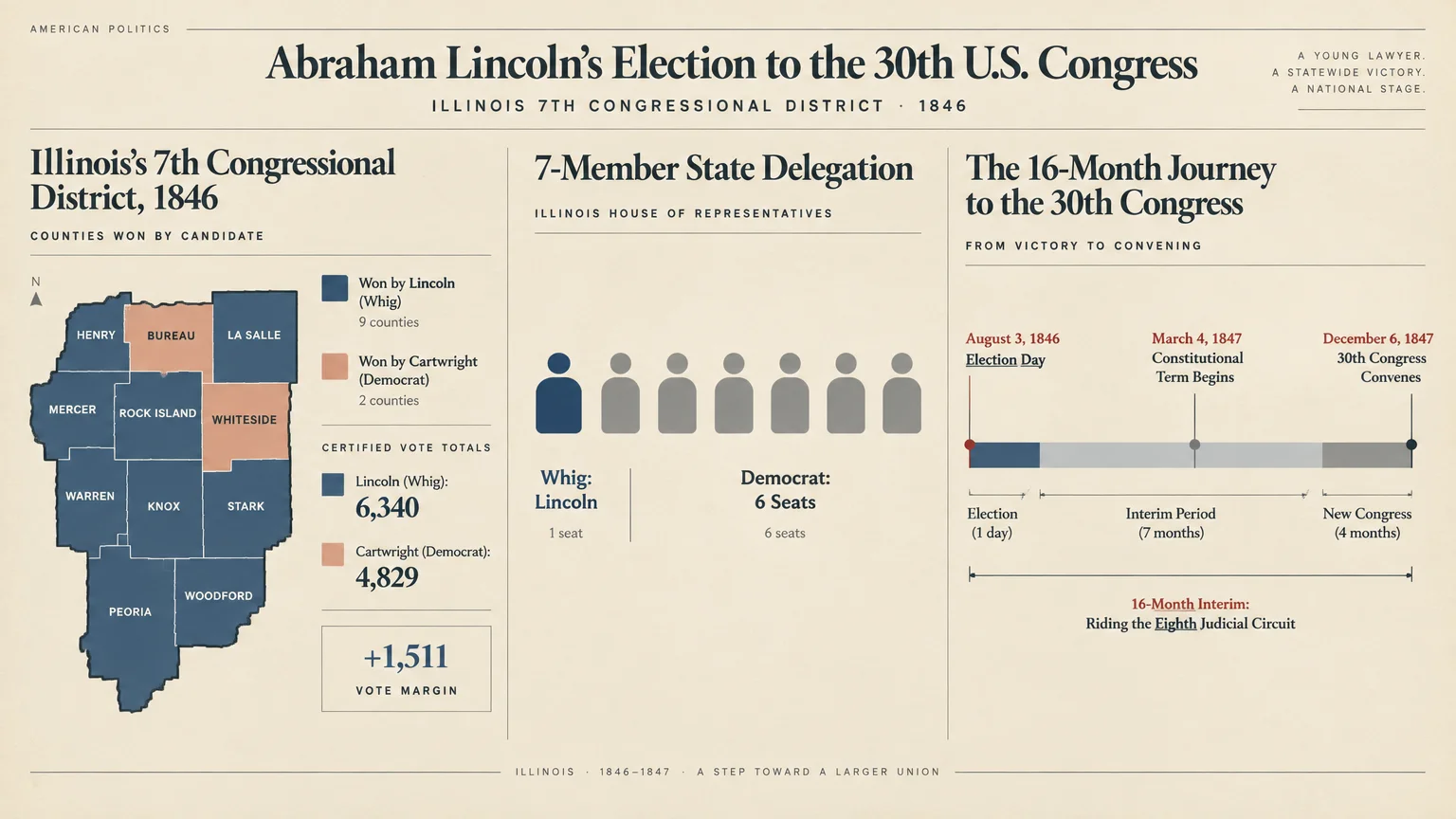
On August 3, 1846, voters in central Illinois elected Lincoln to represent Illinois’s 7th Congressional District. He defeated Democratic nominee Peter Cartwright, a famed Methodist circuit-riding preacher, by a vote of 6,340 to 4,829.
Lincoln won nine of the district’s eleven counties, securing a decisive margin of 1,511 votes. You can confirm this tally in official returns documented by the Office of the Historian of the U.S. House of Representatives.
The victory made Lincoln the sole Whig representative in Illinois’s seven-member House delegation. Democrats controlled the other six House seats, while both Illinois U.S. senators also belonged to the Democratic Party.
Although Lincoln’s constitutional term officially began on March 4, 1847, the 30th Congress did not convene until December 6, 1847. He waited sixteen months between his August 1846 election and his swearing-in on Capitol Hill.
This long congressional recess reflected standard 19th-century practice. Lawmakers used extended recesses between elections and active sessions to settle personal business and practice their civilian trades.
Lincoln spent this sixteen-month waiting period riding the Eighth Judicial Circuit. He argued dozens of civil and criminal cases across central Illinois courthouses to secure income for his young family.
Renting the Springfield Homestead for Capitol Hill Boarding
Preparing for federal office required Lincoln to reorganize his household finances. In October 1847, he leased his Springfield residence to Cornelius Ludlum for an annual rental fee of $90.
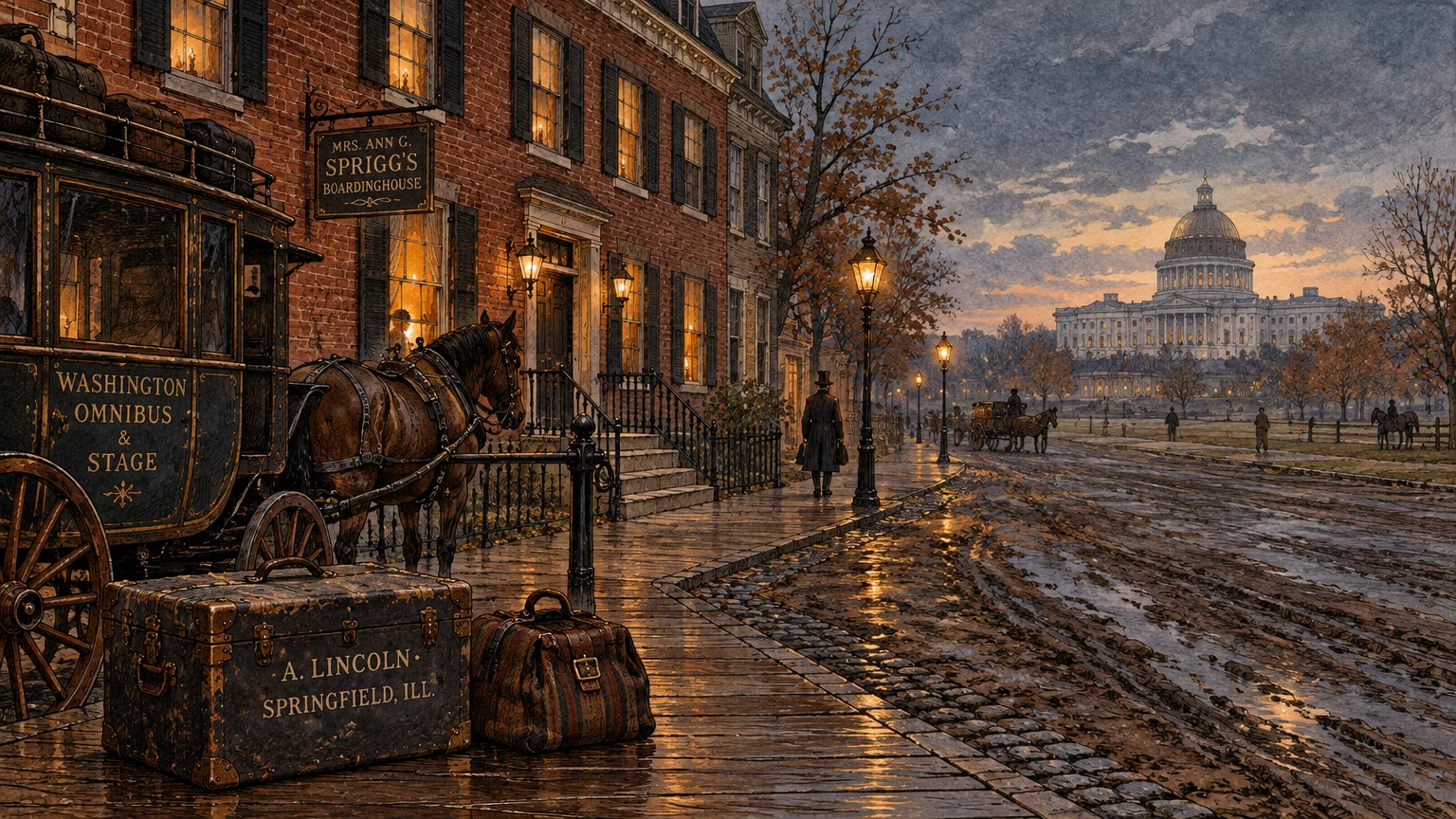
Lincoln, his wife Mary, and their two young sons traveled eastward by stagecoach, steamboat, and train. They arrived in Washington in late November 1847 and took up residence at Mrs. Ann G.
Sprigg’s boardinghouse.
The boardinghouse sat on Capitol Hill along Carroll Row, where the Library of Congress Thomas Jefferson Building stands today. Lincoln lived alongside fellow Whig representatives, regularly debating policy issues over communal meals.
Correspondence held in the Abraham Lincoln Papers at the Library of Congress shows the strain of Washington boarding. Mary Lincoln felt socially isolated in the crowded quarters with two active toddlers.
In the spring of 1848, Mary took the children to her family home in Lexington, Kentucky. Lincoln remained in Washington alone for several months, dedicating his evenings to legislative drafting and party strategy.
The modest living arrangements underscored the financial realities facing rank-and-file congressmen of that era. Members received per diem pay rather than modern congressional salaries, making separate family residences prohibitively expensive.
Challenging the Executive with the Spot Resolutions
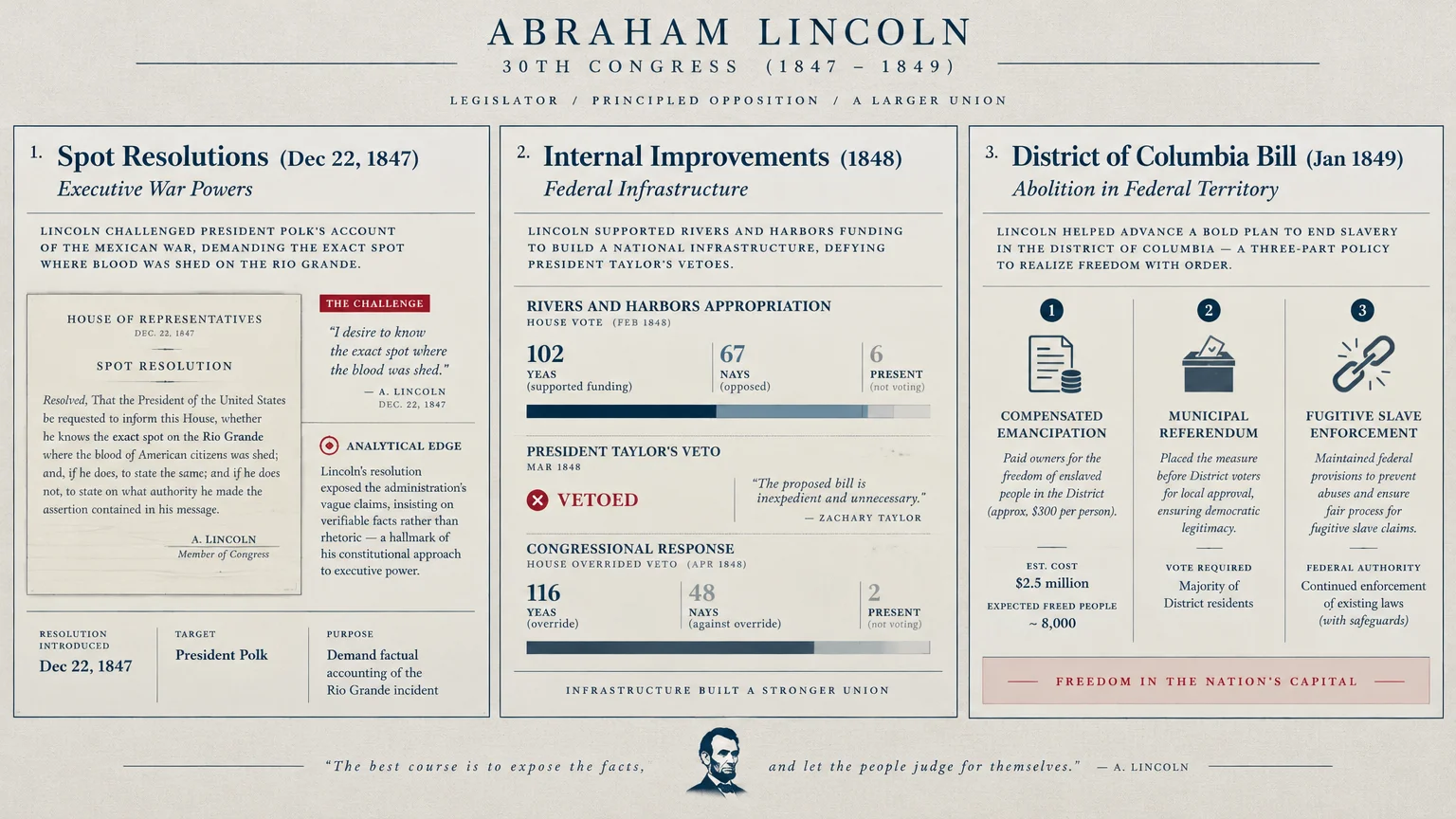
On December 22, 1847, just sixteen days after taking his seat, Lincoln introduced the famous Spot Resolutions. The eight formal resolutions directly challenged President James K.
Polk’s justification for waging the Mexican-American War.
President Polk had told Congress that Mexico initiated hostilities by shedding American blood upon American soil in May 1846. Lincoln demanded that the White House disclose the exact spot where that initial clash occurred.
Lincoln questioned whether the disputed territory between the Nueces River and the Rio Grande had ever submitted to U.S. jurisdiction. He asserted that Spanish and Mexican governments had held continuous jurisdiction over the area before the war.
You can examine Lincoln’s original handwritten resolution draft preserved at the National Archives. He reinforced his demands in a passionate floor speech delivered on January 12, 1848.
The speech attacked Polk’s expansive claims of presidential war power, warning against unilateral executive military strikes. Lincoln cautioned that allowing one man to start wars would destroy constitutional governance.
The House took no formal action on the resolutions, but the political fallout proved immediate and harsh. Democratic newspapers in Illinois mocked him as “Spotty Lincoln,” accusing him of undermining national morale during wartime.
Voting to Supply Field Troops While Opposing the War
Political opponents frequently claimed that Lincoln’s anti-war speeches harmed American soldiers in combat. Democratic critics accused anti-war Whigs of voting to withhold food, uniforms, and ammunition from troops stationed in Mexico.
The Congressional Globe refutes this charge through recorded roll-call votes. On January 3, 1848, Lincoln voted for the Ashmun Amendment to a routine resolution honoring Major General Zachary Taylor.
The amendment passed by a narrow 85 to 81 tally. It stated that the Mexican-American War had been “unnecessarily and unconstitutionally begun by the President.”
While Lincoln consistently criticized Polk’s constitutional overreach, he voted in favor of every military appropriations bill. He supported legislation providing weapons, rations, healthcare, and clothing for troops fighting in the field.
His congressional voting record also included support for key veteran welfare measures:
- Voting for bounties granting 160 acres of public land to volunteer soldiers.
- Approving military pay increases and death benefits for widows of fallen combatants.
- Supporting appropriations bills that funded safe homeward transit for discharged regiments.
Stephen A. Douglas revived the defunding accusation during the 1858 Senate debates.
Lincoln systematically dismantled the claim by citing specific House roll-call numbers proving his continuous support for troop funding.
Witnessing the Floor Collapse of John Quincy Adams
During his congressional service, Lincoln shared the House floor with former President John Quincy Adams. The eighty-year-old Massachusetts representative served as the moral leader of the chamber’s antislavery faction.
On February 21, 1848, Lincoln was present at his desk when the House voted on ceremonial resolutions. The measure proposed formal military decorations for generals serving in the Mexican-American War.
Adams rose to object, shouting an emphatic “No!” before suddenly collapsing onto his desk. Colleagues rushed to his side as the former president suffered a fatal cerebral stroke.
Members lifted Adams and carried him into the Speaker’s Room, where he slipped into a coma. He died two days later on February 23, 1848, surrounded by congressional leaders.
House Speaker Robert C. Winthrop appointed Lincoln to the official Committee of Arrangements for Adams’s funeral.
Lincoln helped organize the state ceremony inside the Capitol rotunda, escorting the casket during formal proceedings.
Serving on this committee placed Lincoln alongside established national statesmen. Watching Adams fight slavery petitions in Congress deeply influenced Lincoln’s understanding of parliamentary procedure and constitutional protest.
Proposing Gradual Abolition in the District of Columbia
Lincoln found the open slave trade in Washington, D.C., morally abhorrent. Enslaved men, women, and children were routinely marched past the Capitol in coffles to holding pens along the National Mall.
On January 10, 1849, Lincoln read a proposed amendment designed to abolish human bondage in the federal capital. His plan attempted to craft a gradual, moderate compromise that could survive congressional scrutiny.
The legislative framework rested on several distinct statutory provisions:
- Compensated emancipation financed by the U.S. Treasury for District slaveholders who voluntarily freed enslaved persons.
- Freedom for all children born to enslaved mothers after January 1, 1850, following a temporary period of apprenticeship.
- A municipal referendum requiring approval from a majority of the District’s white male voters before enactment.
- Directives requiring local authorities to apprehend and return fugitive enslaved individuals escaping into Washington.
Radical abolitionists condemned the measure for including fugitive slave enforcement and financial compensation for enslavers. At the same time, Southern representatives furiously rejected any congressional authority to alter property rights.
When moderate Whig allies withdrew their support under Southern pressure, Lincoln saw that the bill faced certain defeat. He chose not to call up the amendment for a formal vote.
Thirteen years later, on April 16, 1862, President Lincoln signed the District of Columbia Compensated Emancipation Act. That wartime law mirrored the financial compensation principles he outlined in his 1849 congressional proposal.
Abiding by the Whig Rotation Compact at Pekin
Lincoln did not lose re-election in 1848, contrary to popular political myth. Instead, he stepped aside voluntarily to fulfill an informal intraparty agreement known as the Pekin Agreement.
In 1843, central Illinois Whig leaders—including Lincoln, John J. Hardin, and Edward D.
Baker—forged a rotation agreement. Because Illinois contained only one reliable Whig congressional district, each leader agreed to serve a single term.
Lincoln honored the compact when his two years concluded. He declined to seek renomination in 1848, throwing his organizational backing behind his former law partner, Stephen T.
Logan.
However, public resentment against Whig anti-war votes lingered across central Illinois. In August 1848, Democratic challenger Thomas L.
Harris defeated Logan, flipping the district into Democratic hands.
Lincoln’s term concluded on March 3, 1849, when the 30th Congress officially dissolved. You can trace this transition through the Biographical Directory of the United States Congress.
Handing over the seat left Lincoln without an elected office for the next nine years. He returned to Springfield believing his national political career had likely reached its permanent conclusion.
Patenting a Buoyancy Mechanism for Shallow Rivers
During his travels between Washington and Illinois, Lincoln frequently encountered hazardous river conditions. In 1848, a Great Lakes steamer carrying Lincoln ran aground on a sandbar, delaying travel for days.
Lincoln observed the crew forcing empty barrels under the hull to float the vessel free. That experience inspired him to design a permanent mechanical apparatus for lifting grounded boats over shoals.
Lincoln’s invention consisted of expandable waterproof bellows attached to the lower sides of a ship’s hull. When inflated with air, the bellows displaced water, buoyant forces elevated the keel, and the vessel cleared obstacles.
While in Washington, Lincoln consulted patent attorney Zenas C. Robbins and constructed a wooden demonstration model.
He filed his patent application on March 10, 1849, exactly one week after leaving Congress.
On May 22, 1849, the federal government awarded him U.S. Patent No. 6,469 for “buoying vessels over shoals.” Lincoln remains the only American president in history to hold an official patent.
Although riverboat companies never adopted the mechanism commercially, the patent demonstrated Lincoln’s analytical mind. His model remains preserved as an artifact of his technical ingenuity.
Turning Down Federal Territorial Leadership in Oregon
Lincoln campaigned energetically for Whig presidential candidate Zachary Taylor during the summer and autumn of 1848. Following Taylor’s victory, Lincoln sought a rewarding federal patronage position in the incoming administration.
Lincoln lobbied for appointment as Commissioner of the U.S. General Land Office in Washington. However, the Taylor administration appointed rival Chicago Whig Justin Butterfield to the lucrative post in June 1849.
To soothe hard feelings, the Taylor administration offered Lincoln alternative executive appointments in the newly created Oregon Territory. Interior Department officials offered him the Secretaryship of Oregon in August 1849.
When Lincoln hesitated, President Taylor offered him the full Governorship of the Oregon Territory in September 1849. Accepting would have placed Lincoln in charge of a massive western territorial jurisdiction.
Lincoln rejected both territorial posts. Mary Lincoln refused to move their young family to the remote Pacific frontier, and Lincoln feared the post would isolate him from Illinois politics.
Lincoln returned to Springfield in late 1849 to rebuild his private law practice. That decision kept him situated in Illinois, positioning him for his political resurgence during the 1850s.
Summary of Lincoln’s Major Actions in the 30th Congress
You can track the key legislative motions, votes, and administrative decisions from Lincoln’s congressional period in the chronological reference table below.
| Date | Legislative or Public Action | Official Reference | Direct Outcome |
|---|---|---|---|
| Aug 3, 1846 | General House Election | Illinois 7th District Returns | Won election 6,340 to 4,829 |
| Dec 22, 1847 | Spot Resolutions Introduced | House Journal, 30th Cong. | Tabled without formal vote |
| Jan 3, 1848 | Ashmun Amendment Vote | House Roll Call No. 19 | Passed 85 to 81; voted yea |
| Feb 23, 1848 | Adams Funeral Committee | House Committee Records | Appointed as House escort |
| Jan 10, 1849 | D.C. Emancipation Amendment | Congressional Globe, 30th Cong. | Withdrawn without floor vote |
| Mar 3, 1849 | Congressional Term Expiration | U.S. House Journal | Retired per rotation agreement |
| Mar 10, 1849 | Navigation Patent Application | U.S. Patent Office Records | Granted Patent No. 6,469 |
| Sep 1849 | Oregon Territorial Governorship | Department of the Interior | Declined executive appointment |

How Lincoln’s House Term Transformed His Constitutional Strategy
Lincoln’s single term in the House of Representatives laid the legal foundation for his presidency. His clashes with President Polk clarified his philosophy regarding constitutional separation of powers.
In challenging Polk over the Mexican-American War, Lincoln argued that the Constitution vested war-initiating authority solely in Congress. He maintained that giving the president unilateral power to initiate conflicts would undermine constitutional government.
When southern states seceded in 1861, Lincoln exercised broad emergency executive powers as commander-in-chief. Yet he anchored those wartime actions in his constitutional obligation to enforce existing laws and preserve the Union.
Lincoln’s 1849 District of Columbia emancipation bill established a template for his future policies. His proposal demonstrated his preference for gradual, lawful steps that respected statutory property claims.
During the early years of the Civil War, Lincoln repeatedly urged loyal border states to adopt compensated emancipation. When he signed the 1862 D.C. emancipation statute, he implemented the core policies he drafted in 1849.
Lincoln’s congressional experience also taught him how partisan division could damage an ambitious agenda. He watched his party lose Illinois’s 7th District in 1848 because of public backlash against Whig anti-war rhetoric.
That loss showed Lincoln that moral convictions must align with political realism. When he joined the Republican Party in 1856, he prioritized coalition-building across diverse northern voting blocs.
Understanding Lincoln’s two years in Congress provides an essential window into his political evolution. You can see how a freshman legislator developed the constitutional and tactical strategies that guided the nation.
Frequently Asked Questions About Lincoln’s House Term
Did Abraham Lincoln lose his seat in Congress after one term?
No, Lincoln did not lose re-election in 1848. He declined to run because he honored the informal 1843 Pekin Agreement among central Illinois Whigs.
Under this rotation compact, party leaders took turns representing the single safe Whig district. Lincoln stepped aside voluntarily to support his former law partner, Stephen T.
Logan.
Did Lincoln vote to defund American troops fighting in Mexico?
No, Lincoln never voted to cut food, equipment, or ammunition for troops in the field. He consistently voted to approve military supplies, volunteer bounties, and soldier back pay.
Lincoln did vote for the Ashmun Amendment, which asserted that President Polk began the war unconstitutionally. However, he maintained a strict distinction between executive warmaking and supporting active combat troops.
Why did Lincoln turn down the governorship of Oregon in 1849?
Lincoln declined the appointment primarily because of family objections. His wife, Mary Todd Lincoln, refused to relocate their young family to the remote Pacific Northwest frontier.
Lincoln also recognized that moving to Oregon would sever his ties to Illinois legal networks. Staying in Springfield allowed him to build a prominent state and federal legal practice.
How did Lincoln’s congressional anti-slavery plan connect to his presidency?
Lincoln’s 1849 proposal to abolish slavery in Washington, D.C., mirrored the early antislavery measures of his presidency. Both plans relied on compensated emancipation, voluntary compliance, and legislative deliberation.
On April 16, 1862, President Lincoln signed the District of Columbia Compensated Emancipation Act into law. That statute fulfilled the statutory principles he had introduced on the House floor thirteen years earlier.