Modern American governance rests on legal frameworks, archival records, and executive maneuvers built over more than two centuries. These fourteen award-winning volumes trace how federal power expanded through constitutional debate, statutory reform, and institutional conflict.
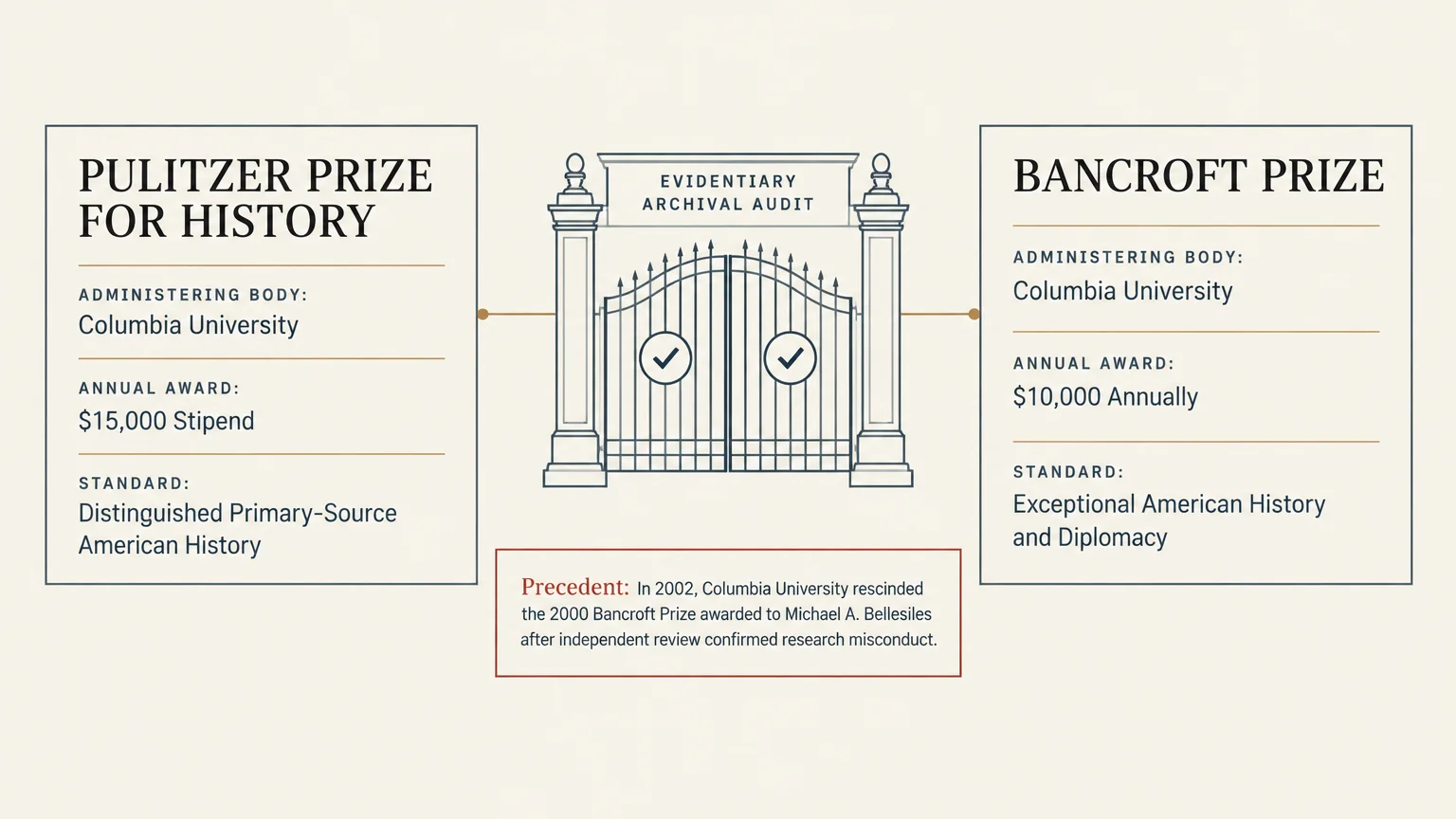
Columbia University administers both the Pulitzer Prize and the Bancroft Prize, recognizing rigorous primary-source scholarship on national power. These histories document the executive orders, legislative roll calls, and judicial rulings that shaped the American state.
Criteria for Selection and Archival Standards
This list counts fourteen books on American political institutions, constitutional doctrines, and electoral systems that won both the Pulitzer Prize and the Bancroft Prize.
Columbia University awards $15,000 for the Pulitzer Prize for History and $10,000 annually for the Bancroft Prize in American history and diplomacy.
Entries were chosen for their focus on federal statutes, congressional roll calls, court dockets, and presidential directives. Each volume relies on verifiable archival records spanning from colonial assemblies to the modern administrative state.
Roosevelt and Hopkins: An Intimate History
Robert E. Sherwood examines how Franklin D.
Roosevelt and his special adviser transformed American foreign policy before formal entry into World War II. The book details how the executive branch structured early wartime diplomacy without formal congressional declarations.
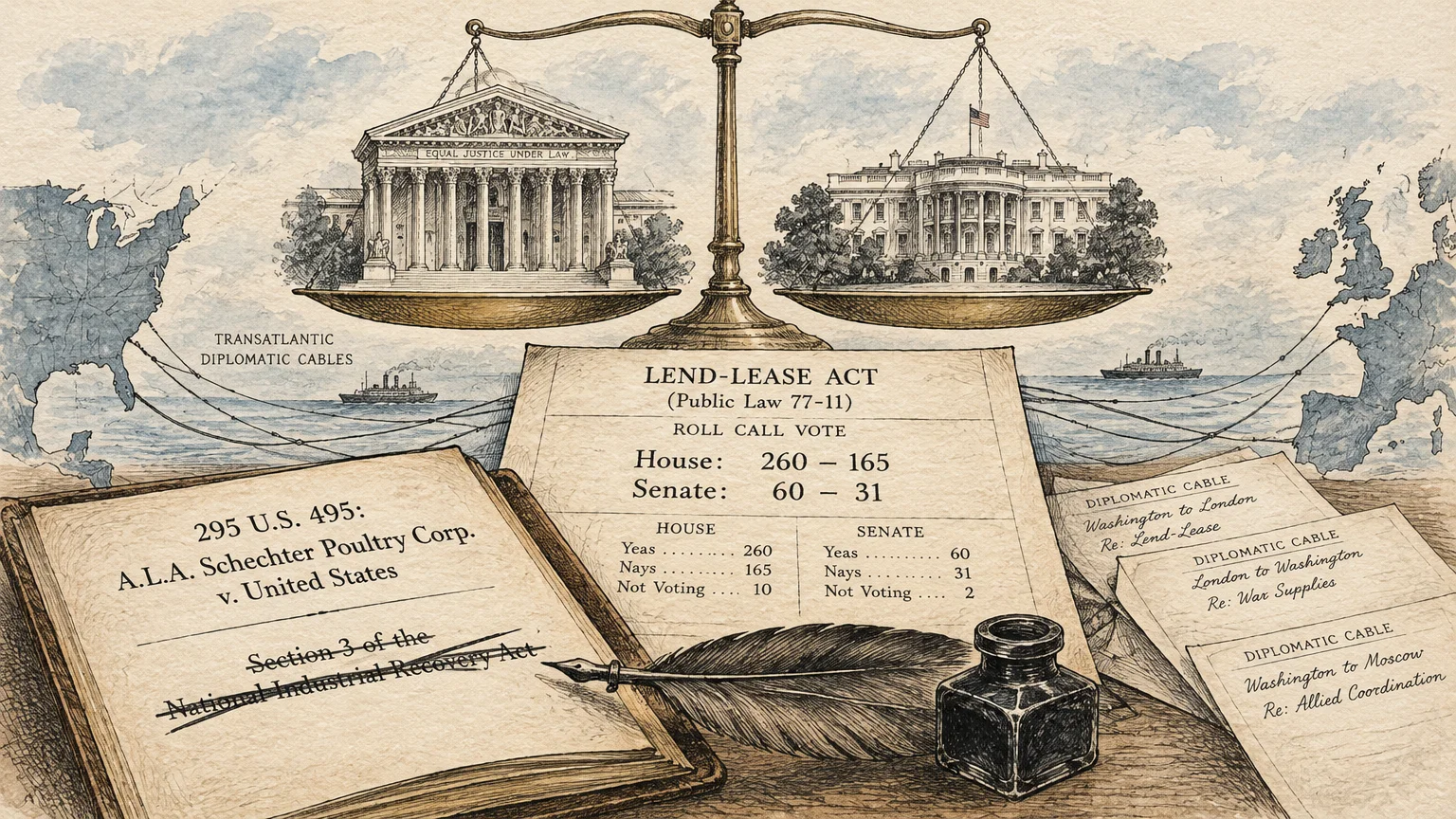
Sherwood documents the legislative maneuvering behind the Lend-Lease Act (Public Law 77-11). Congress passed the measure in March 1941 after a 260–165 vote in the House and a 60–31 tally in the Senate.
Drawing directly from Harry Hopkins’s personal papers, Sherwood reconstructs negotiations with Winston Churchill and Joseph Stalin. These bilateral executive agreements concentrated foreign policy management inside the newly created Executive Office of the President, established under Reorganization Plan No. 1 of 1939.
Charles Evans Hughes
Merlo J. Pusey provides an institutional biography of Charles Evans Hughes, who served as Associate Justice, Secretary of State, and Chief Justice.
Hughes led the Supreme Court during the constitutional battles of the New Deal era.
Pusey analyzes major administrative challenges, including A.L.A. Schechter Poultry Corp. v. United States (295 U.S. 495). On May 27, 1935, a unanimous Court invalidated Section 3 of the National Industrial Recovery Act.
Hughes wrote that Congress could not delegate unfettered legislative power to executive branch agencies.
In March 1937, Hughes sent a formal letter to the Senate Judiciary Committee refuting President Roosevelt’s claim that the Court had fallen behind on its docket, helping defeat the Judicial Procedures Reform Bill.
The Age of Reform
Richard Hofstadter traces the reform movements that reshaped domestic policy between the Populist insurgencies of the 1890s and the New Deal. He examines how economic distress prompted public demands for federal market regulation.
Hofstadter tracks the statutory lineage connecting the Interstate Commerce Act of 1887 (24 Stat. 379) to the Clayton Antitrust Act of 1914 (38 Stat.
730). Agrarian grievances over railroad freight rates laid the statutory foundation for independent federal regulatory commissions.
The book also details the spread of direct primary laws and the ratification of the Seventeenth Amendment in 1913. That constitutional amendment transferred Senate elections from state legislatures to popular state votes, diminishing the leverage of urban party machines.
The Ideological Origins of the American Revolution
Bernard Bailyn demonstrates how revolutionary colonists transformed political pamphlets into durable constitutional principles. Rather than emphasizing economic self-interest alone, Bailyn studies colonial responses to British imperial administrative decrees.
He examines colonial opposition to the Stamp Act of 1765 and the Declaratory Act of 1766 (6 Geo. III, c.
12). Parliament asserted the legal authority to bind the American colonies in all cases whatsoever, provoking organized colonial resistance.
Drawing from the Continental Congress and Constitutional Convention collections, Bailyn shows how radical Whig theory shaped colonial concepts of civic liberty. Colonists viewed royal patronage and standing armies as direct threats to elected colonial assemblies, later codifying restrictions on both in the U.S. Constitution.
The Creation of the American Republic, 1776–1787
Gordon S. Wood chronicles the institutional transition from monarchical resistance to federal constitutional design.
He surveys the initial state constitutions drafted between 1776 and 1780 to show why early legislative supremacy faltered.
Wood contrasts the unicameral assembly established by Pennsylvania’s 1776 Constitution with Massachusetts’s 1780 Constitution. Drafted primarily by John Adams, the Massachusetts charter restored an independent executive veto and a balanced bicameral legislature.
These state-level experiments directly informed the delegates at the Constitutional Convention of 1787. James Madison and his colleagues engineered Article I, Section 8 to delegate enumerated national powers while barring states from issuing paper currency or impairing contracts under Article I, Section 10.
Roosevelt: The Soldier of Freedom
James MacGregor Burns focuses on Franklin D. Roosevelt’s executive leadership during World War II, examining the expansion of emergency presidential powers.
He demonstrates how wartime mobilization transformed the federal bureaucracy into a comprehensive economic manager.
Burns examines the enactment of the Emergency Price Control Act of 1942 (56 Stat. 23), which established price ceilings across the consumer economy.
The administration simultaneously coordinated industrial production quotas through the War Production Board, created by Executive Order 9024.
The narrative also documents friction with Capitol Hill over wartime labor strikes. Congress overrode Roosevelt’s veto of the War Labor Disputes Act (Public Law 78-89) on June 25, 1943, by votes of 56–25 in the Senate and 244–108 in the House.
Fire in the Lake: The Vietnamese and the Americans in Vietnam
Frances FitzGerald examines the institutional failures and bureaucratic assumptions that drove United States intervention in Southeast Asia. She documents how diplomatic misunderstandings and flawed intelligence assessments led to protracted military escalation.
FitzGerald tracks the passage of the Gulf of Tonkin Resolution (Public Law 88-408), approved by Congress on August 10, 1964. The House passed the measure 416–0, while the Senate approved it 88–2.
That resolution authorized the president to use conventional military force in Southeast Asia without a formal declaration of war. Lawmakers repealed the authorization in January 1971 through an amendment to the Foreign Military Sales Act (84 Stat.
2055).
Been in the Storm So Long: The Aftermath of Slavery
Leon F. Litwack documents the immediate political and economic transformation of the American South during Reconstruction.
He utilizes Freedmen’s Bureau field logs and military provost marshal registers to record how formerly enslaved people asserted citizenship.
Litwack examines the statutory implementation of the Freedmen’s Bureau Act of March 3, 1865 (13 Stat. 507).
Local field agents navigated contradictory executive directives after President Andrew Johnson ordered the restoration of confiscated Confederate lands in late 1865.
The narrative details Southern resistance to the Civil Rights Act of 1866 (14 Stat. 27).
Congress enacted this statute over Johnson’s veto on April 9, 1866, by votes of 33–15 in the Senate and 122–41 in the House.
William Cooper’s Town: Power and Persuasion on the Frontier of the Early American Republic
Alan Taylor examines the intersection of land speculation, partisan patronage, and voter mobilization in post-revolutionary New York. He traces the career of William Cooper, who founded Cooperstown and used debt collection and tenant leases to secure political office.
Taylor documents Cooper’s service as a Federalist county judge and his election to the Fourth Congress in 1794. The narrative uncovers eighteenth-century electioneering practices, in which prominent landowners monitored tenant voting before the adoption of secret paper ballots.
The book details the contested New York gubernatorial election of 1792 between John Jay and George Clinton. An 11-member state canvassing board disqualified Otsego County ballots on a 7–4 party-line vote over a technical sheriff-certification dispute, securing Clinton’s reelection.
Freedom from Fear: The American People in Depression and War, 1929–1945
David M. Kennedy presents an operational history of the American state from the 1929 stock market crash through the end of World War II.
He details how statutory innovations rebuilt the national banking system and created a federal social safety net.
Kennedy records the passage of the Social Security Act of 1935 (Public Law 74-271) and the Fair Labor Standards Act of 1938 (52 Stat. 1060).
These statutes established federal old-age insurance, unemployment compensation, a national minimum wage, and the 40-hour workweek.
The narrative also examines wartime civil liberty restrictions under Executive Order 9066, signed on February 19, 1942. That order authorized the War Relocation Authority to remove and incarcerate more than 110,000 Japanese Americans from the West Coast.
The Fiery Trial: Abraham Lincoln and American Slavery
Eric Foner investigates Abraham Lincoln’s constitutional perspective on emancipation, executive authority, and civil rights. Foner demonstrates that Lincoln’s legal thinking evolved through interaction with abolitionist petitions, congressional statutes, and military developments.
Foner examines the legal mechanics of the Second Confiscation Act (12 Stat. 589), approved on July 17, 1862.
That statute freed the enslaved laborers of Confederate officials and supporters who came within Union military lines.
Lincoln grounded the final Emancipation Proclamation of January 1, 1863, strictly on his Article II commander-in-chief powers. Because wartime proclamations risked postwar judicial challenge, Lincoln pressed the Thirty-Eighth Congress to pass the Thirteenth Amendment on January 31, 1865.
Frederick Douglass: Prophet of Freedom
David W. Blight explores how Frederick Douglass transitioned from an abolitionist orator into a Washington political insider and diplomat.
Blight charts Douglass’s use of public speeches, newspaper editorials, and federal lobbying to influence national policy.
The book covers Douglass’s pressure on the Grant administration to suppress paramilitary violence in the Reconstruction South. Douglass lobbied for the Enforcement Act of 1870 (16 Stat.
140) and the Ku Klux Klan Act of 1871 (17 Stat. 13).
Blight details Douglass’s appointment as U.S. Marshal for the District of Columbia in March 1877 under President Rutherford B. Hayes.
The Senate confirmed Douglass by a 30–12 vote, making him the first African American confirmed to a federal post by the Senate.
G-Man: J. Edgar Hoover and the Making of the American Century
Beverly Gage provides a comprehensive biography of J. Edgar Hoover, who led the Bureau of Investigation and the FBI for 48 years from 1924 to 1972.
Gage charts how Hoover built a centralized federal law enforcement agency within the Department of Justice.
Gage traces Hoover’s expansion of domestic intelligence files through confidential presidential directives beginning under Franklin D. Roosevelt in 1936.
Hoover later gained expanded wiretapping parameters under Title III of the Omnibus Crime Control and Safe Streets Act of 1968 (Public Law 90-351).
The author details how bipartisan congressional deference enabled covert counterintelligence programs like COINTELPRO, launched in 1956. Following Hoover’s death, the Senate Church Committee investigated these secret files under Senate Resolution 21 in 1975, prompting the Foreign Intelligence Surveillance Act of 1978.
Native Nations: A Millennium in North America
Kathleen DuVal reframes early American political development by documenting the diplomacy of Indigenous nations over a thousand years. She demonstrates that Native confederacies operated as sovereign polities negotiating border and trade agreements with European powers and the United States.
DuVal examines the statutory foundation of early federal Indian policy, beginning with the Trade and Intercourse Act of 1790 (1 Stat. 137).
Congress mandated that any purchase of Indigenous land required a formal federal treaty ratified under Article II, Section 2 of the Constitution.
The book details how the Quapaw, Cherokee, and Haudenosaunee nations used federal treaties and litigation to contest state encroachment. In Worcester v. Georgia (31 U.S. 515) in 1832, the Supreme Court affirmed that Native nations remained distinct communities in which state laws had no force.
| Title | Author | Award Year | Institutional Focus | Key Document or Statute |
|---|---|---|---|---|
| Roosevelt and Hopkins | Robert E. Sherwood | 1949 | Wartime Executive Diplomacy | Lend-Lease Act (Pub. L. 77-11) |
| Charles Evans Hughes | Merlo J. Pusey | 1952 | Supreme Court Jurisprudence | 295 U.S. 495 (Schechter Poultry) |
| The Age of Reform | Richard Hofstadter | 1956 | Agrarian and Urban Reform | Clayton Antitrust Act (38 Stat. 730) |
| Ideological Origins | Bernard Bailyn | 1968 | Colonial Assembly Power | Declaratory Act (6 Geo. III, c. 12) |
| Creation of the Republic | Gordon S. Wood | 1970 | Early State Constitutions | U.S. Constitution (Article I) |
| Roosevelt: Soldier of Freedom | James MacGregor Burns | 1971 | Presidential War Powers | Smith-Connally Act (Pub. L. 78-89) |
| Fire in the Lake | Frances FitzGerald | 1973 | Foreign Policy Bureaucracy | Tonkin Resolution (Pub. L. 88-408) |
| Been in the Storm So Long | Leon F. Litwack | 1980 | Reconstruction Administration | Civil Rights Act of 1866 |
| William Cooper’s Town | Alan Taylor | 1996 | Early Partisan Mechanics | 1792 N.Y. Gubernatorial Canvass |
| Freedom from Fear | David M. Kennedy | 2000 | New Deal and Homefront | Social Security Act (Pub. L. 74-271) |
| The Fiery Trial | Eric Foner | 2011 | Emancipation Legal Orders | Second Confiscation Act (12 Stat. 589) |
| Frederick Douglass | David W. Blight | 2019 | Civil Rights Enforcement | Enforcement Act of 1870 |
| G-Man | Beverly Gage | 2023 | Federal Police and Surveillance | Pub. L. 90-351 / S. Res. 21 |
| Native Nations | Kathleen DuVal | 2025 | Tribal Sovereign Treaties | Trade & Intercourse Act (1 Stat. 137) |
Archival Patterns in Constitutional and Administrative Development
Across these fourteen histories, American political authority shifted incrementally from local legislative assemblies to a centralized administrative state. Early volumes by Bailyn, Wood, and Taylor document colonial distrust of executive patronage and the initial preference for legislative supremacy.
Works by Foner, Blight, and Litwack show how the Civil War and Reconstruction altered that constitutional design. Ratification of the Thirteenth, Fourteenth, and Fifteenth Amendments granted Congress explicit authority to enforce civil and voting rights through federal statutes.
In the twentieth century, economic crises and world wars prompted Congress to delegate broad regulatory and national security powers. Books by Kennedy, Burns, FitzGerald, and Gage detail how executive agencies acquired discretionary authority over commerce, defense procurement, and domestic surveillance.
Frequently Asked Questions About Award-Winning Political History
What distinguishes the Bancroft Prize from the Pulitzer Prize?
Columbia University oversees both honors, but their formal scopes differ slightly. The Pulitzer Prize for History honors distinguished books on United States history with a $15,000 prize.
The Bancroft Prize recognizes scholarship in American history and diplomacy. Established in 1948 under the will of historian Frederic Bancroft, it awards $10,000 to each winning title.
Why do historians focus so heavily on legislative roll calls and statutes?
Legislative votes and statutory texts provide verifiable evidence of institutional action. Roll calls record how party coalitions, regional interests, and floor amendments shaped federal law.
Comparing public statutes against executive implementation shows how laws operated in practice rather than in campaign rhetoric. Official records in the Statutes at Large and Congressional Record anchor institutional history in primary documentation.
Has an award ever been rescinded after publication?
Yes. In 2002, the Columbia University Trustees rescinded the 2000 Bancroft Prize awarded to Michael A.
Bellesiles for Arming America.
An external investigative panel of historians concluded that the author had fabricated probate data and misrepresented archival sources. It remains the only rescission in the history of the Bancroft Prize.
How can readers verify historical claims against primary sources?
Citations can be cross-referenced directly using public federal repositories. The National Archives, Library of Congress, and govinfo.gov maintain digitized copies of historic bills, roll calls, Supreme Court opinions, and executive orders.