You cast a ballot from your kitchen table today because American election laws evolved through more than a century of military crises and administrative reforms. Remote voting began as an emergency measure for deployed troops rather than a standard convenience for registered citizens.
State lawmakers and federal officials gradually extended battlefield balloting rules to civilian travelers, injured workers, and entire state electorates. Understanding these changes helps you navigate modern registration deadlines, signature verification standards, and mail-in ballot return options.
Public archives document how statutory amendments transformed a rare wartime exception into a fixture of modern American elections. Here is the legal record behind that transformation.
How We Selected the Legal Milestones in Remote Voting
You can trace every modern mail ballot option back to specific legislative votes, federal statutes, and state ballot initiatives. This guide tracks the eight pivotal legal moments that shifted American voting from localized precinct boxes to secure remote balloting.
We selected these milestones by examining statutory enactments that established new legal precedents across state and federal jurisdictions. Each entry documents a structural expansion in how you access the ballot when you cannot physically reach your precinct.
The historical record spans from Union army encampments during the Civil War to statewide all-mail elections enacted at the ballot box. We evaluated legislative records, public laws, and election results to confirm the mechanical evolution of each measure.
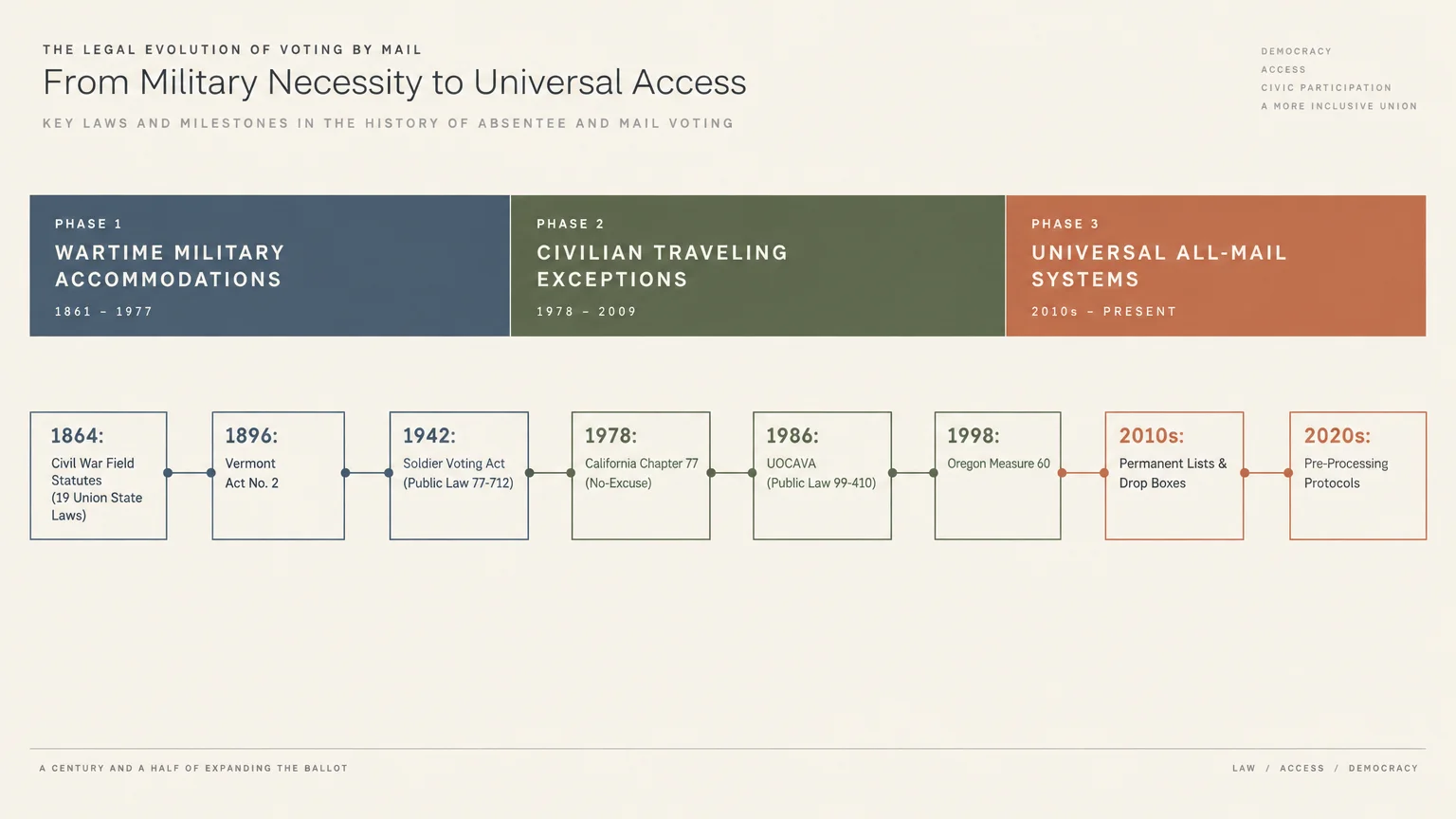
These entries follow the expansion of remote voting across three distinct phases: wartime military accommodations, civilian traveling exceptions, and universal all-mail systems. Together, they explain why your state handles absentee requests, ballot drop boxes, and processing timelines the way it does today.
The table below outlines each major turning point in this statutory progression before we examine each development in detail.
| Milestone | Year | Legal Authority | Key Impact |
|---|---|---|---|
| Civil War Field Statutes | 1864 | 19 Union State Laws | Soldiers cast ballots from military encampments |
| Early Civilian Absenteeism | 1896 | Vermont Act No. 2 | Commercial travelers vote outside home precincts |
| Soldier Voting Act | 1942 | Public Law 77-712 | Federal absentee ballots created for deployed troops |
| No-Excuse Absentee Voting | 1978 | California Chapter 77 | Voters request mail ballots without providing reasons |
| UOCAVA Enactment | 1986 | Public Law 99-410 | Mandates overseas military and civilian ballot access |
| Universal Vote-by-Mail | 1998 | Oregon Measure 60 | Replaces traditional in-person precinct voting |
| Permanent Lists and Drop Boxes | 2010s | State Legislative Codes | Automates recurring ballot delivery and return |
| Pre-Processing Protocols | 2020s | Bipartisan State Statutes | Allows early envelope verification and tabulation |
Civil War Field Voting Statutes
During the War of 1812, Pennsylvania enacted the first military absentee law in 1813 for soldiers stationed over two miles from home. New Jersey followed with a similar statute in 1815, though state lawmakers repealed it five years later.
Remote voting expanded dramatically between 1861 and 1862 when seven of the eleven Confederate states enacted provisions allowing soldiers to vote from the field. Union states soon faced the same administrative and political dilemma as hundreds of thousands of mobilized troops left their home voting districts.
By the November 1864 presidential contest, 19 Union states enacted statutes permitting troops to vote in military encampments or by proxy. The Library of Congress 1864 election collection documents the intense legislative debates surrounding these field voting acts.
Approximately 150,000 Union soldiers cast absentee ballots across military camps and front lines in 1864. In the 12 states that tallied military votes separately from civilian returns, 78% of the military vote supported Lincoln, compared to 53% of the civilian electorate in those same states.
State supreme courts divided sharply over these measures. The Pennsylvania Supreme Court struck down an early version in Chase v. Miller (1862), which forced the state legislature to pass an 1864 constitutional amendment authorizing out-of-precinct military balloting.
These wartime laws established an enduring precedent in American election law. They demonstrated that states could successfully administer secure ballots outside traditional polling precincts during a national crisis.
Civilian Accommodations for Traveling Workers
Following the Civil War, states restricted absentee voting almost exclusively to active-duty military personnel. As interstate commerce and national rail networks grew in the late nineteenth century, thousands of commercial workers found themselves disenfranchised on Election Day.
Vermont broke this pattern in 1896 by passing Act No. 2, the nation’s first civilian absentee voting statute. The law permitted voters away from their home municipalities on Election Day to obtain a certificate allowing them to vote for state officers.
Kansas followed in 1901 by enacting Chapter 180 of the Session Laws of 1901. Lawmakers designed this statute specifically to accommodate traveling railroad employees who could not return to their precincts before poll closing hours.
Under the Kansas law, railway workers presented a certified voucher from their home county clerk to election judges in any precinct along their train route. Local judges then forwarded the completed ballot back to the employee’s home county for canvassing.
Early civilian laws imposed strict requirements to prevent impersonation and fraud:
- Voters filed sworn notarized affidavits detailing their commercial duties.
- Employers verified employment travel schedules in writing before county clerks.
- Clerks cross-checked signatures against local poll books prior to official canvassing.
By the late 1920s, nearly every state had adopted some form of excuse-required civilian absentee voting. These laws treated remote voting not as a general convenience, but as a narrow exception for registered citizens fulfilling unavoidable professional obligations.
Federal Protections Under the Soldier Voting Act of 1942
The outbreak of World War II scattered millions of American citizens across global theaters of conflict. In response, Congress asserted federal authority over military balloting by passing the Soldier Voting Act of 1942 (Public Law 77-712, 56 Stat.
753).
President Franklin D. Roosevelt signed the statute on September 16, 1942, after extensive congressional debate.
As recorded by the U.S. House History Office, the law bypassed restrictive state poll taxes and registration prerequisites for active military personnel in wartime federal elections.
The statute introduced the standard Federal Post Card Application (FPCA) to streamline ballot requests across all 48 states. This single postcard served simultaneously as an emergency voter registration and an absentee ballot request form.
Lawmakers amended the statute in 1944 under Public Law 78-277, creating the United States War Ballot Commission. The revision established a standardized federal write-in ballot for overseas troops who could not receive state ballots in time for Election Day.
The 1944 amendments sparked a fierce states’ rights debate over whether the federal government could supersede state election administration. Lawmakers ultimately reached a compromise that permitted federal write-in ballots only when state governors formally authorized their use.
This legislation proved critical because it established direct federal statutory standards for remote voting. You still rely on modern versions of the Federal Post Card Application whenever you serve overseas today.
California’s Removal of Excuse Requirements
For decades after World War II, states required voters to provide a verified excuse before issuing an absentee ballot. You had to prove an illness, physical disability, religious observance, or mandatory travel outside your home county on Election Day.
California transformed this framework in 1978 by enacting Assembly Bill 1699 (Chapter 77 of the 1978 Statutes). Signed by Governor Jerry Brown, the statute made California the first state to adopt “no-excuse” absentee voting for all registered voters.
The new law eliminated the requirement to submit doctor notes, travel itineraries, or formal justifications under penalty of perjury. Any registered voter could request an absentee ballot simply because they preferred voting from home.
Other states gradually followed California’s model over the subsequent four decades. By October 2025, 29 states offer no-excuse absentee voting to any registered citizen who requests a mail ballot.
When combined with the eight universal all-mail states, 37 states and Washington, D.C., now allow any eligible voter to cast a ballot by mail without providing an excuse. That total reflects a steady rise from 30 states in 2016.
Only 13 states—along with Puerto Rico and the U.S. Virgin Islands—still enforce strict statutory excuse requirements. In those jurisdictions, you must qualify under enumerated legal grounds such as advanced age, disability, or planned absence from the county.
Universal Overseas Rights Under the 1986 UOCAVA Framework
During the mid-twentieth century, overseas civilian workers and military families frequently missed ballot receipt deadlines because of inconsistent state postal rules. Congress addressed this administrative breakdown by passing the Uniformed and Overseas Citizens Absentee Voting Act of 1986.
Formally enacted as Public Law 99-410 (100 Stat. 924) and signed by President Ronald Reagan on August 28, 1986, UOCAVA established comprehensive federal protections codified at 52 U.S.C. § 20301. The measure passed both chambers of Congress by voice vote.
UOCAVA replaced earlier, fragmented military voting laws and guaranteed voting rights to three specific groups:
- Active-duty members of the Uniformed Services and the Merchant Marine.
- Eligible family members residing with deployed service personnel.
- U.S. citizens residing outside the territorial United States for commercial or personal reasons.
The statute designated the Secretary of Defense as the presidential designee responsible for administering federal voting assistance. This administrative responsibility established the Federal Voting Assistance Program (FVAP) as a permanent support agency.
UOCAVA also codified the Federal Write-In Absentee Ballot (FWAB) as a permanent statutory safeguard. If your regular state absentee ballot fails to arrive in time, you can legally cast an emergency write-in ballot from anywhere in the world.
Congress later strengthened UOCAVA in 2009 through the Military and Overseas Voter Empowerment (MOVE) Act. That amendment required states to transmit absentee ballots to overseas voters at least 45 days before federal elections.
Oregon’s Citizen Initiative for Universal Vote-by-Mail
Oregon pioneered modern mail voting by moving beyond the traditional request-based absentee system. Beginning in 1981 with Senate Bill 10, the Oregon Legislative Assembly authorized local election officials to test mail-only voting in local and special elections.
On November 3, 1998, Oregon voters approved Measure 60 by a decisive margin of 69.4%, tallying 757,994 “yes” votes to 334,021 “no” votes. The measure created the nation’s first universal, all-mail voting system for primary and general elections.
As documented by the Oregon Secretary of State Archives, the state conducted its first fully postal presidential election in November 2000. County clerks automatically mailed ballots to every active registered voter without requiring an individual request.
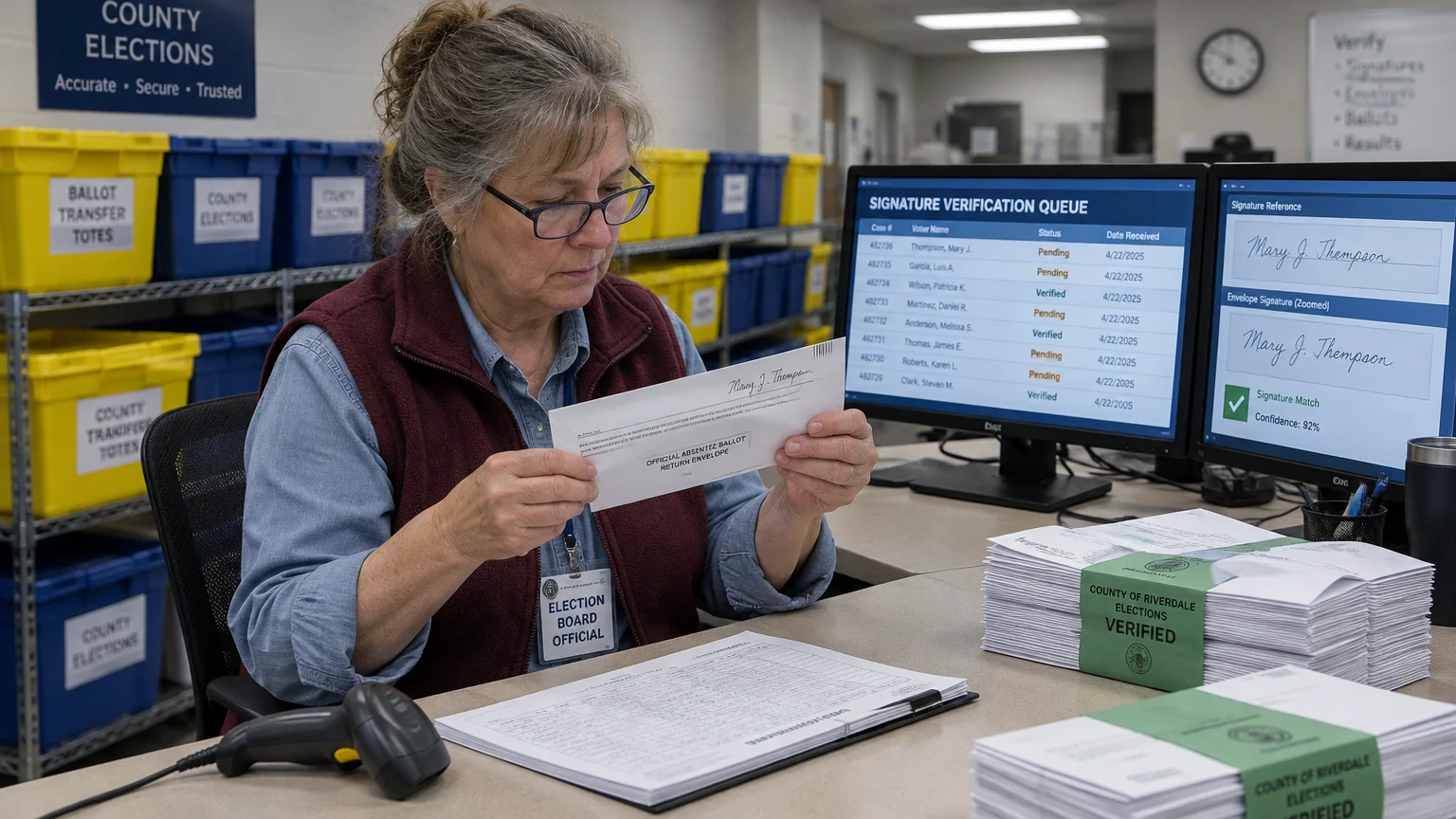
The Oregon model replaced traditional neighborhood precinct polling booths with official ballot return centers and secure drop boxes. Under this system, county election workers verify each voter’s identity by comparing the signature on the return envelope against voter registration records.
Oregon demonstrated that universal mail balloting increased overall voter turnout while reducing precinct staffing costs. The reform prompted several other states to transition away from traditional polling sites over the following two decades:
- Washington adopted full vote-by-mail in 2011 after county-by-county implementation.
- Colorado followed by enacting the Voter Access and Modernized Elections Act in 2013.
- Hawaii adopted universal mail voting in 2019, followed by Nevada and California in 2021.
By October 2025, eight states and Washington, D.C., conduct elections entirely by mail. In these jurisdictions, you automatically receive a ballot in your mailbox weeks before Election Day.
Permanent Absentee Voter Registries and Ballot Drop Boxes
As remote voting gained widespread adoption, voters often faced the burden of submitting new absentee ballot applications for every primary, general, and special election. State lawmakers responded by developing permanent absentee voter registries.
Under a permanent absentee framework, you submit a single application to join your state’s recurring mail list. Election officials then automatically send you a mail-in ballot for every future election until you move or cancel your registration.
Outside of the eight all-mail states, nine states allow any eligible voter to join a permanent absentee list as of October 2025. This administrative mechanism eliminates repetitive paperwork for both voters and county election departments.
States simultaneously developed physical infrastructure to secure the return of remote ballots. By the 2026 midterms, 33 states and Washington, D.C., explicitly permit or regulate secure ballot drop boxes.
Modern state statutes impose rigorous security requirements on these physical drop locations:
- Heavy gauge steel construction anchored directly into concrete foundations.
- Continuous 24-hour video surveillance recording every ballot deposit.
- Dual-custody retrieval procedures requiring bipartisan teams to empty boxes.
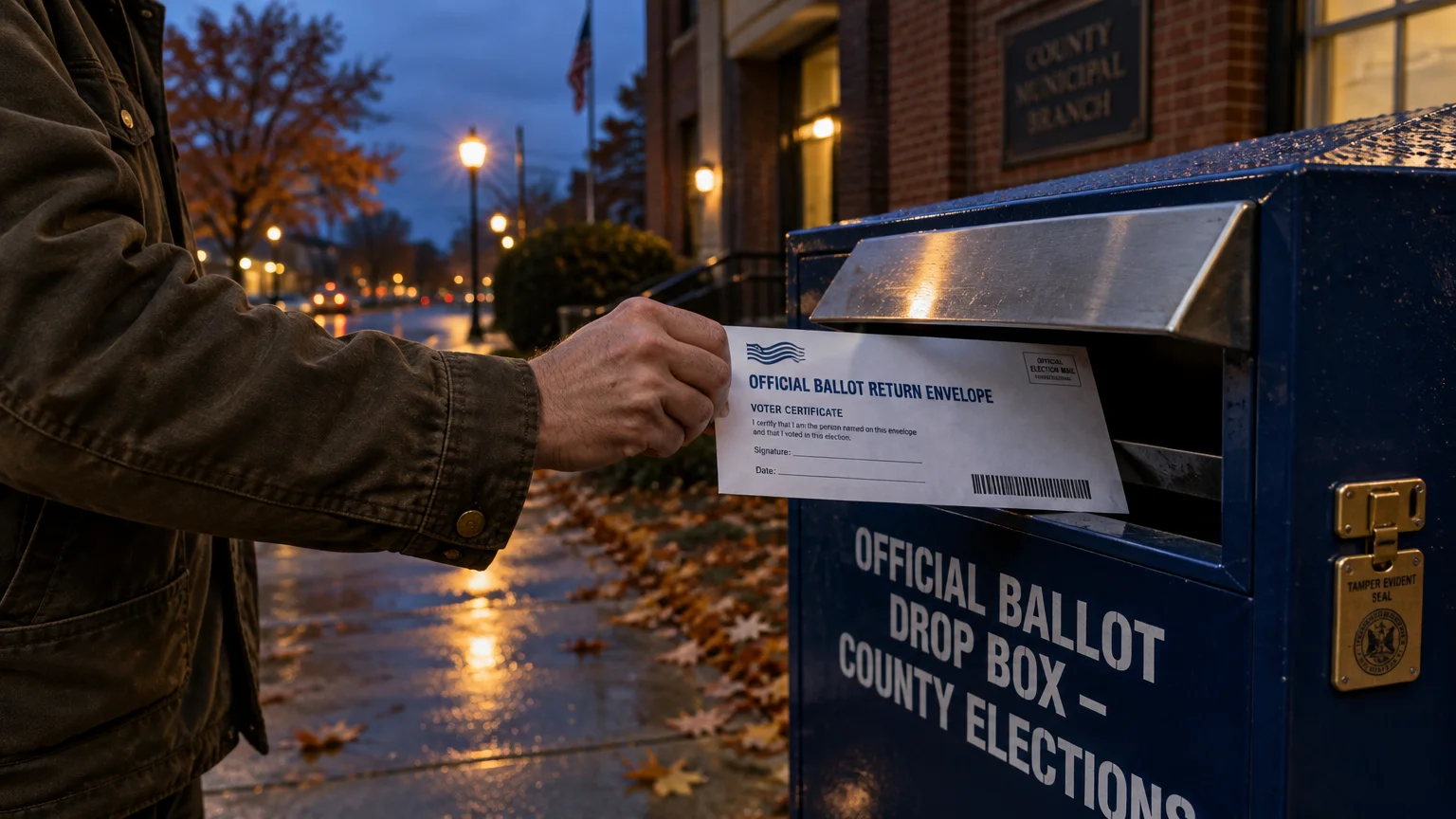
Drop boxes give you a reliable return option that bypasses postal transit times. They ensure your ballot reaches county election custody directly, even on the final evening of an election.
Statewide Ballot Pre-Processing and Automated Tabulation
Mail-in balloting accounted for roughly 5% of all votes cast nationwide prior to the 1980s. According to the U.S. Election Assistance Commission, that figure reached 30.3% in the 2024 general election following peak pandemic turnout in 2020.
Handling tens of millions of mailed envelopes created administrative bottlenecks in states that barred election workers from opening envelopes before Election Day. To prevent reporting delays, state legislatures enacted comprehensive pre-processing statutes.
The Congressional Research Service analysis on election administration outlines how early processing balances procedural integrity with timely results. By October 2025, 44 states authorize local officials to begin processing mail ballots days or weeks before Election Day.
Pre-processing allows election workers to verify envelope signatures against motor vehicle records, open outer transit envelopes, and flatten paper ballots. Additionally, 33 states now permit officials to scan ballots through tabulators before Election Day, up from 20 states in 2016.
State laws strictly protect ballot security during early scanning:
- High-speed scanners record ballot images but do not generate vote totals.
- Tabulation software encrypts results on air-gapped computers until polls close.
- Bipartisan observers monitor each step of the envelope opening and scanning process.
These administrative standards also created statutory cure periods in dozens of states. If your signature is missing or mismatched, your local election office must notify you promptly so you can verify your ballot before certification.
The Structural Pattern Behind Modern Remote Voting Laws
The evolution of remote balloting reveals a clear historical shift in American election law. Voting away from a polling place began as a temporary wartime necessity to prevent troop disenfranchisement during the War of 1812 and the Civil War.
Over the twentieth century, states gradually transitioned from restrictive excuse-based systems to voter-convenience models. What began as a tailored accommodation for railroad workers and commercial travelers eventually expanded to cover all registered citizens across 37 states.
This transition altered election administration from a single-day event into a multi-week operational window. Today, election offices manage continuous postal logistics, secure drop box collections, and automated ballot tracking barcodes.
Despite this nationwide expansion, election laws remain deeply decentralized under the U.S. Constitution’s Elections Clause in Article I, Section 4. While eight states automatically mail ballots to all registered voters, 13 states still require documented justification before you can receive an absentee ballot.
Knowing the specific statutes governing your state ensures you can protect your voting rights. Whether your state mandates signature matching, drop box monitoring, or early pre-processing, every modern protocol reflects more than 160 years of legislative testing.
Frequently Asked Questions About Absentee and Mail-In Ballots
What is the difference between absentee voting and universal vote-by-mail?
Absentee voting requires you to submit an individual application to receive a mail ballot, either with or without an excuse depending on state law. Universal vote-by-mail systems automatically mail a ballot to every active registered voter on the state registry without any application.
As of October 2025, eight states and Washington, D.C., conduct universal vote-by-mail elections, while 29 states offer no-excuse absentee voting. The remaining 13 states strictly require a statutory excuse.
How do election workers verify your identity on a mail-in ballot?
Most jurisdictions verify your identity by comparing the signature on your return envelope against signatures on file from your voter registration or driver’s license. Some states also require a driver’s license number or the last four digits of your Social Security number.
Election workers review these documents in bipartisan pairs using computerized comparison software or manual audits. Envelopes also contain unique barcodes that ensure each registered voter can submit only one valid ballot per election.
What happens if your signature does not match your registration file?
Most states enforce statutory notice and cure laws that protect your vote if an election worker questions your signature. When officials detect a missing or mismatched signature, they must contact you by mail, email, telephone, or text message.
You then receive an opportunity to verify your identity by submitting a signed confirmation form and a copy of an approved identification card. You must complete this verification before the state’s post-election certification deadline.
Can states stop offering universal vote-by-mail after adopting it?
Yes, state legislatures retain the constitutional authority to adjust or repeal remote voting frameworks through standard legislation. For example, Utah adopted universal vote-by-mail in 2019, but state lawmakers enacted legislation in 2025 scheduled to end that system in 2029.
Unless a voting procedure is explicitly mandated by a state constitution or federal statute like UOCAVA, state lawmakers can modify mail-in rules, drop box regulations, and excuse requirements.