
Every ten years, the federal government counts every resident to divide the 435 seats in the House of Representatives among the fifty states. This decennial census determines your community’s direct voting strength in Congress and shapes national presidential elections.
Shifting populations force states to gain or surrender congressional seats based on complex federal statutes and mathematical formulas. Understanding these rules helps you track how legislative influence moves across state borders every decade.
Here is how historical deadlocks, statutory seat caps, and federal population formulas dictate the balance of political power in Washington.
Evaluating the Mechanics and Milestones of Decennial Reapportionment
This guide analyzes nine foundational pillars governing congressional reapportionment, spanning constitutional mandates from 1787 through modern apportionment distributions verified through September 2025. Every entry draws directly from primary records, federal statutes, and federal court rulings.
We examined statutory population thresholds, official roll-call votes in the Congressional Record, and Census Bureau data releases to explain how representation works. These entries document the exact mechanics that translate raw headcounts into congressional districts.
The selection highlights statutory milestones, mathematical models, and judicial decisions that resolved high-stakes disputes between expanding states. You can use these facts to evaluate how decennial census shifts influence state delegations, federal funding streams, and presidential battlegrounds.
By learning how Congress capped its membership and automated seat distribution, you gain actionable insight into upcoming national redistricting battles. Each numbered item delivers verified historical and legal data to show how these mechanics shape your federal representation.
These historical developments reveal that the distribution of congressional seats has never been a static administrative routine. Instead, reapportionment reflects continuous constitutional debates over fairness, urban growth, and state sovereignty.
Constitutional Origins and the Minimum Seat Guarantee
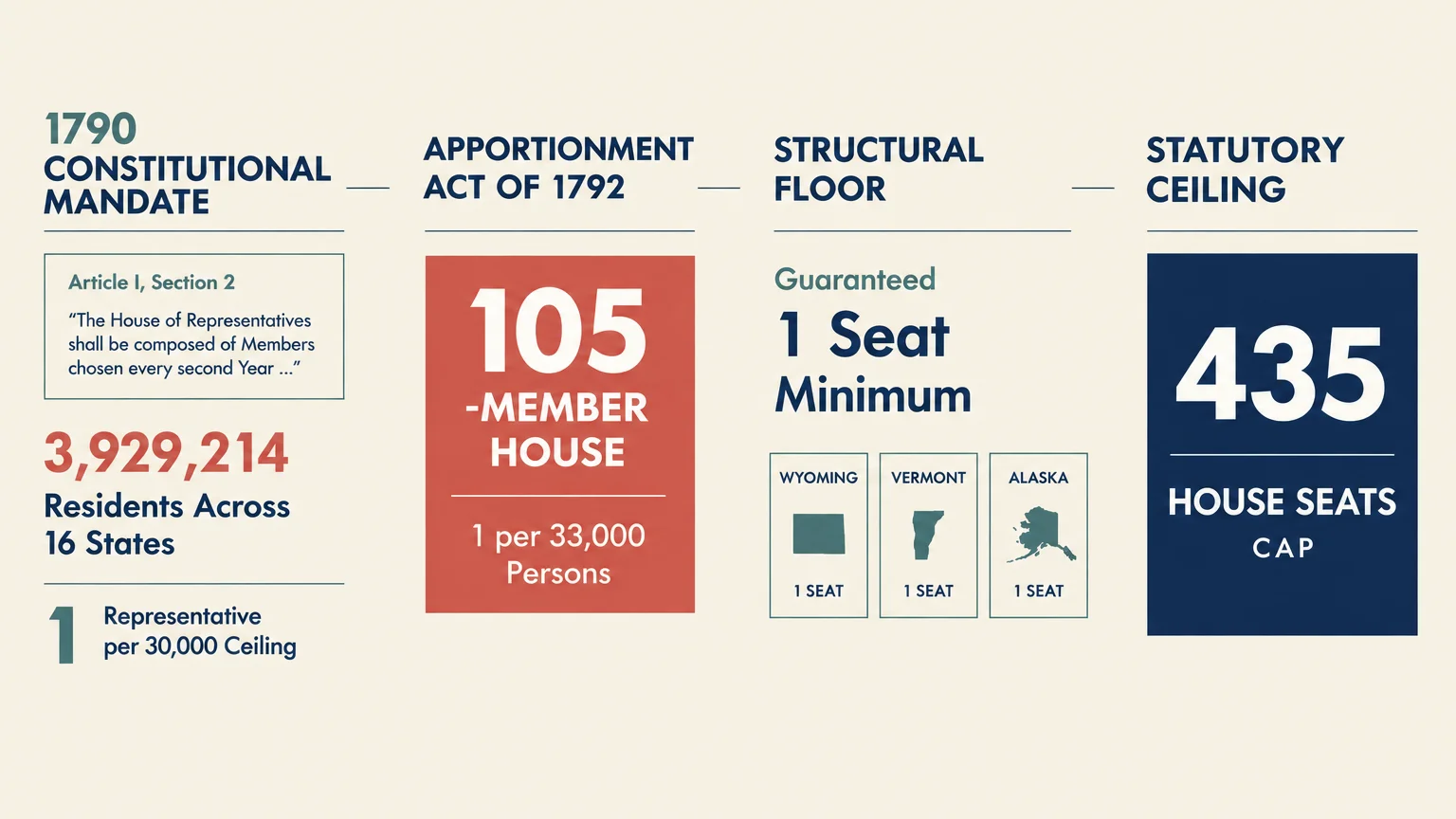
Article I, Section 2 of the U.S. Constitution established the decennial census to apportion members of the House of Representatives among the states. The Framers mandated an actual enumeration every ten years to keep legislative representation aligned with national population growth.
The original constitutional text capped representation at no more than one representative for every 30,000 persons. It also created an enduring structural floor by guaranteeing every state at least one representative regardless of its counted population.
Under the first national census in 1790, federal marshals counted 3,929,214 residents across sixteen states and territories. Congress subsequently passed the Apportionment Act of 1792, establishing a 105-member House and allocating one representative for every 33,000 persons.
The original text of the U.S. Constitution preserved smaller states from total political erasure in the national legislature. Today, low-population states like Wyoming, Vermont, and Alaska still retain their constitutionally guaranteed single at-large House seat.
- Constitutional mandate: Article I, Section 2, Clause 3 established decennial counting.
- Population ratio cap: Maximum of one representative per 30,000 persons.
- Minimum representation floor: Guaranteed at least one House seat per state.
The Rural-Urban Deadlock That Paralyzed the 1920 Reapportionment
The 1920 census revealed a profound demographic transition when official results confirmed that 51.4 percent of Americans lived in urban areas. This marked the first national enumeration in American history where urban populations surpassed rural communities.
Alarmed by the imminent loss of agrarian political power, rural lawmakers in Congress actively blocked reapportionment legislation throughout the entire decade. Representatives from rural states defeated or buried every reapportionment bill introduced between 1921 and 1928.
Consequently, the 1920s became the only decade in United States history where Congress failed to reapportion House seats following a decennial census. Rapidly growing industrial states were denied the additional congressional representation they had lawfully earned.
This legislative paralysis demonstrated that leaving reapportionment to ad hoc congressional votes invited partisan and regional obstruction. Lawmakers recognized that preserving representative democracy required an automated statutory process that bypassed routine political debate.
- Demographic turning point: Urban population officially exceeded rural population in 1920.
- Legislative stalemate: Congress blocked reapportionment across five consecutive congressional terms.
- Historical impact: The only decade in U.S. history with zero congressional reapportionment.
The Permanent Apportionment Act Capped the House at 435 Seats
To resolve the prolonged political deadlock following the 1920 census, Congress enacted the Permanent Apportionment Act of 1929. President Herbert Hoover signed the measure into law on June 18, 1929.
The statute permanently capped the membership of the House of Representatives at 435 voting seats, the number established after the 1910 census. This statutory ceiling ended the historical tradition of expanding the House as the national population expanded.
Codified at 2 U.S.C. Section 2a, the statute established an automatic executive transfer mechanism for decennial apportionments.
The law requires the President to transmit the Census Bureau’s apportionment calculations directly to Congress following each decennial count.
Congress permitted only one temporary deviation from the 435-seat statutory ceiling. When Alaska and Hawaii achieved statehood in 1959, the House briefly expanded to 437 members before reverting back to 435 following the 1960 census reapportionment.
- Statutory authority: 2 U.S.C. Section 2a governs executive apportionment reporting.
- Permanent membership cap: 435 voting members established by the 1929 statute.
- Sole historical exception: Temporary expansion to 437 seats from 1959 to 1962.
The Huntington-Hill Method Calculates Seats by Geometric Mean
In 1941, Congress established the modern formula for apportioning House seats by enacting Public Law 77-291. Known as the Method of Equal Proportions or the Huntington-Hill method, this statutory formula eliminated partisan controversy over seat calculations.
The process begins by assigning each of the fifty states one seat to fulfill the constitutional minimum guarantee. The remaining 385 seats, from seat 51 through seat 435, are awarded sequentially based on calculated priority values.
The Census Bureau calculates priority values by dividing each state’s apportionment population by the geometric mean of its current seat count and next potential seat count. The exact mathematical divisor is the square root of n times n plus one.
The Census Bureau computing apportionment guide explains that this formula minimizes relative percentage differences in district sizes between states. The computer program sorts every state’s priority values in descending order to assign the final seats.
- Initial allocation: First 50 seats automatically assigned (one per state).
- Mathematical divisor: Square root of n multiplied by n plus one.
- Optimization goal: Minimizes relative percentage differences in district populations.
The Supreme Court Upheld Apportionment Math in Montana
Following the 1990 census, Montana lost one of its two House seats, forcing its single remaining representative to represent over 800,000 citizens. Montana sued federal officials, arguing the Huntington-Hill formula unconstitutionally violated the principle of equal representation for equal numbers of people.
The dispute reached the Supreme Court in Department of Commerce v. Montana, Docket Number 91-860. On March 31, 1992, the Supreme Court issued a unanimous 9-0 ruling affirming the constitutionality of the statutory formula.
Writing for the court, Justice John Paul Stevens held that Congress possesses broad constitutional authority under Article I, Section 2 to select an apportionment method. Stevens explained that no mathematical formula can achieve absolute numerical equality across states with fixed borders.
As detailed in the Congressional Research Service House apportionment report, this decision confirmed that the Method of Equal Proportions represents a lawful exercise of legislative discretion. The ruling insulated the decennial mathematical formula against future constitutional challenges.
- Case citation: Department of Commerce v. Montana, 503 U.S. 442 (1992).
- Judicial outcome: Unanimous 9-0 decision authored by Justice John Paul Stevens.
- Legal holding: Congress holds broad discretion to choose equal proportions formulas.
District Populations Swelled Beyond 760,000 Residents
Because the House remains capped at 435 seats while the American population continues to multiply, individual congressional districts have grown drastically larger. In 1910, the average congressional district contained approximately 210,328 residents across the nation.
According to the 2020 census, the resident population reached 331,449,281 people. This substantial population growth drove the national average congressional district size to an unprecedented high of 761,169 residents.
This statutory ceiling produces notable representation inequalities between states of varying populations. For instance, Delaware’s single at-large district contained roughly 990,837 residents after the 2020 count, whereas Wyoming’s single at-large district contained approximately 577,719 residents.
For individual voters, this growth means your representative serves nearly four times as many constituents as lawmakers did a century ago. This sheer volume increases the constituent casework burden while making direct voter access significantly more challenging.
- 1910 baseline average: Approximately 210,328 residents per congressional district.
- 2020 record average: 761,169 residents per congressional district.
- Interstate disparity: Delaware district exceeded 990,000 while Wyoming district had 577,719.
Apportionment Counts Total Residents Rather Than Eligible Voters
Section 2 of the Fourteenth Amendment mandates that representatives shall be apportioned among the states according to their whole number of persons. Codified at 13 U.S.C.
Section 141, federal law requires counting all residents regardless of citizenship status.
The Census Bureau follows the longstanding “usual residence” principle, counting individuals where they live and sleep most of the time. This standard includes children, lawful permanent residents, temporary workers, foreign students, and undocumented immigrants residing in each state.
In addition, federal apportionment headcounts include military personnel and federal civilian employees stationed abroad, together with their accompanying dependents. The Census Bureau allocates these overseas personnel back to their legal home states using administrative records.
However, the Census Bureau excludes residents of Washington, D.C., and U.S. territories like Puerto Rico and Guam from apportionment tallies. Because these jurisdictions lack voting House representation, federal law excludes their populations from seat apportionment mathematics.
- Constitutional standard: Fourteenth Amendment mandates counting the whole number of persons.
- Overseas count: Stationed military and federal personnel assigned to home states.
- Excluded populations: Residents of Washington, D.C., and Puerto Rico lack voting seats.
Decennial Seat Reallocations Come Down to Razor-Thin Margins
The Census Bureau released the official 2020 apportionment counts on April 26, 2021, following administrative delays caused by the coronavirus pandemic. The certified tabulations resulted in seven House seats shifting among thirteen states.
California lost a congressional seat for the first time in its 170-year statehood history, dropping from 53 seats to 52. In contrast, Texas secured two additional congressional districts, expanding its House delegation to 38 members.
The priority calculations often hinge on extraordinarily tiny population margins. New York forfeited its 27th congressional seat to Minnesota’s 8th seat by a margin of just 89 counted residents.
Had census enumerators recorded 89 additional individuals in New York, that final seat would have remained in New York instead of going to Minnesota. Montana also regained a second district, dividing its territory for the first time since 1993.
| State | 2010 Seats | 2020 Seats | Net Change | 2020 Apportionment Population | Average Population per Seat |
|---|---|---|---|---|---|
| Texas | 36 | 38 | +2 | 29,243,342 | 769,562 |
| Colorado | 7 | 8 | +1 | 5,782,171 | 722,771 |
| Florida | 27 | 28 | +1 | 21,570,527 | 770,376 |
| Montana | 1 | 2 | +1 | 1,085,407 | 542,704 |
| North Carolina | 13 | 14 | +1 | 10,453,948 | 746,711 |
| Oregon | 5 | 6 | +1 | 4,241,507 | 706,918 |
| California | 53 | 52 | -1 | 39,576,757 | 761,091 |
| Illinois | 18 | 17 | -1 | 12,822,739 | 754,279 |
| Michigan | 14 | 13 | -1 | 10,084,442 | 775,726 |
| New York | 27 | 26 | -1 | 20,215,751 | 777,529 |
| Ohio | 16 | 15 | -1 | 11,808,848 | 787,257 |
| Pennsylvania | 18 | 17 | -1 | 13,011,844 | 765,403 |
| West Virginia | 3 | 2 | -1 | 1,795,045 | 897,523 |
Census Reapportionment Reshapes the Electoral College and Federal Spending
Reapportionment directly alters the Electoral College landscape because each state’s electoral votes equal its House delegation plus its two senators. Shifts finalized from the 2020 census took effect for the 2024 and 2028 presidential elections.
Fast-growing southern states gained presidential electors, while northern and midwestern industrial states lost electoral votes. These adjustments alter national campaign strategies, advertising allocations, and swing-state math for major party candidates.
Beyond electoral politics, census population data governs the annual allocation of more than $1.5 trillion in federal funding to states and localities. Communities rely on accurate headcounts to secure statutory grants for infrastructure, healthcare, and education.
When local communities experience undercounts, they surrender federal resources for Medicaid, highway construction, and public schools across an entire decade. Ensuring accurate census participation preserves both your community’s legislative voice and its public tax dollars.
- Medicaid and Children’s Health Insurance Program healthcare reimbursements.
- Federal Highway Administration transit and surface infrastructure funding.
- Title I education grants and Head Start early learning grants.

How Capped Representation Shapes Modern American Democracy
The evolution of congressional reapportionment illustrates how statutory decisions made a century ago continue to restrict modern American governance. When Congress capped the House at 435 seats in 1929, it transformed representation into a zero-sum competition.
Because the national seat total never changes, no state can gain representation without another state surrendering an equivalent number of seats. This rigid ceiling intensifies regional competition between rapidly growing Sunbelt states and slower-growing Rust Belt states.
The Huntington-Hill method provides an objective, mathematical resolution to this competition, preventing the legislative breakdowns that paralyzed Congress in the 1920s. By calculating priority values through geometric means, federal law removes partisan negotiation from seat distribution.
Yet this mathematical precision cannot resolve the democratic dilemma posed by an expanding population within a fixed legislative chamber. District sizes now exceed 760,000 residents, increasing constituent service pressures on individual representatives.
Furthermore, the fixed House cap amplifies representation disparities between small states with one at-large seat and medium-sized states approaching a second seat. These structural imbalances affect both the House floor and Electoral College outcomes.
Understanding these apportionment mechanics empowers you to anticipate how future demographic migrations will reshape the national political landscape. As populations continue shifting southward and westward, congressional power will inevitably follow the numbers.
You can track these decennial shifts to evaluate whether your home state will gain or lose legislative leverage in future redistricting cycles. Knowing the statutory rules demystifies how population counts translate into real political clout.
Frequently Asked Questions About Decennial Reapportionment
Can Congress expand the House of Representatives beyond 435 members?
Yes. The 435-seat limit is established by federal statute under the Permanent Apportionment Act of 1929 rather than the U.S. Constitution.
Congress retains full constitutional authority under Article I to enact new legislation adjusting the size of the House of Representatives at any time.
Expanding the chamber would require a standard federal bill passing both houses of Congress and receiving presidential approval.
Why do some states lose seats even when their population increases?
A state can gain population and still lose a House seat if other states experience faster population growth during the same decade.
Because the 435 seats are fixed by law, the Huntington-Hill formula allocates representation based strictly on each state’s relative national population share.
If your state grows by three percent while the nation grows by seven percent, your state’s relative representation share effectively shrinks.
Does the Census Bureau draw new congressional district boundary lines?
No. The Census Bureau only determines the total number of representatives assigned to each state under federal apportionment statutes.
State legislatures or independent state redistricting commissions subsequently draw the internal district boundaries in accordance with state laws and federal voting rights statutes.
The federal government provides the detailed census block data, but state authorities control the actual line-drawing process.
Why does the apportionment headcount include non-citizens?
Section 2 of the Fourteenth Amendment explicitly requires counting the whole number of persons in each state, not just citizens or registered voters.
The Supreme Court and the Department of Justice have consistently confirmed that “persons” encompasses all human residents living within a state’s geographic boundaries.
Federal courts have rejected state attempts to exclude non-citizens from decennial apportionment headcounts absent a constitutional amendment.