
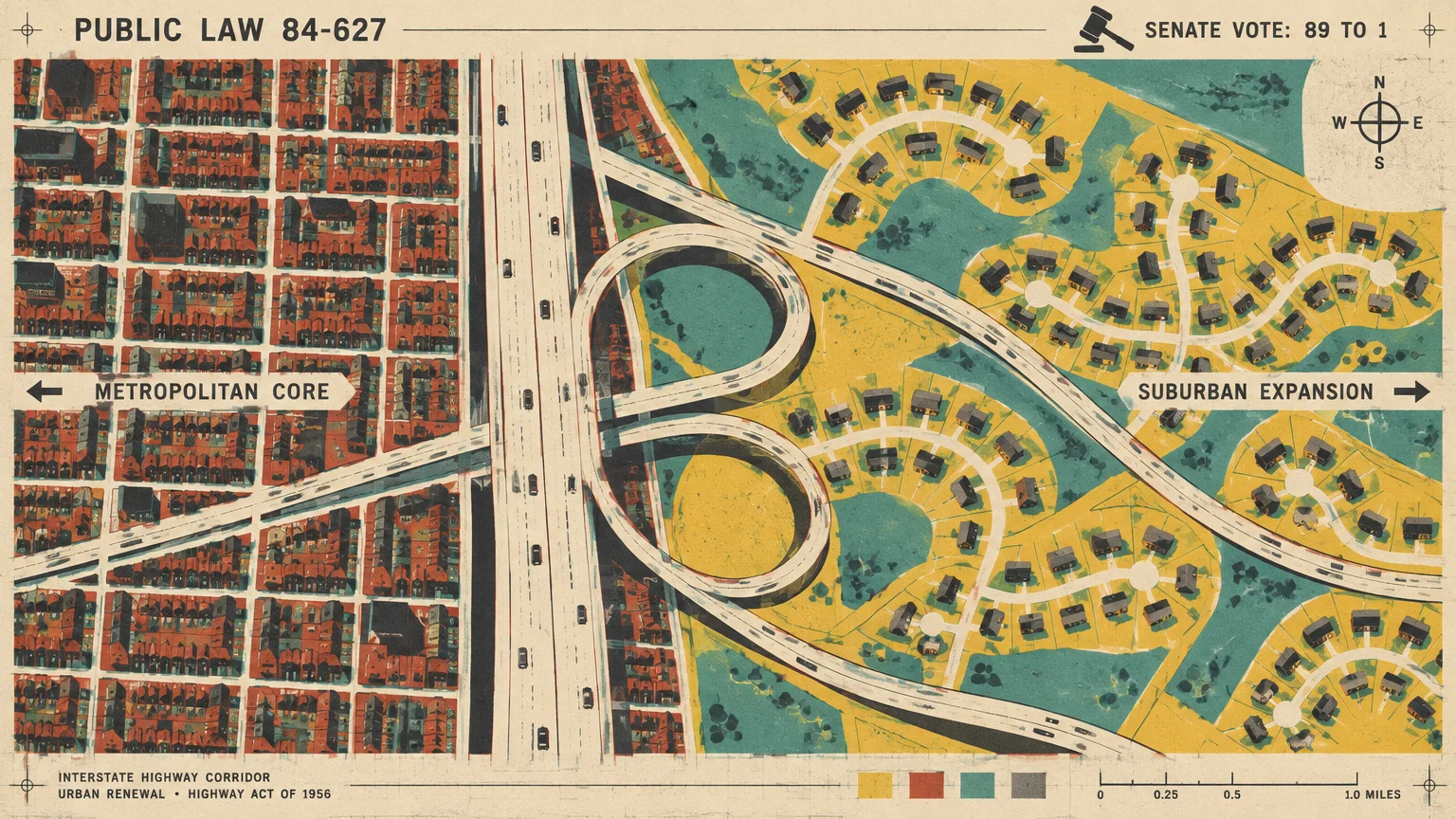
When President Dwight D. Eisenhower signed the Federal-Aid Highway Act of 1956, he fundamentally reshaped where you live, work, and cast your ballot.
The law authorized a 41,000-mile network that redirected tax revenues and triggered unprecedented migrations across the country.
This national infrastructure build shifted legislative representation away from urban centers toward rapidly growing suburban communities. It also triggered fierce political battles over community displacement and highway trust fund spending that continue to impact your daily commute today.
Examining this landmark legislation reveals how physical concrete and federal financing formulas redesigned American democracy over the last seven decades.
Documenting the Political and Demographic Legacy of the 1956 Act
This explainer tracks nine concrete ways the Federal-Aid Highway Act transformed the American political landscape between 1956 and 2026. We selected these items by analyzing federal statutes, decennial census figures, Supreme Court rulings, and administrative records.
Each entry pairs documented historical data with measurable demographic or institutional outcomes. You can verify every statute number, congressional roll call, and population shift against public archives and government records.
Together, these developments show how transportation policy became one of the most powerful political engines in modern American history.
The Ninety-Ten Federal Funding Formula Subordinated State Autonomy
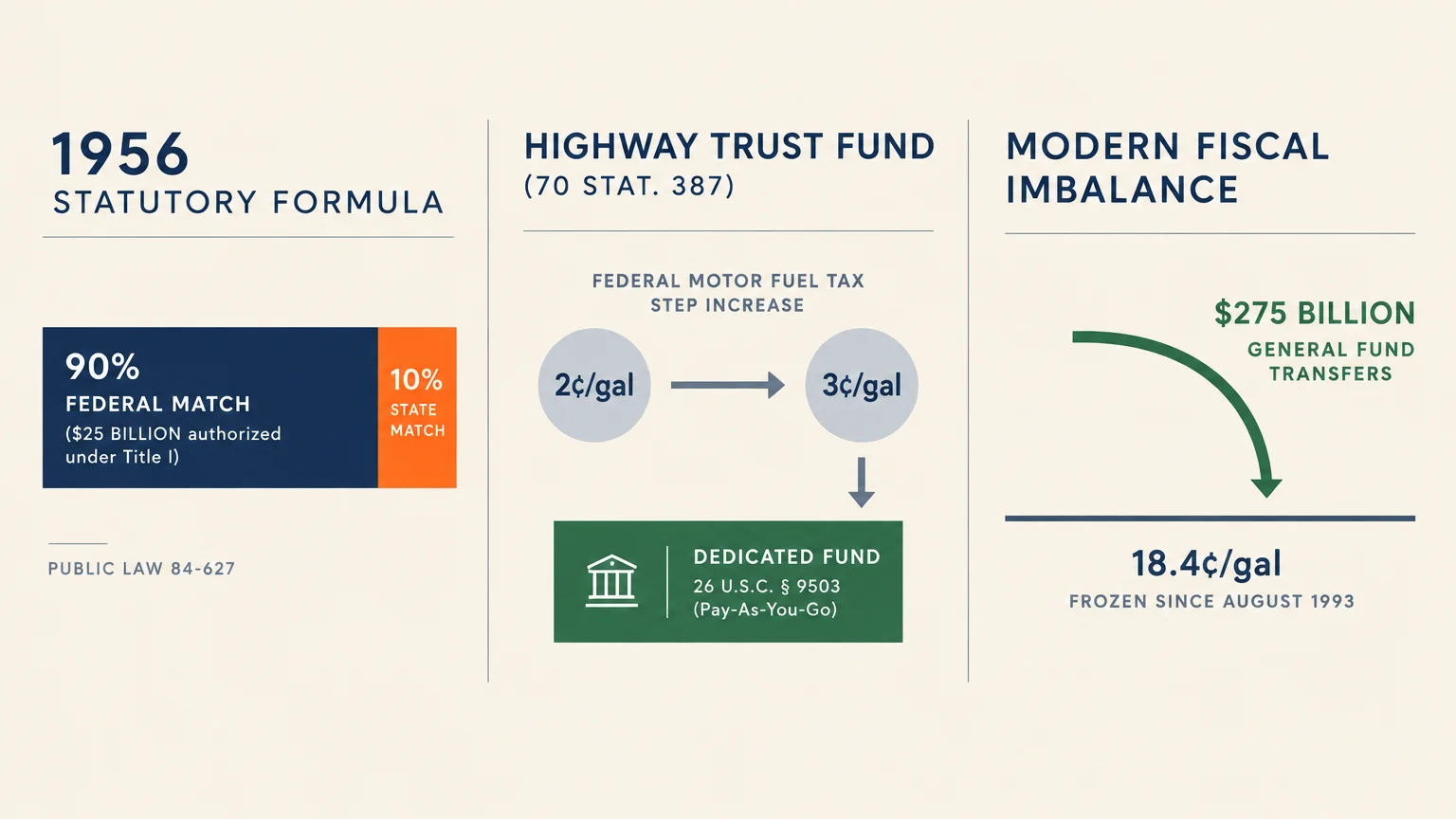
Congress enacted the Federal-Aid Highway Act on June 29, 1956, under Public Law 84-627. The statute established an unprecedented funding mechanism where the federal government covered 90% of construction costs while states contributed only 10%.
The Senate passed the final conference report on June 26, 1956, by a lopsided vote of 89 to 1. The House of Representatives approved the compromise measure via voice vote without a formal roll call tally.
Title I, Section 108 authorized $25 billion over 13 fiscal years, running from 1957 through 1969. This overwhelming federal match made state refusal financially unthinkable for governors and state legislatures nationwide.
Although individual states retained legal ownership of the completed roadways, the federal funding split dictated their capital budgets. State transportation agencies consistently prioritized interstate ribbon-cutting over municipal buses, commuter rail, and local county road repairs.
This fiscal leverage permanently subordinated state transportation agendas to federal planning criteria. By accepting federal cash, your state locked its capital development into an automobile-dominated transit model for generations.
The Highway Trust Fund Created a Self-Perpetuating Fiscal Machine
Title II of the legislation, titled the Highway Revenue Act of 1956, established the Highway Trust Fund under 70 Stat. 387.
The statute codified this mechanism at 26 U.S.C. § 9503 to ensure dedicated, continuous highway financing.
The act raised the federal motor fuel excise tax from 2 cents to 3 cents per gallon. It legally cordoned off those gas tax revenues, preventing Congress from spending them on general government operations.
This structure built a self-reinforcing political lobby of road builders, oil producers, and state highway officials. Because the fund operated on a dedicated “pay-as-you-go” basis, highway expansion bypassed the fierce scrutiny of the annual congressional appropriations process.
That funding design eventually broke down as fuel efficiency increased and vehicle travel patterns shifted. The federal gas tax rate has remained frozen at 18.4 cents per gallon since August 1993.
To keep the Highway Trust Fund solvent, Congress has transferred $275 billion in general treasury funds since 2008. The 2021 Infrastructure Investment and Jobs Act provided $118 billion of that total to prevent immediate insolvency.
Suburban Population Surges Stripped Cities of Congressional Power
The interstate network subsidized suburban outward expansion, triggering profound shifts across U.S. Census Bureau population records. Between 1950 and 1970, the national suburban population doubled from 36 million to 74 million residents.
The 1970 decennial census crossed a historic threshold. For the first time in American history, more citizens lived in suburban rings than in central cities or rural towns.
This geographic reallocation coincided with the landmark Supreme Court ruling in Wesberry v. Sanders (1964). The Court mandated that states draw congressional districts with substantially equal populations under the one-person, one-vote doctrine.
As suburban populations exploded along highway corridors, state legislatures shifted dozens of congressional districts out of central cities. Suburban voters gained decisive influence over House committee assignments, party primaries, and federal budget priorities.
This suburban realignment eroded the political power of urban party machines. In their place, it elevated suburban voting blocs that prioritized low property taxes, single-family zoning, and expanded highway capacity.
Urban Highway Routing Demolished Minority Neighborhoods
The 1956 Act left specific urban routing decisions to state highway departments, which operated with virtually no federal relocation mandates. Highway engineers regularly routed interstate segments through low-income and minority neighborhoods under the banner of “urban renewal.”
Federal Highway Administration data document the staggering human toll of this policy choice. Interstate construction destroyed approximately 475,000 residential homes and forcibly displaced over 1 million Americans across the country.
Planners targeted thriving commercial and cultural centers in minority communities. Prominent examples include the destruction of Claiborne Avenue in New Orleans by Interstate 10, Syracuse’s 15th Ward by Interstate 81, and Black Bottom in Detroit by Interstate 375.
These infrastructure projects severed walkable neighborhoods, wiped out generational family wealth, and intensified racial segregation in northern and southern cities alike. The resulting physical barriers entrenched deep racial and economic divides that persist across your metropolitan landscape.
Congress belatedly acknowledged this damage in the 2021 Bipartisan Infrastructure Law. That statute authorized $1 billion for the Reconnecting Communities Pilot program and $3.3 billion for Reconnecting Communities and Neighborhoods grants to cap or remove these physical divisions.
Interstate Corridors Spurred the Economic and Political Ascent of the Sun Belt
The interstate system laid the physical foundation for the economic rise of the South and West. Corridors like I-10, I-20, I-40, and I-75 connected once-isolated southern towns directly to major national consumer markets.
Combined with the rapid adoption of residential and commercial air conditioning, the highway grid unlocked unprecedented business expansion. Corporations relocated headquarters and manufacturing plants from the urban Northeast and Midwest to low-tax, right-to-work states across the Sun Belt.
This demographic transformation completely redrew the Electoral College map between 1960 and 1980. Industrial states like New York, Pennsylvania, and Ohio steadily lost population share, legislative seats, and presidential electoral clout.
Conversely, Sun Belt states like Florida, Texas, and California gained dozens of congressional districts. This ongoing population flight transformed southern and western suburbs into the focal point of modern presidential and legislative politics.
Your presidential elections now hinge on swing districts across the Sun Belt that did not exist before the 1956 Act opened those regions to rapid expansion.
Cold War Civil Defense Requirements Shaped Roadway Engineering
President Eisenhower championed the highway system largely due to his military observations. According to the Dwight D. Eisenhower Presidential Library, his grueling experience on the 1919 Transcontinental Motor Convoy—which required 62 days to cover 3,251 miles—convinced him that national defense demanded paved roads.
During World War II, Eisenhower observed the strategic speed of the German Reichsautobahn. In 1956, he successfully framed national highway construction as an urgent national security imperative.
Lawmakers formally designated the network the “National System of Interstate and Defense Highways.” Cold War defense strategists argued that multi-lane bypasses were essential to evacuate major population centers during a potential Soviet nuclear strike.
The legislation established strict military design mandates for all designated routes. Contractors had to build minimum 16-foot bridge clearances to accommodate heavy military transport vehicles and intercontinental ballistic missile convoys.
However, public memory frequently distorts these defense rules through persistent urban legends. The widely cited claim that one out of every five miles must be flat and straight for emergency airplane runways is entirely false.
The Federal Highway Administration Historian confirms that neither the 1956 statute nor federal design regulations ever contained a runway requirement. The defense title served strategic logistics, not emergency aircraft operations.
High-Speed Freight Realignment Elevated Trucking Over Rail
Before 1956, freight railroads moved the overwhelming majority of heavy goods between American cities. The construction of a high-speed, toll-free interstate network abruptly shifted the competitive balance toward commercial trucking.
Manufacturers no longer needed rail spurs or downtown warehouse depots to receive raw materials and ship finished products. Instead, companies established sprawling, single-story fulfillment centers along suburban highway beltways.
This industrial migration enabled modern supply chains and “just-in-time” inventory management. Today, the interstate system carries roughly 25% of all vehicle miles traveled in the United States, despite making up only 1% of total road mileage.
This logistics shift fundamentally disrupted national labor dynamics. As private rail employment declined, membership in the International Brotherhood of Teamsters expanded rapidly across the country.
The Teamsters leveraged their control over interstate freight corridors to build immense political influence in Washington. Highway freight transformed transportation labor into a central pillar of late-twentieth-century industrial politics.
Urban Freeway Revolts Ignited Modern Environmental Administrative Law
During the late 1950s and 1960s, state highway departments routed expressways through established communities without public input. This heavy-handed approach sparked intense grassroots pushback known as the “freeway revolts.”
Citizens in San Francisco, Baltimore, Memphis, and Washington, D.C., organized cross-neighborhood coalitions to block planned highway bulldozers. These local activists lobbied city councils, chained themselves to construction equipment, and filed novel federal lawsuits.
The political backlash prompted Congress to inject citizen review mandates into federal transportation statutes. Lawmakers enacted Section 4(f) of the Department of Transportation Act of 1966 (codified at 49 U.S.C. § 303), which barred road construction through public parks unless no feasible alternative existed.
Citizen resistance culminated in the landmark Supreme Court case Citizens to Preserve Overton Park v. Volpe, 401 U.S. 402 (1971). The Court ruled that federal highway approvals must undergo strict judicial review to ensure administrators comply with environmental statutes.
This ruling transformed administrative law. Combined with the National Environmental Policy Act of 1969, it gave you and your local community enforceable legal standing to challenge federal infrastructure projects.
Revenue Stagnation Sparked a Permanent Federal Solvency Crisis
The 1956 Act designed the interstate network to be completely self-funding through motor fuel taxes. However, Congress tied the tax to a fixed cents-per-gallon assessment rather than a percentage of the retail price.
Because the tax rate does not adjust for inflation, the Highway Trust Fund lost massive purchasing power over time. Meanwhile, rising vehicle fuel economy and the adoption of electric vehicles caused fuel tax revenues to decline relative to total vehicle miles driven.
Congress enacted the last federal fuel tax increase in the Omnibus Budget Reconciliation Act of August 1993, setting rates at 18.4 cents per gallon for gasoline and 24.4 cents for diesel.
Lawmakers have avoided raising that rate for more than three decades due to political fallout at the ballot box.
This structural deficit turned highway funding into a chronic fiscal headache for Capitol Hill. Congress repeatedly used general tax revenues to bail out the Highway Trust Fund rather than addressing its long-term revenue deficit.
The fiscal crunch is fast approaching another legislative showdown. Surface transportation spending authorizations under the 2021 Infrastructure Investment and Jobs Act expire on September 30, 2026, and Congressional Budget Office forecasts project total trust fund insolvency by 2028.
To keep the highway system operational, lawmakers must decide whether to raise fuel taxes, implement vehicle-miles-traveled fees, or abandon user-fee principles entirely.
Comparing the Key Provisions and Long-Term Impacts of the 1956 Act
The table below compares the foundational statutory mechanisms established by the 1956 Act with their subsequent political, demographic, and legal results.
| Statutory Mechanism | Primary Legal Authority | Key Metric or Scope | Political or Demographic Consequence |
|---|---|---|---|
| 90-10 Match Formula | P.L. 84-627, Title I | $25B over 13 fiscal years | Subordinated state transit budgets to federal highways. |
| Highway Trust Fund | 70 Stat. 387; 26 U.S.C. § 9503 | 3¢/gal tax (now 18.4¢) | Shielded road construction from annual budget reviews. |
| Suburban Routing | P.L. 84-627, Section 108 | 41,000 original miles | Shifted House representation from cities to suburbs. |
| Urban Land Acquisition | State Eminent Domain Laws | 475,000 homes razed | Bisected minority neighborhoods and fueled segregation. |
| National Defense Mandate | P.L. 84-627, Title I | 16-foot bridge clearance | Spurred regional Sun Belt industrial and electoral growth. |
| Administrative Approvals | 49 U.S.C. § 303 (Section 4f) | Overton Park (1971) | Established modern public judicial review of transit plans. |
How the 1956 Interstate System Redesigned Modern Governance
The Federal-Aid Highway Act of 1956 proved that physical infrastructure decisions produce lasting political consequences. By creating an automatic 90% federal match, Congress reshaped how state and local officials prioritize taxpayer funds.
This spending pattern permanently reorganized American population density. As high-speed freeways radiated outward from central business districts, suburban sprawl redistributed political power across municipal, state, and congressional jurisdictions.
That suburban shift weakened inner-city tax bases and transferred competitive legislative seats to suburban perimeters. At the national level, interstate corridors enabled the demographic rise of the Sun Belt, reorganizing the Electoral College map for modern presidential campaigns.
Simultaneously, the highway construction process exposed major institutional blind spots regarding civil rights and environmental stewardship. The wholesale clearance of minority communities catalyzed modern administrative review laws and spurred federal remediation grants today.
Today, the original funding model faces structural depletion. As the September 30, 2026, expiration of surface transportation authorizations approaches, Congress faces the same basic challenge Eisenhower confronted in 1956: deciding how the nation will pay for its critical arteries.
Frequently Asked Questions
Did the 1956 Act require one in five miles of highway to serve as an airstrip?
No. This widely repeated claim is a myth with no basis in the public record. Neither Public Law 84-627 nor any Federal Highway Administration design manual contains an emergency runway requirement.
Defense specifications focused on overhead bridge clearances and weight capacities for military convoys.
How did highway construction alter congressional apportionment?
The highway network accelerated suburbanization between 1950 and 1970, doubling suburban populations across the country. Following Supreme Court redistricting rulings that mandated equal-population districts, state legislatures transferred dozens of House seats from depopulated central city cores into expanding suburban commuter rings.
Why is the Highway Trust Fund currently running a structural deficit?
Congress has not raised the federal fuel excise tax of 18.4 cents per gallon since August 1993. Inflation has severely reduced the purchasing power of that fixed levy, while improved vehicle fuel economy and electric vehicles reduced per-mile tax collections.
Congress has transferred $275 billion from general revenues since 2008 to prevent insolvency.
What federal steps are underway to repair damage caused by historic highway routes?
The 2021 Bipartisan Infrastructure Law created the Reconnecting Communities Pilot program with $1 billion in initial funding. The initiative, alongside the expanded $3.3 billion Reconnecting Communities and Neighborhoods grant program, funds projects to cap, modify, or remove highways that severed urban minority neighborhoods during mid-century construction.



