Sam Houston famously governed both Tennessee and Texas, yet he is not the only American leader to hold high office across state lines. Seven politicians have served as governor of one state and represented a different state in the United States Congress.
From early nineteenth-century frontier migrations to modern campaigns, these cross-state careers relied on fluid borders and distinct federal and state constitutional rules. Here is how each officeholder achieved this dual-state record.
Criteria for the Dual-State Leadership Record
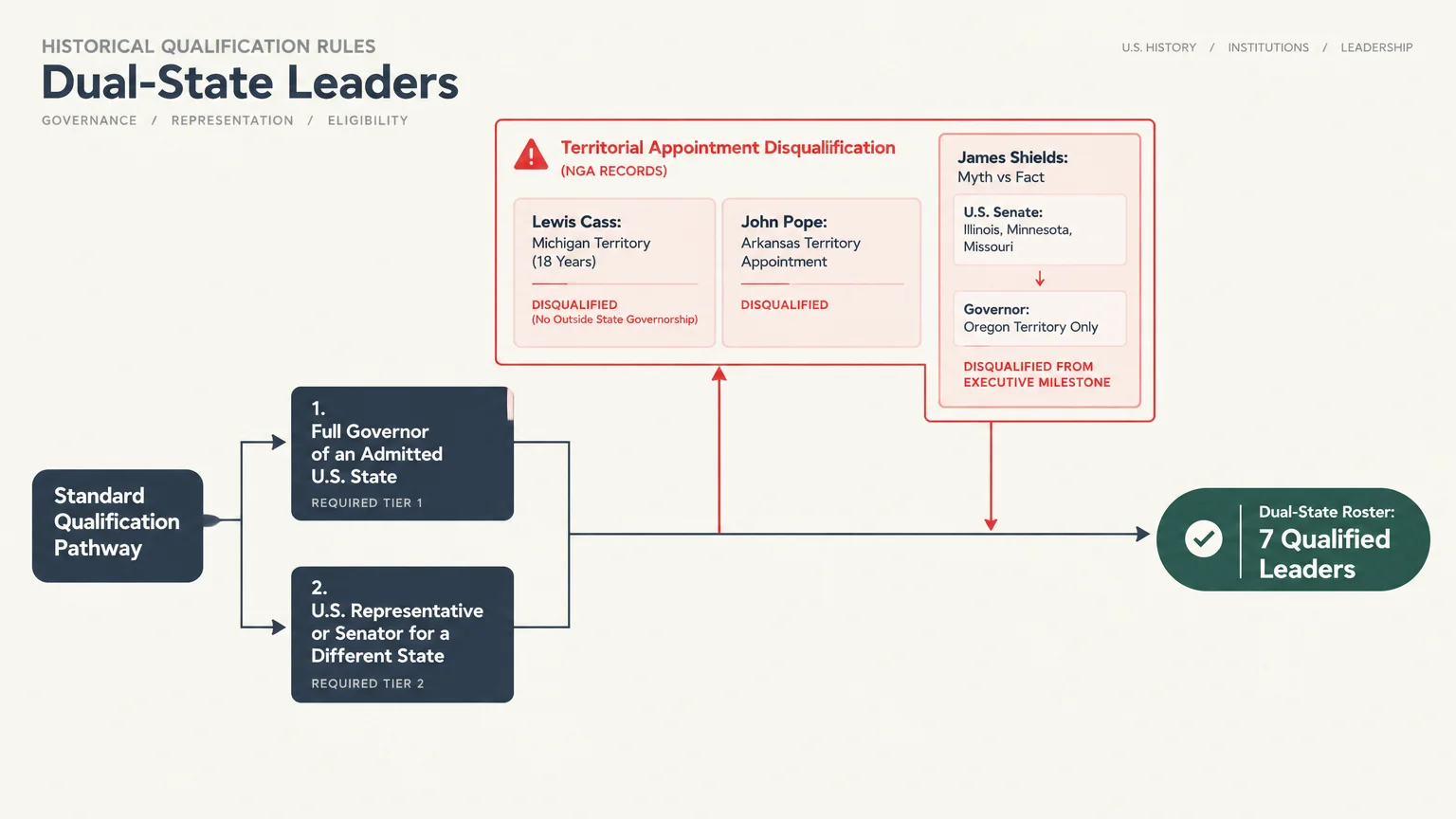
To qualify for this list, a politician must have served as governor of an admitted U.S. state and represented a different state in the U.S. House of Representatives or the U.S. Senate.
Appointed territorial governors do not count as state executives under records maintained by the National Governors Association.
This rule excludes territorial executives such as Lewis Cass (Michigan Territory) and John Pope (Arkansas Territory).
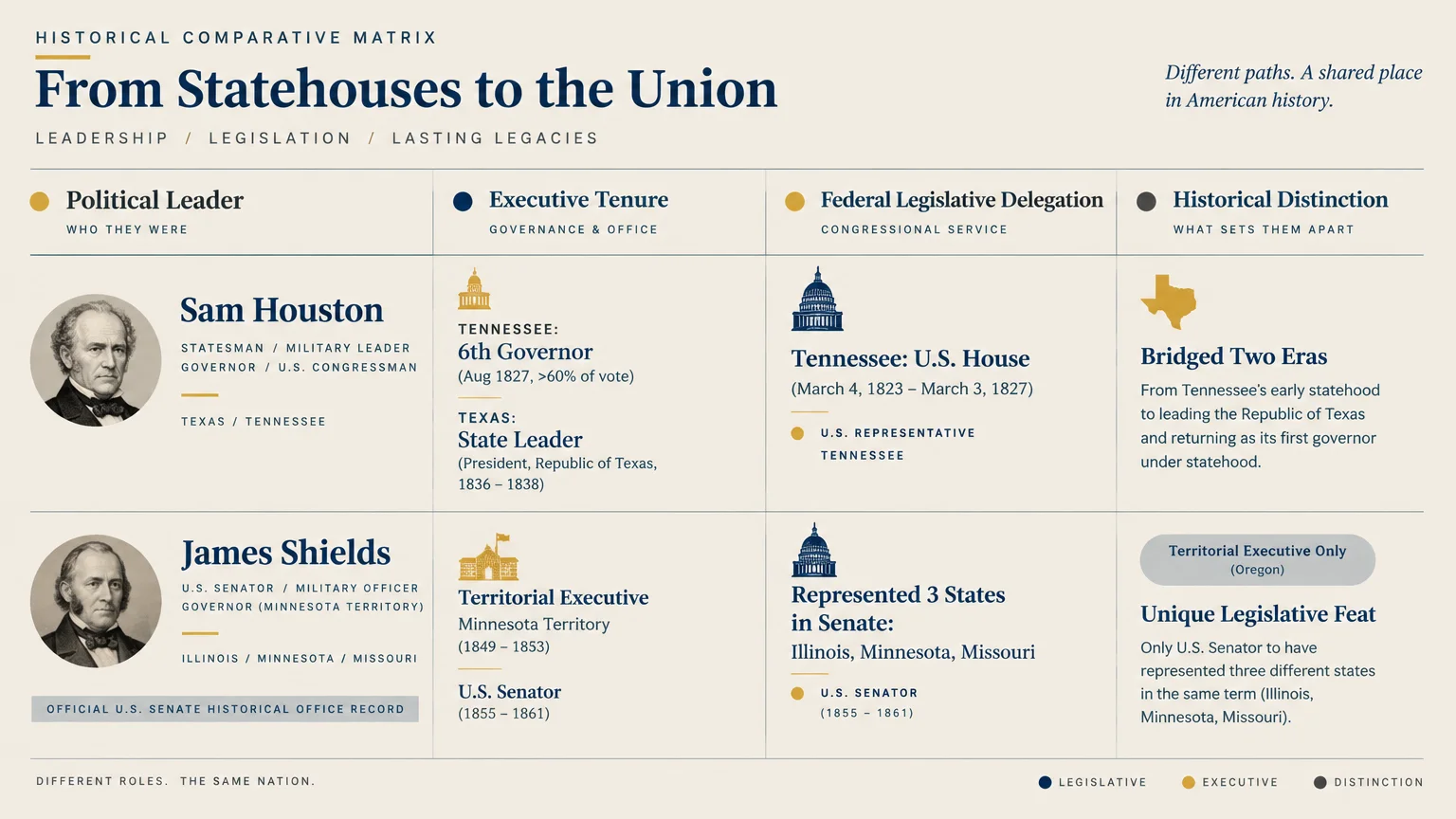
It also excludes James Shields, who represented Illinois, Minnesota, and Missouri in the U.S. Senate and was appointed governor of the Oregon Territory, but never governed an admitted state.
Sam Houston
Sam Houston remains the only person in American history to serve as governor of two separate states. He launched his national career in Tennessee, serving two terms in the U.S. House of Representatives from March 4, 1823, to March 3, 1827.
His post-executive legislative service mirrored the rare path taken by a few former presidents who returned to Congress after leading the executive branch.
Tennessee voters elected Houston as their sixth governor in August 1827 with over 60 percent of the vote against Newton Cannon and former governor Willie Blount. He resigned on April 16, 1829, following the collapse of his marriage to Eliza Allen.
Moving west into Mexican Texas, Houston took command of the Texian Army and defeated Mexican forces at the Battle of San Jacinto in 1836. Voters later elected him as the first and third President of the Republic of Texas.
When Texas entered the Union, its state legislature elected Houston to the U.S. Senate on February 21, 1846. Serving until March 3, 1859, he opposed sectional extremism and alienated Southern Democrats by voting against the Kansas-Nebraska Act of 1854.
Running as an independent Unionist on August 1, 1859, Houston defeated incumbent Texas Governor Hardin R. Runnels by a vote of 36,257 to 27,500.
State authorities ousted him on March 16, 1861, after he refused to swear allegiance to the Confederacy.
According to his profile in the Biographical Directory of the United States Congress, Houston is the only American to hold both a governorship and a congressional seat alongside the presidency of an independent republic.
Mitt Romney
Mitt Romney is the only modern officeholder to achieve this dual-state record, completing the feat across a sixteen-year span. He won the Massachusetts gubernatorial election on November 5, 2002, defeating Democrat Shannon O’Brien 50 percent to 45 percent.
Romney served as the 70th Governor of Massachusetts from January 2, 2003, to January 4, 2007, closing state budget deficits without broad-based tax increases. On April 12, 2006, he signed Chapter 58 of the Acts of 2006, establishing near-universal state healthcare coverage.
Declining to seek re-election in 2006, Romney ran for president in 2008 and 2012 before establishing permanent residency in Utah. When Utah Senator Orrin Hatch announced his retirement in January 2018, Romney won the Republican nomination for the open seat.
On November 6, 2018, Utah voters elected Romney to the U.S. Senate over Democrat Jenny Wilson with 62.6 percent of the vote. Taking office on January 3, 2019, he served on the Foreign Relations and Budget committees until retiring on January 3, 2025.
Romney remains the only politician to serve as governor of one state and U.S. Senator for another since the ratification of the Seventeenth Amendment in 1913 mandated direct senate elections.
William Wyatt Bibb
William Wyatt Bibb carried his political career from Georgia into frontier Alabama during the Era of Good Feelings. He first entered Congress via a special election to the Ninth Congress, taking his U.S. House seat for Georgia on January 26, 1807.
Georgia voters returned Bibb to the House for four consecutive terms until November 6, 1813, where he chaired the Committee on Claims. The Georgia legislature then elected him to the U.S. Senate to fill the vacancy left when William H.
Crawford became minister to France.
Bibb’s Senate tenure ended after he voted for the Compensation Act of 1816, which replaced daily congressional per diems with an annual salary. Facing voter backlash across Georgia, he resigned his seat on November 9, 1816.
President James Monroe appointed Bibb as the first governor of the newly formed Alabama Territory in March 1817. After supervising the drafting of a state constitution, Bibb won election as Alabama’s first state governor on September 21, 1819, defeating William Crawford 8,342 to 7,140.
Inaugurated on November 9, 1819, Bibb died in office on July 10, 1820, at age 38 from injuries sustained in a fall from his horse. Alongside Houston and Romney, he is one of only three people to serve as governor of one state and U.S. Senator for another.
John B. Weller
John B. Weller built a legislative career in Ohio before relocating to California after the Mexican-American War.
Elected as a Democrat in 1838, he represented Ohio’s 2nd Congressional District in the U.S. House for three terms from 1839 to 1845.
After serving as a lieutenant colonel in the Mexican-American War, Weller won the 1848 Democratic nomination for Governor of Ohio. In the October 1848 general election, Whig candidate Seabury Ford defeated him by 311 votes out of nearly 300,000 cast.
President James K. Polk subsequently appointed Weller to lead the Mexican Boundary Commission surveying the border under the Treaty of Guadalupe Hidalgo.
Weller settled in San Francisco, opened a law practice, and joined California’s pro-southern Democratic faction.
On January 30, 1852, the California legislature elected Weller to the U.S. Senate to replace John C. Frémont.
He served in Washington through March 3, 1857, before failing to win re-election.
In 1857, Weller won the California governorship with 53,122 votes over Republican Edward Stanley and American Party nominee George Bowie. He served as California’s fifth governor from January 8, 1858, to January 9, 1860.
William C. C. Claiborne
William Charles Cole Claiborne forged a political career stretching from Tennessee to Louisiana. In August 1797, Tennessee voters elected him to the U.S. House of Representatives to fill the seat vacated when Andrew Jackson moved to the Senate.
Claiborne took his seat on November 23, 1797, at age 22, despite Article I’s requirement that House members be at least 25. Unchallenged by House leadership, he served two terms and cast Tennessee’s decisive House vote for Thomas Jefferson in the 1800 presidential election.
President Jefferson appointed Claiborne Governor of the Mississippi Territory in May 1801 and Governor of the Territory of Orleans in December 1803. Claiborne supervised the Louisiana Purchase transfer and blended French civil law with American common-law procedures.
After Louisiana entered the Union as the eighteenth state, voters elected Claiborne as its first governor. Serving from April 30, 1812, to December 16, 1816, he mobilized the state militia alongside Andrew Jackson during the 1815 Battle of New Orleans.
The Louisiana legislature elected Claiborne to the U.S. Senate on January 13, 1817, but he died on November 23, 1817, at age 42 before taking his seat.
David Holmes
David Holmes represented Virginia in Congress before becoming Mississippi’s first governor. Elected to the U.S. House in late 1796, he took his seat for Virginia’s 2nd Congressional District on May 15, 1797.
Holmes won re-election five times, serving twelve continuous years until March 3, 1809, and chairing the Committee on Claims in the Tenth Congress.
In 1809, President James Madison appointed him as the fourth territorial governor of Mississippi, where he oversaw the 1810 annexation of West Florida.
In 1817, Holmes presided over Mississippi’s constitutional convention and ran unopposed on September 1, 1817, to become the state’s first governor. He served from October 7, 1817, until January 5, 1820.
The Mississippi legislature then elected Holmes to the U.S. Senate, where he took office on August 30, 1820, to fill Walter Leake’s vacated seat. He resigned from the Senate on September 25, 1825, after winning a second gubernatorial term in August 1825.
Inaugurated as Mississippi’s fifth governor on January 7, 1826, Holmes resigned due to declining health on July 25, 1826, and returned to Virginia.
Albion K. Parris
Albion K. Parris held office across two states as a direct result of the Missouri Compromise of 1820.
Elected in 1814 to represent Massachusetts’s 20th Congressional District, he served in the Fourteenth and Fifteenth Congresses from 1815 to 1818.
Because Massachusetts then governed the District of Maine, Parris represented Maine residents as a Massachusetts congressman. He resigned from the House on February 3, 1818, to become a federal district judge and backed Maine’s statehood movement.
After Congress admitted Maine as a free state on March 15, 1820, Parris served as a delegate to its constitutional convention.
Maine voters elected him as their fifth governor in late 1821, and he served five consecutive one-year terms from January 5, 1822, to January 3, 1827.
The Maine legislature then elected Parris to the U.S. Senate, where he served from March 4, 1827, until resigning on August 26, 1828, to join the Maine Supreme Judicial Court.
Fellow lawmaker Enoch Lincoln followed the same path, succeeding Parris in Massachusetts’s 20th District before serving as Maine’s sixth governor from 1827 to 1829.
Historical Comparison of Multi-State Officeholders
The table below compares the congressional and gubernatorial tenures of these seven officeholders.
| Politician | Congressional State & Chamber | Congressional Years | Gubernatorial State | Gubernatorial Years |
|---|---|---|---|---|
| Sam Houston | Tennessee (House), Texas (Senate) | 1823–1827 (TN), 1846–1859 (TX) | Tennessee, Texas | 1827–1829 (TN), 1859–1861 (TX) |
| Mitt Romney | Utah (Senate) | 2019–2025 | Massachusetts | 2003–2007 |
| William Wyatt Bibb | Georgia (House & Senate) | 1807–1813 (House), 1813–1816 (Senate) | Alabama | 1819–1820 |
| John B. Weller | Ohio (House), California (Senate) | 1839–1845 (OH), 1852–1857 (CA) | California | 1858–1860 |
| William C. C. Claiborne | Tennessee (House), Louisiana (Senate) | 1797–1801 (House), 1817 (Senate) | Louisiana | 1812–1816 |
| David Holmes | Virginia (House), Mississippi (Senate) | 1797–1809 (House), 1820–1825 (Senate) | Mississippi | 1817–1820, 1826 |
| Albion K. Parris | Massachusetts (House), Maine (Senate) | 1815–1818 (MA), 1827–1828 (ME) | Maine | 1822–1827 |
Constitutional Mechanics and the Evolution of Cross-State Politics
This cross-state pattern clustered in the early nineteenth century because of frontier expansion and asymmetric constitutional rules. As western territories gained statehood, voters often elected experienced former congressmen from eastern states to build new executive administrations.
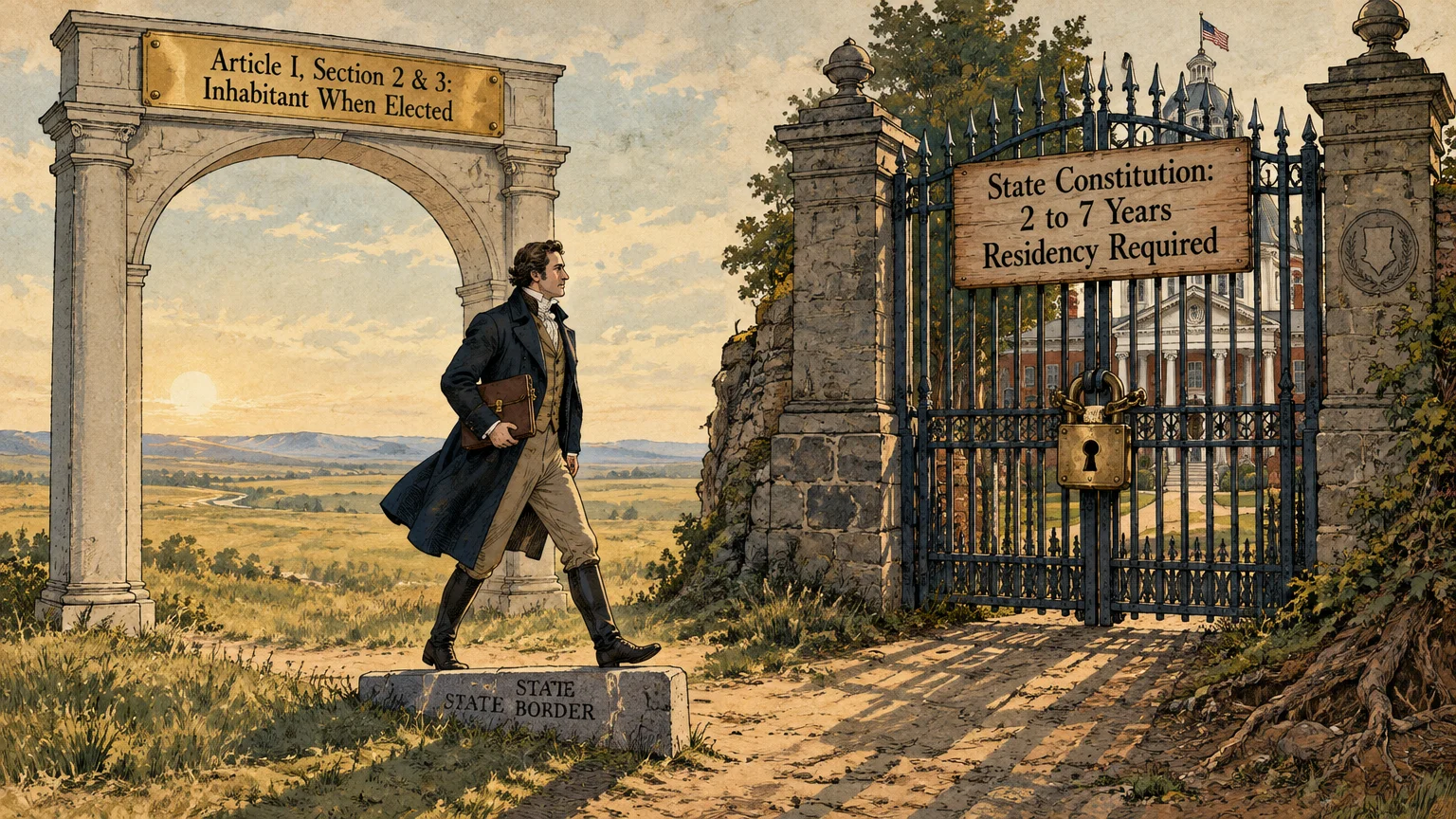
The U.S. Constitution sets minimal residency rules for Congress: Article I, Section 2 (House) and Article I, Section 3 (Senate) require only that a candidate be an inhabitant of the state when elected.
In U.S. Term Limits, Inc. v. Thornton (1995), the Supreme Court confirmed that states cannot add durational residency rules or term limits for federal candidates.
State constitutions, by contrast, impose multi-year residency requirements on gubernatorial candidates. Article V, Section 2 of the California Constitution requires five years of state residency before election, while the Massachusetts Constitution requires seven years.
These rules make it easier for a former governor to run for Congress in a new state than for a former representative to seek a new state’s governorship.
After the Seventeenth Amendment instituted direct popular Senate elections in 1913, only Mitt Romney has completed that transition.
Frequently Asked Questions About Multi-State Officeholders
Did James Shields serve as an elected state governor?
No, James Shields never served as an elected state governor. While he represented Illinois, Minnesota, and Missouri in the U.S. Senate, his only executive role was an appointment as Governor of the Oregon Territory from 1848 to 1849.
Can a candidate run for the U.S. Senate immediately after moving to a new state?
Yes, a candidate can constitutionally run for the Senate immediately after establishing residence. Article I, Section 3 of the U.S. Constitution requires candidates to be inhabitants of their state only at the time of election.
Has any politician ever been elected governor of more than two states?
No American politician has ever won election as governor of three different states. Sam Houston remains the only person in U.S. history to serve as governor of two separate states: Tennessee and Texas.
Why did early American politicians switch states so frequently?
Early politicians relocated frequently because western expansion created newly admitted states that needed experienced administrators. Former federal lawmakers migrated westward as territorial appointees and won the first gubernatorial elections upon statehood.