Between 1957 and 1968, congressional leaders overcame committee blockades and floor filibusters by deploying rare parliamentary rules. These procedural maneuvers turned civil rights bills into federal law.
Grassroots mobilization—starting with the 381-day Montgomery Bus Boycott after Rosa Parks’s arrest on December 1, 1955—built national pressure for reform. Inside the Capitol, lawmakers still had to navigate strict chamber rules to bring bills to a vote.
How Parliamentary Maneuvers Unlocked Four Generational Civil Rights Acts
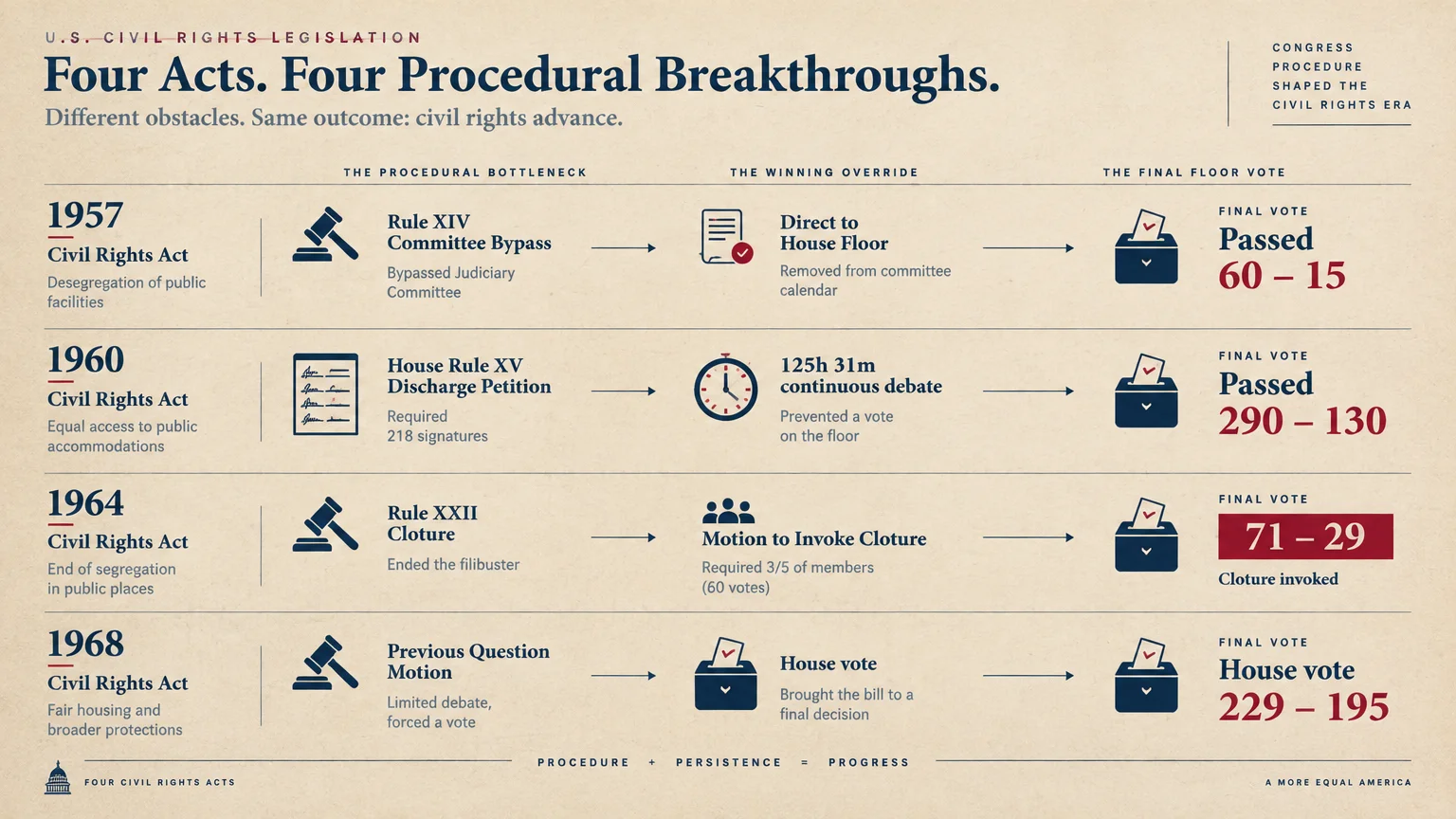
This list counts nine parliamentary procedures used to pass the Civil Rights Acts of 1957, 1960, 1964, and 1968, along with the Voting Rights Act of 1965. Southern committee chairmen routinely buried reform bills, forcing majority leaders to rely on statutory and procedural bypasses.
Entries were selected from the Congressional Record based on roll-call votes, committee discharge thresholds, and floor rulings that directly advanced each statute.
| Year | Legislation | Parliamentary Maneuver | Key Rule or Vote | Outcome |
|---|---|---|---|---|
| 1957 | Civil Rights Act of 1957 | Rule XIV Committee Bypass | Direct calendar referral | Bypassed Judiciary Committee |
| 1957 | Civil Rights Act of 1957 | Solo Floor Filibuster | 24h 18m floor speech | Exhaustion; bill passed 60–15 |
| 1960 | Civil Rights Act of 1960 | House Discharge Petition | House Rule XV (218 signatures) | Forced Rules Committee release |
| 1960 | Civil Rights Act of 1960 | Continuous Senate Session | 125h 31m continuous debate | Compromise reached; bill signed |
| 1961 | House Rules Reform | Rules Committee Expansion | H.Res. 127 (passed 217–212) | Broke conservative 6–6 deadlock |
| 1964 | Civil Rights Act of 1964 | Senate Cloture Invocation | Rule XXII (71–29 vote) | Ended 60-day filibuster |
| 1964 | Civil Rights Act of 1964 | Title VII Floor Amendment | Teller vote (168–133) | Added “sex” to Title VII |
| 1965 | Voting Rights Act of 1965 | House 21-Day Rule | Speaker recognition authority | Overrode Rules Committee veto |
| 1968 | Civil Rights Act of 1968 | Previous Question Motion | House vote (229–195) | Avoided conference committee filibuster |
1. Bypassing the Senate Judiciary Committee Through Rule XIV
Senator James Eastland, a Mississippi Democrat, chaired the Senate Judiciary Committee and routinely blocked civil rights legislation. Eastland routed bills to hostile subcommittees or refused to schedule hearings, leaving advocates with no path through standard committee review.
Senate leaders countered this obstruction by invoking Senate Rule XIV. Under this rule, any senator can object to a House-passed bill’s second reading upon arrival, placing the measure directly onto the Senate legislative calendar rather than sending it to committee.
Senate leadership used Rule XIV to bypass Eastland during debates on the 1957 and 1960 Civil Rights Acts. On February 26, 1964, Majority Leader Mike Mansfield again invoked Rule XIV on H.R.
7152, placing the House-passed civil rights bill directly onto the Senate calendar over Southern protests.
2. Strom Thurmond’s 24-Hour Filibuster Against the 1957 Act
When the Civil Rights Act of 1957 reached the Senate floor, it marked the first federal civil rights legislation to advance since 1875. South Carolina Senator Strom Thurmond mounted a solo filibuster on August 28, 1957, to block final passage.
Thurmond spoke continuously for 24 hours and 18 minutes, reading state election laws, historical treatises, and Supreme Court rulings. Other Southern senators declined to join his blockade, and Thurmond yielded the floor on August 29, 1957.
The Senate passed the conference report 60 to 15, and President Dwight D. Eisenhower signed the bill into law on September 9, 1957, creating the Justice Department’s Civil Rights Division.
Thurmond still holds the record for the longest solo filibuster against a bill, though Senator Cory Booker set the overall Senate floor speech record of 25 hours and 5 minutes on March 31–April 1, 2025.
3. Using House Discharge Petitions to Break Committee Bottlenecks
Representative Howard “Judge” Smith, a Virginia Democrat who chaired the House Rules Committee, opposed civil rights measures and refused to grant rules allowing bills to reach the floor. He frequently retreated to his Virginia dairy farm to prevent the committee from convening.
House Judiciary Chairman Emanuel Celler, a New York Democrat, countered using House Rule XV, which allows members to file a discharge petition to pull a stalled bill from committee. Forcing a bill to the floor required signatures from an absolute majority of 218 House members.
Celler filed discharge petitions on the Civil Rights Acts of 1957, 1960, and 1964, building bipartisan coalitions of Northern Democrats and moderate Republicans.
As documented by the Office of the Historian of the U.S. House, Smith surrendered and granted floor rules each time signature tallies neared 218 to preserve his formal committee authority.
4. Lyndon Johnson’s 125-Hour Round-the-Clock Quorum Marathon
During Senate consideration of the Civil Rights Act of 1960, 18 Southern Democrats divided into organized shifts to hold the floor continuously. Majority Leader Lyndon B.
Johnson ordered the Senate into round-the-clock sessions to exhaust the filibustering coalition.
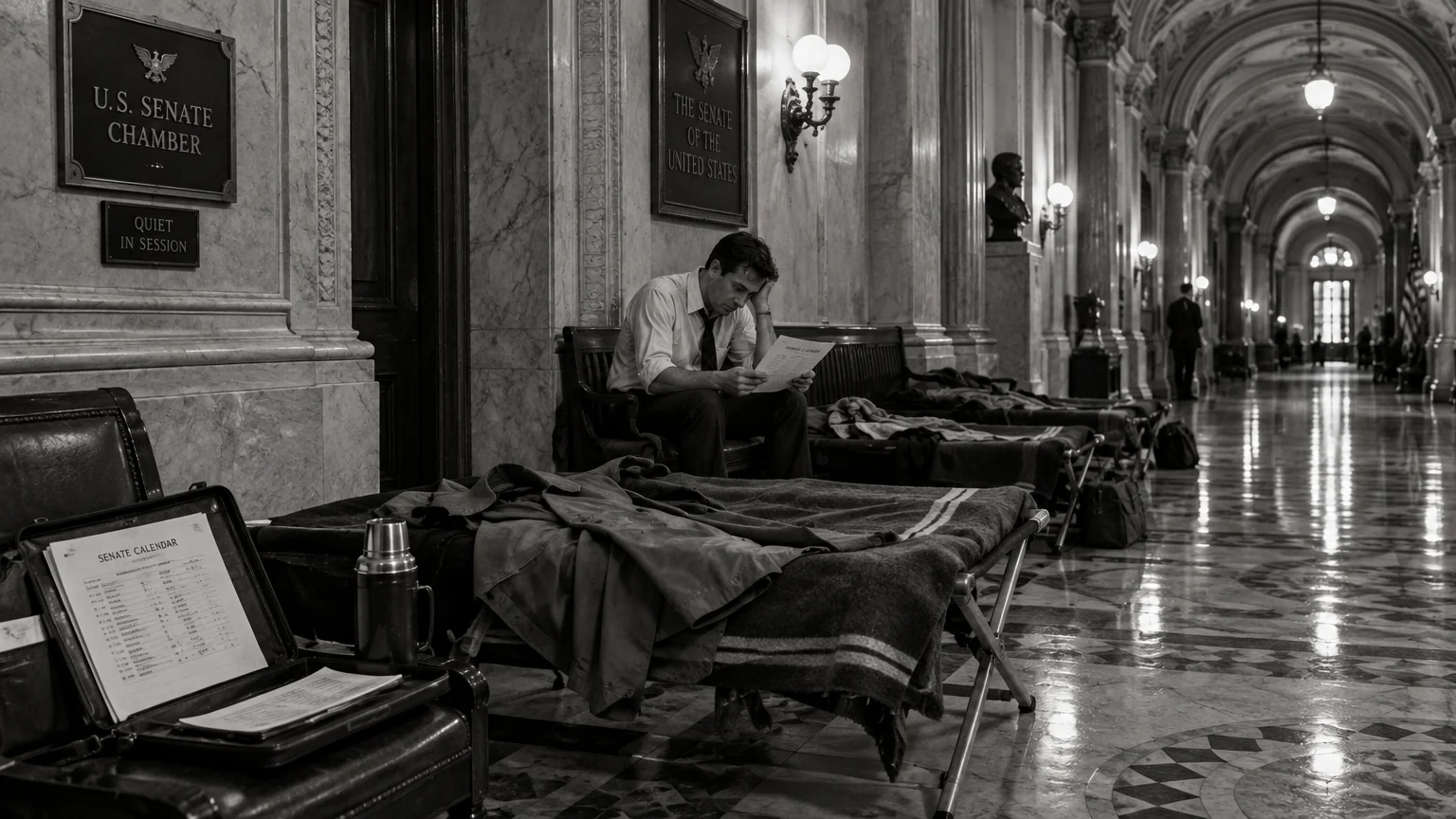
The Architect of the Capitol placed military cots in corridors so majority senators could answer surprise quorum calls; failing to produce 51 senators would force an adjournment.
The session ran continuously for 125 hours and 31 minutes from February 29 to March 8, 1960, pausing only for Sunday church services.
Because rotating Southern teams met their quorum targets while resting off-floor, the marathon did not break the blockade, prompting Johnson to negotiate compromise language.
President Eisenhower signed the Civil Rights Act of 1960 on May 6, 1960, establishing federal penalties for obstructing voter registration and mandating voting record retention.
5. Expanding the House Rules Committee to Break Conservative Control
By 1961, Chairman Howard Smith and another Southern Democrat routinely joined the four Rules Committee Republicans to create a 6–6 deadlock. This tie blocked civil rights legislation and President John F.
Kennedy’s domestic agenda from reaching the House floor.
At the start of the 87th Congress, Speaker Sam Rayburn introduced House Resolution 127 to expand the Rules Committee from 12 to 15 members. Adding two pro-administration Democrats and one Republican would create an 8–7 pro-leadership majority.
On January 31, 1961, the House passed H.Res. 127 by a vote of 217 to 212 after Rayburn won over moderate Southern Democrats and progressive Republicans.
That three-seat expansion enabled the committee to clear the Civil Rights Act of 1964 for floor consideration three years later.
6. Breaking the 60-Day Senate Filibuster with Rule XXII Cloture
In the spring of 1963, the Birmingham Campaign—led by Martin Luther King Jr. and the Southern Christian Leadership Conference—challenged municipal segregation through boycotts and marches, drawing national outrage when police used dogs and high-pressure water hoses on peaceful demonstrators.
President Kennedy introduced comprehensive civil rights legislation that June, and the House passed H.R. 7152 by a 290 to 130 vote on February 10, 1964.
When the bill reached the Senate, Southern opponents launched a 60-working-day filibuster spanning seven consecutive Saturdays. Ending debate under Senate Rule XXII required a two-thirds majority of senators present and voting—67 votes if all 100 senators attended.
Majority Whip Hubert Humphrey and Republican Leader Everett Dirksen negotiated amendments that secured crucial Midwestern Republican backing.
On June 10, 1964, the Senate voted 71 to 29 to invoke cloture on a civil rights bill for the first time in history, with gravely ill Senator Clair Engle of California pointing to his eye to cast an “aye” vote.
President Johnson signed the Civil Rights Act of 1964 into law on July 2, 1964, banning segregation in public accommodations and outlawing employment discrimination.
7. Adding Sex Discrimination to Title VII of the Civil Rights Act
During House floor debate on H.R. 7152 on February 8, 1964, Rules Chairman Howard Smith offered an amendment to add “sex” to Title VII’s employment non-discrimination protections.
Although Smith opposed the broader civil rights bill, he had backed the Equal Rights Amendment since 1943 as an ally of Alice Paul and the National Woman’s Party.
Representative Martha Griffiths, a Michigan Democrat, organized a bipartisan coalition of female lawmakers to defend the amendment on the floor.
As documented in the Library of Congress Civil Rights Exhibit, Griffiths framed the vote as essential to preventing white women from losing job protections relative to other groups.
The House adopted the amendment by a teller vote of 168 to 133, and the Senate kept the provision in the final statute. Title VII established the Equal Employment Opportunity Commission and prohibited workplace discrimination based on race, color, religion, sex, or national origin.
8. Deploying the House 21-Day Rule for the Voting Rights Act
At the start of the 89th Congress in January 1965, the House adopted the 21-day rule, allowing the Speaker to recognize a committee chair to call up any bill held by the Rules Committee for 21 calendar days.
The rule stripped Chairman Howard Smith of his ability to pocket-veto the Voting Rights Act of 1965.
In the Senate, leaders blocked Judiciary Chairman James Eastland from burying the bill by passing a March 18, 1965 motion instructing his committee to report the measure by April 9, 1965. The committee reported the bill without recommendation on the deadline.
On May 25, 1965, the Senate broke a Southern filibuster by invoking cloture on a 70 to 30 vote.
President Johnson signed the Voting Rights Act into law on August 6, 1965, prohibiting literacy tests and authorizing federal examiners in jurisdictions with histories of voter suppression.
9. Concurring Directly in Senate Amendments on the Fair Housing Act
Between 1965 and 1967, the Chicago Freedom Movement—led by Martin Luther King Jr. and the Coordinating Council of Community Organizations—campaigned against northern housing segregation, culminating in an August 5, 1966 open-housing march near Marquette Park where hostile crowds struck King with a rock.
When federal fair housing legislation reached the Senate in 1968, it required four cloture votes before passing 71 to 20 on March 11, 1968.
After King was assassinated in Memphis on April 4, 1968—weeks before his multiracial Poor People’s Campaign erected the Resurrection City encampment on the National Mall in May 1968—House leaders moved to enact the Senate bill immediately.
Amending the bill or requesting a conference committee would have exposed the conference report to a renewed Senate filibuster.
To avoid a conference, House leaders brought up House Resolution 1100 to concur directly in the Senate’s text. On April 10, 1968, the House voted 229 to 195 to move the previous question—cutting off debate and amendments—and approved the resolution 250 to 172.
President Johnson signed the Civil Rights Act of 1968 on April 11, 1968, enacting Title VIII’s ban on discrimination in the sale, rental, and financing of housing.
What These Procedural Battles Reveal About Modern Legislative Power
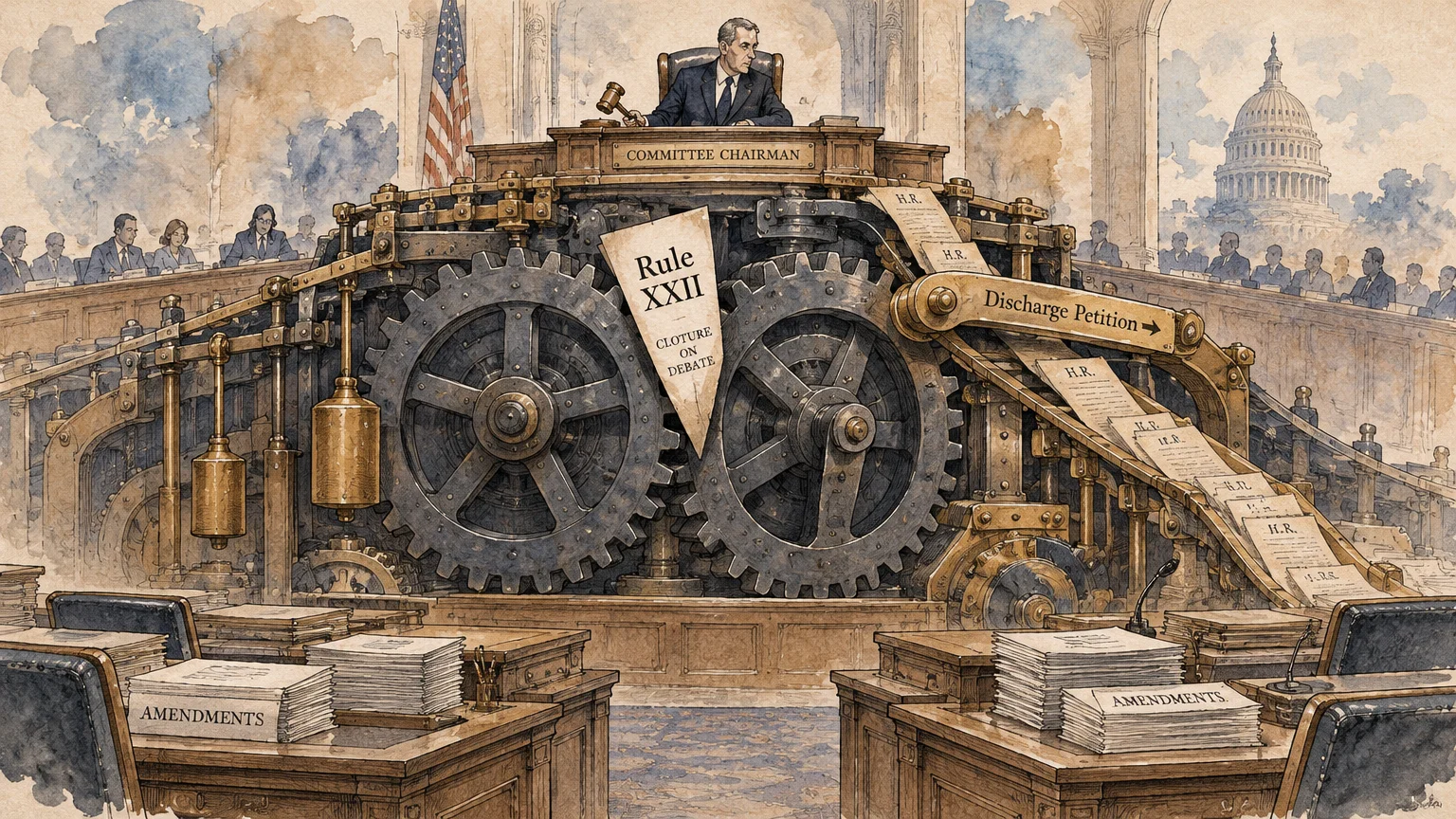
Passing civil rights legislation between 1957 and 1968 required bipartisan majorities to override committee vetoes and supermajority floor hurdles. The procedural battles reshaped internal rules in both chambers.
In the Senate, the 1964 and 1965 cloture votes proved that cross-party coalitions could overcome Southern filibusters. In 1975, the Senate amended Rule XXII to lower the cloture threshold from two-thirds of senators present and voting to three-fifths of the full Senate (60 votes).
In the House, the 1961 Rules Committee expansion and the 1965 21-day rule weakened the conservative coalition of Southern Democrats and Republicans.
Those changes laid the groundwork for the 1970s committee reforms that ended strict seniority rule and placed the Rules Committee under the Speaker’s direct appointment authority.
Frequently Asked Questions About Civil Rights Parliamentary Battles
Why did southern committee chairs hold so much unilateral power?
Southern Democrats accumulated decades of continuous tenure in non-competitive, one-party districts and states. Under strict seniority rules, longest-serving majority members automatically became committee chairs with unilateral authority over agendas, subcommittees, and hearings until the House reforms of the 1970s.
How did the 1964 cloture vote differ from modern filibuster rules?
In 1964, Senate Rule XXII required a two-thirds majority of senators present and voting (67 of 100) to invoke cloture, and opponents had to hold the floor continuously.
Since 1975, cloture on legislation has required three-fifths of all duly chosen and sworn senators (60 of 100), and multi-track scheduling allows virtual filibusters without marathon speeches.
Why did House leaders avoid a conference committee for the 1968 Act?
Conference reports are subject to debate and filibuster in the Senate.
Having needed four cloture attempts to pass the initial Senate bill, House leaders moved the previous question and concurred directly in the Senate amendments on April 10, 1968, sending the bill straight to President Johnson.
Can modern lawmakers still use discharge petitions to bypass committees?
Yes. Under House Rule XV, any member can file a discharge petition after a bill has sat in committee for 30 legislative days; if 218 members sign the petition at the Clerk’s desk, the measure is discharged for floor consideration.