Executive branch scandals do more than damage presidential reputations; they expose dangerous statutory gaps that leave federal power unchecked. When executive officers abuse their authority, Congress frequently responds by passing binding laws that reshape the constitutional balance of power.
From Gilded Age kickbacks to modern intelligence abuses, major political controversies have repeatedly forced lawmakers to create new oversight mechanisms. You can trace nearly every modern ethics standard, financial disclosure requirement, and subpoena authority directly to past executive failures.
This historical record shows how legislative action converted moments of institutional crisis into lasting statutory reforms. Understanding these milestones helps you evaluate how current federal integrity rules function when modern conflicts arise.
Statutory Reforms Sparked by Executive Scandals
This guide tracks institutional executive branch abuses between 1872 and the 1990s that compelled Congress to pass binding statutory remedies or cement judicial oversight.
The list excludes purely personal controversies, such as the 1802 dispute involving Thomas Jefferson and Sally Hemings—an enslaved woman of mixed race owned by Jefferson at Monticello—which produced partisan broadsides but zero statutory changes.
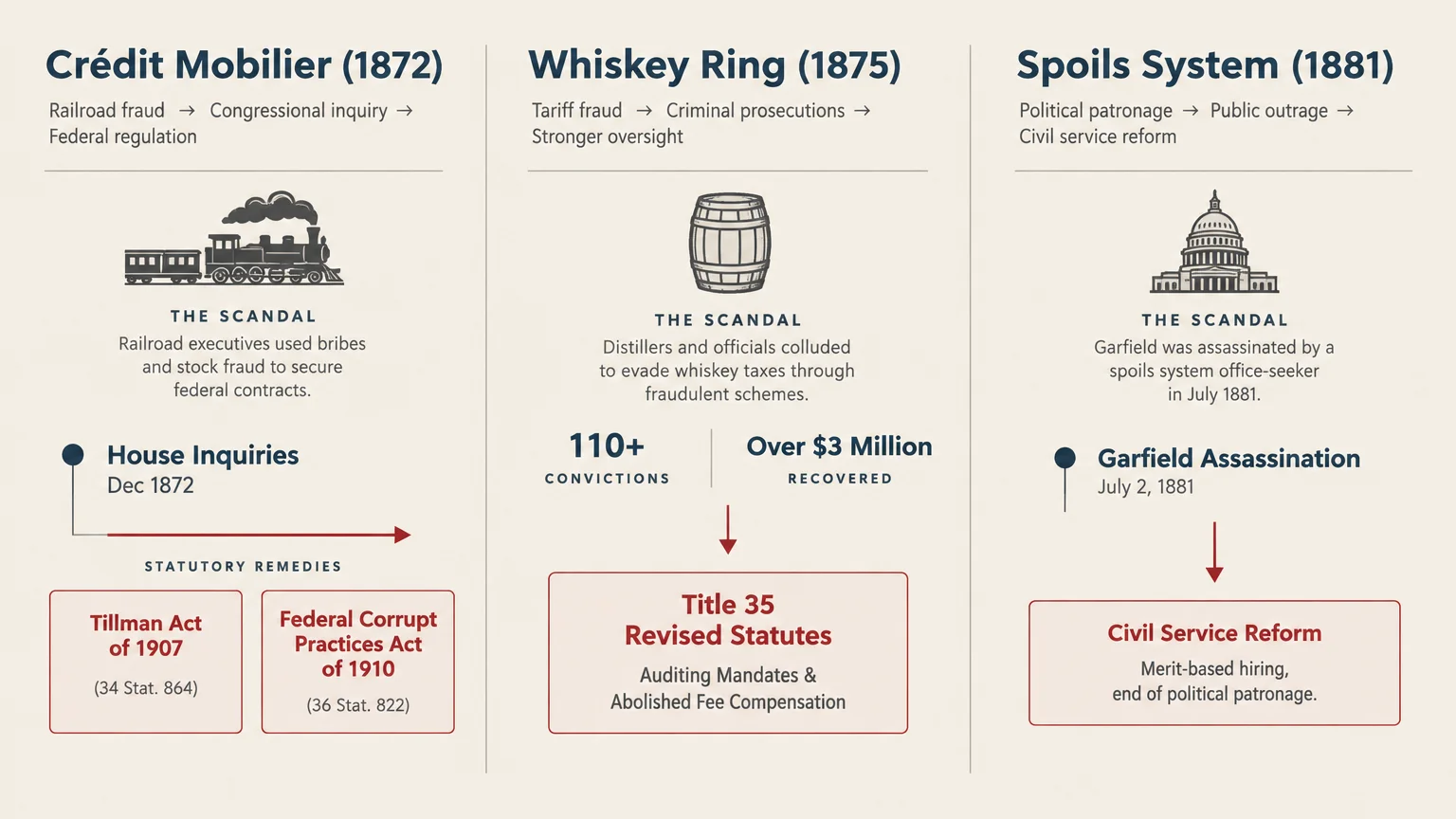
Crédit Mobilier of America
During the construction of the Union Pacific Railroad, company directors formed a sham construction firm named Crédit Mobilier to siphon federal subsidies. Representative Oakes Ames distributed discounted shares to fellow lawmakers and Vice President Schuyler Colfax to block congressional scrutiny.
The House launched formal inquiries in December 1872, resulting in the censure of Ames and Representative James Brooks on February 27, 1873. The investigation revealed that high-level executive officials had accepted corporate equities while overseeing federal railroad subsidies.
In response to corporate influence over federal elections, Congress enacted the Tillman Act of 1907 (34 Stat. 864) on January 26, 1907.
The statute established the first permanent federal ban on corporate contributions to federal political candidates.
Congress expanded this regulatory framework by passing the Federal Corrupt Practices Act of 1910 (36 Stat. 822) on June 25, 1910.
That law established the earliest mandatory post-election campaign disclosure filings for House candidates.
The Whiskey Ring Conspiracy
In May 1875, Treasury Secretary Benjamin Bristow uncovered a nationwide conspiracy among whiskey distillers, revenue agents, and executive officials. The syndicate defrauded the federal government of millions in liquor excise taxes through falsified production ledgers and kickbacks.
Federal prosecutors indicted President Ulysses S. Grant’s private secretary, General Orville E.
Babcock, for complicity in the scheme. President Grant gave a White House deposition in Babcock’s defense, and the jury acquitted Babcock in February 1876.
Despite Babcock’s acquittal, the Justice Department secured more than 110 convictions and recovered over $3 million in unpaid taxes. The scandal demonstrated that executive patronage had compromised federal revenue administration.
Congress overhauled internal revenue administration by codifying stricter auditing mandates under Title 35 of the Revised Statutes. The legislation eliminated the fee-based compensation system that had incentivized corrupt revenue agents.
The Spoils System and the Garfield Assassination
On July 2, 1881, disgruntled office-seeker Charles Guiteau shot President James A. Garfield at a Washington railway depot.
Garfield died on September 19, 1881, sparking public condemnation of the federal patronage system.
Under the prevailing spoils system, incoming administrations routinely fired career administrators to reward partisan loyalists. This patronage model encouraged administrative incompetence and institutional corruption across executive departments.
Congress passed the Pendleton Civil Service Reform Act (22 Stat. 403), which President Chester A.
Arthur signed on January 16, 1883. The Senate approved the measure by a 38–5 vote, and the House followed 155–47.
The statute established the bipartisan, three-member United States Civil Service Commission and mandated competitive merit examinations for federal positions. It also made firing protected federal employees for political reasons illegal under federal law.
The Teapot Dome Scandal
Between 1921 and 1922, Interior Secretary Albert B. Fall leased naval petroleum reserves at Teapot Dome, Wyoming, to private oil companies without competitive bidding.
In return, oil executives provided Fall with roughly $400,000 in bribes and no-interest loans.
A Senate investigation directed by Senator Thomas J. Walsh uncovered the corrupt leases. Fall became the first Cabinet secretary convicted of a felony and imprisoned for misconduct committed while in office.
To ensure congressional oversight of executive finances, Congress passed the Revenue Act of 1924 (43 Stat. 253) on June 2, 1924.
Section 6103(f) of the Internal Revenue Code gave congressional committees statutory authority to subpoena executive branch tax returns.
Congress also passed the Federal Corrupt Practices Act of 1925 (43 Stat. 1070) on February 28, 1925, to mandate campaign contribution disclosures.
In McGrain v. Daugherty (1927), the Supreme Court cemented Congress’s constitutional authority to subpoena executive branch documents.
The Secret Bombing of Cambodia
In 1969, President Richard Nixon initiated Operation Menu, a secret carpet-bombing campaign targeting North Vietnamese forces inside neutral Cambodia. Military officials concealed the operations from Congress for over a year using falsified flight logs and covert reporting channels.
Congressional frustration deepened after Daniel Ellsberg leaked the Pentagon Papers in June 1971. The leaked records revealed decades of executive branch deception regarding military escalation throughout Southeast Asia.
Congress responded by passing the War Powers Resolution (Public Law 93-148), overriding President Nixon’s veto on November 7, 1973. The House voted 284–135, and the Senate voted 75–18 to enact the law.
The statute requires the president to notify Congress within 48 hours of deploying troops into hostilities. It forces military withdrawal after 60 days unless Congress declares war or grants an explicit Authorization for Use of Military Force.
The statute remains a critical point of friction; in October 2026, a Senate war powers resolution restricting military hostilities with Iran narrowly failed in a 49–50 vote.
The Watergate Scandal
On June 17, 1972, authorities apprehended five operatives burglarizing the Democratic National Committee headquarters inside Washington’s Watergate complex. President Richard Nixon and senior aides orchestrated an extensive cover-up involving hush money, CIA obstruction of FBI inquiries, and political espionage.
The confrontation escalated during the October 20, 1973 “Saturday Night Massacre,” when Nixon dismissed Special Prosecutor Archibald Cox. In United States v. Nixon (1974), the Supreme Court ruled unanimously that executive privilege cannot withhold subpoenaed evidence in criminal proceedings.
Congress passed the Ethics in Government Act of 1978 (Public Law 95-521) on October 26, 1978. The statute established the Office of Government Ethics and mandated annual public financial disclosures for top executive branch officials.
Congress also enacted the Inspector General Act of 1978 (Public Law 95-452) to establish independent agency watchdogs. That statute was reinforced in December 2022 to require 30 days’ advance notice before an Inspector General can be removed.
Lawmakers finalized the post-Watergate framework through the Presidential Records Act of 1978 (44 U.S.C. §§ 2201–2209). Effective January 20, 1981, the law transferred legal ownership of all presidential records from the president to the American public.
COINTELPRO and Intelligence Agency Surveillance
In 1975, the Senate established the Select Committee to Study Governmental Operations with Respect to Intelligence Activities, chaired by Senator Frank Church. The committee investigated decades of warrantless domestic wiretapping, mail openings, and assassination plots by federal agencies.
The inquiry exposed the FBI’s COINTELPRO initiative, which targeted civil rights organizations, anti-war activists, and journalists without judicial authorization. The Church Committee Final Report in April 1976 revealed that domestic surveillance had operated without statutory boundaries.
Congress enacted the Foreign Intelligence Surveillance Act of 1978 (Public Law 95-511), which President Jimmy Carter signed on October 25, 1978. The statute created the Foreign Intelligence Surveillance Court to review electronic surveillance warrants targeting foreign powers and their agents.
The law established that executive branch wiretapping within the United States requires prior judicial authorization. While Congress amended the law repeatedly after 2001, core provisions remain contentious, and Section 702 authority officially lapsed after June 12, 2026.
The Iran-Contra Affair
Between 1985 and 1986, senior National Security Council officials arranged secret arms sales to the Iranian government in exchange for American hostages. Executive officials funneled the weapons profits to Contra paramilitaries fighting the Sandinista government in Nicaragua.
These covert financial transfers violated the Boland Amendments (1982–1984). Congress passed the Boland Amendments specifically restricting U.S. intelligence and military funding for the Contra rebels in Nicaragua.
A joint congressional committee conducted exhaustive hearings in 1987, discovering that executive officials had maintained an off-the-books network to evade statutory spending bans. Lieutenant Colonel Oliver North and National Security Advisor John Poindexter shredded key documents before investigators secured them.
Congress responded by passing the Intelligence Authorization Act for Fiscal Year 1991 (Public Law 102-88) on August 14, 1991. The law requires written presidential covert action findings, bans retroactive authorizations, and prohibits using third-party funds to bypass appropriations.
Whitewater and the Independent Counsel Controversies
In 1994, Independent Counsel Kenneth Starr initiated an investigation into Bill and Hillary Clinton’s investments in the Whitewater Development Corporation. The inquiry expanded to examine the White House travel office and presidential depositions, leading to President Clinton’s 1998 impeachment.
The five-year, multi-million-dollar investigation sparked intense criticism from both parties. Lawmakers argued that the Ethics in Government Act created unaccountable independent prosecutors with unlimited budgets, unchecked jurisdiction, and no executive branch supervision.
Refusing to preserve the flawed structure, Congress allowed the Independent Counsel reauthorization (Public Law 103-270) to sunset permanently on June 30, 1999. The decision marked the end of the post-Watergate independent counsel experiment.
The Department of Justice replaced the expired statute by promulgating internal Special Counsel regulations (28 C.F.R. Part 600) on July 1, 1999.
These regulations preserved investigatory latitude while restoring supervisory authority to the Attorney General.
| Scandal | Executive Office | Statute or Case | Year | Statutory Remedy |
|---|---|---|---|---|
| Crédit Mobilier | Congress & Vice President | Tillman Act | 1907 | Banned corporate campaign donations |
| Whiskey Ring | Treasury & White House | Rev. Stat. Tit. 35 | 1876 | Overhauled internal revenue auditing |
| Spoils System | Executive Agencies | Pendleton Act | 1883 | Created competitive merit exams |
| Teapot Dome | Interior Department | Revenue Act of 1924 | 1924 | Authorized tax return subpoenas |
| Cambodia Bombing | White House & DoD | War Powers Resolution | 1973 | Imposed 60-day limit on hostilities |
| Watergate | President & Justice Dept. | Ethics in Gov. Act | 1978 | Mandated public financial disclosures |
| COINTELPRO | FBI, CIA & NSA | FISA | 1978 | Required judicial surveillance warrants |
| Iran-Contra | National Security Council | FY1991 Intel. Act | 1991 | Banned retroactive covert findings |
| Whitewater | Independent Counsel | 28 C.F.R. Part 600 | 1999 | Sunset independent counsel statute |
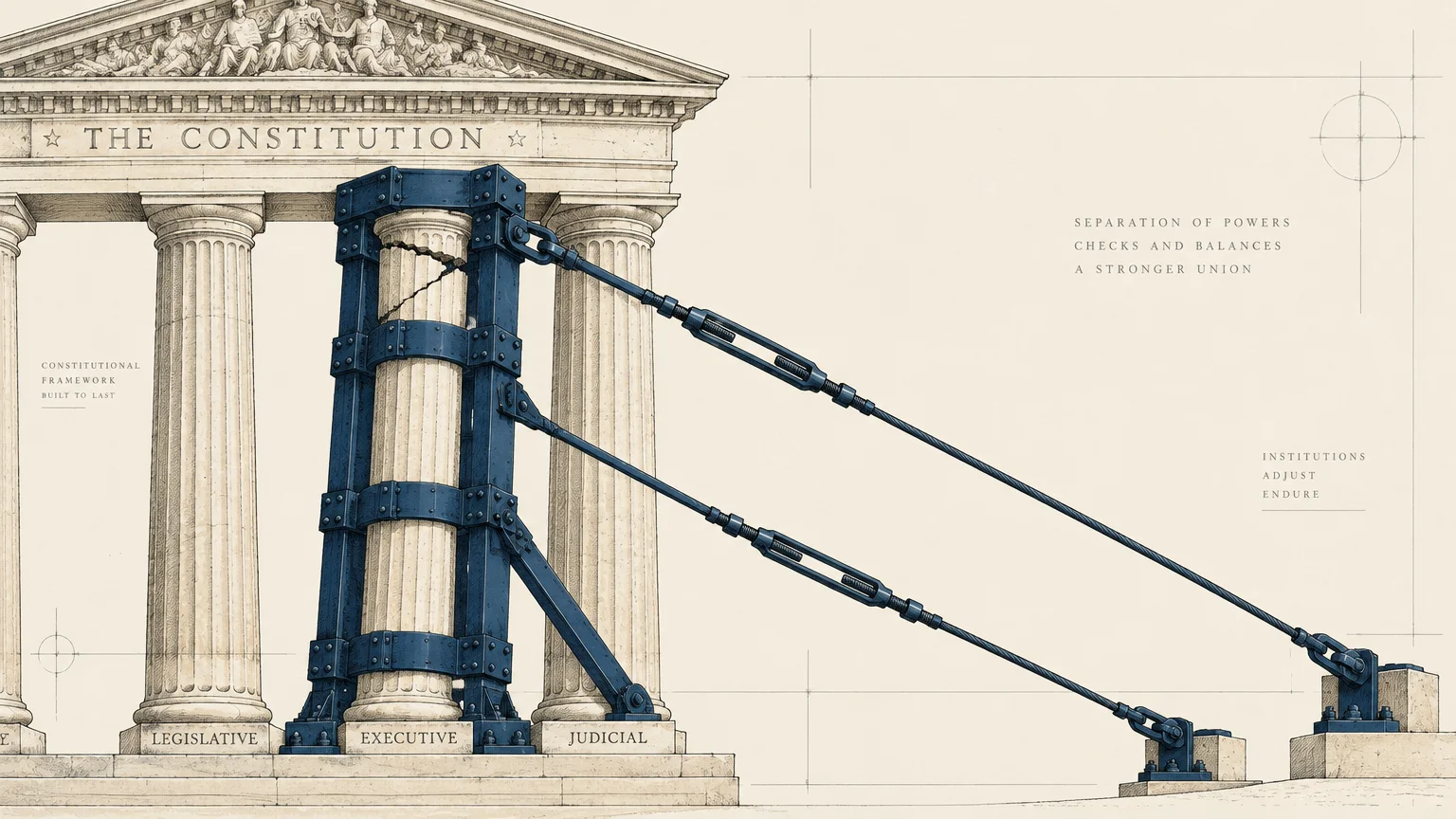
How Executive Scandals Reshape Constitutional Checks and Balances
A consistent pattern defines two centuries of American executive branch controversies. Congress rarely enacts comprehensive integrity legislation during periods of perceived administrative stability.
Instead, statutory reform requires an egregious breach that collapses partisan defenses. Lawmakers then channel public outrage into binding legislative limits that permanently constrain executive discretion.
These statutory frameworks establish three standard mechanisms: mandatory financial disclosures, independent administrative inspectors, and enforceable judicial subpoena authority.
The historical record proves that constitutional checks and balances require active legislative maintenance. When executive power expands unchecked, Congress restores equilibrium by writing enforceable limits into federal law.
Frequently Asked Questions About Executive Branch Oversight
Why did Congress allow the Independent Counsel Act to sunset in 1999?
Congress permitted the Independent Counsel statute to expire on June 30, 1999, because lawmakers concluded it created unaccountable prosecutors with unlimited budgets and indefinite mandates.
The Department of Justice replaced it with internal Special Counsel regulations (28 C.F.R. Part 600), which preserve day-to-day investigatory independence while keeping supervisory authority within the executive branch.
Why are personal controversies like the Jefferson-Hemings dispute excluded from statutory reform?
Personal controversies involve private conduct rather than systemic corruption or abuses of federal administrative authority.
When writer James Callender published allegations in 1802 regarding Thomas Jefferson and Sally Hemings—an enslaved woman of mixed race owned by Jefferson at Monticello—the dispute produced political attacks rather than legislation.
Congress uses its legislative authority to remedy structural administrative breaches, stepping in only when executive officials bypass appropriations, weaponize agencies, or refuse legal oversight.
Can a president use executive privilege to block a criminal subpoena?
No. In United States v. Nixon (1974), the Supreme Court ruled that executive privilege does not grant absolute immunity from judicial demands for evidence in criminal trials.
The court held that generalized claims of confidentiality must yield when prosecutors demonstrate a specific need for evidence in an ongoing criminal proceeding.
What statutory authority allows congressional committees to inspect tax returns?
Congress passed Section 6103(f) of the Internal Revenue Code under the Revenue Act of 1924 following the Teapot Dome investigation.
The statute directs the Treasury Secretary to provide requested tax returns upon written application from the House Ways and Means Committee or Senate Finance Committee.