You can trace the structural evolution of the American party system directly through the legislative roll calls and national conventions of the Republican Party. Since its anti-slavery inception in 1854, the coalition has repeatedly reshaped federal law and constitutional governance.
Understanding these institutional milestones equips you to evaluate modern party platforms, congressional voting alignments, and presidential mandates using checkable public records rather than partisan commentary. Documented history clarifies how regional coalitions transformed across seventeen decades.
This reality check examines nine verified turning points that defined the party’s national trajectory from the antebellum frontier to the 119th Congress. Each milestone highlights primary election tallies, statutory enactments, and recorded legislative debates.
Criteria and Scope for Documenting Party Milestones
To evaluate party history objectively, you must ground your analysis in verified roll calls, statutory texts, and certified election results. Our editorial team selected these nine milestones based on measurable shifts in federal law and governance.
This review spans from the party’s anti-slavery founding in 1854 through the seated 119th Congress in 2026. The selection excludes short-term polling variations to focus on turning points that permanently altered party doctrine or congressional power.
You can audit every statutory citation, vote tally, and platform plank using federal repositories such as Congress.gov and the National Archives. These primary records eliminate partisan revisionism by detailing exact roll calls and statutory language.
By examining these primary records, you gain a practical framework for evaluating current congressional debates and party platforms. The comparative table below summarizes each milestone chronologically before the detailed analysis.
| Milestone | Year | Key Figures | Core Institutional Result |
|---|---|---|---|
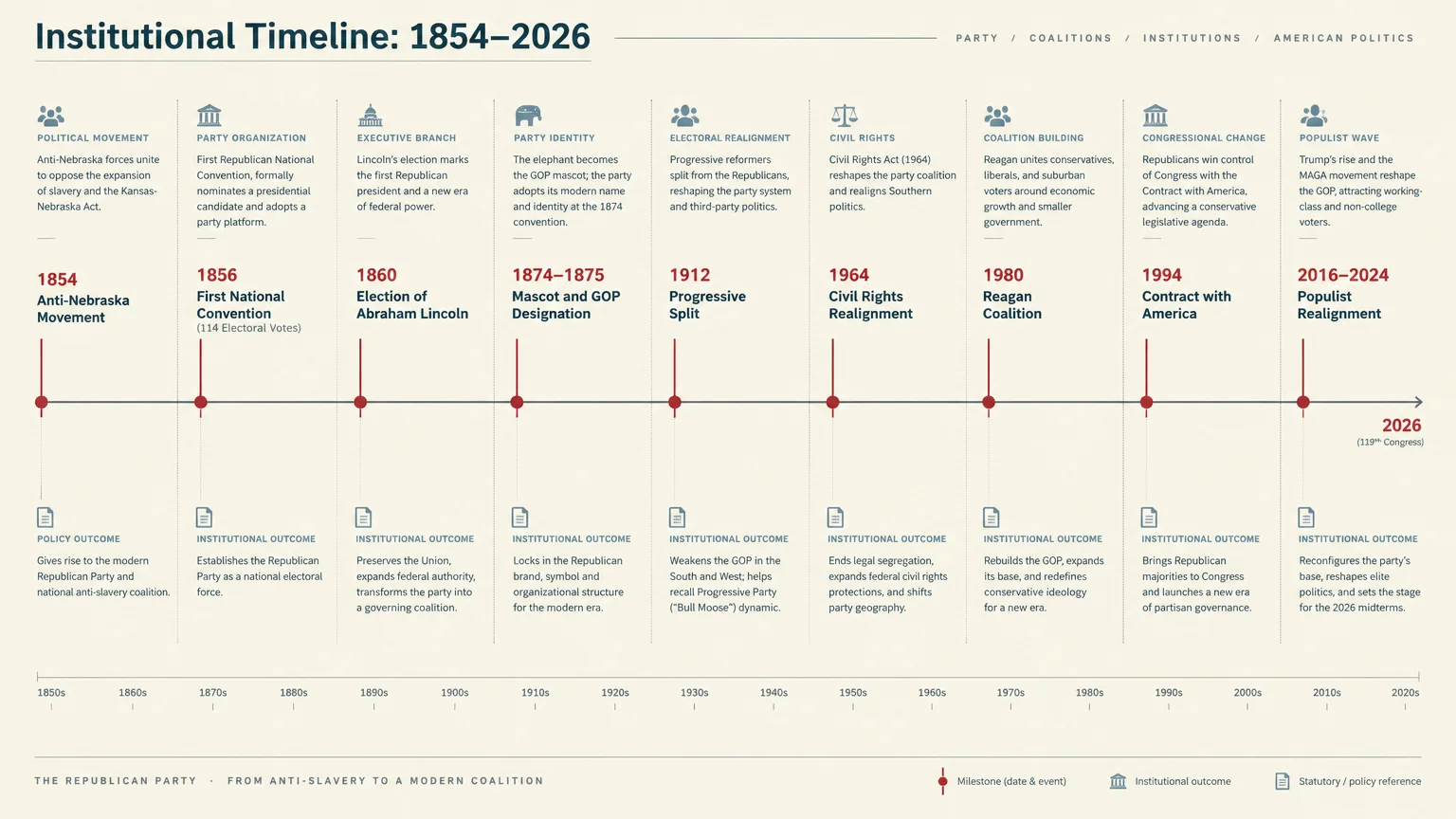
| Anti-Nebraska Movement | 1854 | Alvan Bovay, Whig and Free Soil leaders | Party founded to block slavery expansion into federal territories |
| First National Convention | 1856 | John C. Frémont, William L. Dayton | Adopted first national platform; secured 114 electoral votes |
| Election of Abraham Lincoln | 1860 | Abraham Lincoln, Hannibal Hamlin | Began 72-year period winning 14 of 19 presidential elections |
| Codification of Mascot and Nickname | 1874–1875 | Thomas Nast, Union veterans | Solidified the elephant symbol and Grand Old Party designation |
| The Progressive Split | 1912 | William Howard Taft, Theodore Roosevelt | Fractured party factions, yielding worst incumbent loss in history |
| Civil Rights Act Realignment | 1964 | Everett Dirksen, Barry Goldwater | High congressional party support preceded a Deep South shift |
| Reagan Conservative Realignment | 1980 | Ronald Reagan, Howard Baker | Won Senate majority; codified supply-side tax reform |
| Contract with America | 1994 | Newt Gingrich, Dick Armey | Ended 40 years of continuous Democratic House majorities |
| Modern Populist Realignment | 2016–2024 | Donald Trump, JD Vance | Realigned trade and working-class bases; won non-consecutive terms |
The Anti-Nebraska Movement and the 1854 Coalition
The Republican Party emerged directly from regional outrage over the Kansas-Nebraska Act, signed into law on May 30, 1854. The statute repealed the Missouri Compromise line of 1820, opening northern territories to the potential expansion of slavery.
The measure passed the Senate by a vote of 37 to 14 and the House by 113 to 100. You can review the legislative debates surrounding the bill through the U.S. Senate Historical Office records.
Grassroots activists mobilized across the Upper Midwest before Congress even cast its final votes. On March 20, 1854, fifty-four citizens gathered in a Little White Schoolhouse in Ripon, Wisconsin, under the leadership of Alvan Bovay.
The participants formally recommended creating a new national party named the Republican Party. Bovay chose the title to honor Thomas Jefferson’s historic coalition while underscoring civic virtue and resistance to federal slave power.
The legislative controversy shattered the established Whig Party, leaving northern anti-slavery lawmakers without a national vehicle. Southern and Northern Whigs split permanently over the territorial expansion votes, creating an institutional vacuum.
Three months later, Michigan organizers held the first formal statewide convention. On July 6, 1854, up to ten thousand people assembled Under the Oaks in Jackson, Michigan, to ratify an anti-slavery platform.
The Jackson gathering nominated a full ticket of state candidates, creating a functioning political apparatus. The convention fused anti-slavery Whigs, Free Soilers, and independent Northern Democrats into a single operational unit.
During the autumn 1854 midterm elections, this fledgling anti-Nebraska coalition captured forty-four seats in the 34th Congress. This rapid breakthrough demonstrated that a sectional party could swiftly displace established national organizations.
The 1856 Philadelphia Convention and National Platform
Two years after its Midwestern founding, the party assembled its first national nominating convention in Philadelphia. Delegates gathered at Musical Fund Hall from June 17 to June 19, 1856, to build a nationwide campaign structure.
The convention chose explorer and military officer John C. Frémont of California as its first presidential nominee.
Delegates selected former New Jersey senator William L. Dayton as his vice-presidential running mate.
Delegates adopted an uncompromising platform asserting federal territorial authority over slavery. You can inspect the primary document through the American Presidency Project archive.
The platform declared that Congress held constitutional power to prohibit in the territories those twin relics of barbarism—polygamy and slavery. This explicit plank differentiated the coalition sharply from both the Democrats and the American Party.
Activists mobilized voters using the famous slogan: “Free Soil, Free Labor, Free Speech, Free Men, Frémont.” The campaign framed territorial restriction as an economic protection for independent northern farmers and wage laborers.
The 1856 platform also endorsed federal infrastructure investments, including congressional appropriations for a transcontinental railroad. It advocated river and harbor improvements to foster national commercial integration.
Democrat James Buchanan won the presidency, but Frémont secured 33.1 percent of the popular vote and 114 electoral votes. Frémont carried eleven of sixteen Northern states while receiving virtually no ballots across the South.
This inaugural presidential performance proved that the new party had fully displaced the Whig Party as the main opposition. It also showed you that a united North possessed sufficient electoral votes to contest the White House.
The Presidential Election of 1860 and Union Governance
On November 6, 1860, Abraham Lincoln won the presidency in a fragmented four-candidate race. Lincoln captured 180 electoral votes and 39.8 percent of the popular vote to secure the executive office.
Lincoln defeated Northern Democrat Stephen Douglas, Southern Democrat John C. Breckinridge, and Constitutional Union candidate John Bell.
Underscoring extreme sectional division, Lincoln did not appear on ballots in ten Southern slave states.
You can review Lincoln’s personal campaign correspondence and certified ballot tallies through the Library of Congress Abraham Lincoln Papers. His election triggered secession ordinances across the Deep South before his March 1861 inauguration.
The delegates had nominated Lincoln on the third ballot at the Wigwam convention in Chicago on May 18, 1860. Party leaders favored his moderate tone on slavery over the perceived radicalism of New York’s William H.
Seward.
Lincoln’s victory initiated an unprecedented seventy-two-year period of national executive dominance. Between 1860 and 1932, Republican nominees won fourteen of nineteen presidential elections.
Beyond prosecuting the Civil War to preserve the Union, wartime Republican majorities enacted sweeping developmental statutes. Unopposed by absent Southern members, Congress passed the Homestead Act of 1862 and the Morrill Land-Grant Act.
The party also drafted and passed the Reconstruction amendments to the Constitution. These 13th, 14th, and 15th Amendments abolished slavery, guaranteed equal protection, and prohibited racial discrimination in voting.
The Elephant Mascot and the Grand Old Party Label
Following the Civil War, the party established cultural emblems and rhetorical monikers that remain central to American politics. Renowned cartoonist Thomas Nast popularized the elephant as the party’s official mascot in Harper’s Weekly.
Published on November 7, 1874, Nast’s cartoon titled “Third Term Panic” depicted an elephant labeled “The Republican Vote” stumbling toward a pit. The illustration mocked claims that President Ulysses S.
Grant planned to establish a military dictatorship.
You can examine Nast’s original satirical wood engraving directly through the Library of Congress Prints and Photographs Division. Nast used the elephant repeatedly in subsequent cartoons to convey size, power, and periodic political clumsiness.
At the same time, the party’s famous abbreviation underwent an important semantic shift. During the early 1870s, political speeches and newspaper accounts consistently used the acronym “GOP” to mean “Gallant Old Party.”
That phrase honored Union military veterans who formed the core of the party’s electoral base. By 1875 and 1876, newspaper editors and campaign orators gradually modified the phrase to “Grand Old Party.”
The revised wording shifted the party’s brand from a wartime coalition to an established governing institution. The updated phrasing emphasized economic stewardship, national unity, and the preservation of constitutional amendments.
By the 1888 presidential campaign, the abbreviation GOP had become universally recognized shorthand in print media. The combination of the elephant mascot and the Grand Old Party moniker gave the organization an unmistakable visual identity.
The Progressive Split of 1912
The Republican National Convention of June 1912 in Chicago triggered an ideological rift that transformed the party’s internal balance. The conflict pitted conservative constitutionalists against insurgent progressive reformers.
Former President Theodore Roosevelt challenged his handpicked successor, incumbent President William Howard Taft, for the presidential nomination. Roosevelt won nine of twelve state primary elections, including Taft’s home state of Ohio.
Despite these primary victories, Taft controlled the party’s national machinery and credentials committee. The committee awarded 235 of the 254 contested delegates to Taft, ensuring his first-ballot renomination.
In response, Roosevelt led hundreds of delegates out of the convention hall in protest. In August 1912, he established the independent Progressive Party, which supporters promptly nicknamed the Bull Moose Party.
The resulting split fractured the traditional Republican electorate in the general election of November 1912. Roosevelt won 27.4 percent of the popular vote and eighty-eight electoral votes as a third-party candidate.
Taft finished third with only 23.2 percent of the popular vote and eight electoral votes, carrying just Vermont and Utah. This result remains the poorest electoral showing by an incumbent president in American history.
Democrat Woodrow Wilson won the presidency with 41.8 percent of the popular vote, while Democrats also captured Congress. The progressive defection effectively purged reformist insurgents from key Republican party committees.
Following the 1912 rupture, conservative leaders maintained firm control over the national party machinery. This organizational shift positioned the party to advocate business deregulation, protectionist tariffs, and fiscal conservatism during the 1920s.
The Civil Rights Act of 1964 and Regional Realignment
Congressional debates over the Civil Rights Act of 1964 initiated a structural realignment of the American South. On June 19, 1964, the Senate passed the legislation after breaking a historic fifty-four-day filibuster.
Official roll-call tallies demonstrate that congressional Republicans supported the measure in higher proportions than congressional Democrats. You can verify the legislative vote record via the House Historical Highlights portal.
In the House of Representatives, 80 percent of Republicans (138–34) voted for passage, compared to 61 percent of Democrats (152–96). In the Senate, 82 percent of Republicans (27–6) supported the bill, compared to 69 percent of Democrats (46–21).
Senate Minority Leader Everett Dirksen of Illinois crafted over seventy amendments to build bipartisan consensus. Dirksen invoked Victor Hugo, proclaiming on the Senate floor that no army can withstand the strength of an idea whose time has come.
Despite overwhelming congressional party support, the 1964 presidential nomination of conservative Senator Barry Goldwater marked an institutional turning point. Goldwater voted against the bill, arguing that Titles II and VII unconstitutionally restricted private commerce.
In November 1964, President Lyndon B. Johnson won a landslide victory, carrying forty-four states and 61.1 percent of the popular vote.
Goldwater carried only his home state of Arizona and five states in the Deep South.
Those five states—Alabama, Georgia, Louisiana, Mississippi, and South Carolina—had voted reliably Democratic for nearly a century. Goldwater’s victories in these states established a new regional beachhead for conservative candidates.
This breakthrough catalyzed the long-term migration of southern white conservatives into the Republican Party. Over the next three decades, the formerly “Solid South” transformed into the electoral foundation of modern Republican congressional majorities.
The 1980 Conservative Realignment and Senate Turnover
On November 4, 1980, Ronald Reagan defeated incumbent President Jimmy Carter in a sweeping electoral victory. Reagan won 489 electoral votes and 50.7 percent of the popular vote, carrying forty-four states.
The election also flipped control of the United States Senate to Republicans for the first time since 1954. The party gained twelve Senate seats, creating a 53–46 majority that empowered Howard Baker as Majority Leader.
Reagan united three disparate ideological factions into a cohesive governing coalition often termed the “three-legged stool.” The movement combined supply-side economic libertarians, anti-communist foreign policy hawks, and socially conservative evangelical voters.
The newly installed Senate majority swiftly enacted Reagan’s economic restructuring program. Congress passed the Economic Recovery Tax Act of 1981 (Public Law 97-34), lowering the top marginal individual tax rate from 70 percent to 50 percent.
The administration complemented tax reductions with significant increases in defense appropriations to challenge the Soviet Union. This budgetary approach prioritized market deregulation, monetary stabilization, and judicial originalism.
In November 1984, Reagan validated this conservative coalition by winning forty-nine of fifty states against Walter Mondale. Reagan captured 525 electoral votes, the largest electoral vote tally in United States history.
The Reagan era established modern conservative doctrine as the undisputed orthodoxy of the Republican Party. His policy framework shaped the party’s platform on fiscal discipline, federalism, and judicial restraint for decades.
The 1994 Contract with America and Midterm Majority
On September 27, 1994, more than three hundred Republican candidates gathered on the Capitol steps to sign the Contract with America. Spearheaded by Representatives Newt Gingrich and Dick Armey, the manifesto nationalized the upcoming midterm elections.
The document pledged floor votes on ten specific reforms within the first one hundred days of the 104th Congress. The proposals included balanced budget amendments, welfare restructuring, criminal justice reforms, and congressional term limits.
On November 8, 1994, voters delivered an historic electoral realignment. Republicans gained fifty-four seats in the House of Representatives and eight seats in the Senate without losing a single incumbent.
This midterm victory terminated forty consecutive years of continuous Democratic control of the House, which had stood unbroken since 1955. It established unified Republican congressional control for the first time since the 83rd Congress adjourned in 1955.
As the newly elected Speaker of the House, Newt Gingrich restructured congressional operations. The majority enacted the Congressional Accountability Act of 1995, forcing Congress to comply with the same workplace safety laws it applied to private business.
The new majority also placed six-year term limits on committee chairpersons to prevent entrenched seniority fiefdoms. These procedural changes shifted power directly to party leadership and energized legislative committee schedules.
Collaborating and clashing with Democratic President Bill Clinton, the Republican majority passed the Personal Responsibility and Work Opportunity Reconciliation Act of 1996. Their budget negotiations also yielded four consecutive federal budget surpluses between 1998 and 2001.
The Modern Populist Realignment and Non-Consecutive Terms
Beginning in 2016, the party experienced an ideological transition toward right-wing economic populism. Donald Trump secured the presidential nomination by challenging traditional orthodoxies on international trade, foreign military interventions, and immigration enforcement.
On November 8, 2016, Trump won the presidency with 304 electoral votes, defeating Hillary Clinton. He disrupted traditional voting patterns by winning industrial states across the Upper Midwest, including Michigan, Pennsylvania, and Wisconsin.
Trump’s first administration enacted the Tax Cuts and Jobs Act of 2017 and replaced NAFTA with the United States-Mexico-Canada Agreement. His administration also confirmed three Supreme Court justices and 234 federal judges to lifetime appointments.
Eight years later, on November 5, 2024, Trump staged a historic presidential comeback. He defeated Vice President Kamala Harris, securing 312 electoral votes and winning the national popular vote.
You can inspect the certified state voting certificates through the National Archives Electoral College repository. The certified data showed significant voter shifts toward the party among working-class and minority demographics.
Taking the oath of office on January 20, 2025, Trump became the second president in American history to serve non-consecutive terms. He joined Democrat Grover Cleveland, who served as the 22nd and 24th president.
This milestone expanded the party’s historical total to nineteen individual presidents across twenty distinct administrations. The Republican Party has produced more individual chief executives than any other political party in American history.
In the seated 119th Congress, Republicans maintain unified control of the federal government. Speaker Mike Johnson presides over the House, Senate Majority Leader John Thune directs the Senate, and Joe Gruters heads the Republican National Committee.
Institutional Shifts and the Modern Party System
When you examine these nine milestones across 172 years, you see an organization that consistently adapted its coalition to maintain federal relevance. The party began as an anti-slavery coalition concentrated entirely within Northern free states.
Over subsequent generations, it transformed into an industrial coalition during the Gilded Age, a conservative movement during the Cold War, and a populist alliance today. Each shift responded directly to changing constitutional dilemmas and economic realignments.
The party’s core doctrine has also witnessed dramatic philosophical pivots on specific policy mechanisms. While 19th-century Republicans favored high protective tariffs, late-20th-century leaders embraced free-market globalization, which contemporary populist leaders have since repudiated in favor of tariffs.
Despite these evolving economic positions, the party has maintained a consistent institutional focus on federalism and judicial interpretation. From the Civil War amendments to modern statutory challenges, Republican administrations have continuously reshaped the limits of federal regulatory power.
You can also trace how parliamentary procedural innovations altered governance over time. Whether through the 1964 civil rights filibuster cloture or the 1994 House procedural reforms, legislative mechanics determined when platforms became federal law.
Recognizing these documented historical patterns helps you evaluate contemporary party rhetoric with objective context. By studying primary legislative tallies and platform resolutions, you can distinguish genuine institutional realignment from temporary campaign messaging.
Frequently Asked Questions About Republican Party History
Which city is the recognized birthplace of the Republican Party?
Both Ripon, Wisconsin, and Jackson, Michigan, hold legitimate historical claims to the party’s origin in 1854. Activists met in Ripon on March 20, 1854, to propose the party’s formation and name.
However, Jackson hosted the first formal statewide convention Under the Oaks on July 6, 1854. That meeting adopted the party’s first official platform and nominated its first full slate of candidates.
How did the elephant become the party’s official mascot?
Political cartoonist Thomas Nast popularized the elephant in an 1874 issue of Harper’s Weekly titled “Third Term Panic.” Nast used the animal to symbolize the strength and vulnerability of the Republican vote.
Although earlier illustrators had occasionally depicted elephants, Nast’s repeated cartoons permanently affixed the symbol to the party. The Republican National Committee eventually adopted the elephant as its formal graphic emblem.
How many individual presidents has the Republican Party produced?
As of 2026, nineteen individuals have served as president under the Republican banner across twenty distinct administrations. Abraham Lincoln served as the first in 1861, while Donald Trump serves as the 45th and 47th president.
This total exceeds that of any other American political party. The list includes landmark historical figures such as Ulysses S.
Grant, Theodore Roosevelt, Dwight D. Eisenhower, and Ronald Reagan.
What percentage of congressional Republicans supported the Civil Rights Act of 1964?
Congressional Republicans supported the Civil Rights Act of 1964 in greater percentages than congressional Democrats. In the House, 80 percent of Republicans voted for the bill, compared to 61 percent of Democrats.
In the Senate, 82 percent of Republicans voted for passage, compared to 69 percent of Democrats. Senate Republican Leader Everett Dirksen was instrumental in drafting compromise language that overcame the southern filibuster.