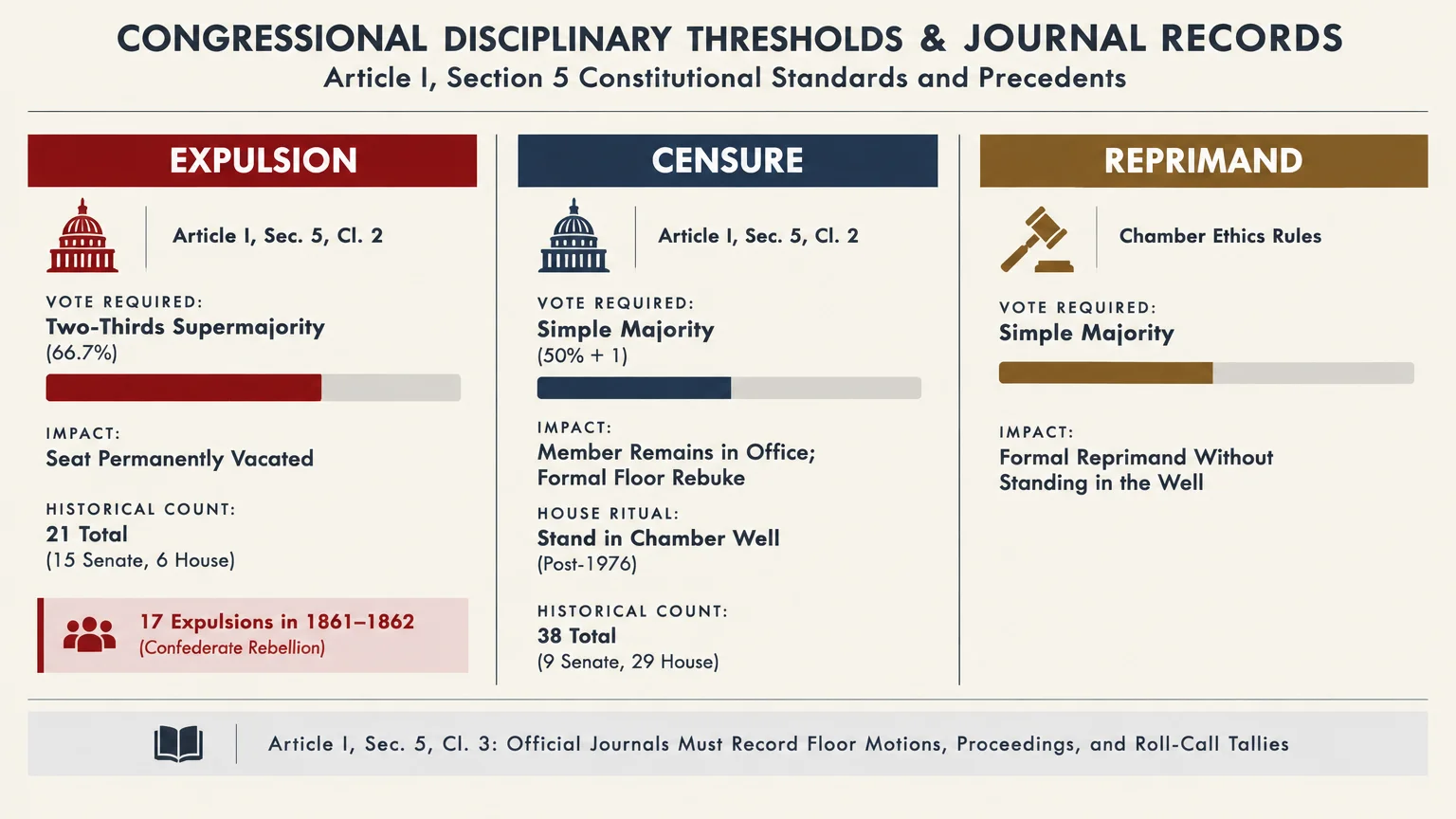
Article I, Section 5 of the U.S. Constitution empowers the House and Senate to punish their own members for disorderly behavior and, by a two-thirds vote, expel a member. Each chamber also maintains an official journal recording floor proceedings, motions, and roll-call votes.
Across American history, Congress has expelled 21 members—15 senators and six representatives—including 17 during the Civil War for supporting the Confederacy. Separate from member discipline, chambers have occasionally adopted political resolutions disapproving of executive officers, such as the Senate’s 1834 censure of President Andrew Jackson.
Constitutional Authority, Journal Records, and Disciplinary Thresholds
This list counts 11 landmark disciplinary proceedings recorded in the House and Senate journals between 1797 and 2026. It covers Article I, Section 5 member expulsions, censures, and exclusions alongside the 1834 Senate political resolution disapproving of President Andrew Jackson.
Entries were selected to illustrate key constitutional precedents, comparing two-thirds expulsion votes that vacate a seat with simple-majority censures that leave a lawmaker in office.
Under House procedures established in 1976, a censured representative must stand in the chamber well while the Speaker reads the resolution.
William Blount
On July 8, 1797, the Senate voted 25–1 to expel Tennessee Senator William Blount, the first member of Congress ever expelled. President John Adams initiated the inquiry by delivering intercepted letters proving Blount conspired with British agents to seize Spanish-controlled Florida and Louisiana.
According to the U.S. Senate Historical Office record on Blount’s expulsion, the Senate ruled his foreign intrigue constituted disorderly behavior under Article I.
Although the House impeached Blount on July 7, 1797, the Senate dismissed the charges on January 11, 1799, finding senators are not impeachable civil officers.
William Stanbery
On July 11, 1832, the House of Representatives voted 93–44 to censure Ohio Representative William Stanbery, the first formal censure recorded in the House Journal.
Stanbery provoked the vote during floor debate by accusing Speaker Andrew Stevenson of shaping committee assignments to favor President Andrew Jackson.
Speaker Stevenson temporarily vacated the chair and demanded a formal House inquiry into Stanbery’s unparliamentary language. As recorded by the Office of the Historian of the U.S. House, the vote established that members face floor discipline for defamatory debate speech.
Andrew Jackson
On March 28, 1834, the Senate voted 26–20 to censure President Andrew Jackson for removing federal deposits from the Second Bank of the United States.
Unlike Article I, Section 5 discipline of a chamber’s own members, Whig Senator Henry Clay’s resolution was a political disapproval of the chief executive.
Jackson protested that the Senate lacked constitutional authority to censure a president outside impeachment, and the U.S. Senate Historical Office record on Jackson’s censure tracks the subsequent reversal.
On January 16, 1837, a Democratic majority expunged the censure, drawing black lines around page 552 of the 1834 journal.
William K. Sebastian
On July 11, 1861, the Senate voted 32–10 under Article I, Section 5 to expel Arkansas Senator William K. Sebastian alongside nine other Southern senators for supporting the Confederacy.
However, Sebastian never joined the rebel government, living quietly and practicing law in Union-occupied Helena, Arkansas, until his death in 1865.
In 1877, a Senate committee reviewed his wartime conduct and verified his loyalty to the Union. The Senate posthumously revoked Sebastian’s expulsion, corrected its official journal record, and paid his full accrued legislative salary to his surviving children.
Benjamin Tillman and John McLaurin
On February 28, 1902, the Senate voted 54–12 to censure South Carolina Democrats Benjamin Tillman and John McLaurin following a physical brawl inside the Senate chamber.
During a February 22, 1902 debate on Philippine trade policy, Tillman accused McLaurin of trading his vote for federal patronage from President William McKinley.
When McLaurin entered the floor and called Tillman a liar, Tillman punched him, sparking a fistfight across the chamber desks. The Senate declared both men in contempt before censuring them, and Tillman later became the only censured senator in history to win re-election.
Joseph McCarthy
On December 2, 1954, the Senate voted 67–22 to discipline Wisconsin Republican Senator Joseph McCarthy following his Permanent Subcommittee on Investigations hearings. Lawmakers amended the final resolution by striking the word “censure” and inserting the word “condemned” in the official journal record.
The official Senate record on the McCarthy condemnation specifies two formal grounds: obstructing the Subcommittee on Privileges and Elections in 1952 and abusing the Watkins Committee in 1954. McCarthy remained in the Senate until his death on May 2, 1957, but never chaired another committee.
Adam Clayton Powell Jr.
On March 1, 1967, the House voted 307–116 to exclude New York Representative Adam Clayton Powell Jr. from the 90th Congress over misused committee funds and state court defiance.
Powell sued, arguing the House could not exclude a duly elected representative who met all constitutional qualifications.
In Powell v. McCormack, 395 U.S. 486 (1969), the Supreme Court ruled 7–1 in Powell’s favor. Chief Justice Earl Warren held that while Congress may expel a seated member by a two-thirds vote, it cannot exclude a member-elect who meets Article I age, citizenship, and residency qualifications.
Michael “Ozzie” Myers
On October 2, 1980, the House voted 376–30 to expel Pennsylvania Democrat Michael “Ozzie” Myers, the first representative expelled since the Civil War. During the FBI’s Abscam sting operation, federal surveillance cameras recorded Myers accepting a briefcase containing $50,000 in cash bribes from undercover agents.
According to the House Historian’s Abscam expulsion record, Myers asked the chamber to wait until his criminal appeals concluded. The House rejected his request and expelled him eight months after his federal bribery conviction.
James Traficant
On July 24, 2002, the House voted 420–1, with nine members voting present, to expel Ohio Democrat James Traficant.
The vote followed Traficant’s federal conviction on ten felony counts, including racketeering, bribery, filing false tax returns, and forcing staffers to kick back portions of their salaries.
Traficant represented himself during the House floor debate, claiming federal prosecutors had fabricated evidence against him. Lawmakers adopted the bipartisan House Ethics Committee’s recommendation to expel him, and Traficant subsequently served a seven-year sentence in federal prison.
George Santos
On December 1, 2023, the House voted 311–114 under Roll Call 691 to expel New York Republican George Santos, the sixth representative expelled in House history. Unlike Myers and Traficant, Santos was expelled before a federal criminal trial or conviction.
The House acted on a bipartisan House Ethics Committee report finding that Santos stole campaign contributions, falsified federal disclosure reports, and committed personal fraud. On August 19, 2024, Santos pleaded guilty in federal court to wire fraud and aggravated identity theft.
Chuck Edwards
As of our October 2026 update, the most recent censure occurred on September 1, 2026, when the House voted 417–2 under House Resolution 1498 to censure North Carolina Republican Chuck Edwards.
The vote followed a House Ethics Committee investigation substantiating workplace sexual harassment and a hostile work environment involving two former female staffers.
Edwards became the 29th representative censured in House history and stood in the well as Speaker Mike Johnson read the resolution aloud. In addition to the formal floor rebuke, the resolution stripped Edwards of his committee assignments.
| Official | Year | Chamber | Action | Vote | Primary Grounds |
|---|---|---|---|---|---|
| William Blount | 1797 | Senate | Expelled | 25–1 | Conspiracy with Great Britain |
| William Stanbery | 1832 | House | Censured | 93–44 | Insulting the Speaker of the House |
| Andrew Jackson (President) | 1834 | Senate | Disapproval Resolution (Expunged) | 26–20 | Withholding Bank War records (non-member political resolution) |
| William K. Sebastian | 1861 | Senate | Expelled (Revoked) | 32–10 | Presumed Confederate support |
| Benjamin Tillman & John McLaurin | 1902 | Senate | Censured | 54–12 | Chamber floor fistfight |
| Joseph McCarthy | 1954 | Senate | Condemned | 67–22 | Committee abuse and obstruction |
| Adam Clayton Powell Jr. | 1967 | House | Excluded (Overturned) | 307–116 | Misuse of committee funds |
| Michael Myers | 1980 | House | Expelled | 376–30 | Abscam bribery conviction |
| James Traficant | 2002 | House | Expelled | 420–1 | Bribery and staff kickbacks |
| George Santos | 2023 | House | Expelled | 311–114 | Campaign fraud and ethics findings |
| Chuck Edwards | 2026 | House | Censured | 417–2 | Staff sexual harassment |
Procedural Evolutions and Modern Disciplinary Precedents
During the nineteenth century, congressional discipline primarily addressed chamber brawls, floor insults, and Confederate disloyalty. After both chambers established permanent ethics committees in the late 1960s, disciplinary inquiries shifted toward formal investigations of bribery, campaign finance fraud, and workplace misconduct.
Before floor votes occur, bipartisan ethics committees typically subpoena documents, interview witnesses, and publish evidentiary reports. The two-thirds requirement under Article I, Section 5 ensures that expulsions require broad cross-party support, whereas simple-majority censures frequently include provisions stripping members of committee assignments.
Frequently Asked Questions About Congressional Discipline
What is the constitutional difference between censure and expulsion?
Expulsion permanently removes a member from Congress and requires a two-thirds supermajority vote under Article I, Section 5, Clause 2. Censure is a formal reprimand adopted by a simple majority vote that leaves the lawmaker in office with full voting privileges.
Can an expelled member run for Congress again?
Yes, expulsion removes a lawmaker only for the remainder of that Congress and does not create a permanent disqualification from future office. Under Powell v. McCormack (1969), if voters re-elect an expelled member who meets constitutional qualifications, the chamber must seat them.
Can federal courts overturn a congressional expulsion?
Federal courts treat internal congressional disciplinary votes as non-justiciable political questions committed by Article I, Section 5 to the legislative branch. While the Supreme Court reviewed an unlawful exclusion in Powell v. McCormack, no federal court has overturned a two-thirds expulsion vote.
How does the House well ritual work during a censure?
Since 1976, House procedure requires a censured representative to stand in the well of the chamber while the Speaker reads the censure resolution aloud. The Senate has no equivalent rule and frequently adopts disciplinary resolutions without the senator standing on the floor.