Congressional roll-call data and presidential approval polling identify the specific eras when national political consensus fractured most severely. When legislative party discipline hardens, cross-party compromise gives way to institutional deadlock.
Nine American presidents governed through these historic ruptures, navigating state secessions, Senate expulsions, impeachment trials, federal government shutdowns, and record partisan approval gaps.
Evaluating Polarization Through NOMINATE Scores and Partisan Approval Gaps
This list ranks the nine U.S. presidencies that experienced the sharpest institutional and public divisions in American history.
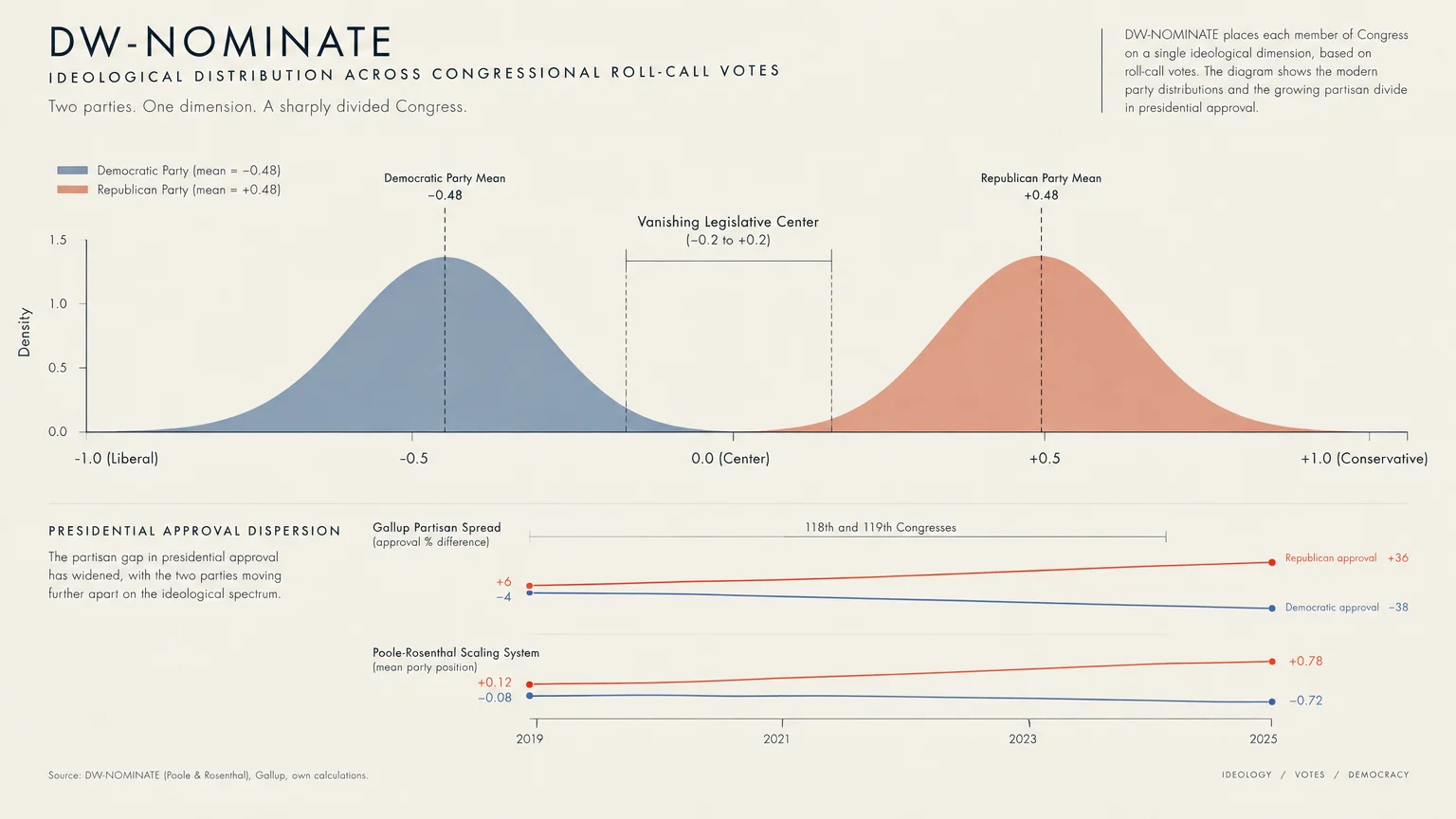
Political scientists measure legislative division using Keith Poole and Howard Rosenthal’s DW-NOMINATE scaling system, which maps every congressional roll-call vote since 1789 to calculate the ideological distance between party averages.
Entries were selected using three historical benchmarks: peak DW-NOMINATE party distance, Gallup partisan approval dispersion (the spread between the president’s party and the opposition party), and constitutional stalemates such as impeachments, expulsions, and multi-ballot leadership deadlocks.
John Adams
John Adams governed from 1797 to 1801 during the emergence of the First Party System. His administration faced ideological conflict between Alexander Hamilton’s Federalist faction and Thomas Jefferson’s Democratic-Republicans over federal authority and foreign alliances with Great Britain and France.
Partisan hostility erupted into physical violence on the House floor on February 15, 1798. Federalist Representative Roger Griswold and Democratic-Republican Matthew Lyon brawled with a walking cane and fireplace tongs following weeks of partisan insult.
Adams signed the Alien and Sedition Acts in July 1798 (1 Stat. 596).
Federalist prosecutors used the Sedition Act against political opponents, indicting opposition newspaper editors and convicting Representative Lyon for criticizing presidential policies.
This rift culminated in the deadlocked presidential election of 1800. The House of Representatives required 36 separate roll-call ballots in February 1801 before breaking an Electoral College tie to elect Thomas Jefferson.
James Buchanan
James Buchanan served from 1857 to 1861 as sectional conflict over slavery in the western territories ended cross-regional legislative compromise.
Two days after his inauguration, the Supreme Court handed down its ruling in Dred Scott v. Sandford (60 U.S. 393), after Buchanan pressured Northern Justice Robert Grier to join the majority opinion.
Floor debates in the 36th Congress grew so combative that lawmakers carried concealed weapons into the legislative chambers. The House remained deadlocked for 44 roll-call ballots over two months before electing Speaker William Pennington in February 1860.
Following Abraham Lincoln’s election in November 1860, South Carolina adopted an ordinance of secession on December 20, 1860.
In his December 1860 annual message, Buchanan declared secession unconstitutional but stated that the federal government lacked lawful authority to coerce departing states to remain in the Union.
Abraham Lincoln
Abraham Lincoln took office in March 1861 confronting armed insurrection and congressional fracture. Between December 1860 and June 8, 1861, eleven Southern states enacted secession ordinances and withdrew their congressional delegations from Washington.
The 37th Congress penalized Southern lawmakers who vacated their seats to join the Confederacy. In July 1861, the Senate voted 32–10 to expel ten Southern senators under Article I, Section 5 of the Constitution.
Lincoln also governed amid Northern domestic polarization during the Civil War. Anti-war Peace Democrats, known as Copperheads, opposed wartime conscription enacted under the Enrollment Act of March 3, 1863 (12 Stat.
731).
Lincoln faced judicial challenges over his suspension of the writ of habeas corpus, including Chief Justice Roger Taney’s circuit ruling in Ex parte Merryman (17 F. Cas.
144). In the 1864 presidential election, Lincoln ran on a National Union coalition ticket with War Democrat Andrew Johnson, winning 212 of 233 electoral votes.
Andrew Johnson
Andrew Johnson succeeded Lincoln in April 1865 and clashed with Radical Republican majorities over Reconstruction and freedmen’s civil rights. The 39th and 40th Congresses overrode 15 of Johnson’s 21 regular vetoes, an all-time record presidential override rate of 71 percent.
Lawmakers passed the Civil Rights Act of April 9, 1866 (14 Stat. 27) over Johnson’s veto, the first override of a major statute in U.S. history.
Congress then enacted the Tenure of Office Act on March 2, 1867 (14 Stat. 430), restricting the president from removing Senate-confirmed officials without Senate approval.
After Johnson sought to replace Secretary of War Edwin Stanton, the House voted 126–47 to impeach him on February 24, 1868. The Senate impeachment trial ended in May 1868 with three separate 35–19 votes, falling one vote short of the two-thirds majority required for conviction.
William McKinley
William McKinley won the 1896 presidential election, ushering in the Fourth Party System. Voteview’s DW-NOMINATE scaling shows that the 55th through 59th Congresses (1897–1907) recorded the widest ideological distance between the two major parties prior to the 2010s.
Partisan conflict centered on the gold standard, protective tariffs, and overseas territorial annexations. Congressional Republicans passed the protectionist Dingley Tariff of July 24, 1897 (30 Stat.
151) on party lines, and McKinley signed the Gold Standard Act of March 14, 1900 (31 Stat. 45), rejecting Democratic bimetallism.
Division extended to treaty ratification after the Spanish-American War. On February 6, 1899, the Senate approved the Treaty of Paris annexing the Philippines, Puerto Rico, and Guam by a vote of 57–27, clearing the constitutional two-thirds threshold by a single vote.
Bill Clinton
Bill Clinton governed from 1993 to 2001 as congressional party discipline hardened. The 1994 midterm elections ended 40 years of uninterrupted Democratic control of the House, giving Republicans a net gain of 54 House seats and 8 Senate seats under incoming Speaker Newt Gingrich.
Ideological budget disputes between Clinton and the 104th Congress caused two federal government shutdowns in late 1995 and early 1996, totaling 26 days.
Partisan conflict peaked on December 19, 1998, when the House adopted House Resolution 611 impeaching Clinton on largely party-line votes of 228–206 for grand jury perjury and 221–212 for obstruction of justice.
The Senate acquitted Clinton on February 12, 1999. Neither charge achieved even a simple majority, with senators voting 45–55 on perjury and 50–50 on obstruction of justice.
Barack Obama
Barack Obama served from 2009 to 2017 while partisan approval gaps reached new sustained highs. Gallup polling data shows that Obama averaged a 70-percentage-point approval gap between self-identified Democrats and Republicans across his eight years in office.
In late October and early November 2012, Gallup recorded an 86-point partisan approval divide: 92 percent of Democrats approved of Obama’s job performance compared with 6 percent of Republicans.
Major domestic statutes passed on strict party lines, including the Patient Protection and Affordable Care Act (Public Law 111-148), which cleared the Senate 60–39 on December 24, 2009, without a single Republican vote in either chamber.
On November 21, 2013, Senate Democrats voted 52–48 to invoke the “nuclear option,” eliminating the 60-vote cloture threshold for executive branch nominees and federal judicial nominees below the Supreme Court.
Donald Trump
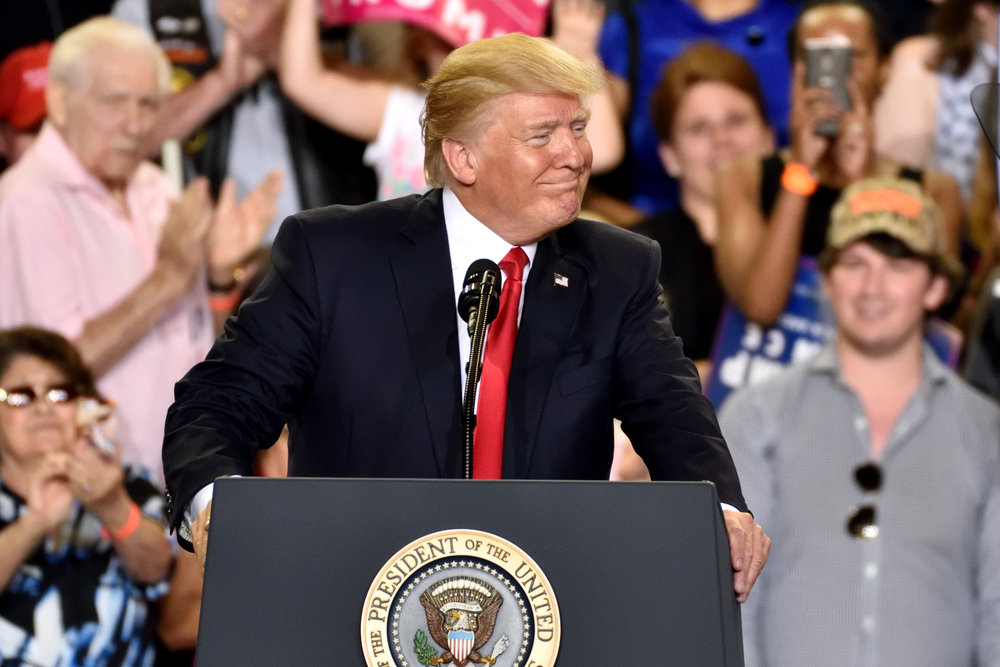
Donald Trump served his first term from 2017 to 2021 and returned to office in January 2025 amid record public and congressional polarization. Across his first term, Trump’s overall Gallup job approval averaged 41 percent, with an average partisan gap of roughly 80 percentage points.
In October 2020, Gallup recorded the widest single-poll partisan approval divide in its history at 92 percentage points (95 percent among Republicans versus 3 percent among Democrats).
In February 2026, Gallup also recorded a 73-point partisan gap on satisfaction with U.S. standing in the world (80 percent among Republicans versus 7 percent among Democrats).
Trump became the only president impeached twice by the House—on December 18, 2019, and January 13, 2021—with both proceedings ending in Senate acquittal.
As of October 2026, Voteview DW-NOMINATE scaling for the 119th Congress shows the ideological gap between party means at its widest level since Reconstruction.
Joe Biden
Joe Biden served from 2021 to 2025 during a period of entrenched partisan alignment. Gallup presidential approval records show that Biden matched Trump’s first-term mark with an average partisan approval gap of roughly 80 percentage points.
Biden concluded his term in January 2025 with a final Gallup approval rating of 40 percent and a four-year average of 42.2 percent, the second-lowest full-term post-World War II average after Trump.
Major domestic spending and tax measures, including the American Rescue Plan Act of 2021 (Public Law 117-2) and the Inflation Reduction Act of 2022 (Public Law 117-169), passed through budget reconciliation with zero Republican votes.
During the 118th Congress (2023–2025), Voteview’s DW-NOMINATE scores registered zero ideological overlap between the two parties, as the most conservative Democrat voted to the left of the most liberal Republican in both chambers.
Structural Shifts and the Vanishing Legislative Center
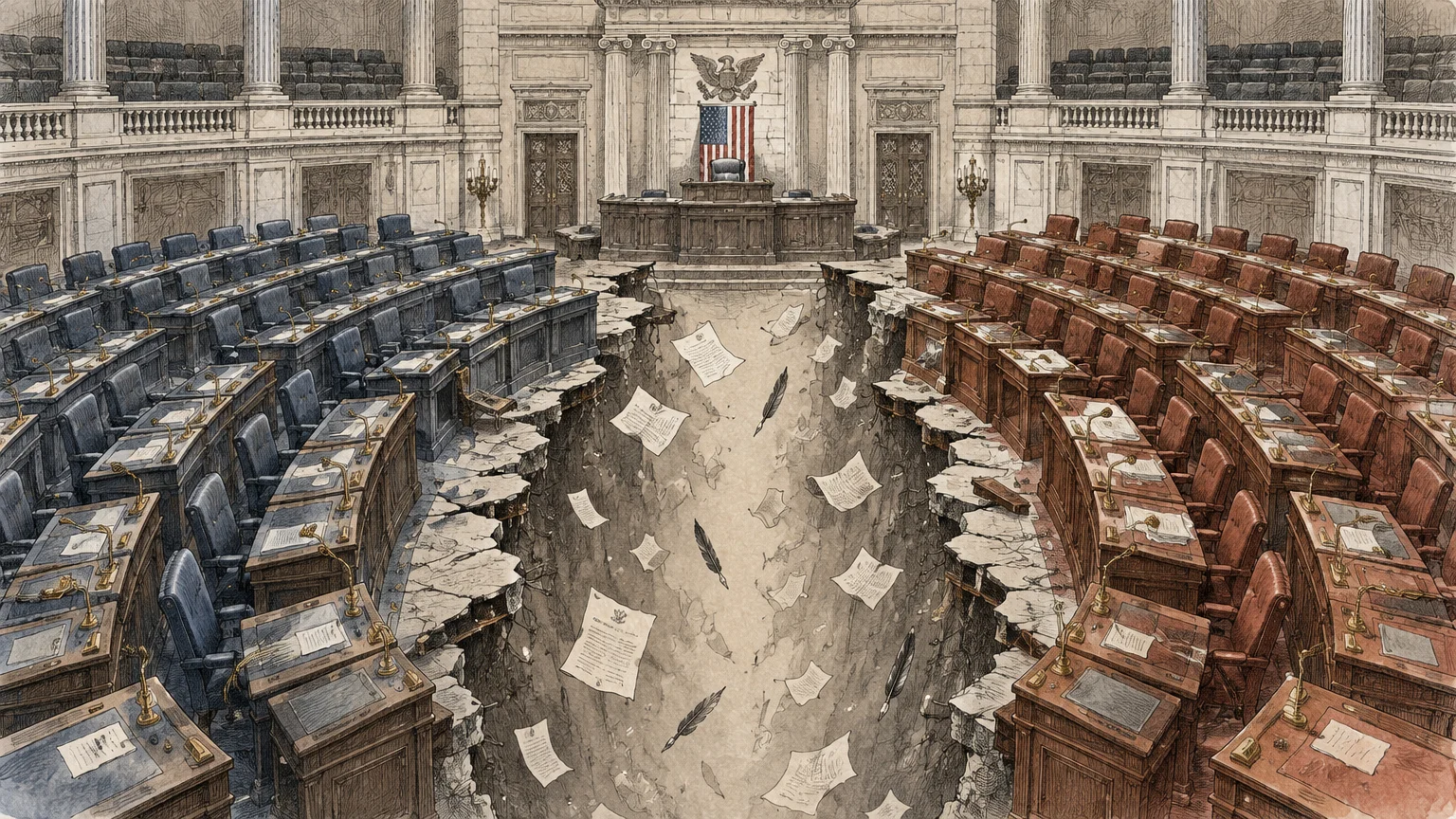
Across these nine presidencies, polarization tracked structural sorting between the parties rather than individual personality clashes. During the 92nd Congress (1971–1972), more than 160 members scored in the ideological middle where the two parties overlapped; by the 118th and 119th Congresses, that overlap vanished.
With cross-party coalitions rare, modern presidents rely heavily on executive orders, national emergency declarations, and federal rulemaking, all of which face immediate judicial challenge or reversal by the next administration.
Congress increasingly relies on budget reconciliation to pass fiscal legislation by simple majority and has eliminated the 60-vote confirmation filibuster for both lower-court judges (2013) and Supreme Court justices (2017).
| President | Years in Office | Primary Polarization Metric | Institutional Milestone |
|---|---|---|---|
| John Adams | 1797–1801 | First Party System ideological split | 36-ballot House election deadlock (1801) |
| James Buchanan | 1857–1861 | Collapse of sectional compromise | 44-ballot Speaker deadlock; 7 states seceded before March 1861 |
| Abraham Lincoln | 1861–1865 | Civil War legislative severance (11 states seceded) | Senate expelled 10 Southern members (1861) |
| Andrew Johnson | 1865–1869 | 71% congressional veto override rate (15 of 21) | First presidential impeachment trial (1868) |
| William McKinley | 1897–1901 | Pre-modern DW-NOMINATE peak distance | Party-line gold standard and tariff statutes |
| Bill Clinton | 1993–2001 | 1994 midterm shift (+54 GOP House seats) | 26 days of shutdowns; 1998 House impeachment |
| Barack Obama | 2009–2017 | 70-point average partisan approval gap | Party-line ACA (2009); nominee filibuster altered (2013) |
| Donald Trump | 2017–2021; 2025–present | 92-point peak approval gap; ~80-point avg | Two impeachments; 119th Congress NOMINATE peak |
| Joe Biden | 2021–2025 | ~80-point avg gap; zero NOMINATE overlap | Party-line budget reconciliation statutes |
Frequently Asked Questions
Which president recorded the widest partisan approval gap in polling history?
Donald Trump holds the single-poll record with a 92-percentage-point partisan approval gap recorded by Gallup in October 2020. Both Trump (first term) and Joe Biden share the full-term record, each averaging roughly an 80-point partisan approval gap, 10 points higher than any prior president.
How do political scientists measure polarization across different historical centuries?
Researchers use Poole-Rosenthal DW-NOMINATE scaling to analyze every congressional roll-call vote since 1789. By calculating the distance between the two parties’ mean ideological scores on a standardized scale from -1 to +1, scholars compare 19th-century sectional conflict directly with modern legislative voting.
When did moderate lawmakers disappear from the United States Congress?
During the 92nd Congress (1971–1972), more than 160 lawmakers fell within the ideological overlap between the Democratic and Republican caucuses. Following decades of geographic and ideological sorting, overlap between the two parties’ congressional delegations reached zero in the 118th and 119th Congresses.
How does extreme polarization alter modern statutory lawmaking?
When neither party can assemble 60 Senate votes for regular order, Congress uses the budget reconciliation process under the Congressional Budget Act of 1974 to pass tax and spending bills by simple majority.
Presidents also turn to executive orders and agency regulations, which successor administrations frequently rescind.