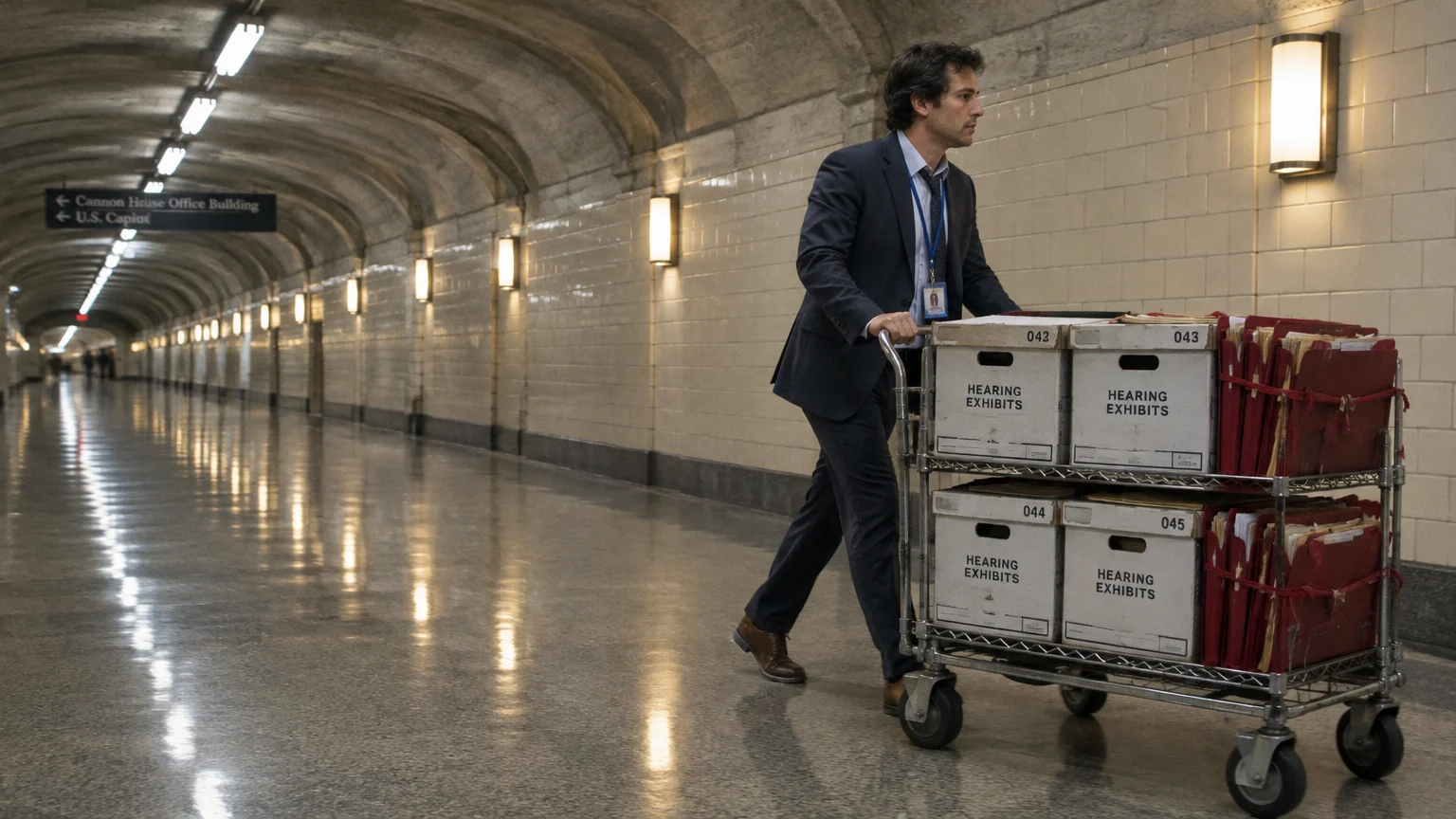
Congressional hearings often appear to be theatrical exercises staged primarily for news soundbites and digital clips. Yet throughout American history, legislative inquiries have dismantled monopolies, stabilized financial markets, and reshaped executive authority.
When lawmakers use committee authority rigorously, witness testimony translates directly into binding statutory mandates. Modern banking protections, intelligence safeguards, and campaign finance disclosure rules all trace back to specific Capitol Hill hearings.
Examining the public record helps you distinguish performative partisan combat from investigations that permanently amended federal statutes. Here is how ten landmark congressional inquiries rewrote the United States Code.
Criteria for Landmark Legislative Inquiries
We examined congressional oversight records from 1912 through 2022 to identify inquiries that directly catalyzed major statutory enactments.
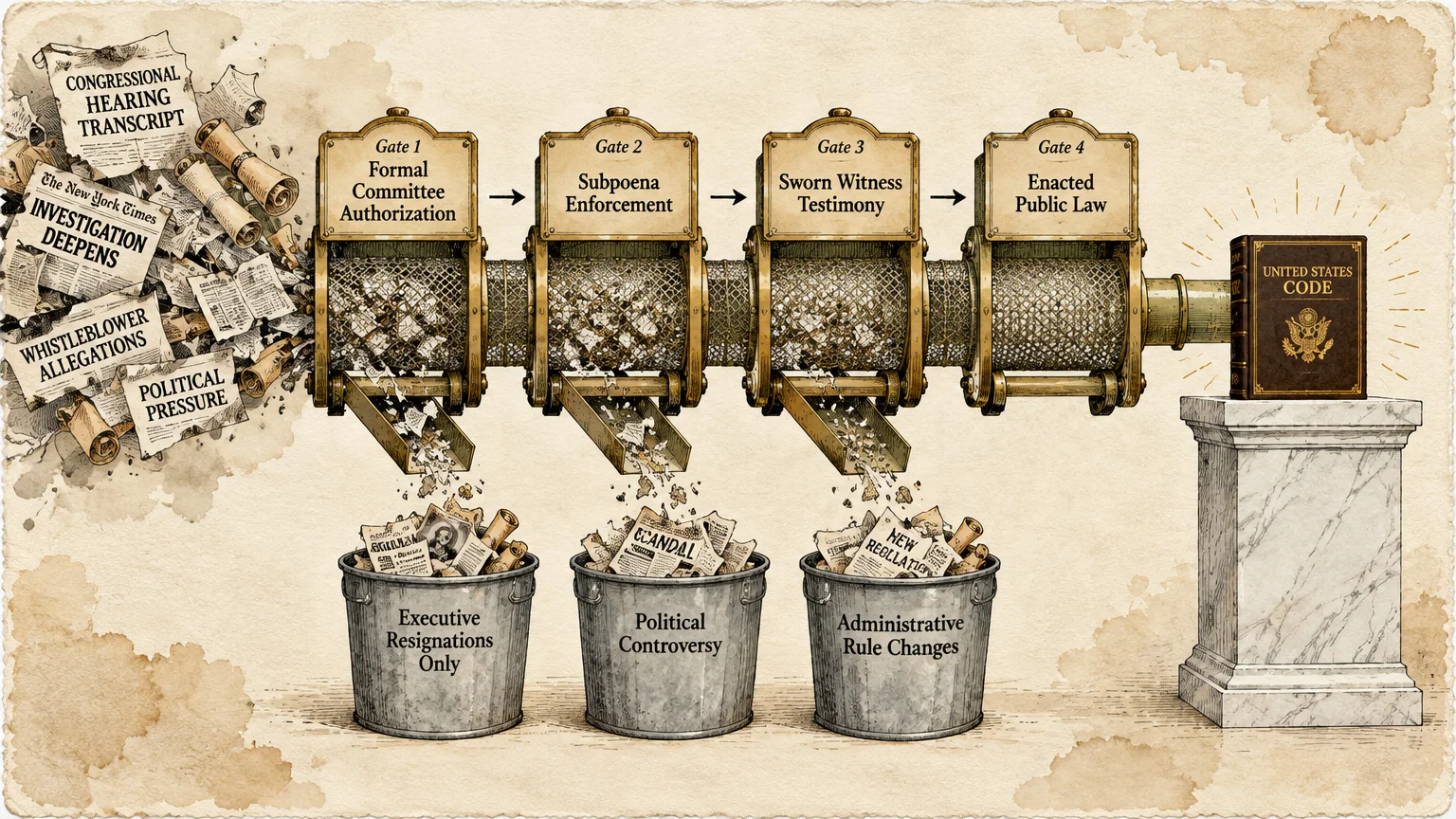
Each selected investigation required formal committee authorization, sworn witness testimony, subpoena enforcement, and clear causation leading to enacted public laws.
We excluded investigations that generated only executive branch resignations, political controversies, or administrative rule changes without subsequent federal legislation.
The chosen inquiries span national banking structure, wartime production, corporate governance, union operations, and constitutional intelligence surveillance.
These historical records demonstrate how formal congressional fact-finding provides the evidentiary baseline required to pass sweeping regulatory overhauls.
Understanding these precedents allows you to evaluate whether current congressional hearings possess the substantive rigor required to amend federal law.
The Pujo Committee Investigation
In February 1912, the House Committee on Banking and Currency authorized a comprehensive inquiry into Wall Street financial consolidation.
Representative Arsène Pujo of Louisiana chaired the subcommittee, while veteran corporate attorney Samuel Untermyer served as chief investigative counsel.
Hearings ran through February 1913, exposing how a consolidated “Money Trust” dominated American commercial credit and corporate capitalization.
Untermyer cross-examined prominent financiers, including J.P. Morgan, revealing that partners of J.P.
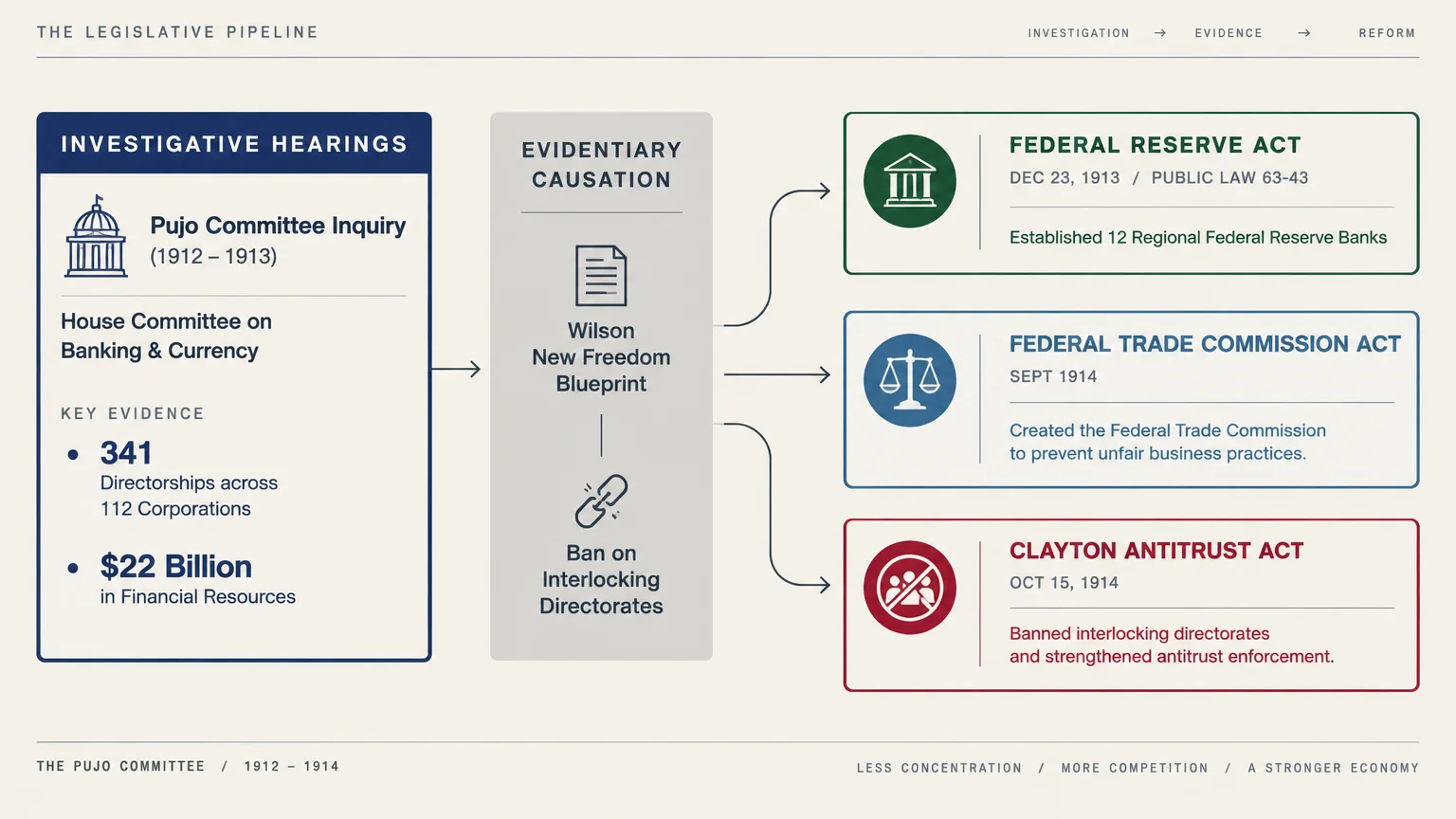
Morgan & Co. held 341 directorships across 112 corporations.
These affiliated firms controlled more than $22 billion in aggregate resources, dominating railroad networks, commercial banks, and industrial manufacturing trusts.
The committee issued its final investigative report on February 28, 1913, detailing how interlocking directorates stifled commercial competition and concentrated systemic risk.
These documented findings provided the evidentiary blueprint for President Woodrow Wilson’s ambitious New Freedom legislative agenda.
Congress responded by passing the Federal Reserve Act, which President Wilson signed into law on December 23, 1913 (Public Law 63-43).
The statute established twelve regional Federal Reserve Banks, creating a public central banking mechanism to counterbalance private financial monopolies.
Lawmakers also passed the Federal Trade Commission Act in September 1914 to investigate and penalize unfair trade practices.
On October 15, 1914, Congress completed this regulatory overhaul by enacting the Clayton Antitrust Act.
The Clayton Act explicitly banned the interlocking corporate directorates that Untermyer had meticulously documented during the committee’s public hearings.
You can verify these committee proceedings through the Office of the Historian of the U.S. House of Representatives.
The Teapot Dome Inquiry
In October 1923, the Senate Committee on Public Lands and Surveys opened hearings into noncompetitive leases of federal naval oil reserves.
Senator Thomas J. Walsh of Montana spearheaded the investigation, sifting through thousands of government lease documents and financial transactions.
Walsh revealed that Interior Secretary Albert B. Fall secretly leased the Teapot Dome naval reserve in Wyoming to Harry Sinclair’s Mammoth Oil Company.
Fall also leased the Elk Hills reserve in California to Edward Doheny’s Pan American Petroleum and Transport Company without competitive bidding.
In exchange, Fall accepted more than $400,000 in zero-interest loans, cash payments, and herd cattle from the oil executives.
One payment included $100,000 in currency carried directly to Fall’s office in a private black bag by Doheny’s son.
The investigation resulted in Fall becoming the first Cabinet member in United States history convicted of a felony and imprisoned.
Beyond criminal convictions, the inquiry forced a major statutory expansion of congressional oversight authority over executive agencies.
Congress enacted the Revenue Act of June 2, 1924, granting tax-writing committee chairs statutory power to inspect private tax returns.
Codified today at 26 U.S.C. § 6103(f), this provision remains the statutory mechanism lawmakers use to inspect executive branch tax records.
Congress also enacted the Federal Corrupt Practices Act of 1925, mandating quarterly financial disclosures from political campaign committees.
When Attorney General Harry Daugherty’s brother refused a committee subpoena, the resulting legal battle generated a landmark constitutional ruling.
In McGrain v. Daugherty (1927), the Supreme Court confirmed that Congress possesses an implied constitutional power to compel witness testimony.
The Pecora Commission
On March 4, 1932, the Senate Banking and Currency Committee initiated an inquiry into the causes of the 1929 stock market crash.
The probe stalled until January 1933, when the committee retained former New York prosecutor Ferdinand Pecora as chief counsel.
Pecora aggressively subpoenaed corporate ledgers, internal trading memoranda, and personal income tax records of Wall Street’s most influential executives.
Under Pecora’s questioning, J.P. Morgan Jr. acknowledged that neither he nor his twenty partners paid any federal income taxes in 1931 and 1932.
Pecora also revealed that Chase National Bank president Albert Wiggin shorted 42,000 shares of his own bank’s stock during the crash.
Wiggin earned over four million dollars in personal tax-free profits while using bank funds to maintain an artificial price floor.
The public outcry generated by Pecora’s daily disclosures gave President Franklin D. Roosevelt irresistible leverage over financial lobbyists.
Lawmakers moved rapidly, passing the Securities Act of 1933 on May 27, 1933, to require complete corporate prospectuses for public securities.
On June 16, 1933, Roosevelt signed the Banking Act of 1933 (Public Law 73-66), commonly known as the Glass-Steagall Act.
Glass-Steagall strictly separated commercial deposit banks from investment underwriting firms and established the Federal Deposit Insurance Corporation.
Congress completed Pecora’s legislative legacy by passing the Securities Exchange Act of June 6, 1934.
The statute established the Securities and Exchange Commission, mandating continuous registration filings and outlawing fraudulent market manipulation practices.
The Nye Munitions Investigation
The Senate established the Special Committee Investigating the Munitions Industry on April 12, 1934, under isolationist Senator Gerald P. Nye.
Between 1934 and 1936, the seven-member committee convened 93 public hearings and deposed more than 200 industrial and financial witnesses.
Nye investigated major defense contractors, including the DuPont corporation, examining internal balance sheets and wartime profit margins from World War I.
The hearings revealed that American arms manufacturers had lobbied foreign governments, shared patent technology internationally, and collected substantial wartime profits.
The committee popularized the concept of “Merchants of Death,” arguing that financial and corporate interests had pushed the country into foreign conflict.
While later historians criticized the panel’s isolationist premises, its factual disclosures prompted an aggressive statutory response from Capitol Hill.
Congress passed the Neutrality Act of August 31, 1935 (Public Law 74-173), imposing mandatory arms embargoes on all belligerent nations.
Subsequent Neutrality Acts enacted in 1936, 1937, and 1939 prohibited private loans to warring countries and restricted travel on belligerent vessels.
The 1935 statute also established the National Munitions Control Board, requiring federal registration and licensing for all commercial arms exporters.
You can review the original transcripts of the Nye hearings at the National Archives Center for Legislative Archives.
Although Congress later repealed the rigid neutrality embargoes as World War II escalated, the export registration framework remains federal law.
The McClellan Labor Rackets Investigation
From January 30, 1957, through March 31, 1960, the Senate Select Committee on Improper Activities in the Labor or Management Field conducted hearings.
Chaired by Senator John L. McClellan of Arkansas, the bipartisan panel employed future Attorney General Robert F.
Kennedy as chief investigative counsel.
The committee held 270 days of public hearings, served more than 8,000 subpoenas, and heard testimony from 1,526 witnesses across several industries.
Robert Kennedy repeatedly confronted International Brotherhood of Teamsters leaders Dave Beck and Jimmy Hoffa regarding misuse of union treasury accounts.
More than 340 witnesses invoked their Fifth Amendment protections as investigators documented systematic extortion, fraudulent union elections, and mob infiltration.
The committee proved that union officials routinely diverted members’ pension contributions into speculative private business ventures and personal accounts.
The exposure forced Congress to enact the Labor-Management Reporting and Disclosure Act of 1959, commonly designated the Landrum-Griffin Act.
President Dwight D. Eisenhower signed the bill into law on September 14, 1959, as Public Law 86-257.
The Landrum-Griffin Act created a statutory “Bill of Rights” for private labor union members, guaranteeing equal voting participation and speech rights.
The statute mandated secret-ballot union leadership elections, required annual financial audits filed with the Department of Labor, and barred felons from union office.
The Kefauver Pharmaceutical Hearings
In December 1959, Senator Estes Kefauver initiated hearings into commercial pharmaceutical pricing through the Senate Antitrust and Monopoly Subcommittee.
Kefauver presented internal cost sheets showing pharmaceutical companies sold prescription medications at wholesale markups exceeding 1,000 percent of production costs.
Subcommittee counsel documented how drug firms spent more money on marketing campaigns and physician gifts than on basic medical research.
The hearings exposed widespread practices of marketing untested combination medications while suppressing data on dangerous patient side effects.
The inquiry initially stalled against aggressive pharmaceutical lobbying until the international thalidomide tragedy became public in late 1961.
Thalidomide, an anti-nausea sedative prescribed widely across Europe, caused thousands of severe infant limb deformities worldwide.
The medication was blocked in the United States by Dr. Frances Kelsey, a vigilant Food and Drug Administration medical reviewer.
Kelsey’s resistance combined with Kefauver’s extensive investigative record created unanimous congressional support for comprehensive pharmaceutical reform.
President John F. Kennedy signed the Kefauver-Harris Drug Amendments (Public Law 87-781) into law on October 10, 1962.
The statute amended the Federal Food, Drug, and Cosmetic Act to establish the modern pharmaceutical regulatory review framework.
For the first time, pharmaceutical manufacturers were legally required to prove clinical efficacy—not merely basic safety—before marketing any drug.
The law also mandated informed consent from clinical trial subjects and required prescription advertisements to disclose recognized adverse reactions.
The Senate Watergate Investigation
On February 7, 1973, the Senate voted 77–0 to create the Select Committee on Presidential Campaign Activities under Senator Sam Ervin.
You can examine the institutional scope of the Ervin Committee through the U.S. Senate Historical Office.
The committee conducted 37 days of nationally televised hearings, investigating the June 1972 break-in at the Democratic National Committee headquarters.
Ervin’s panel systematically uncovered political sabotage, illicit campaign slush funds, and an extensive White House conspiracy to obstruct federal investigations.
On July 16, 1973, deputy presidential assistant Alexander Butterfield revealed to committee counsel the existence of a secret White House voice-activated taping system.
The legal fight to secure those audio recordings culminated in President Richard Nixon’s resignation on August 9, 1974.
The investigative findings prompted Congress to enact a comprehensive slate of post-Watergate government ethics and electoral reform statutes.
On October 15, 1974, Congress passed the Federal Election Campaign Act Amendments, establishing individual campaign contribution ceilings and creating the Federal Election Commission.
Lawmakers also passed the Privacy Act of 1974, prohibiting federal agencies from secretly collecting and maintaining personal dossiers on American citizens.
To preserve historical records, Congress enacted the Presidential Recordings and Materials Preservation Act of 1974, designating Nixon’s tapes as public property.
President Jimmy Carter signed the Ethics in Government Act (Public Law 95-521) on October 26, 1978.
The statute codified mandatory annual financial disclosures for federal officials, established the Office of Government Ethics, and created an independent counsel mechanism.
The Church Committee Intelligence Probe
On January 27, 1975, the Senate voted 82–4 to establish the Select Committee to Study Governmental Operations with Respect to Intelligence Activities.
Chaired by Senator Frank Church of Idaho, the panel conducted the first comprehensive examination of covert American intelligence programs.
Operating alongside the House Pike Committee, Church’s investigators analyzed decades of domestic surveillance operations conducted by the CIA, FBI, and NSA.
The inquiry documented the FBI’s COINTELPRO program, which carried out warrantless surveillance and covert psychological harassment against civil rights figures.
The committee also uncovered Project SHAMROCK, revealing that the NSA systematically intercepted all telegraph traffic entering and exiting the United States.
Staff documented CIA covert operations abroad, including foreign assassination attempts and secret psychological experiments using controlled substances under Project MKUltra.
To institutionalize legislative oversight, the Senate created the permanent Senate Select Committee on Intelligence on May 19, 1976.
Congress then enacted the Foreign Intelligence Surveillance Act of 1978 (Public Law 95-511), which President Carter signed on October 25, 1978.
Codified at 50 U.S.C. § 1801, the statute established the Foreign Intelligence Surveillance Court to review executive branch wiretap applications targeting foreign powers.
The investigation also led directly to the Intelligence Oversight Act of 1980, requiring intelligence agencies to keep congressional committees fully informed of covert activities.
The Enron and Corporate Accounting Inquiries
In December 2001, Enron Corporation filed for bankruptcy with $63.4 billion in assets, marking the largest corporate collapse in American history to that date.
More than a dozen congressional committees initiated immediate investigations, led by the Senate Permanent Subcommittee on Investigations and the House Financial Services Committee.
Investigators discovered that Enron executives used complex off-balance-sheet special purpose entities to conceal billions of dollars in toxic business debt.
Hearings documented that corporate officers sold hundreds of millions of dollars in personal stock while ordinary employees saw their retirement portfolios wiped out.
Committees uncovered that Arthur Andersen LLP, Enron’s independent accounting firm, destroyed tons of corporate audit records after federal inquiries began.
When WorldCom collapsed in mid-2002 following an $11 billion accounting fraud, Congress acted with extraordinary speed and near-unanimous bipartisan consensus.
The House passed reform legislation 423–3, while the Senate approved the measure 99–0.
President George W. Bush signed the Sarbanes-Oxley Act of 2002 (Public Law 107-204) into law on July 30, 2002.
The statute established the Public Company Accounting Oversight Board to conduct independent inspections of private auditing corporations.
Under the law, public accounting firms are strictly barred from providing consulting services to the corporate clients they audit.
Corporate chief executives and chief financial officers must personally certify corporate financial statements, facing up to 20 years in prison for false filings.
The statute also enacted severe criminal penalties under 18 U.S.C. § 1519 for altering, destroying, or concealing corporate documents to obstruct federal proceedings.
The Electoral Count Act Inquiries
On June 30, 2021, the House formed the Select Committee to Investigate the January 6th Attack on the United States Capitol.
Working in parallel with bipartisan investigations by the Senate Rules and Administration Committee, the panel conducted more than 1,000 depositions.
Across ten public hearings during 2022, investigators examined the legal strategies used to challenge the 2020 presidential election results.
The inquiry documented how political operatives exploited ambiguities in the Electoral Count Act of 1887 to contest certified state vote returns.
Hearings detailed efforts to pressure Vice President Mike Pence into unilaterally rejecting certified electors and accepting uncertified alternate slates.
Lawmakers determined that archaic nineteenth-century statutory wording created genuine vulnerabilities during joint sessions of Congress.
These findings catalyzed bipartisan negotiations that produced the Electoral Count Reform and Presidential Transition Improvement Act of 2022.
Congress incorporated the reform as Division P of Public Law 117-328, which President Joe Biden signed on December 29, 2022.
The statute amended 3 U.S.C. § 15 to explicitly establish that the Vice President’s role during electoral counting is solely ministerial.
The law raised the objection threshold from one lawmaker per chamber to one-fifth of the House and one-fifth of the Senate.
The reform also designated each state’s governor as the sole executive authorized to submit certified slates, barring rogue election certificates.
These updated statutory rules successfully governed a joint session of Congress for the first time during the presidential certification on January 6, 2025.
Comparing Landmark Inquiries and Enacted Statutes
The table below compares these ten congressional investigations, showing the convening panels, dates of final enactment, and core statutory changes.
| Investigation | Year Enacted | Primary Statute | Core Regulatory Reform |
|---|---|---|---|
| Pujo Committee | 1913–1914 | Federal Reserve Act / Clayton Act | Created regional central banks; outlawed interlocking directorates. |
| Teapot Dome Inquiry | 1924–1925 | Revenue Act of 1924 (26 U.S.C. § 6103) | Gave Congress tax inspection power; strengthened campaign disclosures. |
| Pecora Commission | 1933–1934 | Glass-Steagall Act / Exchange Act | Separated commercial and investment banks; created FDIC and SEC. |
| Nye Committee | 1935 | Neutrality Act of 1935 (P.L. 74-173) | Mandated weapons embargoes; created munitions export licensing. |
| McClellan Committee | 1959 | Landrum-Griffin Act (P.L. 86-257) | Created union bill of rights; mandated secret ballots and financial audits. |
| Kefauver Hearings | 1962 | Kefauver-Harris Amendments | Mandated clinical proof of drug efficacy and patient informed consent. |
| Watergate Committee | 1974–1978 | FECA Amendments / Ethics in Govt Act | Created FEC; capped campaign contributions; mandated financial disclosures. |
| Church Committee | 1978 | FISA of 1978 (P.L. 95-511) | Established FISA Court warrants for national security wiretaps. |
| Enron Accounting Probes | 2002 | Sarbanes-Oxley Act (P.L. 107-204) | Created PCAOB; required CEO certifications; penalized document shredding. |
| Electoral Count Probes | 2022 | Electoral Count Reform Act | Defined VP role as ministerial; raised objection threshold to 20 percent. |
How Congressional Inquiries Produce Federal Legislation
Congressional investigations fulfill a distinct constitutional role separate from criminal trials or civil lawsuits.
Article I of the Constitution grants Congress implied investigative authority as an essential prerequisite to drafting informed national legislation.
When committees investigate effectively, they uncover structural regulatory failures that private corporations or executive agencies conceal from public view.
Subpoenas for corporate ledgers, bank records, and internal communications expose operational realities that routine lobbying reports never reveal.
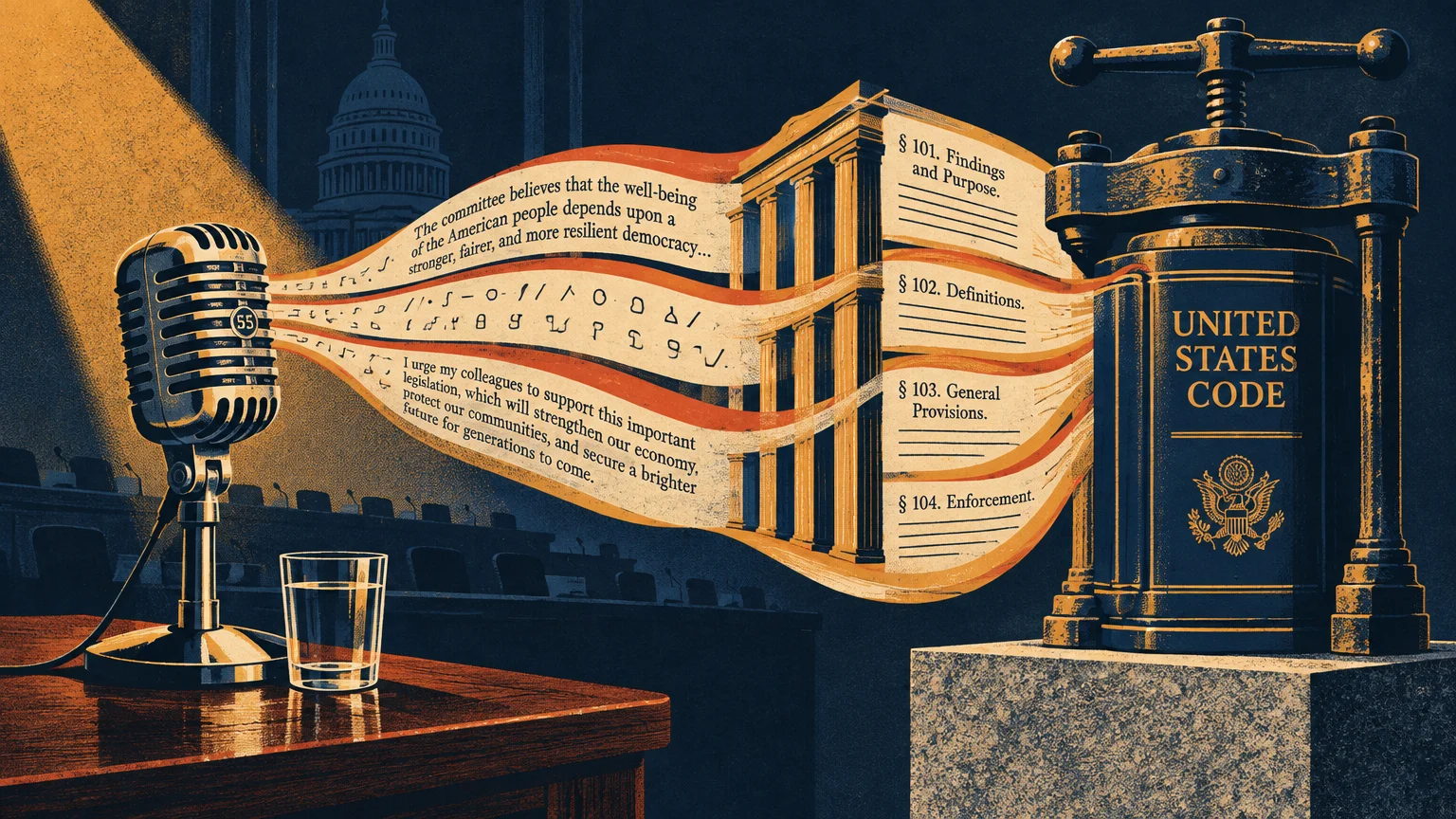
Public hearings compel corporate executives and government officials to answer factual questions under oath, creating a binding evidentiary transcript.
This public testimony breaks legislative gridlock by turning complex policy debates into documented matters of public accountability.
The resulting statutes typically follow distinct patterns: creating independent regulatory boards, mandating continuous public disclosures, or enacting strict criminal penalties.
You can track the legislative viability of modern congressional hearings by examining whether committees focus on developing statutory text or pursuing media visibility.
Frequently Asked Questions About Congressional Investigations
Where does Congress derive its constitutional power to investigate private citizens and corporations?
The Constitution does not contain an explicit “investigation clause,” but the Supreme Court recognized implied oversight authority in McGrain v. Daugherty (1927).
The Court ruled that the power to investigate and compel witness testimony is an indispensable auxiliary to Congress’s legislative function under Article I.
To exercise this power legitimately, an inquiry must possess a valid legislative purpose related to potential statutory enactments or constitutional oversight.
What legal remedies can Congress use if a witness defies a committee subpoena?
Congress maintains three enforcement mechanisms: criminal contempt citations, civil federal court enforcement, and the rarely used inherent contempt power.
Under 2 U.S.C. § 192, a chamber can vote to refer a noncompliant witness to the Department of Justice for criminal misdemeanor prosecution.
Committees can also file civil lawsuits in federal district court, seeking judicial injunctions that order recalcitrant witnesses to comply or face judicial contempt.
Can a congressional committee indict or imprison an individual for criminal conduct?
Congressional committees possess zero judicial power and cannot indict, prosecute, convict, or sentence any individual to prison.
The constitutional doctrine of separation of powers reserves criminal prosecutions exclusively to executive branch prosecutors and federal courts.
When committees uncover criminal activity, they can only vote to send a formal criminal referral to the Department of Justice for executive evaluation.
How can you tell if a contemporary congressional hearing will produce lasting statutory reform?
Genuine legislative inquiries prioritize closed-door staff depositions, comprehensive document subpoenas, and nonpartisan professional staff analysis over televised speeches.
Inquiries that successfully rewrite federal statutes feature sustained bipartisan participation, targeted jurisdictional scope, and draft legislative text debated during the proceedings.
When hearings feature short member questioning periods focused on viral soundbites without follow-up statutory drafting, legislative overhaul rarely follows.




