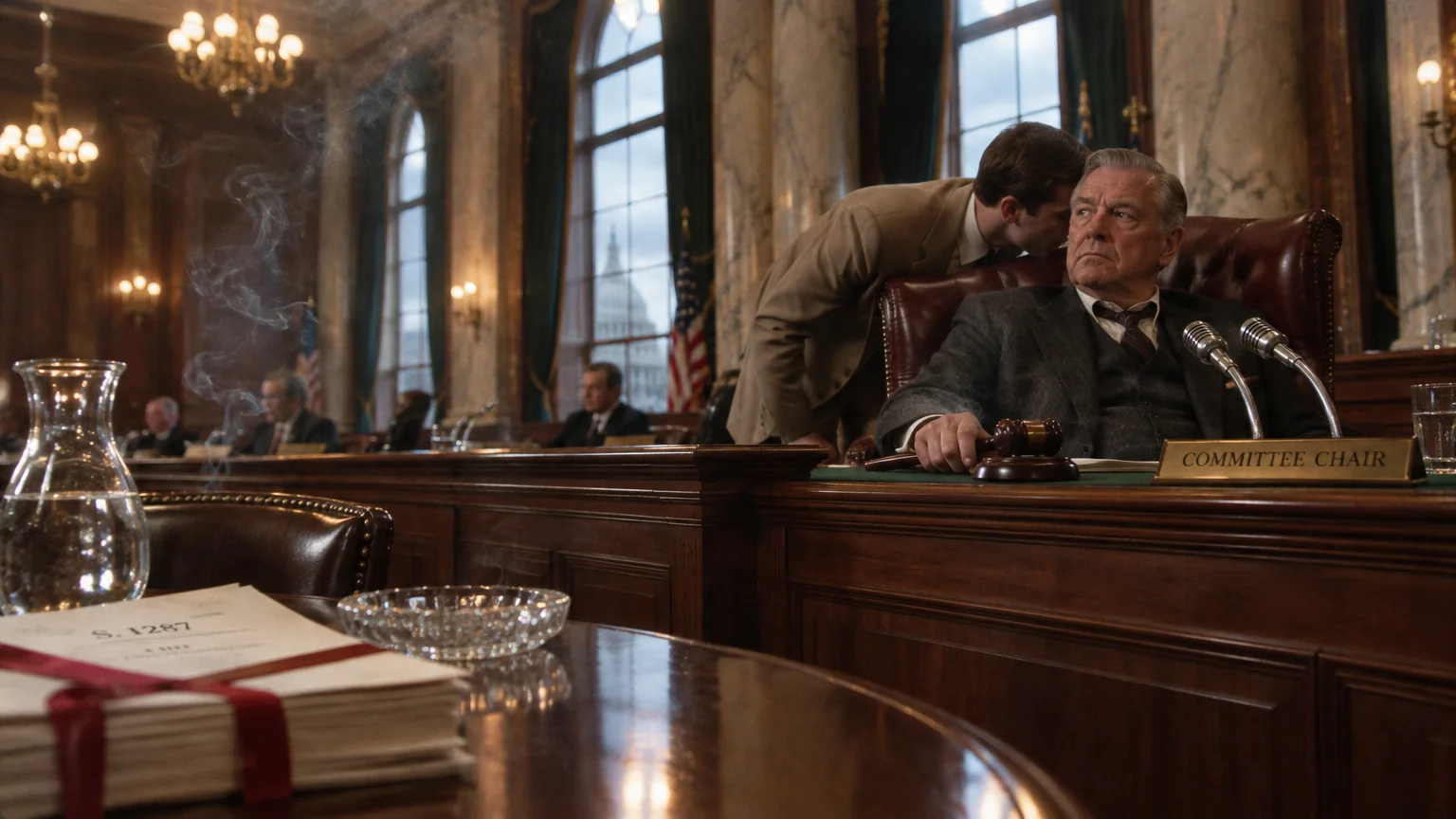
You might assume congressional leaders like the Speaker of the House or Senate Majority Leader always dictate Capitol Hill’s legislative agenda. Throughout much of the twentieth century, however, autonomous committee chairs held far greater authority over the nation’s laws.
These entrenched committee barons wielded absolute control over bill referrals, committee hearings, and legislative markups without answering to their party. They routinely killed presidential initiatives and blocked party leadership priorities with total impunity.
By examining roll-call votes and committee archives, you can see how eight formidable chairmen dominated Congress before historic procedural revolts transformed modern governance.
The Era of Congressional Barons and the Seniority Rule
To understand how these chairmen accumulated such sweeping authority, you must examine the procedural rules governing Congress between 1910 and 1975. During this golden age of committee autonomy, automatic seniority determined who received committee gavels.
On March 19, 1910, a bipartisan House revolt stripped Speaker Joseph G. Cannon of his power to appoint committee members and removed him from the Rules Committee.
This structural change shifted gatekeeping authority directly into the hands of standing committee chairs.
Lawmakers from safe, one-party congressional districts won re-election repeatedly, steadily climbing the seniority ladder. Once seated as chair, a member could hold the gavel indefinitely without facing confirmation votes by the party caucus.
Our editorial team selected these eight chairs based on documented instances where they openly overruled party leaders, dictated terms to sitting presidents, or blocked major national legislation. Their actions reshaped national policy across defense, taxes, and civil rights.
You can trace the operational mechanics of today’s centralized congressional leadership directly to the rules that dismantled these sovereign committee baronies.
Howard Worth Smith
Howard Worth “Judge” Smith represented Virginia’s 8th congressional district and chaired the House Rules Committee from January 3, 1955, to January 3, 1967. He turned his panel into an impenetrable roadblock against civil rights legislation and federal spending programs.
As a leader of the bipartisan Conservative Coalition, Smith decided which bills reached the House floor for debate. When Democratic leadership scheduled legislation he opposed, Smith frequently vanished to his Virginia farm, leaving the committee without a quorum.
To counter his obstruction, Speaker Sam Rayburn and President John F. Kennedy engineered a showdown on January 31, 1961.
In a razor-thin 217 to 212 vote, the House expanded the Rules Committee from twelve to fifteen members.
Even after this defeat, Smith maintained immense legislative leverage. On February 8, 1964, Smith introduced an amendment adding “sex” to Title VII of the Civil Rights Act of 1964, fundamentally altering American employment law.
You can review the legislative record of Smith’s blockade through the House Historian’s analysis of the 1961 Rules Committee expansion.
- Chaired the House Rules Committee for twelve continuous years from 1955 to 1967.
- Forced Speaker Rayburn into a historic 217 to 212 floor showdown to dilute his committee control.
- Authored the amendment incorporating sex discrimination prohibitions into Title VII of the Civil Rights Act of 1964.
Wilbur Mills
Representing Arkansas in the House from 1939 to 1977, Wilbur Mills served as chairman of the Ways and Means Committee from January 7, 1958, until December 10, 1974. Colleagues and cabinet secretaries alike referred to him simply as “Mr. Chairman.”
Mills controlled tax policy, tariffs, trade agreements, and Social Security. His greatest source of internal dominance stemmed from the fact that Ways and Means Democrats served as the Committee on Committees, assigning all House Democrats to their legislative panels.
This arrangement meant freshman and veteran members alike answered to Mills rather than the Speaker if they wanted coveted committee seats. Presidents Lyndon B.
Johnson and Richard Nixon routinely negotiated fiscal compromises with Mills rather than party floor leaders.
Mills personally designed the three-part legislative structure that established Medicare and Medicaid under the Social Security Amendments of 1965. His reign ended only after an October 1974 scandal at the Washington Tidal Basin forced his resignation as chairman.
- Served as the longest continuously seated chair of the House Ways and Means Committee.
- Controlled all committee assignments for House Democrats through the Committee on Committees mechanism.
- Crafted the foundational legislative architecture for the 1965 Medicare and Medicaid programs.
Carl Vinson
Carl Vinson represented Georgia in the House for over fifty years, from November 3, 1914, to January 3, 1965. Across twenty-nine cumulative years, he chaired the Naval Affairs Committee and its successor, the House Armed Services Committee.
Nicknamed “The Swamp Fox,” Vinson operated defense procurement and military base allocations as his personal domain. He authored the Vinson-Trammell Act of 1934 and the Two-Ocean Navy Act of 1940, Public Law 76-757, which expanded naval construction by seventy percent.
Vinson’s mastery over national defense spending allowed him to dictate military requirements directly to Presidents Roosevelt, Truman, and Eisenhower. Speakers avoided challenging him because he held direct veto power over defense installations in their home districts.
His stature was so immense that the Navy named a nuclear-powered aircraft carrier, the USS Carl Vinson, after him in 1980 while he lived. You can examine his service record via the Biographical Directory entry for Carl Vinson.
- Chaired House defense committees across four separate decades between 1931 and 1965.
- Authored the landmark Two-Ocean Navy Act of 1940, dramatically expanding naval shipbuilding.
- Maintained final authority over military base construction and defense procurement programs nationwide.
Richard Russell Jr.
Richard Russell Jr. represented Georgia in the United States Senate from January 12, 1933, until his death on January 21, 1971. He chaired the Senate Armed Services Committee from 1951 to 1969, stepping down only to lead the Appropriations Committee.
Russell led the Senate Southern bloc and served as the institutional mentor to Lyndon B. Johnson.
Even while serving as Senate Majority Leader in the 1950s, Johnson rarely advanced major legislation without securing Russell’s personal approval beforehand.
In 1951, Russell defused a constitutional confrontation by chairing joint committee hearings on President Harry S. Truman’s dismissal of General Douglas MacArthur.
His disciplined, closed-door hearings cooled national tempers and preserved constitutional civilian supremacy over the armed forces.
Russell also drafted and organized the Declaration of Constitutional Principles, known as the Southern Manifesto, in March 1956. You can explore his institutional impact through the U.S. Senate Historical Office biography of Richard Russell.
- Chaired the Senate Armed Services Committee for nearly two decades, shaping Cold War defense posture.
- Conducted the pivotal 1951 MacArthur inquiry, protecting executive branch civilian authority.
- Exercised de facto veto authority over civil rights measures during Lyndon Johnson’s leadership tenure.
James O. Eastland
James O. Eastland of Mississippi served in the Senate for more than three decades, chairing the Senate Judiciary Committee from March 2, 1956, to December 27, 1978.
Lawmakers across Capitol Hill referred to his committee as the legislative graveyard of civil rights.
Eastland openly bragged that he prevented more than one hundred civil rights measures from receiving hearings by sewing bills into his pockets. Because all federal judicial nominations passed through his panel, Eastland extracted policy concessions before confirming judges.
His obstruction grew so complete that Senate Majority Leader Mike Mansfield bypassed the Judiciary Committee entirely on February 17, 1964. Mansfield invoked Senate Rule XIV, placing the House-passed Civil Rights Act of 1964 directly onto the Senate legislative calendar.
This extraordinary procedural gambit demonstrated that floor leaders could advance civil rights only by stripping Eastland of his committee gatekeeping authority. Eastland nevertheless retained absolute command over antitrust, criminal code, and judicial matters for another fourteen years.
- Chaired the Senate Judiciary Committee for twenty-two consecutive years from 1956 to 1978.
- Pocket-vetoed dozens of civil rights bills, denying them hearings or committee votes.
- Compelled Majority Leader Mansfield to invoke Senate Rule XIV to bypass committee jurisdiction in 1964.
John Dingell Jr.
John Dingell Jr. represented Michigan in the House for over fifty-nine years, becoming the longest-serving member in congressional history. He chaired the House Committee on Energy and Commerce from 1981 to 1995, and again from 2007 to 2009.
Dingell expanded his committee’s portfolio until it asserted jurisdiction over nearly half of all bills introduced in the House. He kept a picture of Earth from space in his committee room, asserting that anything moving fell within his panel’s legitimate domain.
Through his Oversight and Investigations Subcommittee, Dingell deployed dreaded investigative inquiries known as “Dingell-grams.” These inquiries targeted corporate wrongdoing, regulatory lapses, and defense waste, often forcing cabinet secretaries to alter executive policies without floor action.
Speakers Tip O’Neill and Jim Wright routinely accommodated Dingell’s legislative demands before attempting to move major environmental or industrial bills. Dingell demonstrated that aggressive jurisdictional expansion could produce baron-level power even within the post-Watergate Congress.
- Commanded jurisdiction over forty to fifty percent of all legislation introduced in the House.
- Subpoenaed federal agencies and corporate executives through relentless “Dingell-gram” oversight letters.
- Negotiated the core statutory provisions of the Clean Air Act Amendments of 1990.
Robert C. Byrd
Robert C. Byrd represented West Virginia in the Senate from January 3, 1959, until his death on June 28, 2010.
After spending twelve years as Democratic floor leader, Byrd executed an unprecedented transfer of personal institutional authority in January 1989.
Byrd stepped down as Majority Leader to take the chairmanship of the Senate Appropriations Committee. He understood that controlling the federal government’s discretionary purse strings offered far more tangible power than negotiating party floor schedules.
Over four distinct stints as chairman, Byrd directed more than ten billion dollars in federal projects and infrastructure to West Virginia. Presidents and cabinet officials courted Byrd constantly, knowing he held line-item discretion over executive department budgets.
Byrd’s choice showed that appropriators wield leverage that party leaders cannot match. You can study Byrd’s reflections on chamber procedures in the Senate Historical Office publication of Byrd’s History of the Senate.
- Voluntarily stepped down as Senate Majority Leader in 1989 to claim the Appropriations gavel.
- Secured more than ten billion dollars in federal earmarks, roads, and facilities for his home state.
- Enforced congressional spending authority against executive overreach across four decades.
Dan Rostenkowski
Dan Rostenkowski represented an Illinois district from January 3, 1959, to January 3, 1995, chairing the Ways and Means Committee from 1981 to 1994. In December 1980, Rostenkowski deliberately rejected party leadership’s offer to make him House Majority Whip.
Rostenkowski recognized that writing federal tax code conferred greater raw power than counting floor votes for the leadership team. As chairman, “Rosty” worked directly with President Ronald Reagan and Treasury officials, often leaving Speaker Tip O’Neill to play catch-up.
Rostenkowski unified divided committee factions to pass the landmark Tax Reform Act of 1986, Public Law 99-514, which completely overhauled federal tax rates. He maintained discipline by deciding which members received targeted transition rules for businesses in their home districts.
His legislative reign abruptly collapsed on May 15, 1994, following a seventeen-count federal indictment arising from the House Post Office investigation. Rostenkowski’s tenure demonstrated that a Ways and Means chairman could negotiate national economic policy as an equal to the president.
- Declined the position of House Majority Whip in 1980 to claim the Ways and Means chairmanship.
- Brokered the historic bipartisan compromise that became the Tax Reform Act of 1986.
- Used targeted transition rules within tax legislation to enforce strict committee voting discipline.
How Watergate Reforms and Term Limits Broke the Committee Barons
The immense authority wielded by these eight chairmen rested on an institutional arrangement that insulated them from party accountability. Strict seniority guaranteed that longevity alone dictated who controlled committee gavels, regardless of party goals or national public opinion.
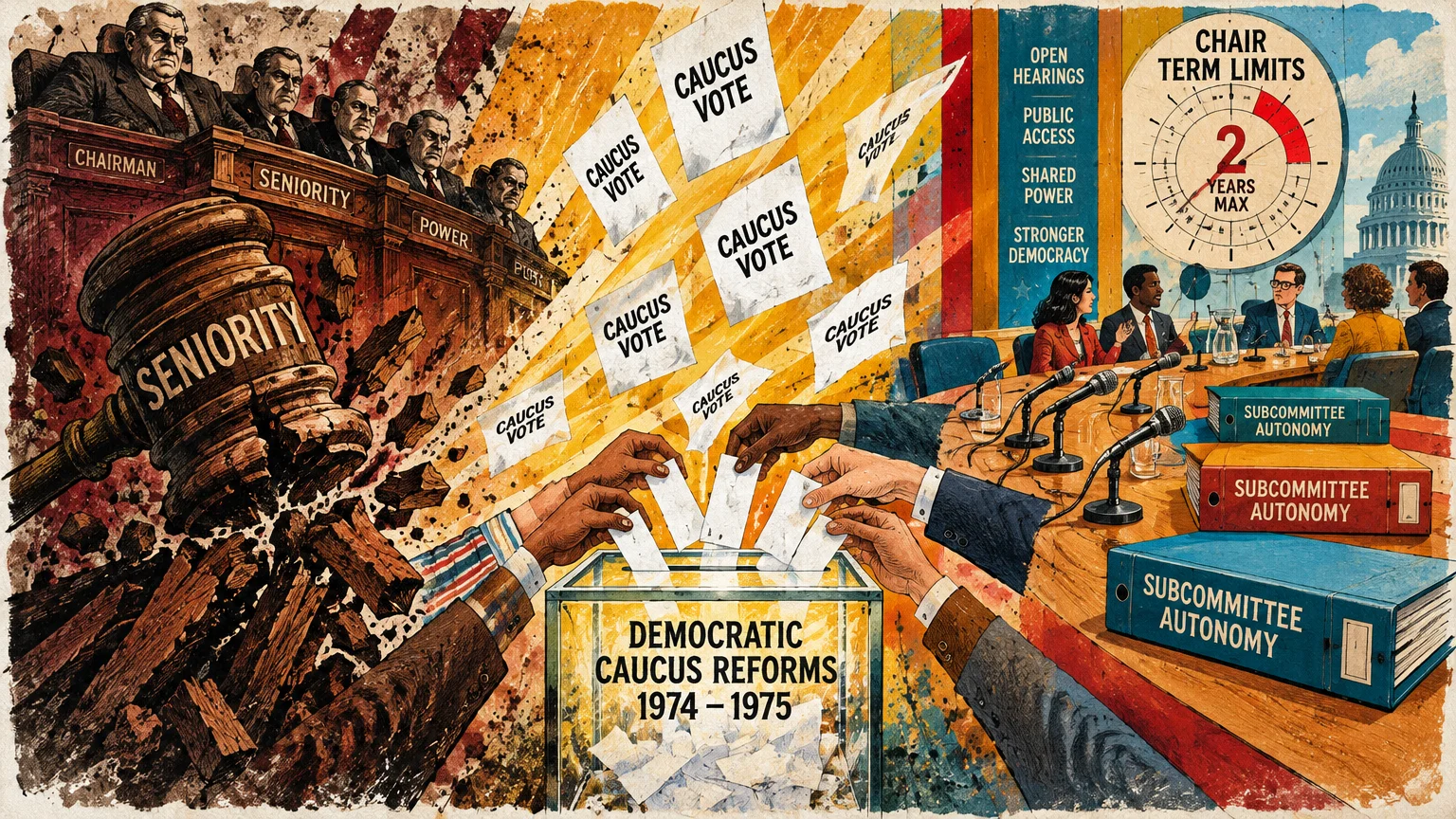
That model fractured in November 1974, when seventy-five reform-minded freshman Democrats were elected to the 94th Congress following the Watergate scandal. These incoming lawmakers allied with veteran reformers to challenge the unchecked autonomy of committee chairmen.
In January 1975, the House Democratic Caucus enacted secret-ballot elections for all committee gavels. The caucus promptly ousted three powerful sitting Southern chairmen: F.
Edward Hébert of Armed Services, W.R. Poage of Agriculture, and Wright Patman of Banking.
Reforms also established the 1973 “Subcommittee Bill of Rights,” which guaranteed subcommittees fixed jurisdictions, independent budgets, and separate staffs. Furthermore, House Democrats stripped the Ways and Means Committee of its appointment powers, transferring them to the Steering and Policy Committee.
You can examine the institutional documentation of this transition through the House Historian’s review of the 1975 seniority reforms.
When House Republicans won the majority in January 1995 under Speaker Newt Gingrich, they implemented a strict six-year term limit on committee and subcommittee chairs. You can review the evolution of these leadership rules in the Congressional Research Service analysis of committee chair selection.
While Democratic caucuses do not enforce chair term limits, secret-ballot retention votes ensure chairs remain responsive to caucus leadership. As a result of these sequential reforms, modern committee chairs operate as team players within a centralized party leadership system.
| Committee Chair | Committee | Chamber & Party | Chair Tenure | Primary Source of Leverage | Key Landmark or Action |
|---|---|---|---|---|---|
| Howard Worth Smith | House Rules | House (D-VA) | 1955–1967 | Gatekeeper of floor schedule | Civil Rights Act of 1964 Title VII |
| Wilbur Mills | House Ways and Means | House (D-AR) | 1958–1974 | Controlled committee assignments | Social Security Amendments of 1965 |
| Carl Vinson | House Armed Services | House (D-GA) | 1949–1953, 1955–1965 | Military procurement & bases | Two-Ocean Navy Act of 1940 |
| Richard Russell Jr. | Senate Armed Services | Senate (D-GA) | 1951–1953, 1955–1969 | Leader of Senate Southern bloc | MacArthur dismissal hearings (1951) |
| James O. Eastland | Senate Judiciary | Senate (D-MS) | 1956–1978 | Chaired judicial confirmations | Bypassed via Senate Rule XIV (1964) |
| John Dingell Jr. | House Energy and Commerce | House (D-MI) | 1981–1995, 2007–2009 | Broad regulatory jurisdiction | Clean Air Act Amendments of 1990 |
| Robert C. Byrd | Senate Appropriations | Senate (D-WV) | 1989–1995, 2001–2009 | Discretionary purse strings | Stepped down as leader to take gavel |
| Dan Rostenkowski | House Ways and Means | House (D-IL) | 1981–1994 | Tax code formulation | Tax Reform Act of 1986 |
Frequently Asked Questions About Congressional Committee Power
How did committee chairs acquire more power than party floor leaders?
The House revolt of March 19, 1910, stripped Speaker Joseph Cannon of his authority to appoint committee chairs and removed him from the Rules Committee. This reform transferred gatekeeping power to senior members who advanced automatically based on continuous service.
Because these senior chairs hailed from safe one-party districts, party floor leaders could neither discipline nor unseat them. Chairs held absolute authority to convene hearings, draft legislation, or kill bills without consulting party leadership.
What was the “Subcommittee Bill of Rights” of 1973?
Adopted by the House Democratic Caucus in 1973, the Subcommittee Bill of Rights stripped autocratic full committee chairs of unilateral authority. The reform required that subcommittees have established jurisdictions, independent operating budgets, and professional staff.
It also established that committee members, rather than the chair, selected subcommittee chairmanships. This reform dispersed procedural authority to junior lawmakers and prevented single barons from suffocating legislation favored by the party majority.
Can a modern committee chair still unilaterally kill a bill?
Modern committee chairs retain the authority to decide when hearings occur and which bills undergo committee markup. However, party leaders possess procedural tools to reassign bills, set floor deadlines, or use discharge mechanisms to bypass uncooperative chairs.
Furthermore, because chairs face secret-ballot elections in party caucus meetings at the start of every Congress, chairs who defy leadership directives risk immediate removal from their gavels.
Why do Republicans impose committee term limits while Democrats do not?
When House Republicans captured the majority in January 1995, they established a six-year, three-term limit on committee and subcommittee chairs to prevent power concentration. Both House and Senate Republicans maintain this restriction in their internal conference rules.
House and Senate Democrats reject term limits, arguing that uninterrupted tenure preserves vital institutional memory and deep subject-matter expertise. Democrats rely instead on secret-ballot caucus elections to remove underperforming or obstructionist committee leaders.