
When the House of Representatives impeaches a federal official, you have witnessed an indictment rather than a removal from office. The United States Constitution deliberately separates the power to accuse from the authority to judge.
Across American history, the House has impeached 21 individuals across 22 separate proceedings. Yet the Senate has convicted and removed only eight officials, and every single one was a federal judge.
Understanding the six distinct constitutional rules governing this mechanism helps you evaluate modern political battles against historical precedent. The public record reveals a demanding system designed to make removal exceedingly difficult.

The Constitutional Architecture of Federal Impeachment
The Framers of the Constitution created impeachment as a political remedy rather than a criminal process. They scattered its rules across Article I and Article II to balance legislative oversight against executive and judicial independence.
The system counts 21 distinct civil officials impeached by the House since 1797. The roster includes three presidents, one senator, two cabinet secretaries, and fifteen federal judges.
To evaluate how the process functions, you must understand each constitutional command governing formal charges, trials, thresholds, and punishments. The following six rules establish the boundaries of congressional power over federal officeholders.
The House Holds the Sole Power to Impeach by Simple Majority
Article I, Section 2, Clause 5 grants the House of Representatives the sole power of impeachment. This provision assigns the investigative and charging authority exclusively to the lower chamber of Congress.
In this initial phase, the House acts much like a grand jury. Representatives evaluate evidence, draft specific articles of impeachment, and debate whether the official’s conduct warrants a formal trial.
The constitutional threshold for House approval requires only a simple majority of members present and voting. If all 435 representatives cast ballots, 218 votes suffice to approve articles of impeachment.
The Office of the Historian of the U.S. House documents that the chamber first exercised this authority on July 7, 1797. On that date, the House voted to impeach Tennessee Senator William Blount.
The House approved articles against President Andrew Johnson in 1868 by a vote of 126 to 47. More than a century later, the chamber impeached President Bill Clinton in 1998 on two separate articles.
The chamber impeached President Donald Trump twice—first in December 2019 and again in January 2021. Trump remains the only federal official in United States history impeached on multiple occasions.
Most recently, the House impeached Secretary of Homeland Security Alejandro Mayorkas on February 13, 2024. The chamber passed House Resolution 863 by a narrow vote of 214 to 213.
Once the House approves at least one article, the official stands formally impeached. However, an affirmative House vote produces zero immediate change in the official’s legal authority or title.
The House selects several representatives, known as managers, to carry the articles to the Senate. These managers act as prosecutors before the upper chamber during the subsequent trial proceedings.
The Senate Holds the Sole Power to Try Impeachments by Two-Thirds Vote
Article I, Section 3, Clause 6 assigns the Senate the sole power to conduct trials on all impeachments. While the House levels the accusations, the Senate acts as both judge and jury.
The Constitution establishes a strict procedural condition before proceedings can commence. Senators must sit under oath or affirmation, transforming the legislative chamber into a specialized court of impeachment.
Securing a conviction requires a supermajority vote of two-thirds of the senators present. If all 100 senators cast votes, 67 must vote guilty on an article to remove the official.
According to the U.S. Senate Historical Office, this demanding threshold has protected almost every impeached official from removal. The Senate has convicted only eight individuals across 238 years.
All eight convicted officials were federal judges whose misconduct alienated members of both political parties. The Senate removed Judge John Pickering in 1804 and Judge G.
Thomas Porteous Jr. in 2010.
Every president tried by the Senate won acquittal because prosecutors failed to reach the two-thirds mark. Andrew Johnson survived removal in May 1868 by a single vote, tallying 35 guilty to 19 not guilty.
The Senate acquitted Bill Clinton in February 1999 when neither article secured even a simple majority. Senators split 50 to 50 on obstruction of justice and 45 to 55 on perjury.
During Donald Trump’s first trial in February 2020, the Senate acquitted him on votes of 52 to 48 and 53 to 47. His second trial in February 2021 ended in acquittal with 57 guilty votes to 43.
The Senate can also dispose of charges without conducting a full evidentiary trial. On April 17, 2024, the Senate voted along party lines to dismiss both articles against Secretary Mayorkas as unconstitutional.
A Senate conviction is final and irrevocable. The Constitution provides no mechanism for an appeal, ensuring that a two-thirds Senate vote permanently settles the matter of guilt.
The Chief Justice Presides Over Presidential Trials
Article I, Section 3, Clause 6 specifies that when the President of the United States faces trial, the Chief Justice shall preside. This requirement represents an intentional constitutional exception.
In standard impeachment trials, the Vice President of the United States presides as President of the Senate. The Senate’s President pro tempore assumes the chair whenever the Vice President is absent.
The Framers recognized an obvious structural conflict of interest regarding presidential impeachments. If the Senate convicted a president, the sitting vice president would instantly inherit the presidency.
To eliminate personal incentive from the proceedings, the Constitution strips the vice president of the gavel. The Chief Justice of the United States steps in as an impartial presiding officer.
Chief Justice Salmon P. Chase established the initial precedents while presiding over Andrew Johnson’s trial in 1868.
Chase asserted the power to rule on evidentiary disputes subject to Senate overrule.
Chief Justice William H. Rehnquist adopted a more reserved administrative approach during Bill Clinton’s trial in 1999.
Chief Justice John G. Roberts Jr. presided similarly during Donald Trump’s first trial in 2020.
However, the Chief Justice does not preside over the impeachment trials of former presidents. During Trump’s second trial in 2021, Trump had already completed his term and vacated the office.
Because the defendant was no longer the sitting president, Chief Justice Roberts declined to preside. Senate President pro tempore Patrick Leahy wielded the gavel instead throughout the February 2021 proceedings.
The Chief Justice’s authority remains strictly procedural rather than judicial in nature. The full Senate retains the ultimate constitutional power to overturn any procedural ruling made by the presiding officer.
Penalties Extend Only to Removal and Disqualification
Article I, Section 3, Clause 7 restricts the scope of congressional punishment in impeachment trials. The Senate cannot sentence a convicted official to prison, impose monetary fines, or seize property.
The Constitution limits judgment exclusively to removal from office and disqualification to hold future federal positions. Impeachment functions to safeguard public institutions rather than penalize criminal guilt.
Senate historical precedent separates the penalty of removal from the penalty of disqualification. A conviction on any single article triggers immediate, automatic removal from the civil office.
Barring an official from holding future office requires an entirely separate vote. Crucially, the Senate enforces disqualification through a simple majority vote rather than the two-thirds required for conviction.
The Senate has exercised this disqualification power against only three individuals in American history. All three were federal judges: West H.
Humphreys in 1862, Robert W. Archbald in 1913, and G.
Thomas Porteous Jr. in 2010.
When the Senate convicts an official but bypasses a disqualification vote, that individual remains eligible for federal service. The case of Judge Alcee L.
Hastings proves the practical impact of this rule.
The Senate convicted and removed Hastings from his federal judgeship on October 20, 1989. However, the Senate never held a vote to disqualify him from future federal office.
Hastings subsequently campaigned for federal office and won election to the House of Representatives in 1992. He served Florida in Congress for nearly three decades following his judicial removal.
Clause 7 also confirms that an impeached official remains liable to criminal prosecution. Removal shields no individual from ordinary indictment, trial, and sentencing in standard courts of law.
The Presidential Pardon Power Never Extends to Impeachment
Article II, Section 2, Clause 1 grants the president broad authority to grant reprieves and pardons for federal crimes. However, the text explicitly establishes one limitation: “except in Cases of Impeachment.”
This exception creates a crucial check on executive authority within the constitutional framework. A president cannot grant clemency to shield an executive subordinate from congressional scrutiny and removal.
Without this clause, a president could direct cabinet members to commit unlawful acts and protect them from legislative accountability. The limitation preserves Congress’s authority to purge corrupt executive officials.
A presidential pardon cannot reverse a Senate conviction or reinstate a removed official. Once the Senate enters a judgment of removal, that legislative decision stands beyond executive alteration.
Legal scholars analyzing the Congressional Research Service report on Impeachment and Removal highlight the clean divide between legal regimes. Impeachment addresses political abuse, while pardons address statutory crimes.
This limitation also prevents an executive from issuing a self-pardon to stop an impeachment trial. A president facing charges in the Senate must stand trial regardless of any executive proclamations.
However, the exception applies strictly to the legislative impeachment proceeding itself. The president retains standard pardon authority over any separate criminal offenses an impeached individual might have committed.
When Gerald Ford issued Proclamation 4311 on September 8, 1974, he pardoned Richard Nixon for all federal offenses. That pardon protected Nixon from criminal prosecution, but it carried zero authority over congressional impeachment proceedings.
Had the House impeached Nixon after his resignation, Ford’s pardon could not have stopped the Senate from trying him. The executive pardon power and the legislative impeachment power occupy distinct constitutional categories.
Removal Applies Exclusively to Civil Officers for Specified Offenses
Article II, Section 4 outlines both the targets of impeachment and the legal standards required for removal. The provision covers the President, Vice President, and all civil officers of the United States.
The phrase “civil officers” includes federal judges, cabinet secretaries, and agency heads confirmed by the Senate. It excludes military personnel, who answer instead to the Uniform Code of Military Justice.
The phrase also excludes members of the United States Senate and House of Representatives. The Senate established this foundational precedent during the 1797 impeachment of Senator William Blount.
The Senate expelled Blount under Article I, Section 5, which permits each chamber to expel members by a two-thirds vote. The Senate then dismissed the House’s impeachment charges on January 11, 1799, for lack of jurisdiction.
The Constitution Annotated analysis of Article II, Section 4 clarifies the permissible grounds for removal. An official may only be removed upon conviction for “Treason, Bribery, or other high Crimes and Misdemeanors.”
Treason and bribery represent defined criminal offenses within the constitutional text and federal statutes. In contrast, the phrase “high Crimes and Misdemeanors” carries a specialized historical meaning derived from British parliamentary practice.
The Framers rejected narrow definitions that would limit impeachment strictly to statutory indictments. The standard encompasses severe abuses of public power, gross negligence of duty, and violations of constitutional oaths.
The Senate’s first judicial removal demonstrated that a statutory crime is not strictly required. In 1804, the Senate convicted District Judge John Pickering for drunkenness and erratic behavior on the bench.
Subsequent removals have involved clear criminal behavior, including bribery, perjury, and kickbacks. Nevertheless, the constitutional text preserves legislative discretion to address non-criminal breaches of the public trust.

Every Federal Official Convicted and Removed by the U.S. Senate
The House has approved articles of impeachment against 21 individuals since the ratification of the Constitution. The Senate conducted trials for most of these officials, though several resigned before proceedings concluded.
Out of all 21 impeached officials, the Senate convicted and removed exactly eight individuals. The historical record reveals that every single removed official held a seat on the federal judiciary.
The following table details every successful removal in American history, including the year, office, Senate vote, and disqualification outcome.
| Year | Official | Office Held | Senate Vote | Disqualified? |
|---|---|---|---|---|
| 1804 | John Pickering | U.S. District Judge (NH) | 19–7 | No |
| 1862 | West H. Humphreys | U.S. District Judge (TN) | 38–0 | Yes |
| 1913 | Robert W. Archbald | U.S. Commerce Court | 68–5 | Yes |
| 1936 | Halsted L. Ritter | U.S. District Judge (FL) | 56–28 | No |
| 1986 | Harry E. Claiborne | U.S. District Judge (NV) | 87–10 | No |
| 1989 | Alcee L. Hastings | U.S. District Judge (FL) | 69–26 | No |
| 1989 | Walter L. Nixon | U.S. District Judge (MS) | 89–10 | No |
| 2010 | G. Thomas Porteous Jr. | U.S. District Judge (LA) | 96–0 | Yes |
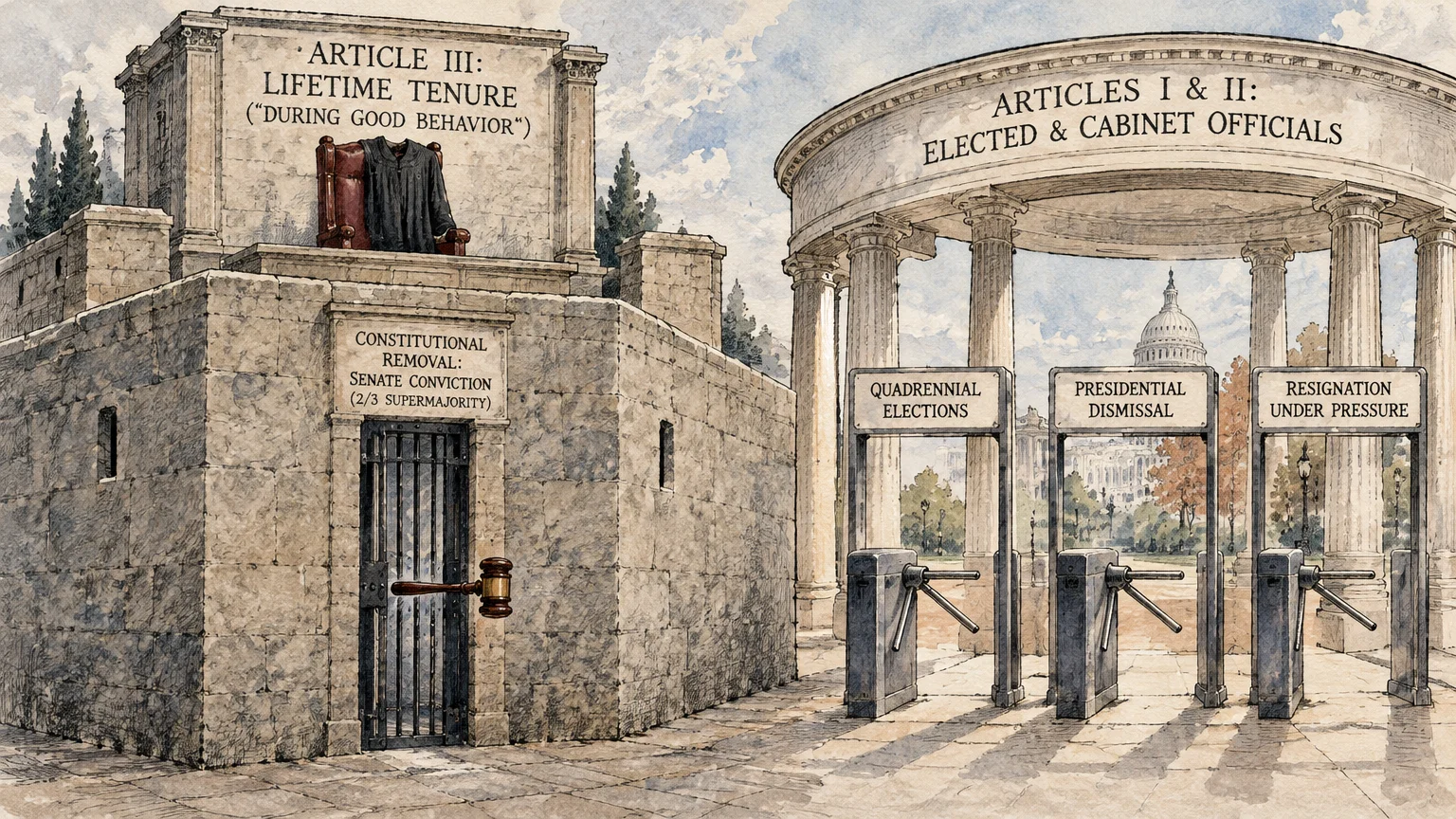
Why All Eight Removals in American History Involve Federal Judges
The fact that only federal judges have been convicted reveals how structural incentives operate in Washington. Executive branch officials operate under fundamentally different constitutional rules than life-tenured judges.
Article III of the Constitution grants federal judges lifetime tenure during “good Behaviour.” Consequently, impeachment represents the only constitutional mechanism to remove a corrupt or incapacitated judge from office.
Neither the President nor the Supreme Court possesses the authority to dismiss a federal district judge. If a judge refuses to resign, Congress must execute the entire impeachment process to vacate the seat.
In contrast, executive officials rarely require Senate removal to terminate their service. The President holds constitutional authority to dismiss cabinet secretaries and political appointees at will.
When cabinet officers face credible allegations of misconduct, they routinely resign or face immediate presidential firing. Secretary of War William Belknap resigned in 1876 mere hours before the House impeached him.
Presidents also face regular democratic accountability through national elections every four years. A president who loses public confidence can be voted out of office through the ballot box.
Furthermore, intense partisan polarization protects executive branch leaders in the modern Senate. Securing 67 votes requires substantial support from the president’s own political party.
When President Richard Nixon faced inevitable removal in 1974, his congressional support collapsed completely. Rather than endure House impeachment and a Senate trial, Nixon chose to resign on August 9, 1974.
Judicial impeachments, by comparison, frequently bypass intense partisan division. The Senate removed Judge Porteous in 2010 on a unanimous 96 to 0 vote after examining evidence of kickbacks and false statements.
Congress treats the judicial branch with bipartisan consensus when criminal corruption appears in the record. Partisan alignment routinely prevents that same consensus from forming against presidents.
Frequently Asked Questions About Federal Impeachment
Can Congress impeach and try an official who has already resigned?
Yes, historical precedent confirms that Congress retains jurisdiction to impeach and try former officials. In 1876, the House impeached Secretary of War William Belknap after he delivered his resignation to President Ulysses S.
Grant.
The Senate debated its jurisdiction and formally voted that Belknap remained subject to trial. Although the Senate ultimately acquitted Belknap, a majority of senators voted that former officials remain liable to trial.
The Senate reaffirmed this principle in February 2021 during the second trial of Donald Trump. Senators voted 56 to 44 that the Constitution permits the trial of a former president.
The constitutional rationale rests on the dual penalties established in Article I. Because the Senate can permanently disqualify an official from future office, resignation does not render the proceeding moot.
Why is Richard Nixon omitted from the list of impeached presidents?
Richard Nixon was never impeached by the United States House of Representatives. While the public frequently equates his downfall with impeachment, Nixon resigned before the House could vote.
The House Committee on the Judiciary did approve three articles of impeachment against Nixon in late July 1974. However, committee approval merely serves as a recommendation to the full legislative chamber.
Before the full House could debate or vote on the articles, Nixon released the “Smoking Gun” tape recording. Recognizing that the House would impeach him and the Senate would convict him, Nixon resigned on August 9, 1974.
Because the full House never adopted the articles on the floor, Nixon avoided formal impeachment. Only Andrew Johnson, Bill Clinton, and Donald Trump appear on the official roster of impeached presidents.
Can the Supreme Court overturn a Senate impeachment conviction?
The United States Supreme Court cannot review or overturn a Senate impeachment conviction. The high court addressed this precise question in the landmark 1993 ruling Nixon v. United States.
Judge Walter L. Nixon sued after his 1989 removal, arguing that a Senate committee trial violated Article I.
The Supreme Court ruled 9 to 0 that judicial review does not extend to Senate impeachment procedures.
Chief Justice William Rehnquist explained that the Constitution grants the Senate the “sole” power to try impeachments. This language commits trial procedures entirely to legislative discretion as a non-justiciable political question.
Allowing judicial appeals would disrupt the constitutional separation of powers. The Senate stands as the final court of review in all impeachment proceedings, free from judicial oversight.
Can members of the House or Senate be impeached?
No, members of Congress are not subject to the impeachment process. The Constitution categorizes representatives and senators as legislators rather than “civil officers of the United States.”
The Framers provided a separate, internal mechanism for congressional discipline in Article I, Section 5, Clause 2. Each chamber holds the authority to punish its members for disorderly behavior and expel them by a two-thirds vote.
When the House impeached Senator William Blount in 1797, the Senate did not remove him through an impeachment trial. Instead, the Senate voted 25 to 1 to expel Blount under its Article I disciplinary authority.
The Senate formally dismissed Blount’s impeachment articles in January 1799. That historic decision established the precedent that members of Congress answer to their respective chambers, not to the impeachment clause.




