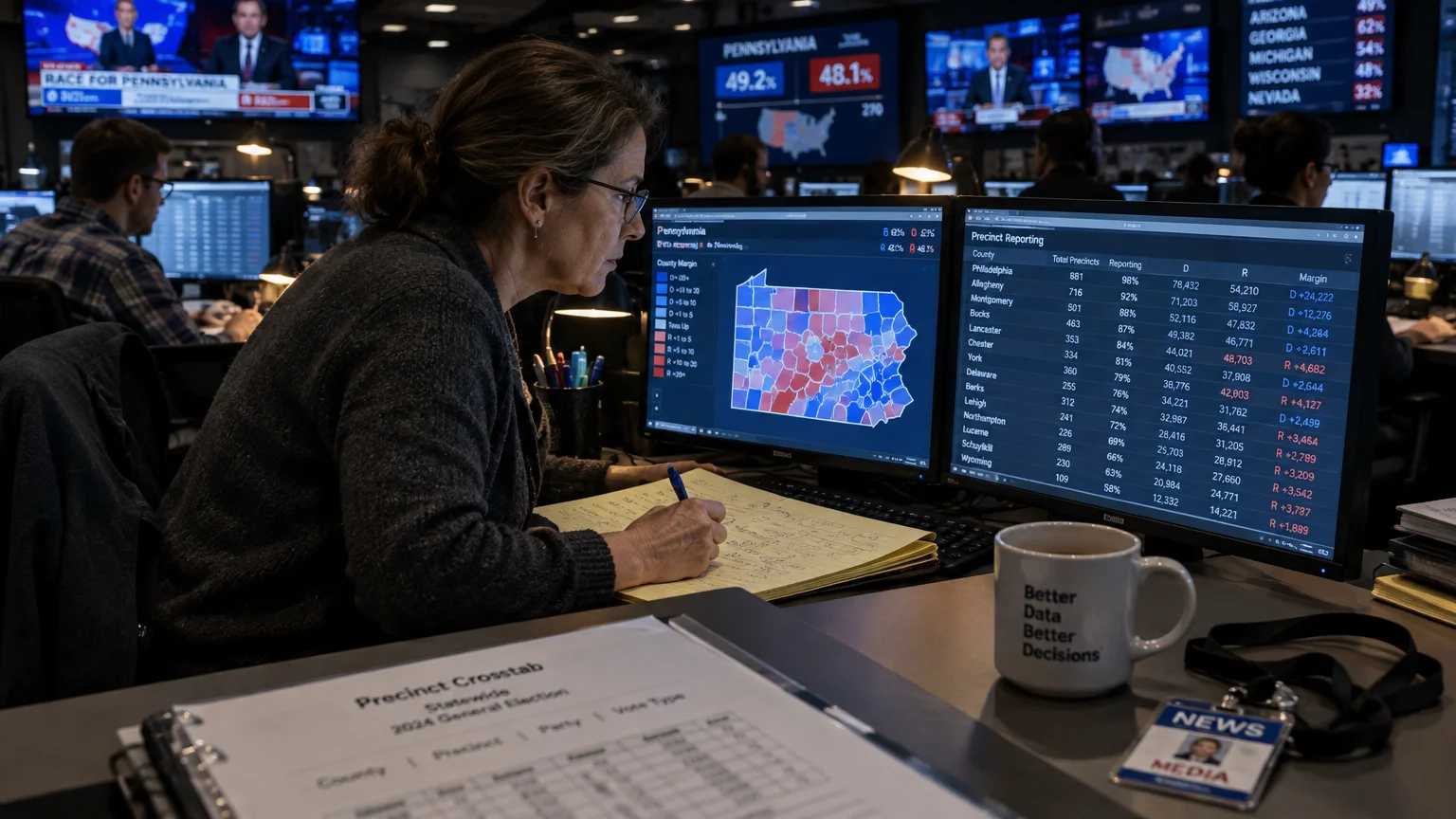
When television screens flash projected winners on election night, broadcasts display private statistical forecasts rather than legal election outcomes. Media decision desks use predictive models to determine when trailing candidates have no remaining mathematical path to victory.
Meanwhile, local and state election officials follow rigid statutory timelines to inspect, tally, and verify every physical ballot. Federal and state laws give zero legal weight to network declarations; only state-certified canvasses determine who takes office.
Framework: Operational and Legal Benchmarks
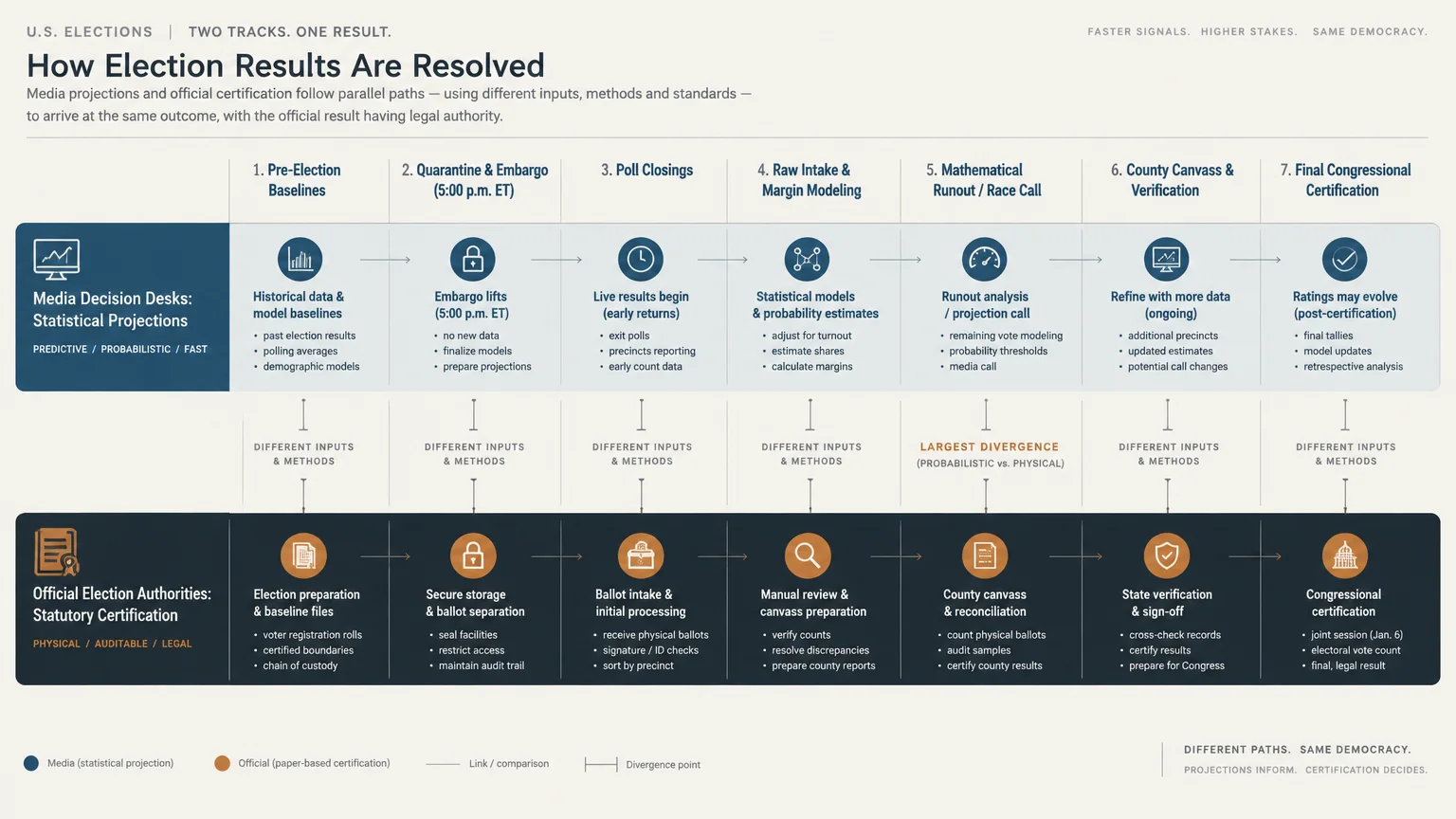
This list examines seven operational rules and statutory benchmarks that separate unofficial election-night media projections from legally binding election results. The first four entries cover private newsroom standards for poll-closing embargos, voter surveys, recount buffers, and county stringer reporting.
The final three entries trace the public statutory process from local ballot reconciliation and mandatory county certification to the federal Electoral Count Reform Act timetable. Each entry pairs newsroom protocols with the state and federal laws enforced by election boards and courts.
1. The Poll-Closing Embargo and Quarantine Protocol
Major news organizations enforce a broadcast embargo that forbids projecting a winner before scheduled polling places close in that jurisdiction. Even when statistical models show an insurmountable lead, decision desks hold calls until precinct doors close.
In 1980, NBC projected Ronald Reagan’s presidential victory at 8:15 p.m. Eastern Time, well before West Coast polls closed. That broadcast prompted congressional hearings and led news executives to adopt voluntary poll-closing embargos.
The rule faces its strictest test in states split across two time zones, including Florida, Indiana, Kentucky, and Tennessee. Networks wait until voting ends in the western counties unless a candidate’s lead exceeds the open zone’s entire voting-age population.
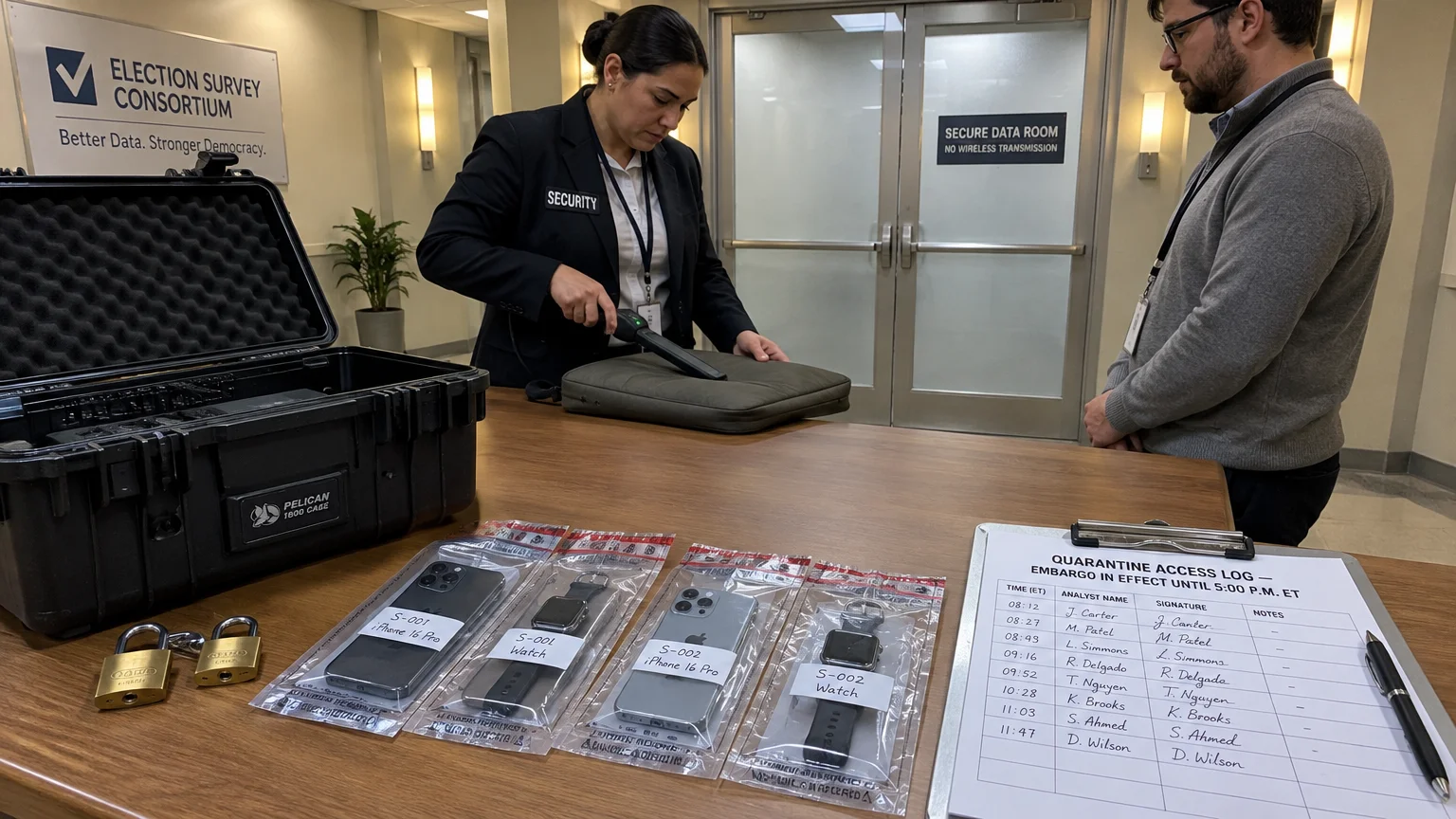
To prevent early data leaks, polling consortia isolate top survey analysts inside secure facilities known as quarantine rooms. Analysts surrender mobile phones, smartwatches, and internet access on Tuesday morning and analyze initial survey returns in isolation until 5:00 p.m. Eastern Time.
Federal law does not require this blackout; news organizations enforce the quarantine voluntarily to prevent market manipulation and premature leaks. Official election canvassers, by contrast, operate under state sunshine laws that mandate public notice and bipartisan observation rather than broadcast embargos.
2. Exit Polls, Probability Surveys, and Demographic Modeling
Since 2017, major American news organizations have evaluated the electorate through two major survey systems.
The National Election Pool—comprising ABC, CBS, CNN, and NBC—relies on Edison Research, while the Associated Press and Fox News use AP VoteCast, conducted by NORC at the University of Chicago.
Both systems adapted their methodologies to account for the sharp rise in early and mail-in voting over the past decade. Because precinct exit interviewers cannot reach mail-in voters, researchers conduct extensive probability-based telephone, mail, and online polling weeks before Election Day.
Analysts apply calibration weights to adjust raw demographic samples against verified state voter registration files and historical turnout records. Statisticians then combine those advance survey responses with Election Day precinct interviews and early county vote returns to model how uncounted ballots will break.
Administrative shifts in voting methods are detailed in the CRS Report on Federal Election Administration. State canvassing boards never consult survey data; state statutes require officials to tabulate verified physical ballots rather than demographic models.
3. The 0.5-Percent Recount Margin and Statistical Calling Thresholds
Media decision desks do not wait for election workers to open every envelope before projecting an apparent winner.
Instead, statistical algorithms estimate the number of uncounted ballots remaining in each county and evaluate whether the trailing candidate has any plausible mathematical path to overtake the leader.
Since 2019, the Associated Press has formally distinguished between races labeled “too early to call” and “too close to call.”
A contest remains too early to call while desks await representative county returns, and becomes too close to call when counting nears completion within a razor-thin margin.
Under AP operating rules, decision desks do not project a winner if the lead sits inside 0.5 percentage points or within a state’s mandatory recount threshold. That 0.5-percent buffer matches the statutory boundary that triggers automatic, publicly funded recounts in many states.
For example, Florida Statute § 102.141 mandates an automatic machine recount whenever a statewide or federal margin falls to 0.5 percent or less.
In Wisconsin, candidates trailing by 1 percent or less may petition for a recount, which is publicly funded only if the margin is 0.25 percent or less.
On election night, the AP also withholds calls in state legislative contests separated by less than 2 percentage points or 200 votes. Official recount boards follow statutory calendars, running paper ballots through calibrated optical scanners under bipartisan observation.
4. Decentralized County-Level Stringer Networks Versus Official Tabulation
The United States has no centralized federal election agency to collect and publish unofficial results on election night. To gather returns across more than 3,100 counties and independent cities, news organizations fund private data-collection networks operated by the Associated Press and Edison Research.
To power its nationwide count, the Associated Press deploys roughly 4,000 local stringers to county and municipal election offices. Stringers collect physical tally printouts from county clerks and transmit precinct figures to regional vote-entry centers, while automated scrapers capture county web uploads.
Approximately 800 AP vote-entry clerks and automated software checks verify incoming figures against historical county baselines and registered voter limits. The AP has conducted this unofficial count since 1848, when it gathered telegraph dispatches to report Zachary Taylor’s presidential victory.
In both the 2020 and 2024 general election cycles, the AP called winners across nearly 7,000 contests with a 99.9 percent accuracy rate. Despite that precision, stringer tallies remain private news reports with zero legal authority until state administrators certify official municipal repositories.
5. The Mandatory Canvass and the Strict Verification of Provisional Ballots
While media desks project winners within hours of poll closures, official state tallies require weeks of statutory reconciliation known as the canvass. During the canvass, bipartisan local boards reconcile precinct poll books against scanner logs to confirm that ballots counted match voter check-ins.
Local boards also review and adjudicate every provisional, absentee, and overseas military ballot cast in the jurisdiction. Under the Uniformed and Overseas Citizens Absentee Voting Act, eligible military and overseas ballots postmarked by Election Day receive extended arrival windows in many states.
Provisional ballots remain sealed until county clerks verify each voter’s registration status and confirm that the person did not already vote. Many states also provide statutory cure periods allowing voters to fix missing mail-ballot signatures or affidavit discrepancies before certification.
Standard reconciliation procedures are outlined in the U.S. Election Assistance Commission Canvassing and Certification Guide.
States such as Colorado and Georgia also conduct post-election risk-limiting audits, pulling random paper ballots to verify machine tabulation accuracy before finalizing results between two and four weeks after Election Day.
6. The Ministerial Legal Duty of County and State Certifying Boards
Once canvassing boards finish reconciling physical ballots, county and state bodies must formally certify the final vote totals. Under state election statutes and settled court precedent, certifying election results is a mandatory ministerial duty rather than a discretionary policy choice.
A ministerial duty gives certifying boards zero authority to withhold signatures over policy disputes, media projections, or unproven fraud allegations. State statutes require challenges and fraud claims to be litigated in court through formal election contests rather than decided by canvassing boards.
When local officials refuse to certify, state courts routinely issue emergency writs of mandamus compelling them to sign the returns immediately. In November 2022, an Arizona superior court judge ordered Cochise County supervisors to certify their county canvass after they missed the statutory deadline.
Officials who defy mandamus orders face judicial contempt citations, civil fines, removal from office, and criminal misdemeanor or felony charges. For an overview of federal administrative standards, see the CRS In Focus on Federal Role in U.S. Campaigns and Elections.
7. The Federal Electoral Count Reform Act Deadlines and Congressional Certification
For presidential elections, certified state tallies feed into a strict federal timetable established by the Electoral Count Reform Act of 2022.
Codified in Title 3 of the U.S. Code under Public Law 117-328, the statute replaced the Electoral Count Act of 1887 and repealed the old “safe harbor” provision.
Under the revised law, each state’s governor—or another official designated by state law enacted before Election Day—must issue a Certificate of Ascertainment at least six days before the electors meet.
The statute also creates an expedited review process before a three-judge federal district court panel, with direct appeal to the U.S. Supreme Court, to resolve certification disputes before that deadline.
Presidential electors convene in their respective states on the first Tuesday after the second Wednesday in December to cast their electoral votes.
As detailed by the National Archives and Records Administration, states transmit those signed certificates to Congress and the Archivist of the United States.
On January 6, the House and Senate meet in joint session to count the electoral votes, with 3 U.S.C. § 15 explicitly defining the Vice President’s presiding role as solely ministerial.
The 2022 law also raised the threshold for objecting to a state’s electoral votes from a single member of each chamber to at least one-fifth of both the House and the Senate.
| Dimension | Media Decision Desks | Official State Canvasses |
|---|---|---|
| Primary Objective | Rapid, accurate public forecasting | Legal certification of verified votes |
| Legal Standing | Zero legal or binding effect | Legally binding statutory outcome |
| Primary Data Source | AP/Edison stringers and voter surveys | Reconciled physical paper ballots |
| Reporting Speed | Minutes to hours after polls close | Two to four weeks post-election |
| Recount Buffer | Calls held if margin is under 0.5% | Mandatory statutory retabulations |
| Final Authority | Network decision desk directors | State canvassing boards and courts |
How Media Projections and Official Certifications Intersect
The gap between election-night media calls and official state certifications reflects their distinct institutional roles. News decision desks use statistical sampling and county stringer feeds to identify when a trailing candidate has no mathematical path to overtake the leader.
State election administrators, by contrast, cannot use statistical estimation and must verify every eligible absentee, provisional, and precinct ballot. Under state election codes and the Electoral Count Reform Act of 2022, only certified state canvasses confer legal authority to take office.
Frequently Asked Questions About Election Night Projections
Can a news organization retract a projected winner after calling a race?
Yes, networks retract race calls if later ballot batches or county data-entry corrections alter the mathematical trajectory of the count. Retractions are rare because desks hold projections inside a 0.5-percentage-point recount buffer, though networks famously retracted two presidential calls in Florida during the 2000 election.
Why do official state tallies take several weeks to complete after Tuesday?
State statutes require local boards to process timely postmarked mail ballots, overseas military ballots, and cured provisional envelopes before closing the count.
Bipartisan canvassers must also reconcile signed precinct poll books against scanner logs and complete statutory audits, a process that spans two to four weeks in most states.
What happens if a county canvassing board refuses to certify election results?
Because certification is a mandatory ministerial duty under state law, state courts issue emergency writs of mandamus ordering holdout boards to sign the canvas.
Officials who defy court orders face civil contempt fines, removal from office, or criminal prosecution, while courts leave fraud claims to post-certification lawsuits.
Does the federal government maintain an official vote-tally system on election night?
No, the U.S. Constitution assigns election administration to the states, and no federal agency operates a live election-night vote-counting system. Private news organizations, led by the Associated Press and Edison Research, deploy thousands of county stringers to compile unofficial national returns on election night.