You can track the path to the White House through seven battleground states that shifted political power over the past quarter-century. Understanding these certified margins shows you where presidential elections are truly decided.
Between the historic 2000 Florida recount and the November 5, 2024 election, demographic transitions reshaped both the Rust Belt and the Sun Belt. George W.
Bush won four of these battlegrounds in 2000, while Al Gore secured three.
Donald Trump swept all seven battlegrounds in 2024, securing 312 electoral votes against Kamala Harris. Reviewing the certified state data reveals how regional coalitions realigned over seven consecutive presidential cycles.
Tracking the Seven Decisive Battlegrounds from 2000 to 2024
This list examines certified election returns across the seven modern battlegrounds: Arizona, Georgia, Michigan, Nevada, North Carolina, Pennsylvania, and Wisconsin. It measures state outcomes between November 7, 2000, and November 5, 2024.
These specific seven states formed the decisive presidential arena because razor-thin margins separated the candidates in both 2020 and 2024. Together, they held 93 pivotal electoral votes in the 2024 presidential contest.
Arizona
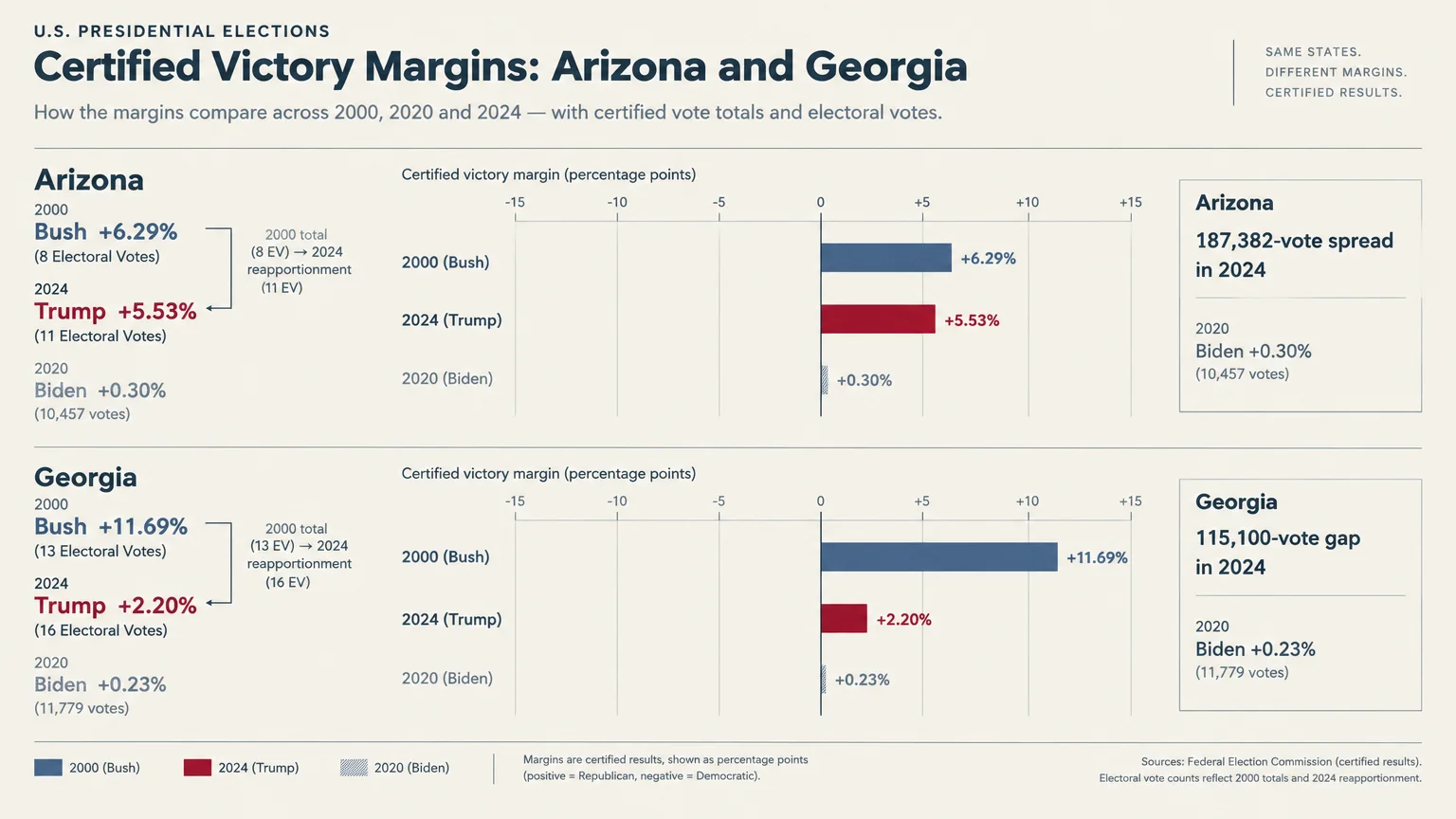
On November 7, 2000, Republican George W. Bush won Arizona by 6.29 percentage points, taking 781,652 votes to Democrat Al Gore’s 685,341.
Bush’s 96,311-vote margin confirmed Arizona’s standing as a dependable Republican stronghold.
Rapid suburban expansion across Maricopa County altered the state’s political profile over the following two decades. Reapportionment data from the U.S. Census Bureau expanded Arizona’s electoral allotment from 8 votes in 2000 to 11 in 2024.
In 2020, Joe Biden became the first Democrat to carry Arizona since Bill Clinton in 1996. Biden captured the state by 10,457 votes, finishing with 1,672,143 votes (49.36 percent) against Donald Trump’s 1,661,686 (49.06 percent).
Donald Trump reclaimed Arizona on November 5, 2024, winning 1,770,242 votes (52.22 percent) to Kamala Harris’s 1,582,860 (46.69 percent). That 187,382-vote difference produced a 5.53-point margin, the widest spread among all seven battlegrounds.
Arizona Secretary of State Adrian Fontes officially certified the statewide canvass on December 2, 2024, pursuant to Arizona Revised Statutes Section 16-648.
The Federal Election Commission documented Arizona’s 11 electoral votes for Donald Trump in its compiled general election report on January 16, 2025.
Georgia
George W. Bush carried Georgia decisively on November 7, 2000, winning by 11.69 percentage points.
Bush secured 1,419,720 votes (54.67 percent) to Al Gore’s 1,116,230 (42.98 percent), creating a 303,490-vote victory margin.
Robust population growth throughout the Atlanta metropolitan area transformed Georgia from a solid red state into an ultracompetitive battleground. Congressional reapportionment elevated the state’s Electoral College weight from 13 electoral votes in 2000 to 16 in 2024.
In 2020, Joe Biden carried Georgia by 11,779 votes, earning 2,473,633 votes (49.47 percent) against Donald Trump’s 2,461,854 (49.24 percent). This razor-thin 0.23-point margin represented the first Democratic presidential victory in Georgia since 1992.
Donald Trump reversed that outcome on November 5, 2024, tallying 2,663,117 votes (50.73 percent) against Kamala Harris’s 2,548,017 (48.53 percent). The resulting 115,100-vote gap yielded a certified 2.20-point victory margin.
Georgia Secretary of State Brad Raffensperger certified the general election returns on November 22, 2024, under Official Code of Georgia Annotated Section 21-2-499.
Certified canvass data on the Georgia Secretary of State election results page confirmed total voter turnout exceeding 5.2 million ballots.
Michigan
Democrat Al Gore won Michigan on November 7, 2000, capturing 2,170,418 votes (51.28 percent) to George W. Bush’s 1,953,139 (46.15 percent).
That 217,279-vote win maintained Michigan’s role in the Democratic Blue Wall.
Slower demographic growth across the industrial Midwest steadily reduced Michigan’s representation in Washington. The state held 18 electoral votes in 2000, but subsequent census apportionments dropped its total to 15 votes by 2024.
Donald Trump fractured that Blue Wall in 2016 by 10,704 votes, but Joe Biden won the state back in 2020. Biden garnered 2,804,040 votes to Trump’s 2,649,852, posting a 154,188-vote victory margin of 2.78 percentage points.
On November 5, 2024, Donald Trump flipped Michigan back to the Republican column by 80,103 votes. Trump earned 2,816,636 votes (49.73 percent), while Kamala Harris received 2,736,533 votes (48.31 percent), producing a 1.42-point margin.
Shifting vote shares among working-class suburban voters and union households confirmed Michigan as an Electoral College battleground rather than a safe partisan redoubt.
The Michigan Board of State Canvassers formally approved and certified the state’s presidential election canvass on November 25, 2024.
Nevada
George W. Bush won Nevada on November 7, 2000, collecting 301,575 votes (49.49 percent) compared to Al Gore’s 279,978 (45.94 percent).
That 21,597-vote margin gave Bush a 3.55-point victory in a state with just four electoral votes.
Massive population influx into Clark and Washoe counties spurred congressional growth. Nevada gained two additional electoral votes through decennial reapportionment, expanding its electoral delegation from four votes in 2000 to six in 2024.
Nevada backed Democratic presidential nominees across four consecutive elections from 2008 through 2020. Joe Biden won the state in 2020 by 33,596 votes, finishing with 703,486 votes to Donald Trump’s 669,890 for a 2.39-point spread.
Donald Trump ended that two-decade Democratic streak on November 5, 2024. Trump received 751,205 votes (50.59 percent) to Kamala Harris’s 705,197 (47.49 percent), winning Nevada by 46,008 votes, or 3.10 percentage points.
Shifts across service-industry corridors in Clark County anchored the state’s transition back to the Republican column.
The Justices of the Nevada Supreme Court met on November 26, 2024, to certify the statewide general election canvass pursuant to Nevada Revised Statutes 293.395.
North Carolina
George W. Bush secured North Carolina on November 7, 2000, by 12.81 percentage points.
Bush won 1,631,163 votes (55.96 percent) to Al Gore’s 1,257,692 (43.15 percent), a commanding margin of 373,471 votes.
Sizable corporate migration into Charlotte and the Research Triangle expanded the state’s political clout. Reapportionment following census counts increased North Carolina’s electoral vote allotment from 14 votes in 2000 to 16 in 2024.
Barack Obama narrowly won North Carolina in 2008 by 14,177 votes, marking the sole Democratic presidential win there since 1976. Donald Trump held the state in 2020, winning by 74,483 votes (1.34 percentage points) against Joe Biden.
Contrary to common misconceptions, North Carolina did not flip from Joe Biden in 2024. Trump won the state in both 2020 and 2024, making North Carolina the only core battleground that maintained its party alignment across both cycles.
On November 5, 2024, Trump widened his victory margin to 183,048 votes, capturing 2,898,423 votes (50.86 percent) against Kamala Harris’s 2,715,375 (47.65 percent). That outcome established a certified 3.21-point Republican victory.
The North Carolina State Board of Elections certified these final official results during its public canvass meeting on November 26, 2024.
Pennsylvania
On November 7, 2000, Al Gore carried Pennsylvania by 204,840 votes over George W. Bush, recording a 4.17-point margin.
Gore received 2,485,967 votes (50.60 percent) to Bush’s 2,281,127 (46.43 percent).
Pennsylvania commanded 23 electoral votes in 2000, but shifting national populations cost the commonwealth representation over time. Successive apportionments reduced Pennsylvania’s total to 19 votes by 2024, though it remained the cycle’s largest swing-state prize.
Donald Trump captured Pennsylvania in 2016 by 44,292 votes, breaking six straight Democratic victories. Joe Biden reclaimed the commonwealth in 2020 by 80,555 votes, winning 3,458,229 votes (49.85 percent) to Trump’s 3,377,674 (48.69 percent).
In 2024, Pennsylvania acted as the critical tipping-point state that sealed Donald Trump’s Electoral College victory. Trump won 3,543,308 votes (50.37 percent) to Kamala Harris’s 3,423,042 (48.66 percent), achieving a 120,266-vote margin of 1.71 percentage points.
Pennsylvania Secretary of the Commonwealth Al Schmidt officially certified the statewide presidential election return on November 27, 2024.
Official electors convened at the State Capitol in Harrisburg on December 17, 2024, to formally cast the commonwealth’s 19 electoral ballots.
Wisconsin
Wisconsin registered the narrowest spread among all seven battleground states on November 7, 2000. Al Gore edged George W.
Bush by just 5,708 votes, winning 1,242,987 votes (47.83 percent) to 1,237,279 (47.61 percent).
Gore’s 0.22-point margin foreshadowed a quarter-century of razor-thin presidential finishes. Reapportionment after the 2000 census reduced Wisconsin’s electoral delegation from 11 votes to 10, a baseline that held through the 2024 cycle.
Donald Trump carried Wisconsin in 2016 by 22,748 votes, and Joe Biden flipped it back in 2020 by 20,682 votes. Both elections saw margins fall well beneath one single percentage point.
On November 5, 2024, Wisconsin was the only state in the nation decided by less than one percentage point. Donald Trump carried the state by 29,397 votes, collecting 1,697,626 votes (49.60 percent) to Kamala Harris’s 1,668,229 (48.74 percent).
Trump’s 0.86-point margin marked the fourth consecutive presidential election in Wisconsin resolved by fewer than 30,000 total ballots.
The Wisconsin Elections Commission certified the official general election canvass on December 1, 2024, in accordance with Wisconsin Statutes Section 7.70.

Realignments, Demographic Shifts, and the Disappearance of Former Bellwethers
Between 2000 and 2024, major demographic realignments pushed several traditional swing states entirely out of the competitive battleground tier. States that long decided national elections drifted decisively into safe partisan territory.
Florida and Ohio once represented the definitive national bellwethers. George W.
Bush won Florida by 537 votes in 2000, while Ohio famously decided his 2004 reelection victory.
Historical archives from The American Presidency Project document how Ohio and Florida determined the presidency at the turn of the century. Subsequent shifts among working-class voters, retirees, and non-metropolitan communities steadily moved both states toward Republicans.
Donald Trump carried Ohio by more than eight percentage points across three consecutive elections. In Florida, Trump expanded his margin from 1.20 points in 2016 to over 13 percentage points in 2024, removing Florida from swing-state status.
Iowa underwent an identical transition toward the Republican column. After voting for Barack Obama twice, Iowa supported Donald Trump by solid margins in 2016, 2020, and 2024 due to durable rural realignments.
Conversely, Colorado and Virginia migrated firmly into the Democratic coalition. Both states voted Republican in 2000 and 2004, but rapid growth among college-educated suburban voters and professional industries altered their electorates.
By 2020 and 2024, Democratic presidential candidates carried Virginia and Colorado by margins exceeding normal battleground ranges. These shifts left presidential campaigns concentrated across the seven modern core states.
Presidential records published by the National Archives and Records Administration confirm this sharp geographic concentration of electoral battlegrounds. The following table tracks certified popular vote margins across these seven states over the last three presidential cycles.
| State | 2016 Margin | 2020 Margin | 2024 Margin | 2024 Winner |
|---|---|---|---|---|
| Arizona | Trump +3.55% | Biden +0.31% | Trump +5.53% | Trump |
| Georgia | Trump +5.16% | Biden +0.23% | Trump +2.20% | Trump |
| Michigan | Trump +0.23% | Biden +2.78% | Trump +1.42% | Trump |
| Nevada | Clinton +2.42% | Biden +2.39% | Trump +3.10% | Trump |
| North Carolina | Trump +3.66% | Trump +1.34% | Trump +3.21% | Trump |
| Pennsylvania | Trump +0.72% | Biden +1.16% | Trump +1.71% | Trump |
| Wisconsin | Trump +0.77% | Biden +0.63% | Trump +0.86% | Trump |
Official figures compiled in the Federal Election Commission report highlight how volatile these seven battlegrounds remained. A shift of fewer than 250,000 votes distributed across these states decided the entire 2024 Electoral College outcome.
Frequently Asked Questions About Modern Swing States
Does the Federal Election Commission certify presidential election results?
No, the Federal Election Commission does not certify election results. Under federal law, state election officials and canvassing boards certify their own popular vote totals.
The FEC compiles and publishes these state-certified numbers as an official public record, releasing its 2024 general election report on January 16, 2025.
Which battleground state had the closest finish in 2024?
Wisconsin recorded the narrowest margin in the 2024 presidential contest. Donald Trump carried Wisconsin by 29,397 votes, or 0.86 percentage points.
Wisconsin was the only state in the country decided by less than one single percentage point in 2024.
Did North Carolina flip from Joe Biden to Donald Trump in 2024?
No, North Carolina did not flip from Joe Biden in 2024. Donald Trump carried North Carolina in both 2020 and 2024.
Trump won North Carolina by 1.34 percentage points in 2020 and widened his certified margin to 3.21 percentage points in 2024.
How did Electoral College apportionment change these seven states between 2000 and 2024?
Sun Belt states gained representation while Rust Belt states lost it. Arizona gained three electoral votes, Georgia gained three, Nevada gained two, and North Carolina gained two.
Conversely, Pennsylvania lost four electoral votes, Michigan lost three, and Wisconsin lost one, shifting national political leverage toward the South and Mountain West.