
Title IX directs the flow of federal tax dollars to every corner of American education, far beyond varsity athletics. When you examine the 37-word statute, you discover a financial lever that opened professional degrees, faculty tenure, and laboratory research to millions of Americans.
Representatives Edith Green and Patsy Mink did not draft the measure as a sports policy. They designed it to strip federal funding from institutions that denied women equal access to classrooms and academic careers.
Today, this funding condition governs more than 17,600 school districts and 5,000 postsecondary institutions nationwide. Here is how that statutory rule reshaped American schooling.
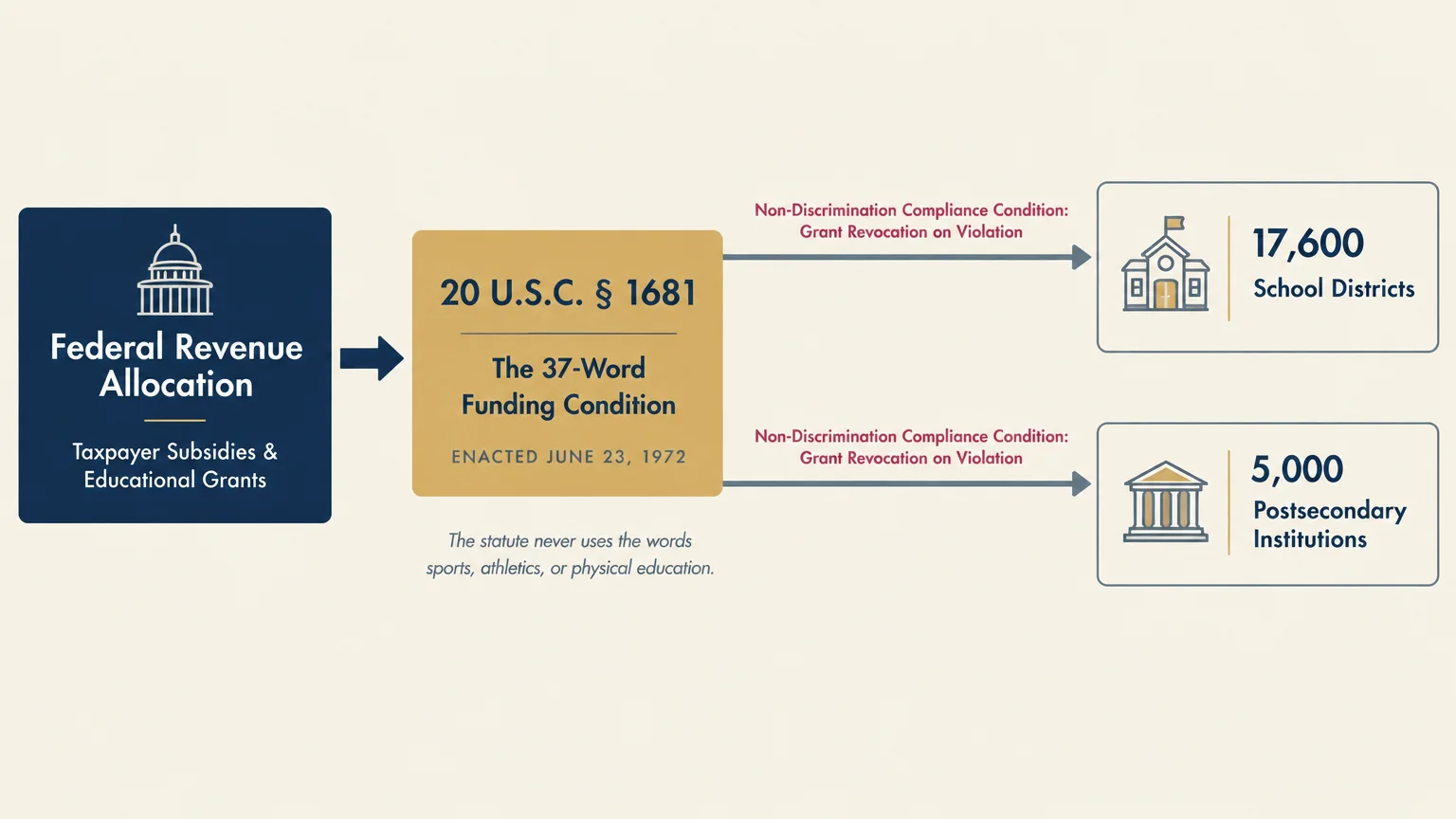
Mapping How Public Law 92-318 Redefined Federal Assistance
On June 23, 1972, President Richard Nixon signed the Education Amendments of 1972 into law. The statute, recorded as Public Law 92-318, introduced a revolutionary funding condition to American schooling.
Codified at 20 U.S.C. § 1681, the core statute contains exactly 37 words. The text never once uses the words “sports,” “athletics,” or “physical education.”
Instead, the statute conditions every stream of federal educational revenue on sex non-discrimination. Any institution that maintains discriminatory practices places its entire federal grant allocation at immediate risk.
Lawmakers designed this mechanism to protect both educational access and federal revenue integrity. When universities accept taxpayer subsidies, they enter into a binding covenant with the federal government.
This list tracks nine non-athletic areas transformed by Title IX between June 1972 and 2026. We selected each entry based on federal statutes, binding regulations, or landmark Supreme Court decisions.
Our editorial team cross-referenced each milestone against legislative rolls, executive agency data, and federal court dockets. These entries demonstrate how Congress transformed government spending power into an enduring instrument of civil rights compliance.
Each entry highlights the statutory citations, federal court holdings, and practical governance rules that shape your educational rights. Understanding these administrative mechanics clarifies how federal spending controls institutional policy nationwide.
By reviewing these legal standards, you can understand how federal dollars continue to protect students, instructors, and researchers across the country. Here is how that statutory funding rule operates across American education.
Eliminating Admissions Quotas and Gender Caps in Higher Education
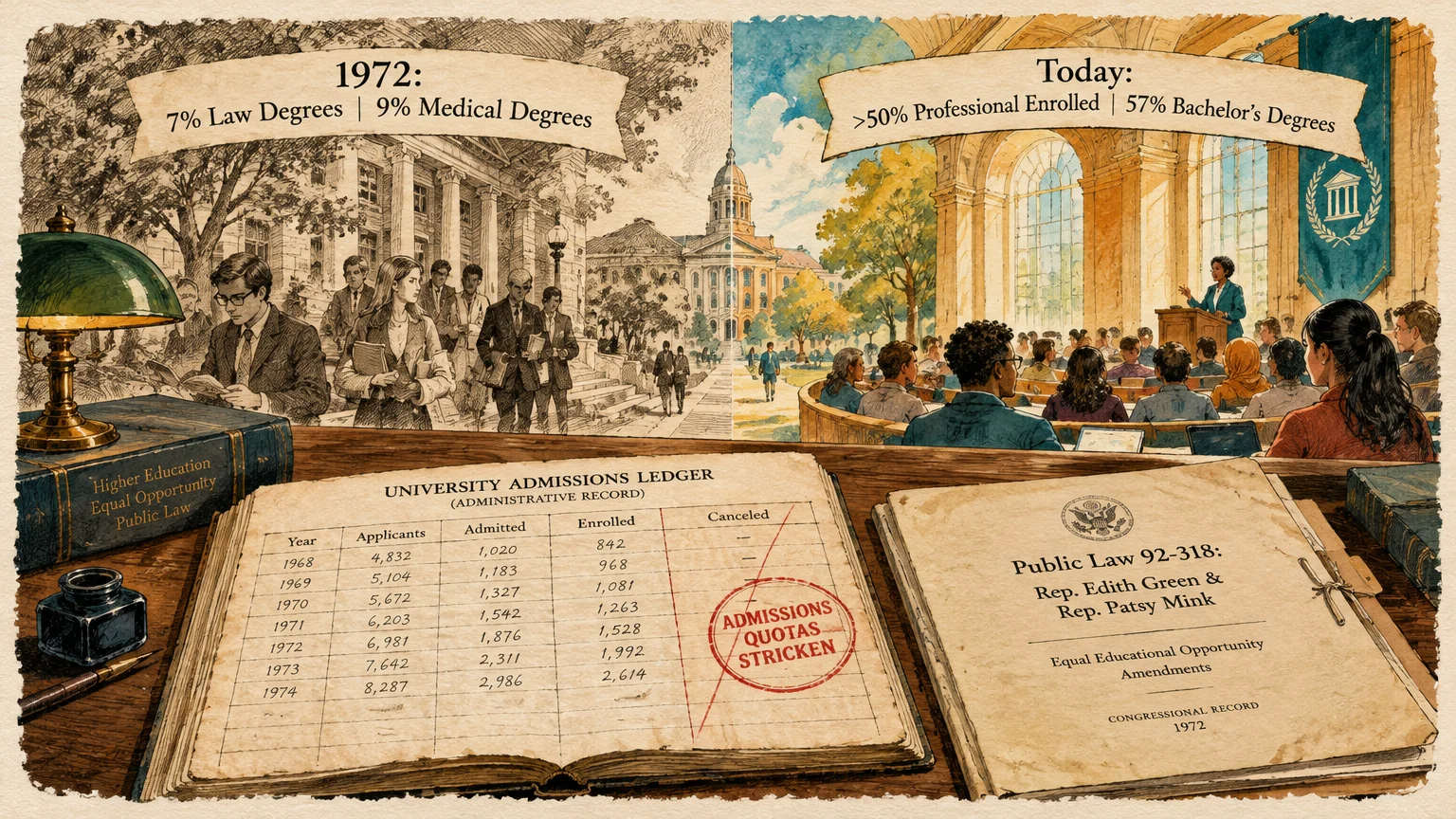
Before 1972, American universities routinely enforced numerical quotas that capped female enrollment across undergraduate and graduate programs. Elite professional schools openly limited women to single-digit percentages of each incoming class regardless of their test scores or qualifications.
Representative Edith Green of Oregon and Representative Patsy Mink of Hawaii drafted Title IX to dismantle these artificial ceilings. They targeted institutions that absorbed federal tax subsidies while locking women out of professional training.
Public records document the dramatic gender imbalances that existed when President Nixon signed the statute. In 1972, men represented 57 percent of college students, while women earned just 7 percent of law degrees and 9 percent of medical degrees.
Today, those admissions disparities have entirely vanished across federally funded campuses. Women earn roughly 57 percent of all bachelor’s degrees and account for more than 50 percent of all students enrolled in accredited American medical and law schools.
- Enacted as part of Public Law 92-318 on June 23, 1972.
- Eliminated admissions quotas across federally funded graduate and professional schools.
- Shifted medical and law school female enrollment from under 10 percent to over 50 percent.
Desegregating K–12 Vocational and Technical Courses
Prior to 1972, public school districts regularly sorted secondary students into separate courses based on biological sex. High schools barred female students from enrolling in auto mechanics, woodworking, and mechanical drafting while prohibiting male students from taking home economics.
The nondiscrimination mandate in Public Law 92-318 applied directly to local public school districts that accepted federal assistance. School boards could no longer receive federal secondary school grants if they restricted vocational course access by gender.
Federal officials enforced this mandate through grants authorized by the Carl D. Perkins Vocational and Technical Education Act.
To maintain eligibility for federal Perkins funds, districts had to open all technical, agricultural, and industrial training courses to all students.
This funding requirement eliminated segregated tracking in secondary schools across the country. It established formal pathways for female students to enter skilled manufacturing trades, computer-aided drafting, and certified technical career fields.
- Codified statutory compliance under 20 U.S.C. § 1681 for secondary public schools.
- Conditioned Carl D. Perkins federal vocational grants on desegregated course enrollment.
- Prohibited sex-exclusive admissions policies for technical and career training academies.
Protecting Pregnant and Parenting Students From Academic Exclusion
For generations, public elementary and secondary schools routinely expelled pregnant students or coerced them into withdrawing. Administrators justified these punitive exclusions by arguing that visibly pregnant teenagers disrupted classroom discipline and compromised institutional moral standards.
In July 1975, federal regulators promulgated formal Title IX administrative rules that outlawed these discriminatory practices. Codified at 34 C.F.R. § 106.40, the regulation expressly forbids federally funded schools from excluding or discriminating against any student based on pregnancy, childbirth, or termination.
Under this federal rule, schools must treat pregnancy and related conditions like any other temporary medical leave. Instructors must excuse documented medical absences and permit returning students to resume the exact academic standing they held before taking leave.
If a school district provides a specialized alternative program for parenting teens, that program must offer instructional quality completely equal to standard courses. Violating these parenting protections places a district’s federal education funding at direct risk of administrative forfeiture.
- Established binding protections under federal regulation 34 C.F.R. § 106.40 in July 1975.
- Mandated excused medical leave for childbirth without academic penalty or loss of standing.
- Required alternative instructional programs for young parents to match mainstream curricular standards.
Securing Equal Employment and Faculty Tenure Rights
Following the enactment of Title IX, university boards and school districts argued that the statute applied solely to enrolled students. Educational employers claimed they retained complete discretion to make sex-based distinctions regarding faculty hiring, compensation, and tenure promotion.
Two Connecticut public school systems challenged federal regulatory authority after female instructors filed sex discrimination complaints over employment benefits and maternity leave. That legal dispute reached the nation’s highest court as North Haven Board of Education v. Bell.
On May 17, 1982, the Supreme Court ruled 6–3 that Title IX’s statutory protections extend directly to employees. Writing for the majority, Justice Harry Blackmun held that Section 901(a) encompasses all personnel employed by federally assisted education programs.
This ruling transformed university faculty governance and employment contracts across the nation. Colleges had to eliminate gender pay inequities and reform tenure review procedures to avoid losing their vital federal research and institutional funding.
- Decided by the Supreme Court in a 6–3 ruling on May 17, 1982.
- Interpreted Section 901(a) of Title IX to protect educational staff and professors.
- Prohibited sex discrimination in academic hiring, compensation packages, and faculty tenure reviews.
Establishing Student Financial Aid as Federal Institutional Assistance
Many private colleges sought to escape federal civil rights mandates by refusing direct institutional funding or government construction loans. Grove City College, a private Christian college in Pennsylvania, intentionally declined all direct state and federal funds to preserve institutional independence.
However, numerous Grove City students paid their tuition using federal Basic Educational Opportunity Grants, now known as Pell Grants. Federal officials argued that this indirect student aid triggered full institutional compliance under federal Title IX mandates.
On February 28, 1984, the Supreme Court delivered a landmark 7–2 ruling in Grove City College v. Bell. The Court affirmed that student financial aid grants constitute federal financial assistance to the educational institution itself.
This ruling established that private colleges cannot enroll students using federal financial aid while asserting immunity from civil rights standards. By enrolling students who use federal grants, private institutions voluntarily subject themselves to federal regulatory enforcement.
- Decided by the Supreme Court on February 28, 1984 (465 U.S. 555).
- Affirmed 7–2 that federal student grants like Pell Grants trigger Title IX jurisdiction.
- Brought thousands of independent private colleges under federal civil rights compliance rules.
Restoring Campus-Wide Compliance Through Federal Mandates
While the Grove City ruling established that student aid constitutes federal funding, the Court created a severe enforcement loophole. The majority ruled that Title IX applied only to the specific department receiving funds—in Grove City’s case, its financial aid office.
This narrow interpretation meant universities could legally discriminate in academic departments, athletics, or administrative hiring if those specific units did not receive direct federal grants. Civil rights advocates warned this decision neutralized effective federal oversight.
Congress responded by drafting the Civil Rights Restoration Act of 1987. When President Ronald Reagan vetoed the legislation, Congress overrode his veto on March 22, 1988, by votes of 73–24 in the Senate and 292–133 in the House.
Enacted as Public Law 100-259, this statute amended Title IX to define an entire educational institution as a covered entity. If any single department of a college accepts federal funding, the entire institution must comply across all operations.
- Passed over presidential veto by bipartisan supermajorities on March 22, 1988.
- Overturned the restrictive program-specific rule established in Grove City College v. Bell.
- Established that federal aid to one campus office binds the entire educational institution.
Expanding Opportunities in Doctoral Programs and STEM Research
When Title IX passed in 1972, American men earned eight times as many doctoral degrees as women. Major research universities directed federal fellowship grants, laboratory appointments, and post-doctoral stipends almost exclusively toward male doctoral candidates.
Legislative records from the Patsy T. Mink Papers at the Library of Congress show that drafters intentionally targeted discriminatory graduate practices. Mink argued that federal research dollars should never subsidize academic departments that barred qualified women from scientific discovery.
Federal research agencies, including the National Science Foundation and the National Institutes of Health, condition all institutional grant awards on Title IX compliance. Graduate schools risk losing millions of dollars in federal research awards if they permit sex bias in lab access or research fellowships.
This statutory leverage compelled major research institutions to open laboratory benches, technical fellowships, and faculty research appointments to female scholars. Today, women earn more doctoral degrees overall than men and occupy leadership positions across major federally funded scientific research centers.
- Tied federal scientific research grants from NSF and NIH to sex nondiscrimination.
- Dismantled historical male-only doctoral admissions quotas and laboratory assignment limits.
- Shifted graduate degree attainment from an 8-to-1 male ratio to female parity.
Mandating Institutional Title IX Coordinators and Grievance Systems
Federal funding conditions require reliable administrative enforcement structures on every campus. In July 1975, federal regulators introduced structural accountability requirements codified at 34 C.F.R. § 106.8 to manage civil rights compliance.
Under this federal rule, any school district or postsecondary institution receiving federal funds must formally designate at least one employee as Title IX Coordinator. This coordinator oversees institutional compliance, coordinates mandatory staff training, and manages all sex discrimination inquiries.
The regulations also mandate that institutions publish and maintain prompt, equitable grievance procedures for resolving sex discrimination complaints. Schools must prominently distribute their coordinator’s direct contact information to all enrolled students, employees, and prospective applicants.
Failing to employ a certified coordinator or maintain compliant grievance protocols constitutes an independent regulatory violation. The Department of Education can suspend or terminate federal education funding to any school that neglects these basic administrative mandates.
- Codified administrative requirements under federal regulation 34 C.F.R. § 106.8 in 1975.
- Required all federally funded educational institutions to appoint an official Title IX Coordinator.
- Mandated formal, published grievance procedures for students, parents, and school employees.
Establishing Financial Liability and Grievance Standards for Harassment
For two decades following Title IX’s passage, school administrators often treated campus harassment as an internal disciplinary issue rather than a civil rights violation. Without financial exposure, schools rarely dedicated sufficient resources to investigate allegations or protect vulnerable victims.
In 1992, the Supreme Court decided Franklin v. Gwinnett County Public Schools, ruling unanimously that individuals can recover monetary damages from schools under Title IX.
Seven years later, the Court established peer harassment standards in Davis v. Monroe County Board of Education.
In Davis, the Court held that federally funded schools face monetary liability if officials display deliberate indifference to known, severe, and pervasive peer sexual harassment. This ruling created substantial financial risk for institutions that ignored reported student abuse.
Following a nationwide federal district court order on January 9, 2025, that vacated the 2024 administrative rewrite, schools continue to follow the 2020 regulations. This operative framework requires colleges to conduct formal live hearings with cross-examination during sexual misconduct adjudications.
- Authorized monetary damages for intentional discrimination in Franklin v. Gwinnett County (1992).
- Established school liability for deliberate indifference in Davis v. Monroe County (1999).
- Enforced procedural live-hearing standards under operative 2020 Title IX federal regulations.
| Area Reshaped | Year | Governing Authority | Federal Funding Condition |
|---|---|---|---|
| University Admissions | 1972 | Public Law 92-318 | Prohibits enrollment caps and quotas. |
| K–12 Vocational Tracks | 1972 | 20 U.S.C. § 1681 | Conditions Perkins grants on open access. |
| Pregnant Students | 1975 | 34 C.F.R. § 106.40 | Bars expulsion; protects medical leave. |
| Faculty Employment | 1982 | North Haven v. Bell | Applies funding rules to hiring and tenure. |
| Indirect Student Aid | 1984 | Grove City v. Bell | Pell Grants establish Title IX jurisdiction. |
| Institution-Wide Scope | 1988 | Public Law 100-259 | Binds entire campus if any unit takes aid. |
| STEM Research Grants | 1972 | 20 U.S.C. § 1681 | Ties NSF and NIH awards to non-discrimination. |
| Compliance Officers | 1975 | 34 C.F.R. § 106.8 | Mandates coordinators and grievance systems. |
| Harassment Liability | 1992 | Franklin v. Gwinnett | Permits monetary damages for violations. |
How Title IX Converted Federal Dollars into Civil Rights Enforcement
Title IX fundamentally transformed how the federal government interacts with local educational institutions. Rather than imposing direct federal curriculum control, Congress relied on its constitutional spending power under Article I, Section 8.
Under this Spending Clause framework, federal educational assistance functions as a binding legal contract. When an institution accepts federal dollars, it voluntarily agrees to comply with comprehensive federal civil rights mandates.
The Civil Rights Restoration Act of 1987 established that this funding agreement covers the entire school. An institution cannot isolate federal aid within a single department while permitting discriminatory practices elsewhere on campus.
The U.S. Department of Education’s Office for Civil Rights (OCR) actively enforces these contractual obligations. OCR currently exercises jurisdiction over approximately 17,600 local school districts and more than 5,000 postsecondary institutions nationwide.
Federal funding streams covered by Title IX include Pell Grants, direct federal research awards, and Carl D. Perkins vocational allocations.
Even non-academic entities like public libraries and municipal museums fall under this statutory umbrella if they accept federal grants.
If an institution refuses to correct identified civil rights violations, OCR can initiate formal administrative proceedings to terminate all federal funds. Alternatively, the agency can refer recalcitrant institutions to the Department of Justice for judicial enforcement.
Because federal grants and student loan dollars provide essential operating revenue, schools almost never risk fund termination. Instead, institutions consistently agree to legally enforceable resolution agreements that mandate comprehensive policy reforms.
Federal courts continue to shape how agencies administer these spending conditions. Following the nationwide vacatur of the 2024 regulations on January 9, 2025, schools operate under the procedural requirements of the 2020 framework.
That operative standard requires higher education institutions to maintain transparent investigation processes, including live hearings with advisor cross-examination. These procedural rules protect both complaining witnesses and accused individuals throughout formal administrative investigations.
These legal mechanics prove that Title IX is fundamentally a federal financing statute. The 37-word law remains one of the most powerful spending levers in American history.
Frequently Asked Questions About Title IX and Federal Funding
Does Title IX mention college athletics anywhere in its statutory text?
No. The core statutory text enacted in 1972 contains just 37 words and does not mention sports, athletics, or teams. Congress focused on eliminating sex discrimination in admissions, academic departments, and faculty employment.
Specific regulatory guidelines governing varsity and intercollegiate sports were introduced three years later, when federal agencies promulgated comprehensive administrative rules in July 1975.
Those 1975 administrative rules required proportional athletic opportunities and scholarship allocations to mirror academic nondiscrimination standards across funded campuses.
Can a private college avoid Title IX rules by declining direct federal grants?
Under the Supreme Court’s ruling in Grove City College v. Bell, indirect aid triggers federal jurisdiction.
If your students use federal Pell Grants or guaranteed student loans, your institution must comply.
Only a tiny handful of private institutions that refuse all direct and indirect federal aid remain legally exempt from Title IX enforcement.
If an exempt college accepts even a single competitive federal research grant, that award immediately activates campus-wide Title IX oversight under the Civil Rights Restoration Act.
What federal regulations currently govern Title IX enforcement across schools?
Following a federal court order on January 9, 2025, that vacated the Biden administration’s 2024 regulatory rewrite nationwide, schools operate under the 2020 framework.
These 2020 regulations require postsecondary institutions to conduct formal live hearings with advisor cross-examination when adjudicating formal sexual misconduct complaints.
K–12 school districts must follow formal grievance protocols under the 2020 framework, though elementary and secondary schools are not required to hold live cross-examination hearings.
How does the federal government penalize a school that violates Title IX?
The Department of Education’s Office for Civil Rights investigates violations and can initiate administrative proceedings to terminate all federal financial assistance. OCR can also refer non-compliant institutions to the Department of Justice.
In practice, institutions almost always enter into binding resolution agreements to remedy violations rather than risk losing millions of dollars in federal funding.
In addition to administrative penalties, individuals can file private civil lawsuits in federal court to seek monetary damages under Supreme Court precedents.