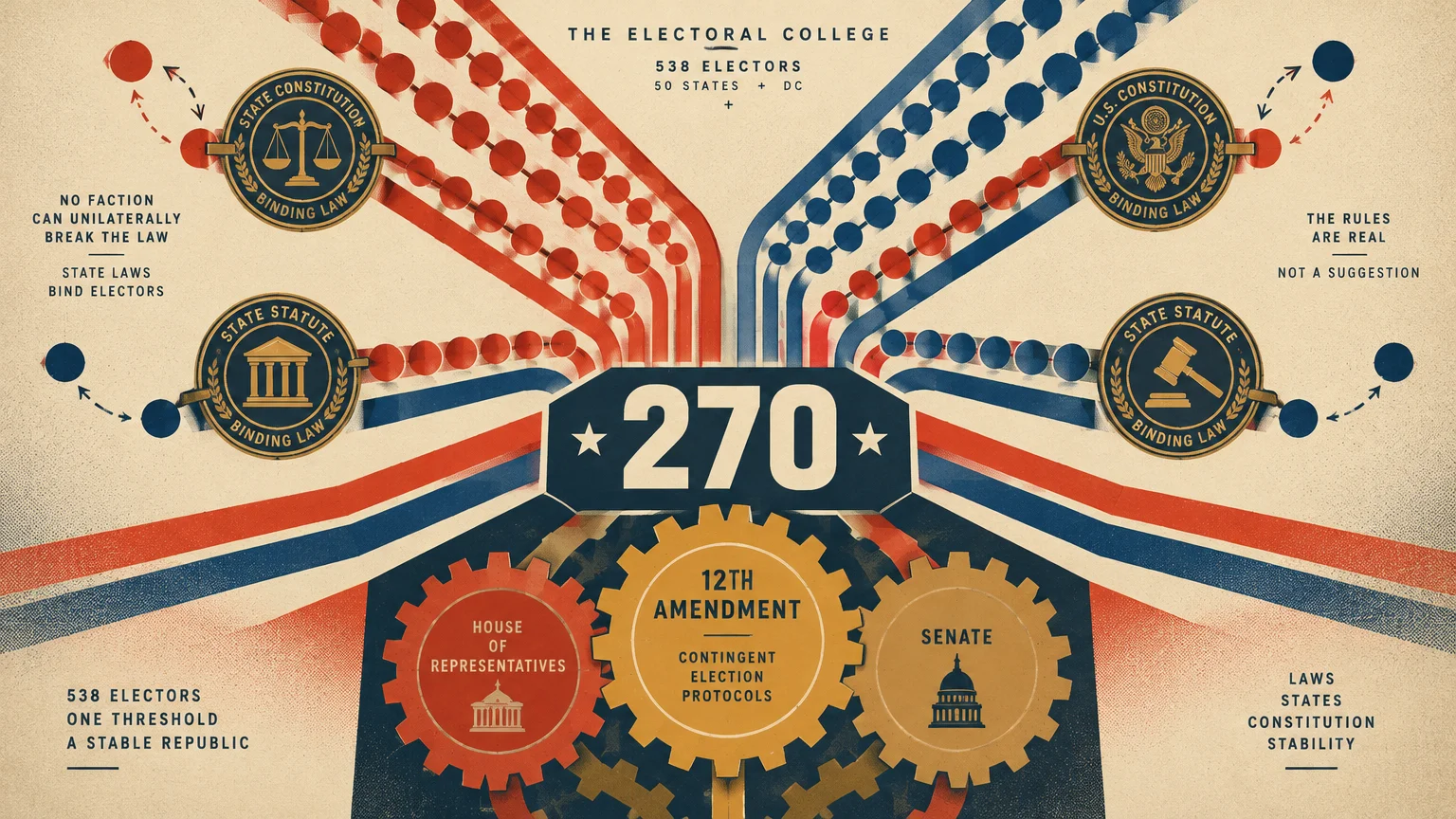
Every four years, you hear pervasive claims about how presidential electors vote, whether rogue delegates can swing an election, and what happens if nobody reaches a majority. Most of these popular assumptions directly contradict federal statutes, Supreme Court rulings, and constitutional procedures.
Misunderstanding these rules can leave you unprepared for how disputed counts, state certifications, and contested ballots actually unfold under the law. We verified the historical record against constitutional provisions, statutory updates, and court precedents.
Here is the statute-by-statute reality behind the modern Electoral College system and how electors cast your presidential ballots.
How We Evaluated Modern Electoral College Rules and Historical Precedents
Our editorial team evaluated the rules governing all 60 quadrennial presidential elections held through the 2024 election. We assessed federal statutes, constitutional amendments, and binding legal precedents through January 22, 2026.
We specifically focused on three contested areas of the system: the independence of individual electors, the allocation models used by individual states, and the exact protocols triggered during an electoral deadlock.
To verify the legal standing of each myth, we examined primary materials from the National Archives, the Congressional Research Service, and the records of the United States Supreme Court.
We also analyzed the statutory changes enacted under the Electoral Count Reform and Presidential Transition Improvement Act of 2022 to reflect how federal certification functions today.
These eight entries represent the most frequent legal and historical misunderstandings cited by voters, commentators, and civic organizations.
Electors Possess Absolute Freedom to Vote Against Their Pledged Candidate
You often hear that presidential electors serve as completely independent agents who can vote for anyone they choose once appointed. The United States Supreme Court definitively rejected this idea in a landmark constitutional ruling.
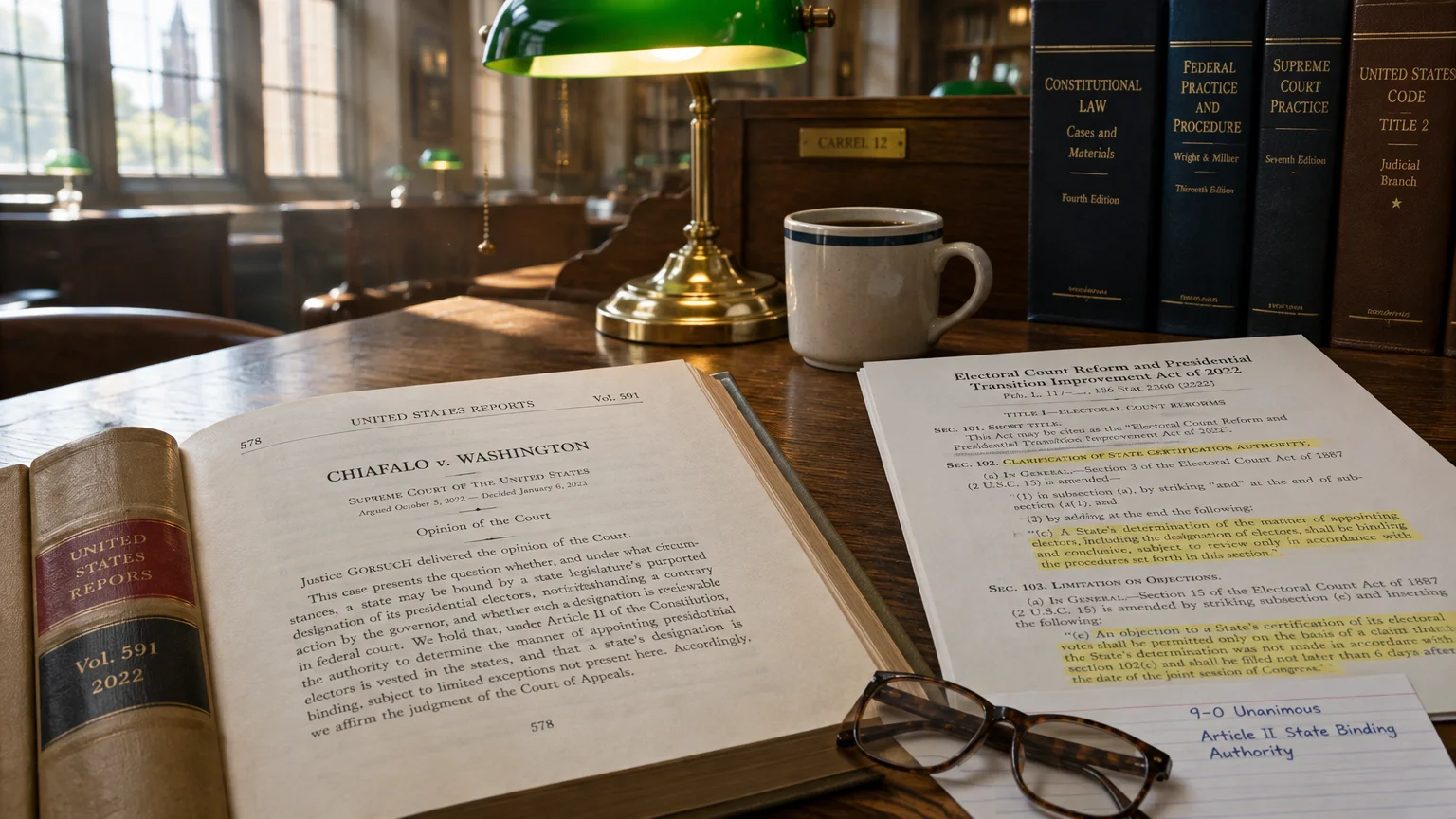
On July 6, 2020, the Supreme Court issued a unanimous 9–0 decision in Chiafalo v. Washington, 591 U.S. 578 (Docket No. 19-465). The Court held that states possess constitutional authority under Article II to bind electors to their state’s popular vote.
Writing for the Court, Justice Elena Kagan explained that Article II, Section 1 gives states broad power to appoint electors on terms they see fit. That power includes penalizing, removing, or replacing an elector who breaks a pledge.
The companion case, Colorado Department of State v. Baca, affirmed that same day that states can immediately cancel a deviant ballot and substitute an alternate elector before the state’s tally becomes final.
Across the country, 37 to 38 states and the District of Columbia maintain binding statutes requiring electors to vote for their party nominee or the winner of the state’s popular election.
Furthermore, 24 states and Washington, D.C., enforce laws that automatically void a contrary vote and immediately remove the faithless delegate from the electoral meeting.
Eighteen of those states have formally enacted the Uniform Faithful Presidential Electors Act to standardize this removal process. If an elector attempts to cast an unauthorized ballot in those states, officials discard it instantly.
Electors do not hold an unfettered constitutional right to exercise personal discretion. When you cast your presidential ballot, your state holds full legal authority to enforce your vote.
Faithless Electors Have Previously Altered Presidential Election Outcomes
Pundits often warn that rogue electors could secretly coordinate to overturn a certified election outcome. While faithless electors have occurred across American history, they have never flipped a single presidential election.
Across all 60 quadrennial elections conducted through 2024, electors cast 165 faithless votes. Of those deviant votes, electors cast 90 for president and 75 for vice president.
The overwhelming majority of those presidential defections occurred in a single anomalous election. In 1872, the losing Democratic nominee, Horace Greeley, died between the November election and the December balloting of electors.
Following Greeley’s death, 63 of his 66 pledged electors scattered their presidential votes across four other candidates. Ulysses S.
Grant had already won an outright majority, meaning those votes had zero impact on the presidency.
The modern record for faithless voting occurred in the 2016 election, when seven electors cast dissenting votes that Congress officially counted. Three other electors attempted to defect but faced immediate removal or correction under state laws.
Those seven votes constituted a modern record, yet they did not alter the winner. Donald Trump won the presidency with 304 electoral votes, well above the 270 threshold needed for victory.
During the 2020 and 2024 presidential elections, exactly zero electors broke their pledges. Electors cast every certified electoral vote in full alignment with their states’ certified results.
Historical data compiled by the National Archives and Records Administration shows that faithless voting remains a symbolic protest rather than an outcome-altering political mechanism.
The United States Constitution Mandates a Winner-Take-All Allocation System
Many voters believe the Constitution requires states to award all their electoral votes to the statewide popular vote winner. In reality, the text of the Constitution contains no such requirement.
Article II, Section 1, Clause 2 states that each state shall appoint electors in such manner as the legislature thereof may direct. This clause grants state legislatures plenary authority over how they distribute their electoral votes.
During early American elections, state legislatures frequently selected electors directly, without holding a popular vote at all. Other states held popular elections within individual congressional or special districts.
Today, 48 states and Washington, D.C., use a winner-take-all model, but they do so entirely because of individual state statutes. Two states consciously choose a different method.
Maine adopted the “congressional district method” in 1969, putting it into effect for the 1972 election under Title 21-A, Section 802 of the Maine Revised Statutes. Nebraska adopted the same district system in 1991, launching it in 1992 under Nebraska Revised Statutes Section 32-1038.
Under this district structure, each state awards two statewide electoral votes to the state popular vote winner, while awarding one electoral vote to the winner of each individual congressional district.
This split allocation occurred directly in both 2020 and 2024. In both elections, Maine awarded one district vote to Donald Trump, while Nebraska awarded its 2nd Congressional District vote to the Democratic nominee.
State lawmakers in Nebraska introduced legislation to return to a winner-take-all system during recent sessions, but those measures failed to pass the state’s unicameral legislature. Any state could abandon winner-take-all tomorrow simply by passing an ordinary state statute.
The House Elects the President by Individual Representative Headcount During Deadlocks
If no presidential candidate wins an electoral majority, the decision moves to the House of Representatives. Many citizens incorrectly assume all 435 members of Congress cast individual votes just like they do on legislation.
The Twelfth Amendment, ratified in 1804, strictly governs contingent elections. The text mandates that when electing the president, “the votes shall be taken by states, the representation from each state having one vote.”
This rule means each state’s delegation meets internally to determine how to cast that single, combined ballot. A state delegation with dozens of members possesses the exact same voting power as a state with only one representative.
To win the presidency during a contingent election, a candidate must secure an absolute majority of the states. That currently requires winning 26 out of the 50 state delegation votes.
If a state delegation ties internally among its members, that state loses its vote for that ballot. It records an abstention until the delegation breaks its internal deadlock.
Furthermore, representatives cannot select just anyone. The Twelfth Amendment restricts the House’s selection pool exclusively to the top three electoral vote-getters from the certified Electoral College returns.
The House has resolved an election this way only twice under the Constitution: in 1800, choosing Thomas Jefferson on the 36th ballot, and in 1824, electing John Quincy Adams on the first ballot.
A contingent election tests state-level party control rather than overall legislative seat totals. You must track which party controls a majority of state delegations, not the overall House majority.
A Deadlocked Vice Presidential Contest Follows the Same Rules as the Presidential Vote
Voters often assume that if an election deadlocks, the House of Representatives chooses both the president and the vice president as a paired ticket. That is incorrect under the Constitution.
Under the Twelfth Amendment, a vice presidential deadlock triggers an entirely separate contingent election in the United States Senate. The House plays no constitutional role in choosing the vice president.
The Senate’s procedural rules differ fundamentally from the House’s state-by-state system. In the Senate, every individual senator casts one personal vote for vice president.
State delegations do not caucus together to produce a single ballot. Senators vote as individual lawmakers, with 51 votes required out of 100 to secure election.
The candidate pool is also narrower. The Senate considers only the top two electoral vote-getters for vice president, rather than the top three candidates considered by the House.
The Senate has conducted a contingent election for vice president only once in American history. Following the election of 1836, Democratic vice presidential nominee Richard Mentor Johnson fell one vote shy of an electoral majority.
On February 8, 1837, the Senate voted 33–16 to elect Johnson on the first ballot. You can read the official proceedings in the Senate Journal for the 24th Congress.
Because the House and Senate vote independently under entirely different rules, a contingent election could produce a president from one political party and a vice president from the opposing party.
A Single Lawmaker Can Halt the Electoral Vote Certification on January 6
During past certification cycles, individual lawmakers often filed public objections to halt the counting of electoral certificates. Federal law no longer allows single members of Congress to interrupt the certification process.
Under the historic Electoral Count Act of 1887, a challenge required signatures from only one representative and one senator. That tiny threshold allowed isolated lawmakers to force both chambers into hours of separate debate.
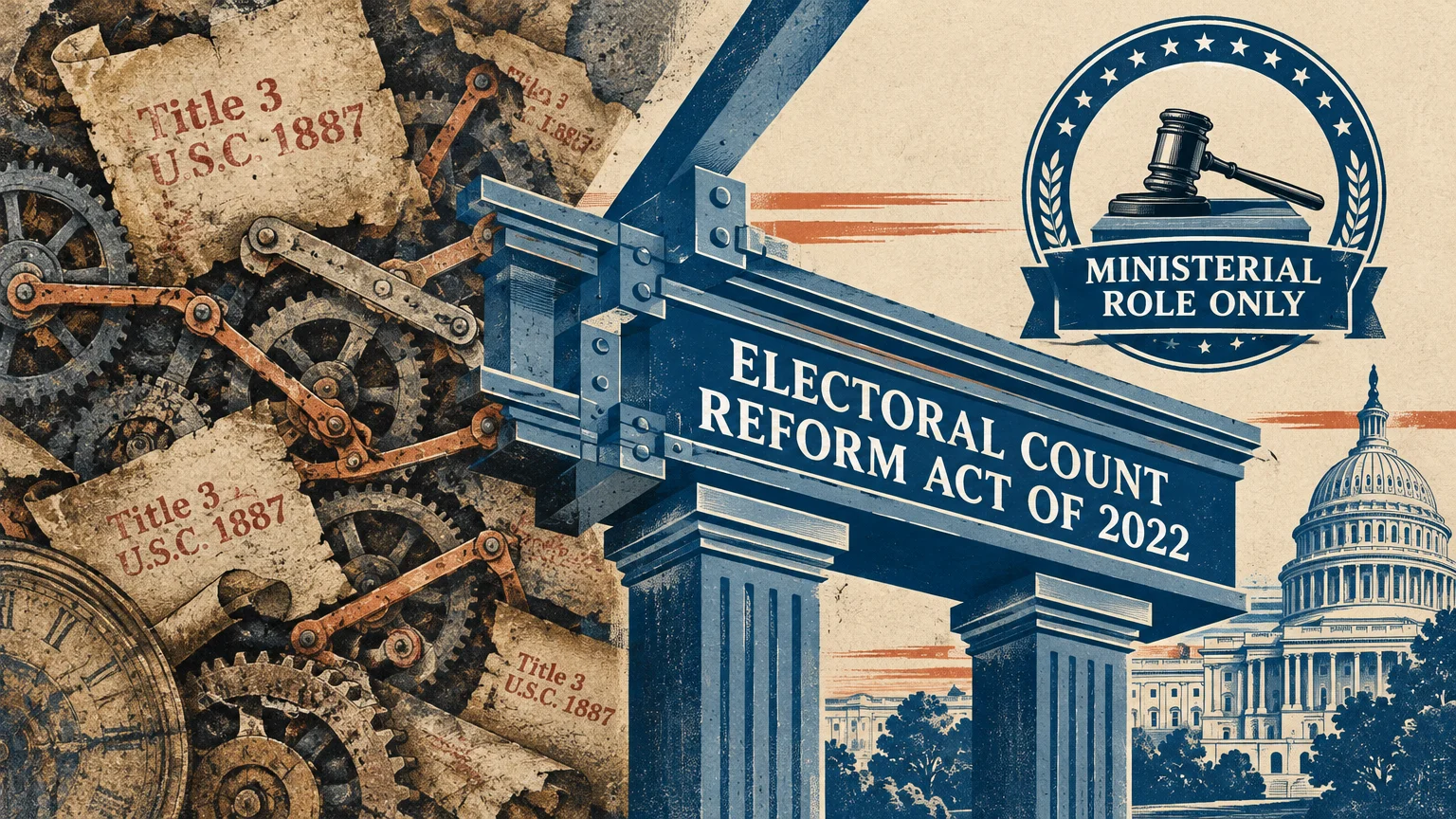
Congress permanently eliminated that procedure on December 29, 2022, by passing the Electoral Count Reform and Presidential Transition Improvement Act (Public Law 117-328, Division P). This statute fundamentally overhauled Title 3 of the United States Code.
Under 3 U.S.C. § 15, an objection now requires the written signatures of at least one-fifth of the House of Representatives and one-fifth of the Senate. That means at least 87 representatives and 20 senators must sign an objection before Congress can debate it.
The statute also strictly limits the legal grounds for objections. Lawmakers can object only if electors were not lawfully certified by their governor or if an elector’s vote was not regularly given.
Additionally, the 2022 statute explicitly clarified the role of the Vice President presiding over the joint session. Section 15 states that the presiding officer’s role is strictly ministerial, with no power to determine, accept, or reject electoral certificates.
The law also designates each state’s governor as the sole executive responsible for submitting the Certificate of Ascertainment, unless state law provided otherwise prior to election day. This rule bars conflicting slates of electors.
A rogue lawmaker cannot derail the transfer of power on the House floor. Federal law requires substantial bicameral consensus before Congress can even pause the official count.
A Split Between the Popular Vote and the Electoral College Violates the System’s Design
Whenever the national popular vote winner loses the Electoral College, public debate often labels the result an unconstitutional malfunction. The Constitution, however, intentionally designed the presidency around state-level tallies rather than a single national aggregate.
The Framers specifically rejected direct national popular voting at the Constitutional Convention of 1787. They established a federalist mechanism that balances representation across individual sovereign states.
Across 60 quadrennial elections, the Electoral College winner has diverged from the national popular vote winner five times: 1824, 1876, 1888, 2000, and 2016. In all other 55 elections, the electoral winner also won the popular vote.
In 1824, John Quincy Adams won the presidency in the House despite Andrew Jackson winning a plurality of both the popular and electoral votes. In 1888, Benjamin Harrison defeated Grover Cleveland in the Electoral College despite trailing by nearly 100,000 popular votes.
In 2000, George W. Bush secured 271 electoral votes to win the White House despite trailing Al Gore nationwide by 543,895 votes.
In 2016, Donald Trump won 304 electoral votes while trailing Hillary Clinton in the nationwide popular tally.
In the 2024 election, this divergence did not occur. Donald Trump won both the Electoral College, 312 to 226, and the nationwide popular vote.
A comprehensive study by the Congressional Research Service (Report RL32611) confirms that the Constitution measures legal legitimacy solely through the 538 authorized electors.
No federal constitutional mechanism has ever tallied national aggregate votes to award the presidency. The system functions legally as 51 simultaneous, separate elections.
The National Popular Vote Compact Has Already Taken Legal Effect
Supporters and opponents often talk about the National Popular Vote Interstate Compact (NPVIC) as if it already controls modern presidential contests. The compact remains completely inactive and exercises zero legal authority today.
The NPVIC is an electoral reform initiative where joining states pledge to award all their electoral votes to whichever presidential candidate wins the national popular vote. However, the legislation includes an explicit activation clause.
Under the text of the agreement, the compact takes legal effect only when joined by states holding a combined majority of the Electoral College. That threshold requires member states to control at least 270 electoral votes.
As of January 22, 2026, 18 states and the District of Columbia have passed the NPVIC into law. These jurisdictions include states like California, New York, Washington, Colorado, Maine, and Virginia.
Together, these 19 jurisdictions control 222 electoral votes. That represents approximately 82% of the total needed to activate the agreement, leaving the compact 48 electoral votes short of legal viability.
Even if the compact secures an additional 48 electoral votes, it faces significant constitutional obstacles before altering an election. Opponents plan immediate federal lawsuits under Article I, Section 10 of the Constitution.
That constitutional clause, known as the Compact Clause, strictly prohibits any state from entering into any agreement or compact with another state without the explicit consent of Congress.
Until the compact crosses the 270-vote statutory threshold and survives judicial review, states must allocate their electors under existing state statutes. The national popular vote does not dictate any state’s electoral distribution today.

Comparing Electoral College Deadlocks, Legal Precedents, and Reform Thresholds
The table below summarizes the core constitutional provisions, historical thresholds, and federal statutes governing Electoral College deadlocks and reforms.
| Scenario or Mechanism | Governing Authority | Decision-Making Body | Legal Threshold Required |
|---|---|---|---|
| Standard Presidential Election | Article II, Section 1; 23rd Amendment | 538 Appointed Electors | Majority of 270 Electoral Votes |
| Binding Faithless Electors | Chiafalo v. Washington (2020) | Individual State Legislatures | State Enforcement Statutes (38 States) |
| House Contingent Election | Twelfth Amendment (1804) | House State Delegations (1 Vote Per State) | Absolute Majority of 26 of 50 States |
| Senate Contingent Election | Twelfth Amendment (1804) | 100 Individual Senators (1 Vote Each) | Absolute Majority of 51 of 100 Senators |
| Objection to State Electors | 3 U.S.C. § 15 (ECRA of 2022) | Joint Session of Congress | 20% of House (87) and 20% of Senate (20) |
| National Popular Vote Activation | NPVIC Text; Article II, Section 1 | Interstate Compact Signatories | Enacting States Totalling 270 Electors |
How Modern Statutes and Precedents Reshaped Electoral Mechanics
When you trace the evolution of the Electoral College, a clear pattern emerges. The system has shifted decisively away from delegate discretion toward strict legal standardization.
In the nineteenth century, electors operated with loose procedural rules, minimal federal oversight, and uncertain binding commitments. Today, federal statutes and court decisions tightly restrict every stage of the process.
The Supreme Court’s decision in Chiafalo v. Washington settled more than two centuries of constitutional debate. States now possess confirmed power to treat electors as faithful agents of the voters rather than independent trustees.
At the federal level, the Electoral Count Reform Act of 2022 closed major statutory ambiguities that persisted for 135 years. By establishing clear objection thresholds, Congress eliminated procedural exploits during the joint certification session.
The law also established strict expedited judicial review for state election certification disputes. Federal courts must now resolve any candidate challenges well before electors meet in mid-December.
Understanding these mechanisms helps you navigate presidential election cycles with confidence. The transfer of executive power relies on explicit statutory deadlines, codified thresholds, and binding judicial precedents.
Frequently Asked Questions About Electoral College Rules
Can an elector cast a faithless vote in secret to avoid state penalties?
No, an elector cannot cast a secret faithless ballot in states with modern enforcement laws. Electors sign public ballots during their official mid-December meetings under procedures supervised by state election officials.
In states enforcing the Uniform Faithful Presidential Electors Act, officials inspect each paper ballot immediately upon submission. If a ballot fails to match the elector’s statutory pledge, the presiding officer voids the vote instantly.
The state then terminates that elector’s appointment on the spot and installs a pre-selected alternate to cast the required ballot.
What happens if a contingent election in the House ends in a 25–25 delegation tie?
If the House deadlocks at 25–25 and fails to elect a president by Inauguration Day on January 20, the Twentieth Amendment governs presidential succession. The newly elected vice president serves as acting president.
This outcome requires the Senate to have successfully completed its own contingent election to choose the vice president. The vice president acts as president until the House breaks its deadlock.
If both chambers deadlock simultaneously, the Presidential Succession Act of 1947 (3 U.S.C. § 19) takes effect. The Speaker of the House resigns to become acting president.
Why haven’t more states adopted the Maine and Nebraska district system?
Most state legislatures prefer the winner-take-all model because it maximizes their political leverage during presidential campaigns. Winner-take-all encourages candidates to campaign across an entire state to capture its full electoral haul.
Adopting a district system unilaterally can also disadvantage the dominant party in a state legislature. A party holding unified control rarely votes to concede individual congressional district electors to political opponents.
Unless both parties agree to coordinate simultaneous adoptions across multiple states, state lawmakers generally maintain their existing winner-take-all systems.