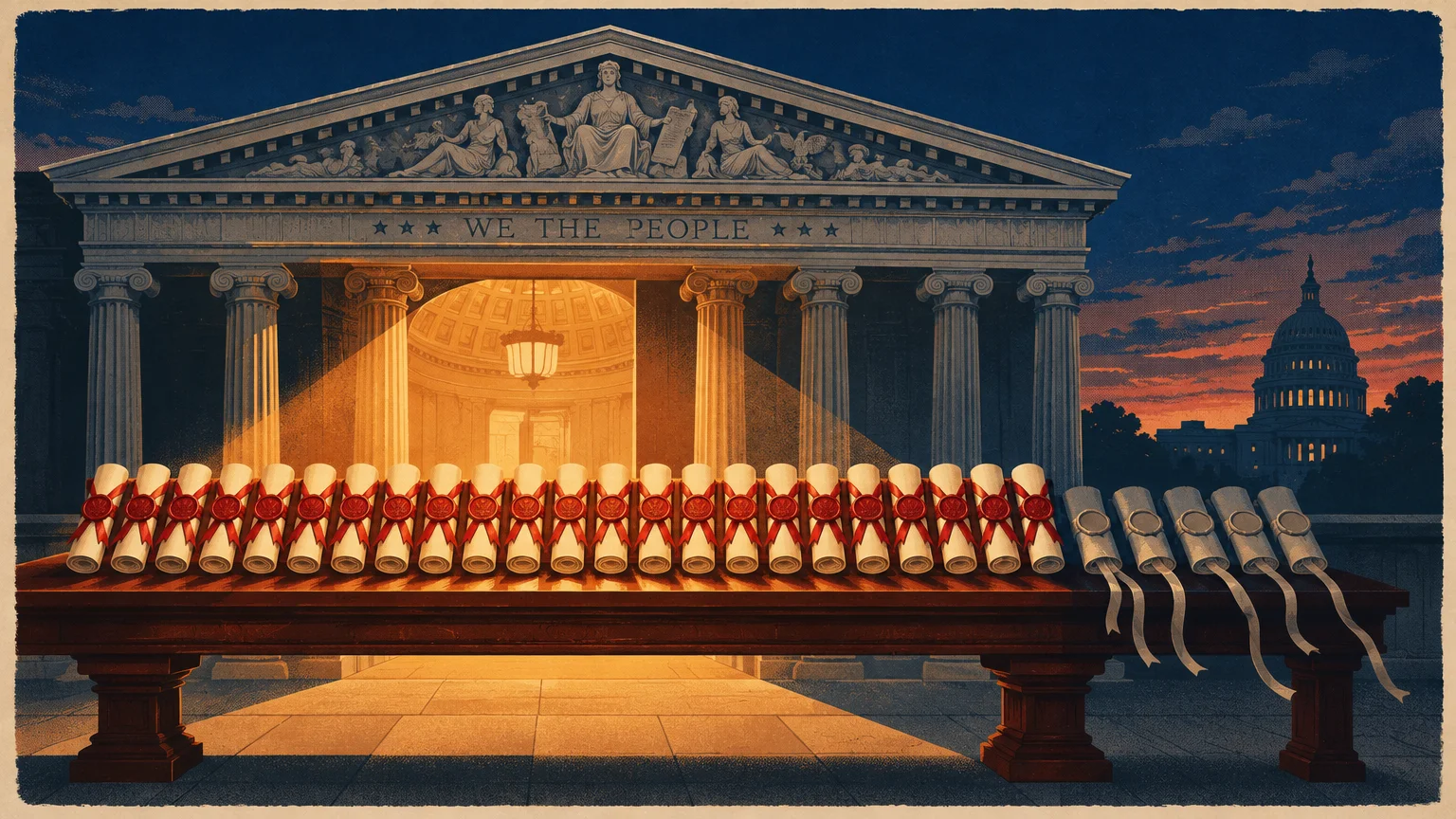
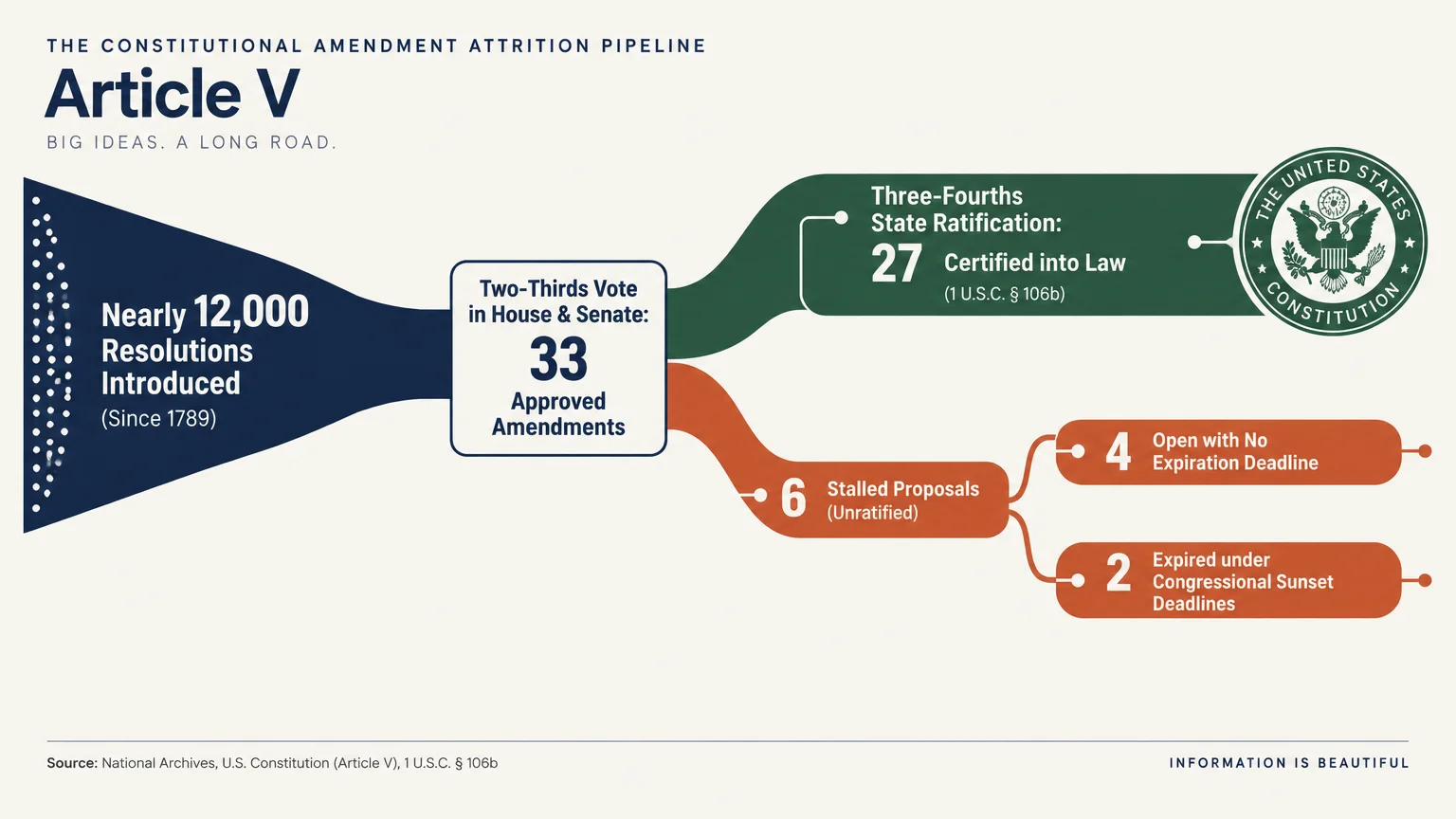
The U.S. Constitution includes 27 ratified amendments, yet Congress has approved 33 proposals by the required two-thirds votes since 1789. Six measures cleared Capitol Hill only to stall before winning ratification from three-fourths of the states.
These unratified proposals addressed congressional district sizes, foreign titles of nobility, slavery, child labor, equal rights, and Washington, D.C. representation. Four remain technically pending before state legislatures because Congress attached no ratification deadlines, while two expired under explicit time limits.
The Article V Hurdle and the 33 Approved Proposals
Under Article V of the U.S. Constitution, an amendment requires a two-thirds vote in both the House and Senate—or a convention called by two-thirds of the states, a mechanism never used—followed by ratification from three-fourths of the states (38 of 50 today).
Under 1 U.S.C. § 106b, the Archivist of the United States formally certifies an amendment upon receiving official notice from the required number of states.
Since 1789, members of Congress have introduced nearly 12,000 amendment resolutions, according to the Congressional Research Service guide to the amendment process.
This list covers the six proposals that passed both chambers of Congress by two-thirds majorities but never achieved the three-fourths state ratification threshold required to become part of the Constitution.
1. Congressional Apportionment Amendment
On September 25, 1789, the First Congress submitted 12 amendments to the states as part of the original Bill of Rights package. Representative James Madison placed this measure first, designating it Article the First.
The proposal established a mathematical formula to regulate the size of the House of Representatives as national census counts grew. Once the chamber reached 200 members, the formula capped each congressional district at no more than 50,000 residents per representative.
By June 27, 1792, 11 states had ratified the proposal, concluding with Kentucky. Because Vermont and Kentucky had entered the union, the total number of states rose to 15, elevating the three-fourths ratification threshold to 12 states.
The apportionment measure stalled one state short of ratification, as detailed in the Constitution Annotated on Congress.gov. Because the First Congress included no expiration deadline, Article the First remains technically pending before the states.
Instead of a constitutional formula that would require more than 6,000 House members today, Congress capped the chamber at 435 voting representatives through the Permanent Apportionment Act of 1929.
2. Titles of Nobility Amendment
During the early 19th century, Senator Philip Reed of Maryland introduced an amendment to tighten the Constitution’s foreign emoluments clauses.
The Senate approved the resolution 19–5 on April 27, 1810, and the House passed it 87–3 on May 1, 1810, as recorded in the Library of Congress Century of Lawmaking collection.
The amendment proposed stripping U.S. citizenship from any person who accepted a title of nobility from an emperor, king, or foreign power. It also revoked citizenship for accepting unauthorized foreign pensions, presents, or offices.
New Hampshire became the 12th state to ratify the amendment on December 9, 1812. With Louisiana attaining statehood in April 1812, the union reached 18 states, leaving the proposal two states short of the 14 required.
Slow communications produced a persistent misconception that Virginia had ratified the measure, and several statute books printed between 1815 and 1818 mistakenly included it as the 13th Amendment.
Secretary of State John Quincy Adams investigated in 1818 and confirmed that Virginia had postponed consideration indefinitely, leaving the deadline-free proposal pending before state legislatures.
3. Corwin Amendment
In early 1861, following the secession of seven Deep South states, Representative Thomas Corwin of Ohio introduced a compromise resolution to keep border states in the union.
The House passed House Joint Resolution 80 by a 133–65 vote on February 28, 1861, and the Senate approved it 24–12 on March 2, 1861.
The text prohibited any future constitutional amendment empowering Congress to abolish or interfere with “domestic institutions” within any state, a direct reference to chattel slavery.
Outgoing President James Buchanan signed the resolution on March 2, 1861, though presidential signatures carry no legal weight under Article V.
President Abraham Lincoln referenced the proposal in his First Inaugural Address on March 4, 1861, stating he had no objection to making existing constitutional understandings express and irrevocable.
Only five states ratified the measure—Kentucky, Ohio, Rhode Island, Maryland, and Illinois—before the bombardment of Fort Sumter in April 1861 halted the compromise effort.
Ohio voted to rescind its ratification in 1864, followed by Maryland in 2014 and Illinois in 2022. The ratification of the 13th Amendment in December 1865 abolished slavery nationwide, rendering the Corwin Amendment moot.
4. Child Labor Amendment
In the early 20th century, the Supreme Court invalidated two federal statutes restricting child labor: a commerce ban in Hammer v. Dagenhart (1918) and an excise tax in Bailey v. Drexel Furniture Co. (1922).
In response, Congress approved House Joint Resolution 184 on June 2, 1924, by votes of 297–69 in the House and 61–23 in the Senate.
The proposal granted Congress explicit power to “limit, regulate, and prohibit the labor of persons under eighteen years of age” while preserving state authority to enact stricter youth labor laws.
Strong opposition from manufacturing associations and farm bureaus slowed state ratifications, and by 1937 only 28 state legislatures had approved the text.
Opponents challenged Kansas’s 1937 ratification after a prior rejection, leading to the Supreme Court’s ruling in Coleman v. Miller (1939) that ratification timeliness is a political question reserved for Congress.
The amendment became practically unnecessary after the Supreme Court unanimously upheld the Fair Labor Standards Act of 1938 in United States v. Darby (1941), though the 1924 resolution carries no expiration date.
5. Equal Rights Amendment
First drafted by Alice Paul and the National Woman’s Party in 1923, the Equal Rights Amendment reached the House floor in 1971 after Representative Martha Griffiths filed a successful discharge petition.
The House approved the resolution 354–24 in October 1971, and the Senate passed it 84–8 on March 22, 1972.
The central clause states that equality of rights under the law shall not be denied or abridged by the United States or by any state on account of sex.
Congress placed a seven-year ratification deadline of March 22, 1979, in the proposing clause, and 35 states ratified the measure by 1977.
Five state legislatures—Nebraska, Tennessee, Idaho, Kentucky, and South Dakota—voted to rescind their approvals between 1973 and 1979. In 1978, Congress passed a joint resolution by simple majority extending the deadline to June 30, 1982, but no additional states ratified before that date passed.
Decades later, three additional states voted to ratify: Nevada in 2017, Illinois in 2018, and Virginia in January 2020. However, a January 2020 Department of Justice Office of Legal Counsel opinion declared the 1982 deadline binding, and the D.C.
Circuit ruled in Illinois v. Ferriero (2023) that the Archivist could not be compelled to certify the amendment.
On January 17, 2025, President Joe Biden issued a statement asserting the ERA had cleared all ratification hurdles, but the National Archivist declined to certify the text absent congressional or judicial action, as documented in the National Archives records of unratified amendments.
6. District of Columbia Voting Rights Amendment
Washington, D.C. residents gained three presidential electors under the 23rd Amendment in 1961 but remained without voting representation in Congress.
On August 22, 1978, the Senate approved House Joint Resolution 554 by a 67–32 vote following the House’s 289–127 passage, as recorded in the United States Senate amendment records.
The proposal treated the District of Columbia as a state for congressional representation, presidential elections, and Article V amendment ratifications, granting the capital two Senators and at least one voting Representative. It also repealed the 23rd Amendment to avoid duplicate Electoral College representation.
Unlike the ERA, Congress embedded an express seven-year ratification deadline directly inside Section 4 of the proposed constitutional text. Only 16 states ratified the measure—concluding with Delaware in 1984—before the amendment expired on August 22, 1985, 22 states short of the required 38.
| Amendment Proposal | Proposed Date | Ratifications Recorded | Ratification Deadline | Modern Legal Status |
|---|---|---|---|---|
| Congressional Apportionment | Sept. 25, 1789 | 11 states | None | Technically pending |
| Titles of Nobility | May 1, 1810 | 12 states | None | Technically pending |
| Corwin Amendment | March 2, 1861 | 5 states | None | Moot; 3 rescissions |
| Child Labor | June 2, 1924 | 28 states | None | Technically pending |
| Equal Rights (ERA) | March 22, 1972 | 38 states (disputed) | June 30, 1982 | Uncertified; expired deadline |
| D.C. Voting Rights | Aug. 22, 1978 | 16 states | Aug. 22, 1985 | Expired |
What the Unratified Amendments Reveal About the Amending Process
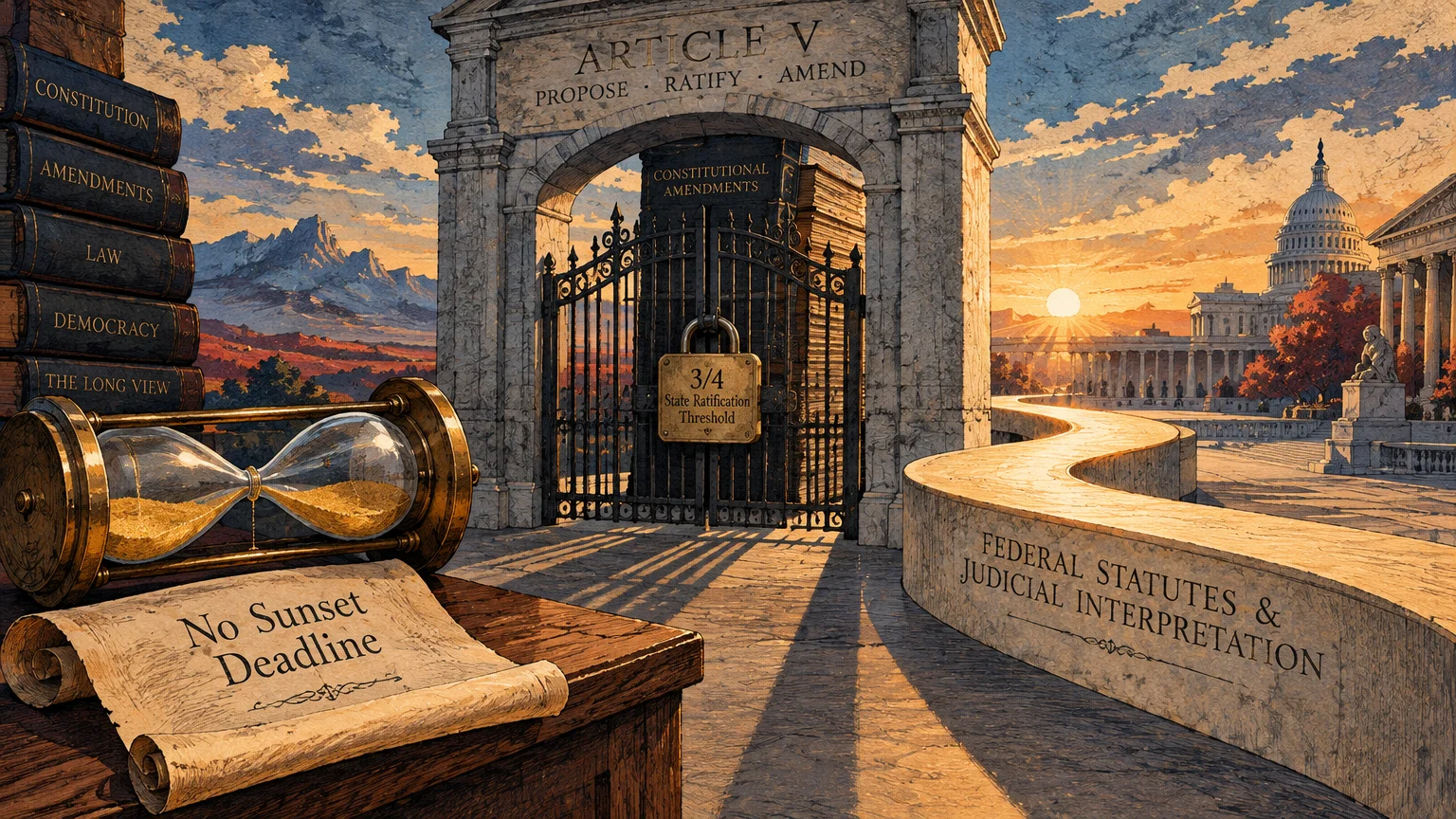
The fate of these six proposals underscores the difficulty of securing three-fourths of the states after clearing two-thirds majorities in Congress. Before proposing the 18th Amendment in 1917, Congress sent resolutions to the states without time limits.
In Dillon v. Gloss (1921), the Supreme Court upheld Congress’s power to set reasonable ratification deadlines so that amendments reflect a contemporaneous national consensus.
Placing a deadline inside the substantive text of the amendment binds the states unconditionally, whereas placing it in the proposing clause has generated ongoing legal disputes over whether a later Congress can extend or remove it.
The 1992 ratification of the 27th Amendment demonstrated that deadline-free proposals from 1789 can still take effect if 38 states approve them.
Conversely, when formal amendments stall, Congress and the courts have sometimes addressed the underlying issue through federal statutes and Commerce Clause jurisprudence, as occurred with child labor restrictions in 1938 and 1941.
Frequently Asked Questions About Unratified Amendments
Can a state legislature rescind its ratification before certification?
Article V does not mention rescissions, leaving the question unsettled in constitutional law.
During Reconstruction, when New Jersey and Ohio voted to rescind their ratifications of the 14th Amendment in 1868, Congress and Secretary of State William Seward counted both states toward the three-fourths majority anyway.
Federal courts have treated the validity of ratifications and rescissions as a political question reserved for Congress under Coleman v. Miller (1939).
Why did the 27th Amendment pass after 202 years while others stalled?
The 27th Amendment succeeded because the First Congress attached no expiration deadline when proposing it alongside the Bill of Rights in 1789.
In 1982, University of Texas sophomore Gregory Watson launched a nationwide letter-writing campaign urging state legislatures to ratify the dormant measure delaying congressional pay raises until after an intervening election.
When Michigan became the 38th state to ratify in May 1992, the Archivist of the United States certified the amendment, and Congress passed concurrent resolutions confirming its validity.
Does the President have the power to veto an amendment?
The President has no constitutional role in proposing, signing, or vetoing amendments under Article V. In Hollingsworth v. Virginia (1798), the Supreme Court held that the Presentment Clause does not apply to constitutional amendments.
Although President James Buchanan signed the Corwin Amendment in 1861, his signature was purely ceremonial, and presidential statements carry no authority in the statutory certification process under 1 U.S.C. § 106b.
Could Congress retroactively eliminate an expired ratification deadline?
Constitutional scholars and federal litigators remain divided over whether Congress can retroactively alter or remove a deadline placed in a proposing clause.
Proponents argue that a subsequent Congress can repeal a resolution’s time limit by simple majority, while opponents maintain that an expired deadline terminates the proposal unless Congress passes a new amendment by two-thirds votes.
Federal courts have dismissed lawsuits seeking to compel the Archivist to certify the Equal Rights Amendment without resolving whether Congress possesses the power to lift an expired deadline retroactively.