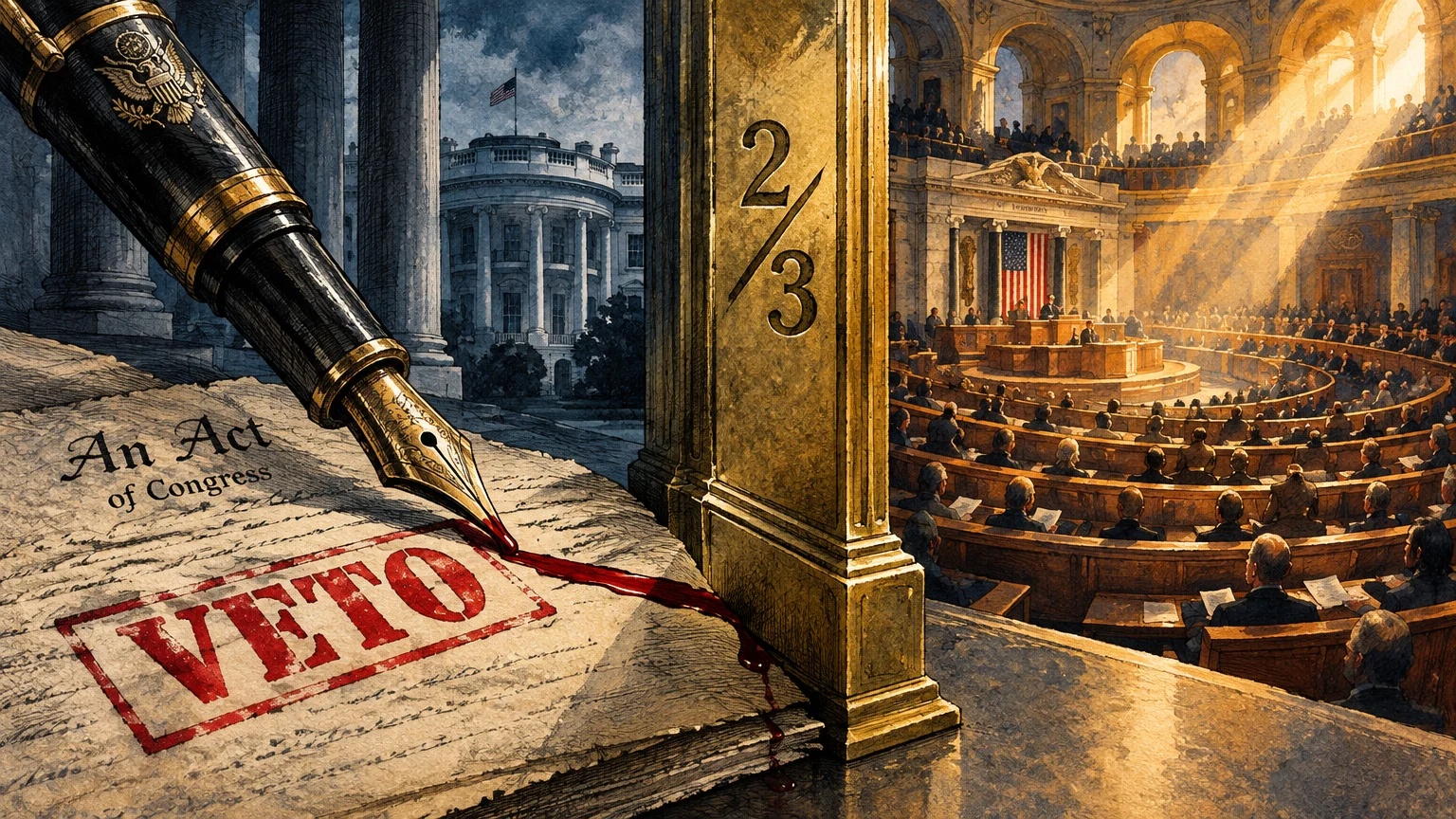
You often hear that a presidential veto kills a bill for good. While the veto pen carries immense constitutional weight, lawmakers can overturn executive rejections if both chambers muster a strict two-thirds majority.
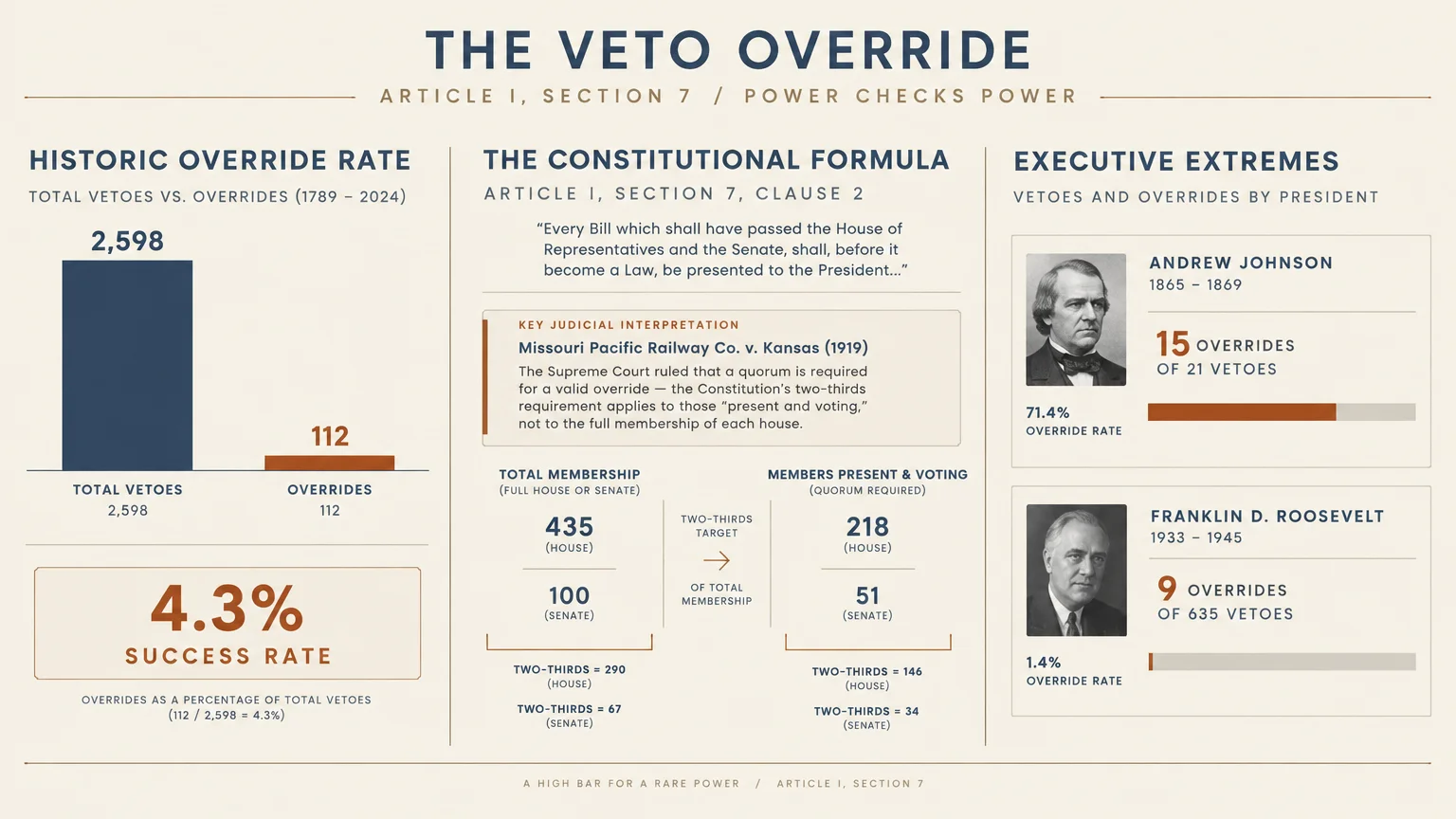
Across American history, presidents have issued 2,598 total vetoes. Congress has managed to override only 112 of them, translating to a historically low override rate of roughly 4.3 percent.
Achieving that supermajority requires extraordinary political alignment across party lines. Here is how Congress overcame presidential resistance on seven major laws by the slimmest legislative margins on record.
The Two-Thirds Threshold and Historic Veto Battles
Article I, Section 7, Clause 2 of the U.S. Constitution establishes the presidential veto framework. You can read the official mechanics outlined in Congressional Research Service reports on regular and pocket vetoes.
The Constitution gives the president 10 days, excluding Sundays, to sign or return a bill. If the president rejects the measure, Congress must muster a two-thirds vote in both the House and the Senate to enact it.
You might assume that two-thirds means two-thirds of the entire congressional membership. However, the Supreme Court clarified this rule in the 1919 case Missouri Pacific Railway Co. v. Kansas.
The Court confirmed that the two-thirds requirement applies only to members present and voting, assuming a quorum exists. You can review this precedent in the Library of Congress record of U.S. Reports.
Because members frequently miss roll calls, the target number shifts during floor action. That mathematical reality creates high-stakes drama whenever party leaders try to pass contested legislation over executive objections.
Presidents have used this power with vastly different frequencies. Franklin D.
Roosevelt issued 635 vetoes across his four terms, and Congress overrode only nine of them.
Conversely, Andrew Johnson faced a hostile post-Civil War Congress that overrode 15 of his 21 regular vetoes. Johnson still holds the record for the most veto overrides suffered by any chief executive.
In modern politics, successful overrides remain exceptionally rare. The 116th Congress enacted the most recent override on January 1, 2021, passing the FY2021 National Defense Authorization Act over Donald Trump’s veto.
Joe Biden issued 13 regular vetoes during his 2021–2025 term, and Congress overrode zero. In his second term, Donald Trump has issued two vetoes, and lawmakers sustained both.
The following list highlights seven pivotal moments when Congress barely crossed the constitutional threshold. We selected these measures by measuring the razor-thin margin of votes to spare in the deciding chamber.
Surface Transportation and Uniform Relocation Assistance Act of 1987
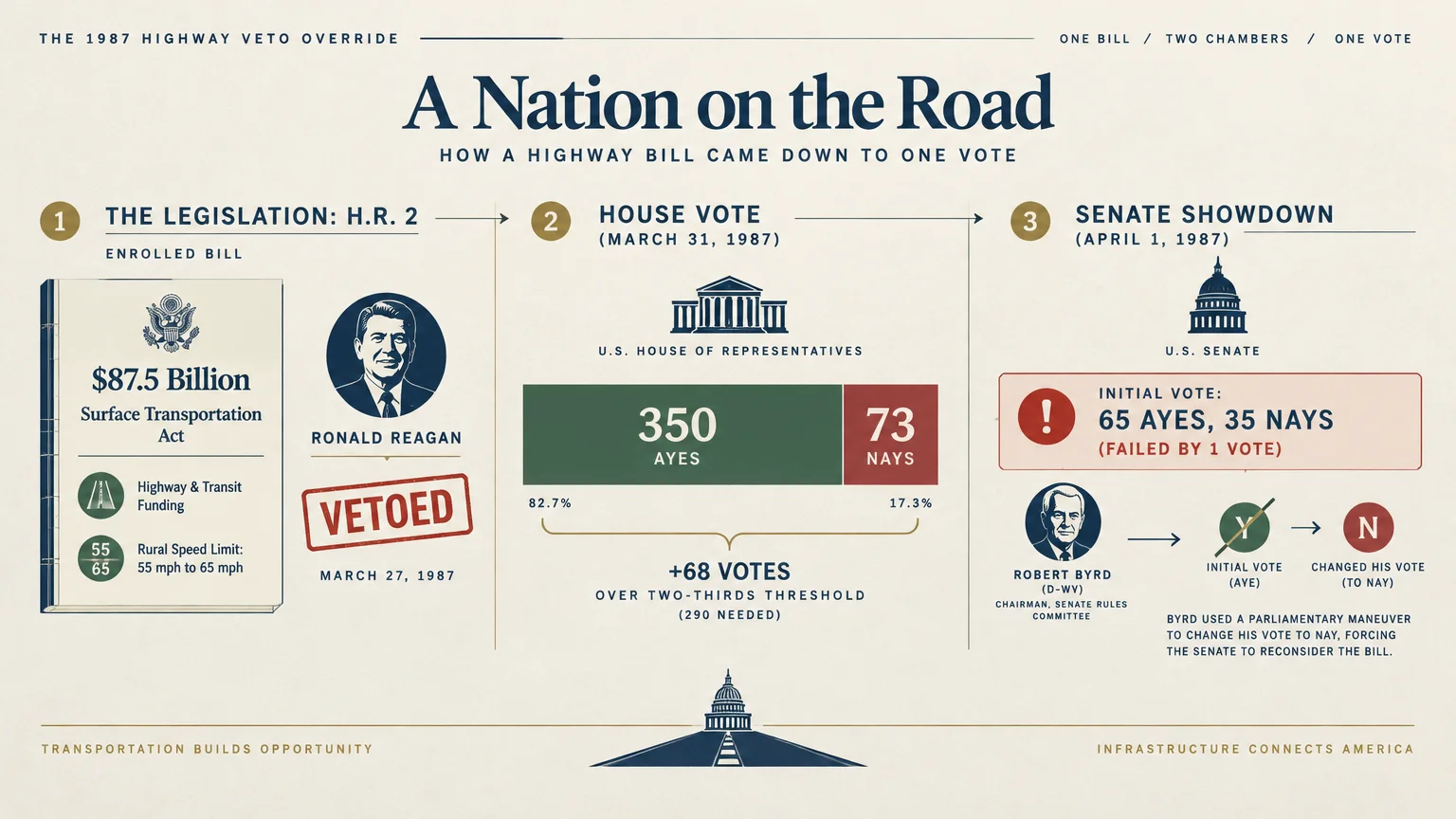
President Ronald Reagan drew a sharp line against federal spending on March 27, 1987. He vetoed H.R.
2, an $87.5 billion highway and transit measure, labeling it a pork-barrel bill.
Beyond funding roads and public transit, the bill carried a popular policy provision. It permitted states to raise rural interstate speed limits from 55 mph to 65 mph.
The House of Representatives acted quickly on March 31, 1987. House lawmakers voted 350–73 to override the veto, providing 68 votes more than the required two-thirds threshold.
The Senate staged a far more dramatic showdown on April 1, 1987. The chamber’s initial override vote failed 65–35 after freshman Democratic Senator Terry Sanford of North Carolina voted to sustain.
Senate Majority Leader Robert Byrd immediately changed his vote to “nay” before the gavel fell. Byrd used that parliamentary tactic so he could move to reconsider the vote the following day.
Reagan traveled to Capitol Hill in person to lobby wavering lawmakers; he urged Republicans to hold the line. Despite intense White House pressure, Sanford switched his position overnight after facing furious appeals from home-state colleagues.
On April 2, 1987, the Senate held its second roll-call vote. The chamber voted 67–33 to override the veto, hitting the exact two-thirds required among 100 voting senators.
Because a single vote change would have sustained Reagan’s veto, Congress enacted Public Law 100-17 with zero votes to spare. The legislative showdown stands as one of the closest override roll calls in modern history.
Civil Rights Act of 1866
Following the Civil War, congressional Republicans sought to guarantee basic legal protections for newly freed African Americans. They drafted Senate Bill 61 to establish birthright citizenship and prohibit discriminatory Black Codes.
President Andrew Johnson vetoed the measure on March 27, 1866. Johnson argued that the legislation infringed on state sovereignty and claimed Congress lacked authority to pass laws while southern states sat unrepresented.
The battle moved to the Senate floor, where supporters confronted a precarious math problem. According to the Office of the Historian of the U.S. House of Representatives, lawmakers engaged in bitter procedural warfare.
To ensure a supermajority, Senate Republicans took the extraordinary step of unseating Democratic Senator John P. Stockton of New Jersey over a contested election dispute.
That unseating reduced the chamber roster just days before the vote.
On April 6, 1866, the Senate voted 33–15 to override Johnson’s veto. With 48 senators voting, the constitutional threshold required exactly 32 votes.
Had a single senator switched from “aye” to “nay,” the tally would have fallen to 32–16, sustaining the veto. The override cleared the Senate with a margin of just one vote to spare.
Three days later, on April 9, 1866, the House completed the override by a vote of 122–41. With 163 members voting, House leaders needed 109 votes and cleared the bar with room to spare.
This vote marked the first time in American history that Congress enacted a major piece of legislation over a presidential veto. The statute later served as the statutory blueprint for the Fourteenth Amendment.
Immigration and Nationality Act of 1952
Lawmakers combined numerous immigration laws into H.R. 5678, commonly known as the McCarran–Walter Act.
While the bill eliminated formal racial exclusions for Asian immigration, it preserved national-origins quotas created in 1924.
President Harry S. Truman vetoed the bill on June 25, 1952.
Truman condemned the quota formula as an un-American system that discriminated against southern and eastern Europeans during the early Cold War.
Supporters argued that the legislation established crucial screening procedures to keep communist infiltrators out of the country. That national security message resonated strongly across conservative wings of both parties.
The House moved the following day, June 26, 1952. Lawmakers voted 278–113 to overturn Truman’s veto; with 391 members voting, supporters needed 261 votes and cleared the threshold by 17 votes.
The Senate took up the bill on June 27, 1952, under heavy pressure from bill co-sponsor Pat McCarran. The final Senate roll call ended at 57–26.
Eighty-three senators cast ballots, meaning the constitutional two-thirds mark stood at 55.33 votes. In congressional voting, the presiding officer rounds up fractional requirements, meaning supporters needed 56 votes.
The measure cleared the Senate with only 1.67 votes above the required fraction. If two senators had switched sides, the tally would have dropped to 55–28, handing Truman a major legislative victory.
The McCarran–Walter Act became Public Law 82-414 despite Truman’s objections. Decades later, Congress finally replaced its controversial national-origins quota system through the Immigration and Nationality Act of 1965.
Private Securities Litigation Reform Act of 1995
In 1995, the newly installed Republican majority passed H.R. 1058 to overhaul federal securities laws.
The bill sought to curb frivolous class-action lawsuits against publicly traded corporations and tech startups.
President Bill Clinton supported litigation reform in principle but objected to the final draft’s stringent pleading standards. On December 19, 1995, Clinton vetoed the bill, arguing it closed courthouse doors to defrauded investors.
The House moved instantly to challenge the White House. On December 20, 1995, House members voted 319–100 to override the veto, exceeding the required 280 votes by a comfortable margin.
The real contest played out on the Senate floor on December 22, 1995. Pro-business Democrats joined forces with the Republican majority to defend the legislation against White House appeals.
Ninety-eight senators answered the roll call, meaning supporters needed 65.33 votes to reach two-thirds. Under Senate rules, that fractional bar required at least 66 affirmative votes.
The Senate recorded a 68–30 vote to override Clinton’s veto. The override cleared the constitutional hurdle by just two votes to spare.
Had two senators switched sides, the affirmative count would have fallen to 66 against 32, failing to meet the required margin. The narrow victory made H.R.
1058 one of only two veto overrides enacted during Clinton’s eight years in office.
The statute restructured securities class-action procedures and raised pleading standards across the country. You can review Clinton’s complete veto record through the U.S. Senate Historical Office summary of bills vetoed.
Freedom of Information Act Amendments of 1974
In the shadow of the Watergate scandal, the 93rd Congress drafted H.R. 12471 to strengthen open-government laws.
The bill mandated quicker agency responses and empowered federal judges to review classified records behind closed doors.
President Gerald R. Ford recognized the public demand for government transparency after Richard Nixon’s resignation.
However, senior advisers urged Ford to reject the measure on national security grounds.
White House Chief of Staff Donald Rumsfeld, Deputy Chief of Staff Dick Cheney, and Justice Department lawyer Antonin Scalia warned Ford that judicial review would compromise intelligence sources. Ford vetoed the bill on October 17, 1974.
The House overwhelmingly rejected Ford’s constitutional arguments on November 20, 1974. Lawmakers recorded an emphatic 371–31 vote to override, easily beating the necessary two-thirds mark.
The Senate vote on November 21, 1974, proved far tighter. Executive branch officials lobbied defense-minded senators to sustain the veto, pointing to potential risks for the military and intelligence services.
Ninety-two senators cast votes on the Senate floor. That participation level required 61.33 votes, setting the practical threshold at 62 affirmative ballots.
The final roll call produced a 65–27 result in favor of the override. The tally cleared the threshold by roughly three votes, meaning a four-senator shift would have sustained Ford’s veto.
Congress enacted the FOIA Amendments of 1974, transforming access to federal records. The legislative showdown established the modern system that allows journalists, researchers, and citizens to challenge agency secrecy in court.
War Powers Resolution of 1973
Congress enacted House Joint Resolution 542 in response to executive military actions during the Vietnam War. Lawmakers particularly objected to secret bombing campaigns in Cambodia conducted without explicit congressional approval.
The resolution requires the president to notify Congress within 48 hours of deploying armed forces into hostilities. It also mandates that troops withdraw within 60 days unless Congress declares war or authorizes an extension.
President Richard Nixon vetoed the resolution on October 24, 1973. Nixon claimed the measure unconstitutionally undermined the president’s authority as commander-in-chief under Article II of the Constitution.
Nixon’s veto arrived during a profound executive crisis. Just days earlier, Nixon ordered the firing of Watergate Special Prosecutor Archibald Cox during the “Saturday Night Massacre,” triggering widespread congressional backlash.
Despite public outrage over Watergate, the override vote in the House of Representatives on November 7, 1973, was exceptionally close. Four hundred and nineteen members cast ballots, creating an override threshold of 280 votes.
The House passed the override by a vote of 284–135, clearing the constitutional minimum by fewer than five votes. If five representatives had switched sides, the tally would have fallen to 279–140, sustaining the veto.
Later that same afternoon, the Senate took up the measure with far less suspense. Senators voted 75–18 to override, surpassing the required 62 votes by a comfortable 13-vote margin.
The War Powers Resolution remains one of the most consequential foreign policy statutes ever enacted over an executive veto. You can study the original enrolled document through the National Archives Center for Legislative Archives.
Labor Management Relations Act of 1947
Following a massive wave of postwar strikes in 1946, the Republican-led 80th Congress drafted H.R. 3020.
Popularly known as the Taft–Hartley Act, the legislation sought to rein in the growing power of industrial labor unions.
The bill banned closed shops, allowed states to pass “right-to-work” laws, and restricted secondary boycotts. It also authorized federal courts to impose an 80-day cooling-off injunction on strikes that threatened national security.
President Harry S. Truman strongly opposed the measure and issued a veto on June 20, 1947.
Truman delivered a national radio address calling the legislation dangerous to free collective bargaining and biased against working Americans.
House leaders pushed for an immediate showdown that very afternoon. On June 20, 1947, the House voted 331–83 to override the veto, clearing the 276-vote threshold by 55 votes.
In the Senate, prolabor lawmakers staged a marathon filibuster over the weekend to give Truman time to sway votes. Union members sent thousands of telegrams urging senators to sustain the president’s veto.
The Senate finally held its roll call on June 23, 1947. Ninety-three senators voted, establishing an override requirement of 62 votes.
The chamber voted 68–25 to override the veto, providing a six-vote margin above the minimum threshold. A switch of six senators would have left supporters with 62–31, preserving Truman’s veto on a tie.
The enactment of Taft–Hartley reshaped modern American labor law. The statute weakened union bargaining leverage and created the framework that still governs state-level right-to-work statutes today.
Comparing Narrow Veto Overrides Across U.S. History
Examining these historical roll calls reveals how much procedural rules and chamber attendance influence final outcomes. The table below outlines how each measure navigated the constitutional override threshold.
| Legislation | Year | President | Deciding Chamber | Final Vote | Votes to Spare |
|---|---|---|---|---|---|
| Surface Transportation Act (H.R. 2) | 1987 | Ronald Reagan | Senate | 67–33 | 0 |
| Civil Rights Act of 1866 (S. 61) | 1866 | Andrew Johnson | Senate | 33–15 | 1 |
| Immigration Act of 1952 (H.R. 5678) | 1952 | Harry S. Truman | Senate | 57–26 | 1.67 |
| Securities Litigation Act (H.R. 1058) | 1995 | Bill Clinton | Senate | 68–30 | 2 |
| FOIA Amendments of 1974 (H.R. 12471) | 1974 | Gerald R. Ford | Senate | 65–27 | 3.67 |
| War Powers Resolution (H.J.Res. 542) | 1973 | Richard Nixon | House | 284–135 | 4.67 |
| Taft–Hartley Act (H.R. 3020) | 1947 | Harry S. Truman | Senate | 68–25 | 6 |
What Razor-Thin Overrides Reveal About Congressional Power
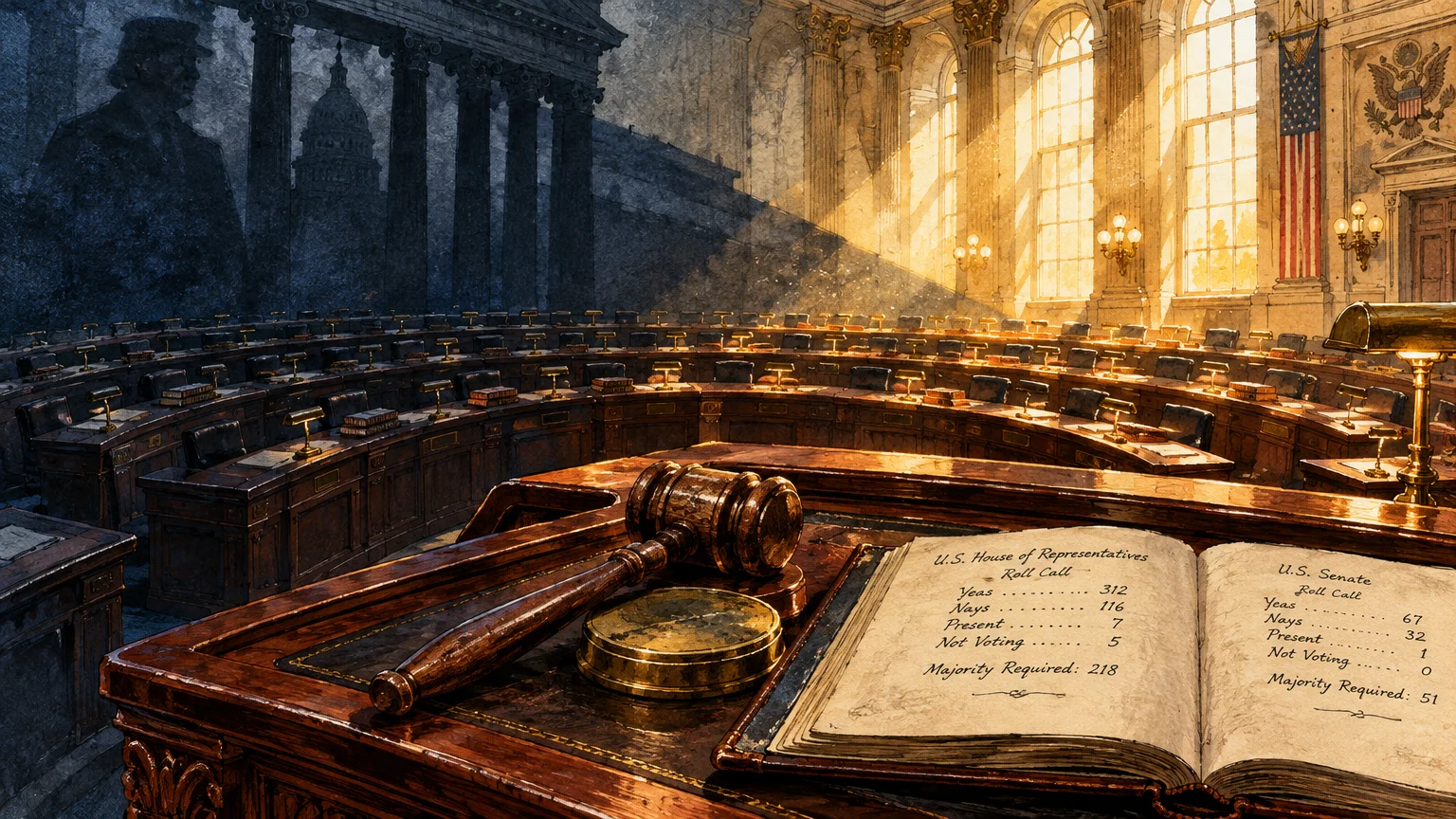
These historic showdowns demonstrate that overriding a presidential veto is one of the steepest hurdles in constitutional governance. The process forces lawmakers to place institutional loyalty or local priorities above simple party unity.
In almost every case on this list, success depended on building a bipartisan coalition against the White House. Ronald Reagan could not stop farm-state Republicans from overriding his highway veto in 1987.
Similarly, Harry Truman could not hold conservative Southern Democrats when Congress passed the Taft–Hartley and McCarran–Walter acts. When regional or business interests align, party discipline often breaks down.
Chamber attendance patterns also dictate the final arithmetic. Because the two-thirds threshold measures only those present and voting, absences can make or break an override effort.
Party whips carefully track sick days, official travel, and committee meetings before calling a veto override to the floor. In tight battles like the Civil Rights Act of 1866, managing floor attendance proved decisive.
In our modern era of intense partisan polarization, supermajority coalitions have become extraordinarily difficult to assemble. Today’s razor-thin chamber majorities make it nearly impossible for one party to override a president from the other side.
When you evaluate modern veto threats, remember these historical lessons. The veto pen remains the president’s most durable constitutional weapon, but determined congressional coalitions can dismantle it when the arithmetic aligns.
Frequently Asked Questions About Presidential Veto Overrides
Does a two-thirds override require two-thirds of the entire Congress or just those present?
The Constitution requires two-thirds of members present and voting, provided that a quorum exists in the chamber. The Supreme Court affirmed this principle in the 1919 decision Missouri Pacific Railway Co. v. Kansas.
Can Congress override a presidential pocket veto?
No, Congress cannot override a pocket veto. If the president does not sign a bill within 10 days and Congress has adjourned, the bill dies automatically without returning to Capitol Hill.
Which American president had the most vetoes overridden by Congress?
Andrew Johnson holds the presidential record. During his post-Civil War tenure, the Republican-led Congress successfully overrode 15 of his 21 regular vetoes.
How does a veto override vote differ between the House and the Senate?
The Constitution mandates that both chambers take a roll-call vote on an override. Lawmakers must record each member’s vote by name in the journal of each chamber, preventing secret or unrecorded voice votes.




