When television networks project a winner on election night, those media calls reflect unofficial exit polls and raw precinct tallies rather than binding legal authority. Not a single lawmaker is seated by a broadcast projection.
Federal and state statutes require a strict administrative chain of custody before any candidate receives official credentials. Local boards must canvass ballots, reconcile poll books, and audit paper trails before state officials can act.
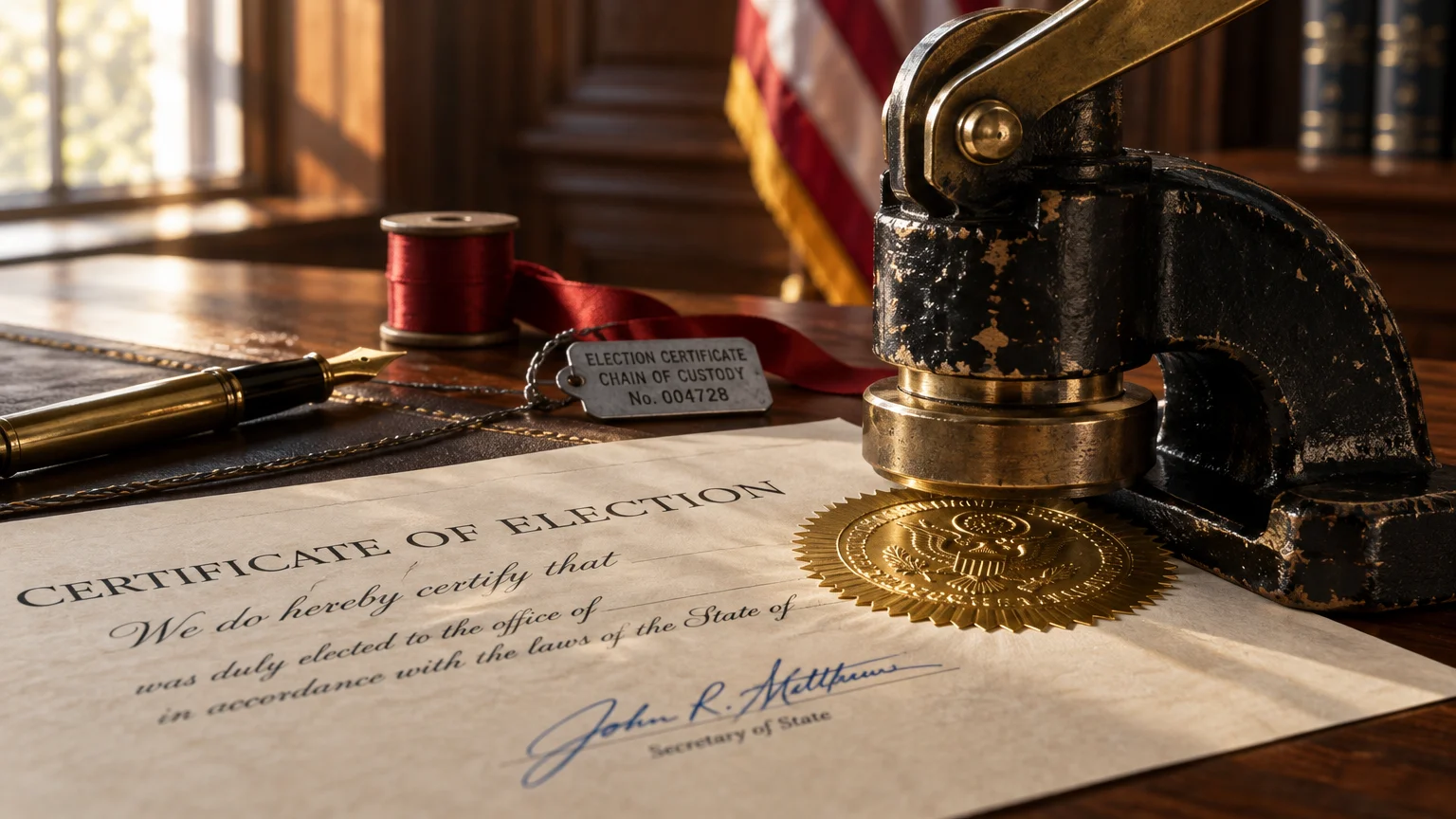
Only after governors affix their signatures and state Great Seals do winners secure the Certificate of Election. That parchment serves as the lawful instrument that opens the doors of Congress on swearing-in day.
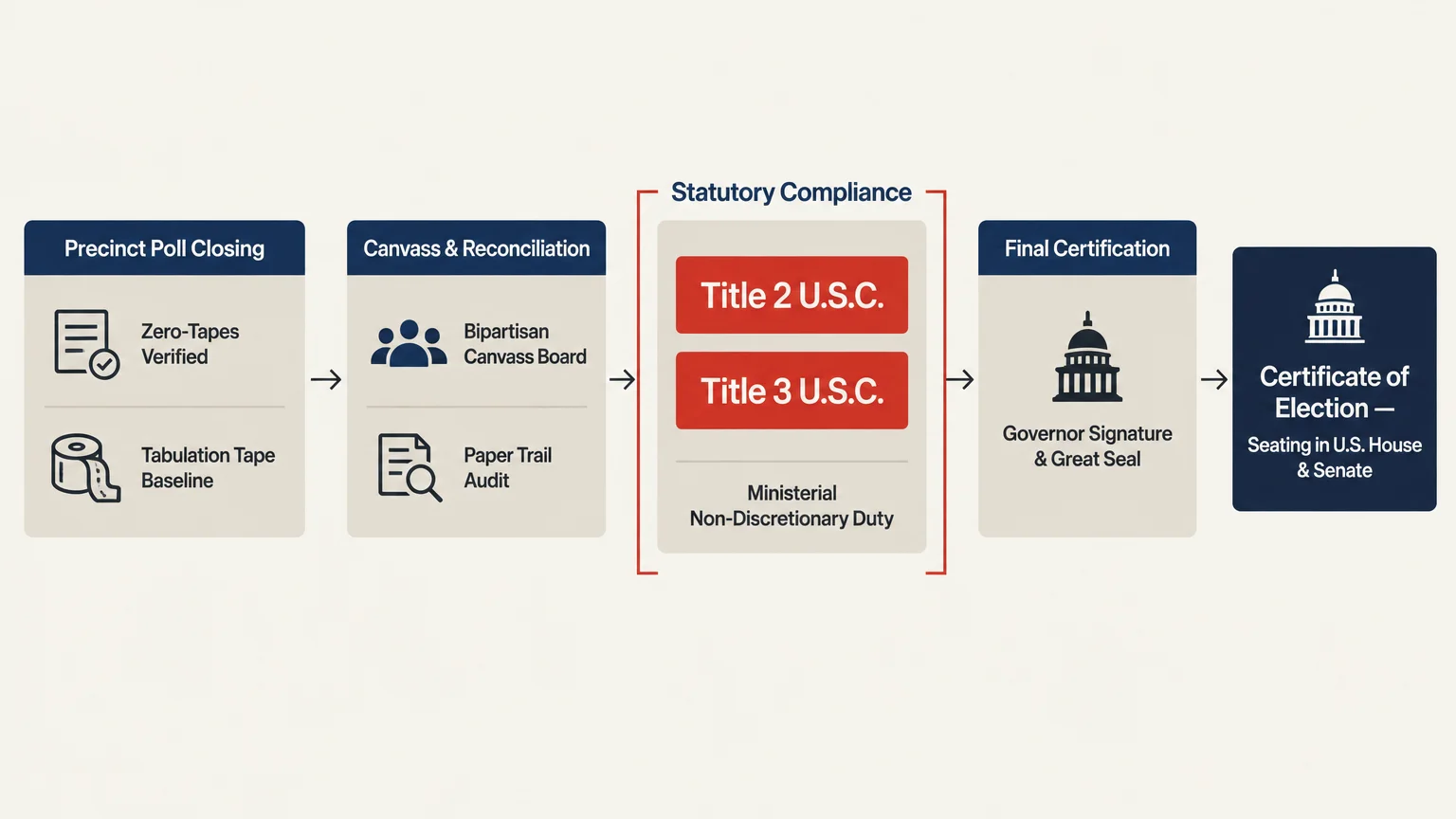
The Legal Framework Governing Election Certification
This list traces the eight sequential administrative steps required by state election codes and Title 2 and Title 3 of the United States Code to turn raw ballots into official congressional credentials.
The entries follow the statutory paper trail from precinct poll closing to final seating in the House of Representatives and Senate.
Every step in this process is a ministerial, non-discretionary duty under federal and state law. Election administrators must count and report every lawfully cast ballot, and state governors must certify winning candidates under their sovereign state seals.
1. Precinct Poll Closing and Tabulation Tape Generation
The formal certification process begins the moment bipartisan poll workers close precinct voting locations on Election Day. State statutes establish mandatory closing hours, which typically fall between 7:00 p.m. and 8:00 p.m. local time.
Before opening any ballot storage compartment, election inspectors check tamper-evident seals on every scanning machine and ballot box. They cross-check serial numbers against logs signed that morning to verify chain-of-custody integrity.
Poll workers then command optical scanners to print physical summary tapes detailing all ballots cast in that precinct. Bipartisan teams sign these paper tally rolls alongside the morning zero-tapes that confirmed empty counters before the polls opened.
These printed paper tapes provide the initial, unofficial election night results transmitted to county tabulation centers. They establish a permanent physical baseline before ballots and memory cards travel in locked containers to county headquarters.
2. Canvassing Boards Processing Absentee, Military, and Provisional Ballots
Election night returns remain incomplete until county canvassers process all lawfully submitted non-precinct ballots. This window integrates military, overseas, mail-in, and provisional votes into the official administrative count.
County boards process service member ballots under the Uniformed and Overseas Citizens Absentee Voting Act (P.L. 99-410).
Federal law guarantees active-duty military personnel and overseas citizens protections to return absentee ballots cast from abroad.
Bipartisan boards also review provisional ballots cast under Section 302 of the Help America Vote Act of 2002. Workers verify voter eligibility against statewide registration databases before separating ballots from signed affidavit envelopes for tabulation.
In states with statutory ballot curing windows, voters can resolve minor envelope defects such as missing or mismatched signatures. These state laws typically grant voters between three and seven business days after Election Day to verify their signatures.
3. County Board Reconciliation and Mandatory Canvass Audits
Following initial ballot processing, county canvassing boards conduct mathematical reconciliations across every precinct. They balance the number of checked-in voters recorded in precinct poll books against the total number of physical ballots scanned.
Under Section 11(a) of the Voting Rights Act of 1965 (52 U.S.C. § 10307(a)), election officials have an affirmative legal duty to tabulate and report all valid ballots. Refusing to report lawfully cast votes violates federal law.
Most states require post-election logic and accuracy checks or risk-limiting audits during the official canvass. Bipartisan audit teams hand-count paper ballots from randomly sampled precincts to confirm machine tabulation accuracy before certifying.
In State ex rel. Plain Dealer Publishing Co. v. Geauga County Board of Elections (2002), the Ohio Supreme Court reiterated that canvassing is a ministerial duty. Canvassers must certify arithmetic totals without adjudicating broader legal challenges.
4. Transmitting Certified Local Returns to State Election Authorities
Once county boards complete reconciliation, local officials must transmit certified abstracts to state election divisions. State codes establish strict statutory deadlines, generally requiring delivery within seven to twenty-one calendar days after Election Day.
County clerks dispatch these returns using encrypted state election portals and physical document couriers. The submission packages include signed canvass certificates, precinct-by-precinct tabulations, and official county seal impressions.
When local supervisors attempt to delay certification past statutory deadlines, state courts enforce compliance through writs of mandamus. In December 2022, Arizona Superior Court Judge Casey McGinley ordered Cochise County supervisors to certify their county canvass in Hobbs v. Crosby.
Once county abstracts reach state election authorities, the certified county totals become the official administrative record used for statewide tabulation.
5. State Canvassing Board Review and Aggregate Tallies Compilation
State canvassing boards or secretaries of state receive certified returns from every county in their jurisdiction. They aggregate these county abstracts into a unified balance sheet for congressional districts and statewide contests.
State canvassing authorities verify arithmetic calculations and confirm that multi-county congressional district totals align. Under longstanding state precedent, such as the Michigan Court of Appeals ruling in Davis v. Wayne County Election Commission (1993), canvassing boards lack authority to investigate fraud allegations during the canvass.
The Electoral Count Reform Act of 2022 established firm federal deadlines for presidential certification and reinforced the ministerial nature of state certifications. Canvassing bodies must calculate totals strictly from the lawful returns certified by local authorities.
The state board votes in an open public meeting to adopt the official statewide abstract of votes. That vote concludes the administrative count and authorizes the state executive branch to issue official credentials.
6. Affixing the State Great Seal and Gubernatorial Attestation
Following statewide certification, state executive offices prepare the formal Certificate of Election for each winning candidate. For members of the United States Senate, federal law under 2 U.S.C. § 1a governs the certification procedure.
The state governor signs the certificate, which the secretary of state countersigns and validates with the state Great Seal. The U.S. Senate Manual sets out the recommended statutory form for incoming senators under 2 U.S.C. § 1b.
For presidential electors, state executives follow parallel procedures under Title 3 of the United States Code. Under 3 U.S.C. § 5, the governor must issue a Certificate of Ascertainment bearing the state seal and at least one security feature to prevent counterfeiting.
This attestation converts an electoral victory into an official legal instrument recognized by the federal government. The state Great Seal serves as prima facie authentication that the candidate won election under state law.
7. Transmitting Official Credentials to the House Clerk and Senate Secretary
Governors do not rely on winning candidates to hand-deliver their own Certificates of Election. Federal practice and statute direct state executives to transmit these credentials directly to legislative officers in Washington.
Under 2 U.S.C. § 26, the Clerk of the U.S. House of Representatives receives the certified credentials of representatives-elect from each state.
For Senate contests, governors transmit certificates to the President of the Senate, where they are received and recorded by the Secretary of the Senate.
Parliamentarians and chamber officers examine every arriving credential to verify compliance with federal statutory forms. They check for gubernatorial signatures, state seals, and constitutional term dates before entering the certificates into official files.
Filing a proper certificate establishes the member-elect’s prima facie entitlement to a seat in the upcoming Congress. Chamber officers log these instruments to construct the official roll of members-elect for opening day.
8. Compiling the House Roll and Administering the Oath of Office
Under the Twentieth Amendment to the United States Constitution, each new Congress convenes at noon on January 3 of odd-numbered years.
The Clerk of the preceding House calls the chamber to order and calls the roll of representatives-elect whose credentials have been filed under 2 U.S.C. § 26.
In Roudebush v. Hartke (1972), the Supreme Court confirmed that a state recount does not prevent the Senate from making an initial determination to seat a candidate holding a certified credential, because Article I, Section 5 makes each house the ultimate judge of its members’ elections.
After representatives elect their Speaker, the Dean of the House administers the oath to the Speaker under 2 U.S.C. § 25. The Speaker then administers the constitutional oath of office (5 U.S.C. § 3331) to all members-elect en masse.
In the Senate, the Vice President administers the oath to newly certified senators in groups of four. Sworn lawmakers then sign the official oath books of their respective chambers to complete their entry into office.
| Stage | Primary Authority | Key Officials | Instrument Produced |
|---|---|---|---|
| Precinct Tabulation | State Election Codes | Poll Inspectors | Tabulation Paper Tape |
| County Reconciliation | 52 U.S.C. § 10307(a) | County Canvassers | Certified County Return |
| State Consolidation | Title 2 & Title 3 U.S.C. | State Canvassing Board | State Abstract of Votes |
| Executive Attestation | 2 U.S.C. § 1a & § 1b | Governor & Secretary | Certificate of Election |
| Chamber Seating | 2 U.S.C. § 25 & § 26 | Clerk & Presiding Officer | Official Chamber Roll |
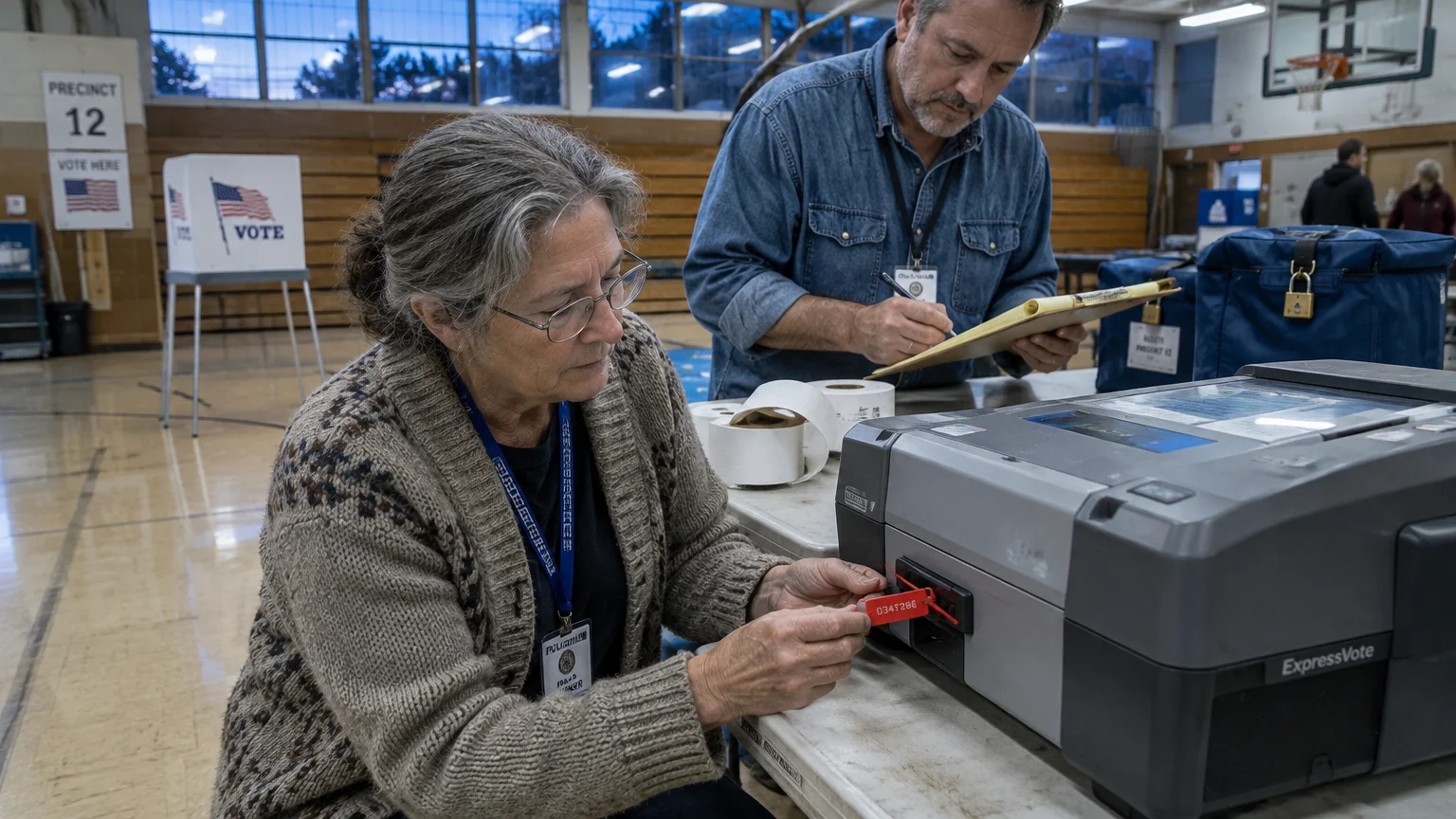
How Ministerial Duty and Strict Deadlines Protect the Chain of Custody
The American election certification structure operates as a sequential administrative chain across local, state, and federal tiers. Each governmental level builds directly upon the sworn physical records generated by the preceding jurisdiction.
At the center of this legal framework is the doctrine of ministerial duty. Election boards perform arithmetic calculations mandated by statute rather than exercising personal discretion over which certified precinct returns to accept.
State and federal courts enforce this distinction through expedited mandamus proceedings. When local boards miss statutory deadlines, judges compel officials to complete their certification duties.
The Electoral Count Reform Act of 2022 reinforced these timelines for presidential elections by requiring governors to issue Certificates of Ascertainment at least six days before the meeting of electors.
For congressional contests, completed state certifications allow House and Senate officers to assemble the opening-day rolls before January 3.
Frequently Asked Questions About Election Certification
Can a county board refuse to certify election results?
County election boards have no legal authority to refuse or delay certification of lawful returns. Under state election statutes and the federal Voting Rights Act, certifying election returns is a mandatory, ministerial duty.
If county canvassers refuse to vote for certification, state courts issue writs of mandamus compelling them to act. Judges can hold non-compliant officials in contempt or authorize state officials to complete the canvass.
Federal law under 52 U.S.C. § 10307(a) also imposes criminal penalties on anyone acting under color of law who willfully fails or refuses to tabulate, count, and report valid votes.
What happens if a governor refuses to sign a Certificate of Election?
Federal and state laws obligate governors to execute certificates for candidates who win certified statewide vote totals. Under 2 U.S.C. § 1a, gubernatorial attestation of Senate elections is a statutory executive duty.
Candidates can petition state or federal courts for emergency mandamus or injunctive relief.
For presidential electors, the Electoral Count Reform Act (3 U.S.C. § 5) explicitly grants federal courts expedited jurisdiction to compel a governor or other required state official to issue the Certificate of Ascertainment.
If a state executive fails to comply, federal courts can order the appropriate state official to issue the certificate before the federal deadline expires.
How do congressional Certificates of Election differ from presidential certificates?
Congressional Certificates of Election credential individual senators and representatives under 2 U.S.C. § 1a and § 26. State executives transmit these documents to the Secretary of the Senate and the Clerk of the House to establish the legislative roll.
Presidential elections use Certificates of Ascertainment under 3 U.S.C. § 5 to certify the winning slate of presidential electors in each state. Those electors then meet in their respective states in mid-December to cast and sign Certificates of Vote for President and Vice President.
The Archivist of the United States and the President of the Senate receive presidential certificates, whereas congressional credentials go directly to House and Senate officers.
Can Congress reject a certified Certificate of Election on swearing-in day?
A valid Certificate of Election confers a prima facie right to be seated on opening day. Under congressional precedent and Roudebush v. Hartke, chambers routinely seat certified members-elect without prejudice to subsequent election contests.
Under Article I, Section 5 of the Constitution, each chamber remains the final judge of the elections, returns, and qualifications of its own members.
A chamber may refer a disputed election to the House Committee on House Administration or the Senate Committee on Rules and Administration, which can ultimately recommend seating either candidate or declaring the seat vacant by majority vote.