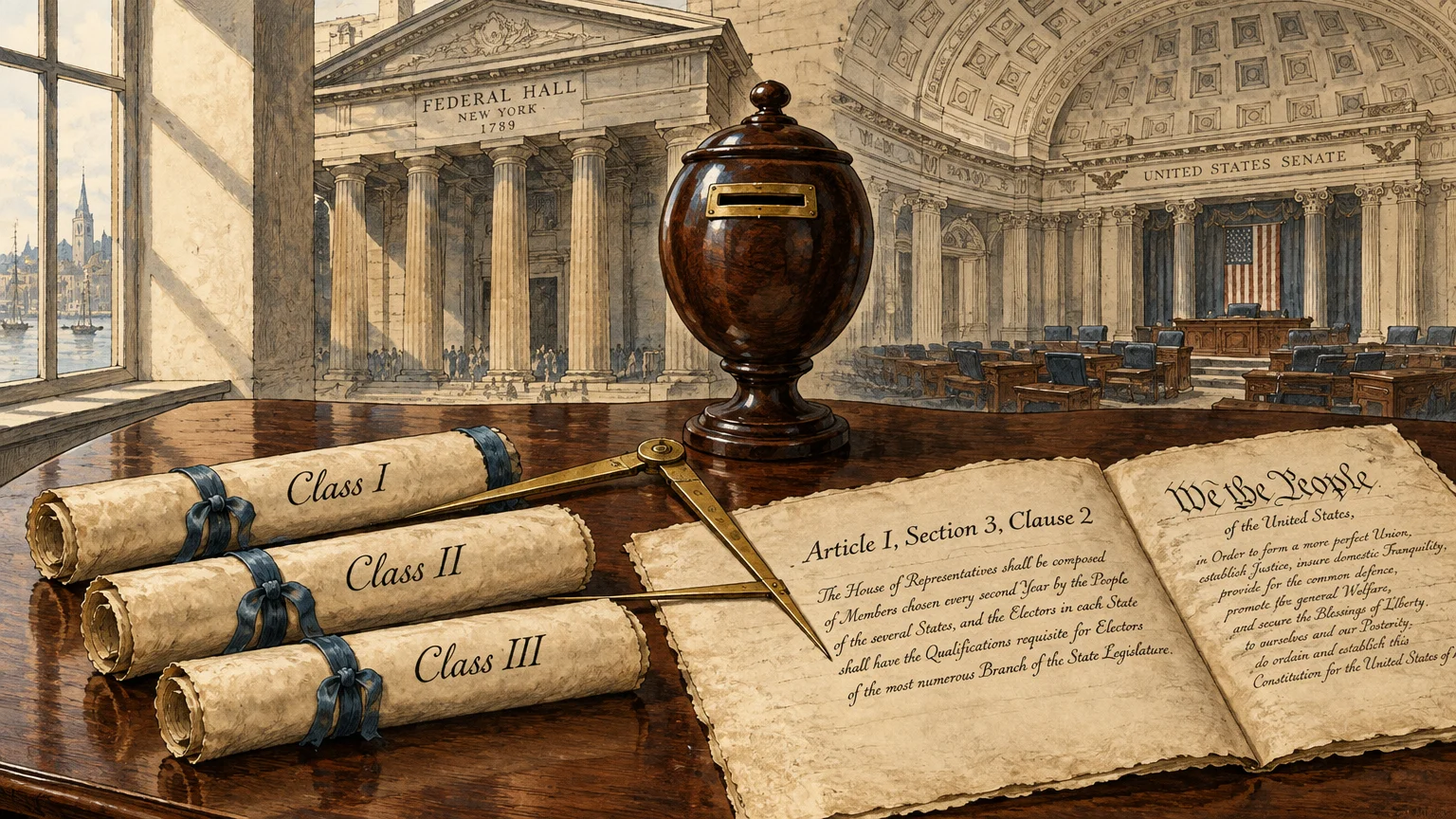
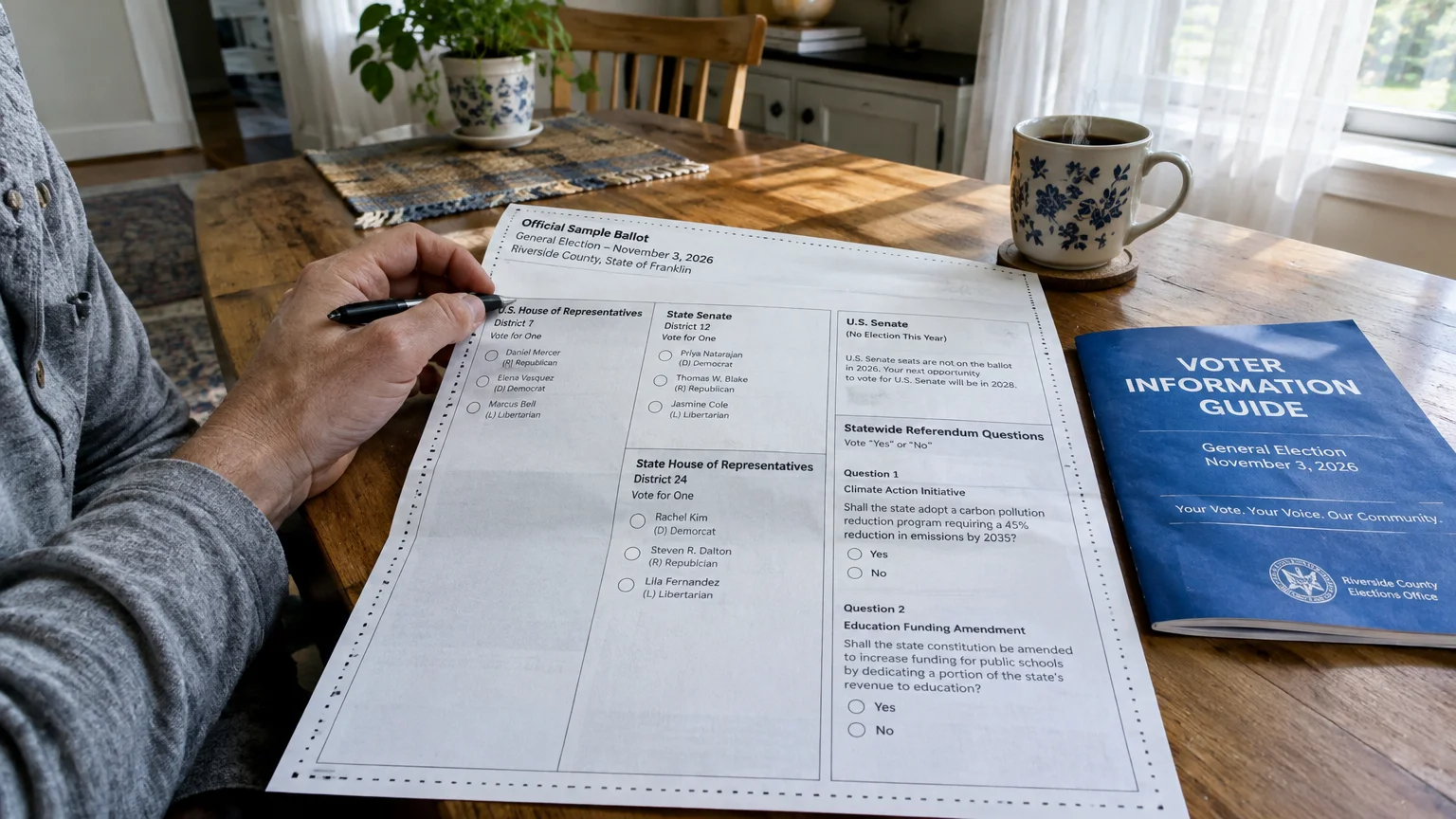
A 2026 sample ballot may lack a U.S. Senate race even while neighboring states vote on theirs. This omission occurs because the Constitution divides the Senate into three staggered election classes.
Only one-third of the 100 Senate seats faces voters during any regular biennial federal election. Every senator serves a six-year term, ensuring that two-thirds of the chamber remains seated at every transition.
This rotation began with a 1789 lottery at Federal Hall that assigned senators into three permanent classes.
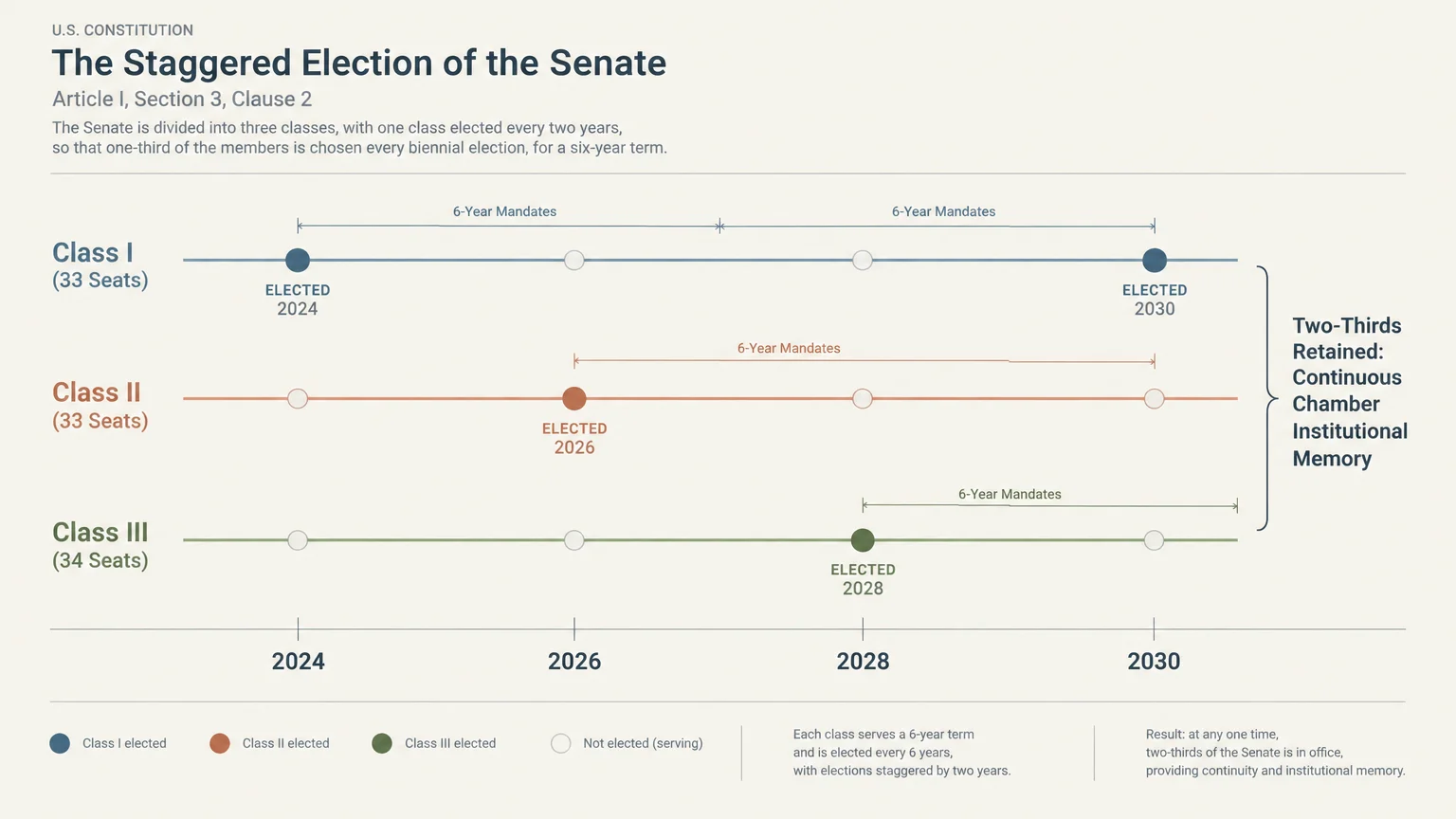
The Constitutional Mechanics Governing Staggered Senate Elections
The biennial Senate election cycle rests on Article I, Section 3, Clause 2 of the Constitution, which established a continuous legislative chamber rather than an assembly facing total biennial dissolution.
These seven constitutional provisions, statutory rules, and institutional precedents trace the three-class rotation from its 1787 drafting and 1789 lottery to the 2026 midterm elections.
Constitutional Design for Chamber Stability and Institutional Memory
The Framers designed the Senate to serve as a stabilizing anchor against rapid political turnover. While the entire House of Representatives faces election every two years, the Senate maintains continuous operational stability.
On September 17, 1787, delegates at the Philadelphia Convention signed the Constitution containing Article I, Section 3, Clause 2. This clause mandated dividing the Senate into three equal classes immediately after convening.
The convention debated legislative terms extensively during June 1787. On June 26, 1787, delegates voted 7–4 to reject shorter terms and establish six-year mandates for senators.
James Madison defended this staggered schedule in Federalist No. 62, published on February 27, 1788. He warned that a completely shifting assembly produces legislative instability and rewards factions.
Madison argued that institutional memory protects public policy from sudden reversals. Staggered six-year terms ensure that at least two-thirds of the chamber holds prior federal legislative experience at the start of every Congress.
The Federal Hall Lottery of May 1789
The Constitution mandated three staggered classes, but it did not assign specific senators to them. The 1st United States Congress resolved this organizational requirement in New York City in May 1789.
On May 11, 1789, the Senate appointed a committee consisting of Oliver Ellsworth, William Maclay, and Caleb Strong. They developed a plan to divide the 20 seated senators into three balanced cohorts.
Ten states had ratified the Constitution by that time, while North Carolina, Rhode Island, and New York lacked seated delegations. The committee ensured that no two senators from the same state shared a single cohort.
According to Senate Journal records, the lot drawing occurred on May 15, 1789. Senator Tristram Dalton of Massachusetts drew three slips from a wooden box in Federal Hall.
The slips assigned the three groups to initial terms of two, four, and six years, formally creating Senate Classes 1, 2, and 3.
Class 1 received two-year terms that expired on March 3, 1791, requiring seven senators to seek reelection first. Class 2 received four-year terms expiring in 1793, while Class 3 received full six-year terms expiring in 1795.
The Prohibition Against Same-State Seat Overlap
Article I requires that the two senators from each state belong to different election classes. This rule prevents a state from electing both of its regular senators on the same biennial cycle.
Simultaneous regular elections could replace a state’s entire Senate delegation in a single vote. Staggering ensures that each state retains one continuing senator during every regular election cycle.
This class separation creates a three-election rhythm for each state. Every state participates in two consecutive biennial Senate elections and then observes one off-year cycle without a regular Senate contest.
The Constitution Annotated confirms that states cannot alter this class assignment. No state legislature, governor, or court holds the authority to place both regular seats into the same class.
Equal Distribution Formulas for Admitted States
As new states joined the Union, Congress used a lottery formula to maintain balanced class sizes. The Senate established this procedure when Vermont gained statehood on March 4, 1791.
Under this rule, a new state’s two senators draw lots upon taking office so that incoming seats fill the smallest existing classes first. The two new senators never enter the same class.
Congress applied this lottery mechanism for all 37 states admitted between 1791 and 1959. Hawaii completed this progression following its admission on August 21, 1959, under Public Law 86-3.
Senators Hiram Fong and Oren Long drew lots on the Senate floor on August 24, 1959. Fong drew Class 1 and Long drew Class 3, establishing the modern 100-seat distribution.
According to the Senate Historical Office, because 100 does not divide evenly by three, the modern Senate operates on a 33–33–34 distribution: Class 1 holds 33 seats, Class 2 holds 33 seats, and Class 3 holds 34 seats.
The Legal Doctrine of the Senate as a Continuing Body
The staggered rotation creates a formal legal distinction between the Senate and the House of Representatives. Because two-thirds of the Senate remains in office across each election, the chamber operates without legal expiration.
The House of Representatives dissolves completely every two years at the conclusion of each Congress. The House must elect a Speaker and readopt its standing rules from scratch on opening day.
In contrast, the Senate’s standing rules remain in continuous force across biennial transitions. Senate Standing Rule V, Section 2 codifies this permanence by stating that chamber rules continue from one Congress to the next unless amended.
The Supreme Court affirmed this constitutional status in McGrain v. Daugherty, 273 U.S. 135 (1927). Justice Willis Van Devanter delivered the unanimous opinion upholding Senate investigative authority across Congresses because two-thirds of its members remain in office.
Preserving the Rotation Under the Seventeenth Amendment
State legislatures originally chose U.S. senators under Article I, Section 3. That practice ended when the states ratified the Seventeenth Amendment on April 8, 1913.
The Seventeenth Amendment established direct popular elections for senators while keeping the three staggered classes and six-year terms intact. It also standardized procedures for filling vacancies caused by death, resignation, or expulsion.
When a vacancy occurs, the state executive issues a writ of election, and state legislatures may authorize governors to appoint temporary replacements. Under 2 U.S.C. § 8, an appointee or special election winner serves only the unexpired remainder of the original term.
This vacancy rule explains why the November 3, 2026 ballot features 35 Senate races instead of 33. Alongside the 33 regular Class 2 contests, two Class 3 seats appear on the ballot as special elections.
Appointee Jon Husted in Ohio and appointee Ashley Moody in Florida hold Class 3 seats vacated by executive appointments. Voters in those states elect senators on November 3, 2026, to complete terms expiring on January 3, 2029.
Insulation of Long-Term Treaty and Confirmation Powers
Article II, Section 2 of the Constitution grants the Senate exclusive authority to ratify treaties and confirm federal appointments. Staggered six-year terms insulate these constitutional duties from single-cycle electoral turnover.
Ratifying an international treaty requires a two-thirds supermajority of senators present. Alexander Hamilton wrote in Federalist No. 75, published on March 26, 1788, that diplomatic agreements require an experienced body insulated from sudden shifts in popular mood.
The same constitutional structure governs the confirmation of cabinet officials, ambassadors, and Article III federal judges, who hold lifetime tenure during good behavior.
| Senate Class | Total Seats | Last Regular Election | Upcoming Regular Election | Subsequent Election | Initial 1789 Term |
|---|---|---|---|---|---|
| Class 1 | 33 Seats | November 2024 | November 2030 | November 2036 | 2 Years (1789–1791) |
| Class 2 | 33 Seats | November 2020 | November 2026 | November 2032 | 4 Years (1789–1793) |
| Class 3 | 34 Seats | November 2022 | November 2028 | November 2034 | 6 Years (1789–1795) |
How the Three-Class System Shapes Modern Senate Power
The three-class rotation prevents rapid chamber-wide turnover by limiting regular elections to 33 or 34 seats every two years. Capturing a Senate majority typically requires a political party to win seats across multiple biennial cycles.
In the 119th Congress, Republicans hold a 53–47 majority over Democrats and allied independents, reflecting the combined outcomes of the 2020, 2022, and 2024 elections.
The 33 regular Class 2 seats on the November 3, 2026 ballot consist of 20 seats held by Republicans and 13 held by Democrats.
Regardless of the 2026 election results, 65 non-contested senators from Classes 1 and 3 remain in office when the 120th Congress convenes on January 3, 2027.
Frequently Asked Questions About Senate Election Cycles
Why does my state have no Senate race on the 2026 ballot?
A state has no regular Senate election in 2026 if its two senators belong to Class 1 and Class 3. The 2026 regular election cycle includes only the 33 states with a Class 2 seat.
States with only Class 1 and Class 3 seats—such as California, New York, and Washington—held regular Senate elections in 2022 and 2024 and hold their next regular contests in 2028 and 2030.
Can a state ever vote on both Senate seats at the same time?
A state votes on both seats simultaneously only when a special election for a vacant seat coincides with the regular election for the state’s other seat.
For example, Georgia voters voted on both Senate seats in the November 2020 general election and January 2021 runoffs: one regular election for a full Class 2 six-year term, and one special election to finish an unexpired Class 3 term following a resignation.
Why are there 35 Senate elections in 2026 instead of 33?
The November 3, 2026 ballot features 35 contests because two Class 3 seats in Ohio and Florida require special elections following vacancies created by executive appointments.
Voters in Ohio and Florida elect senators to serve the remainder of those Class 3 terms through January 3, 2029, alongside the 33 regular Class 2 elections for six-year terms ending in January 2033.
What happens if a senator resigns or dies midway through a term?
The Seventeenth Amendment and state statutes govern Senate vacancies. In most states, the governor appoints an interim senator who serves until voters choose a successor in a special election.
The winner of that special election serves only the unexpired balance of the original six-year term, preserving the permanent 33–33–34 class alignment.