The United States Constitution restrains unilateral White House authority through structural boundaries, statutory limits, and judicial review. When an administration issues an executive order or proclamation, it must operate within explicit legal lanes.
If a directive strays beyond delegated powers, federal courts and congressional checks can invalidate it. The legal record establishes ten primary constitutional and statutory boundaries on presidential decrees.
How Constitutional Law Restrains Unilateral White House Directives
The Constitution never explicitly mentions executive orders or presidential proclamations. Instead, presidents derive directive authority from Article II executive powers and specific statutory delegations passed by Congress.
This list counts the ten core constitutional and statutory boundaries that constrain presidential directives, selected by our editorial team from controlling Supreme Court precedents and federal statutes.
As of October 15, 2026, President Donald Trump had signed 289 second-term executive orders and 188 proclamations subject to these checks.
Direct Alteration of Constitutional Amendments
A president cannot use an executive order or proclamation to redefine, alter, or cancel explicit language inside the U.S. Constitution. Only the Article V amendment process can alter constitutional provisions.
On June 30, 2026, the Supreme Court enforced this barrier in Trump v. Barbara (609 U.S. ___). The decision invalidated Executive Order 14160, which attempted to restrict birthright citizenship.
President Donald Trump signed Executive Order 14160 on January 20, 2025, directing federal agencies to deny citizenship to children born to undocumented parents. The Court ruled that the Fourteenth Amendment guarantees birthright citizenship unconditionally.
The ruling confirmed that the Citizenship Clause covers all children born on American soil, excluding only foreign diplomats and occupying enemies. Executive directives cannot circumvent the strict Article V amendment framework.
Contradicting Express Acts of Congress
Executive power operates at its weakest when a president acts contrary to the express will of Congress. White House directives that contradict enacted federal statutes violate basic separation-of-powers principles.
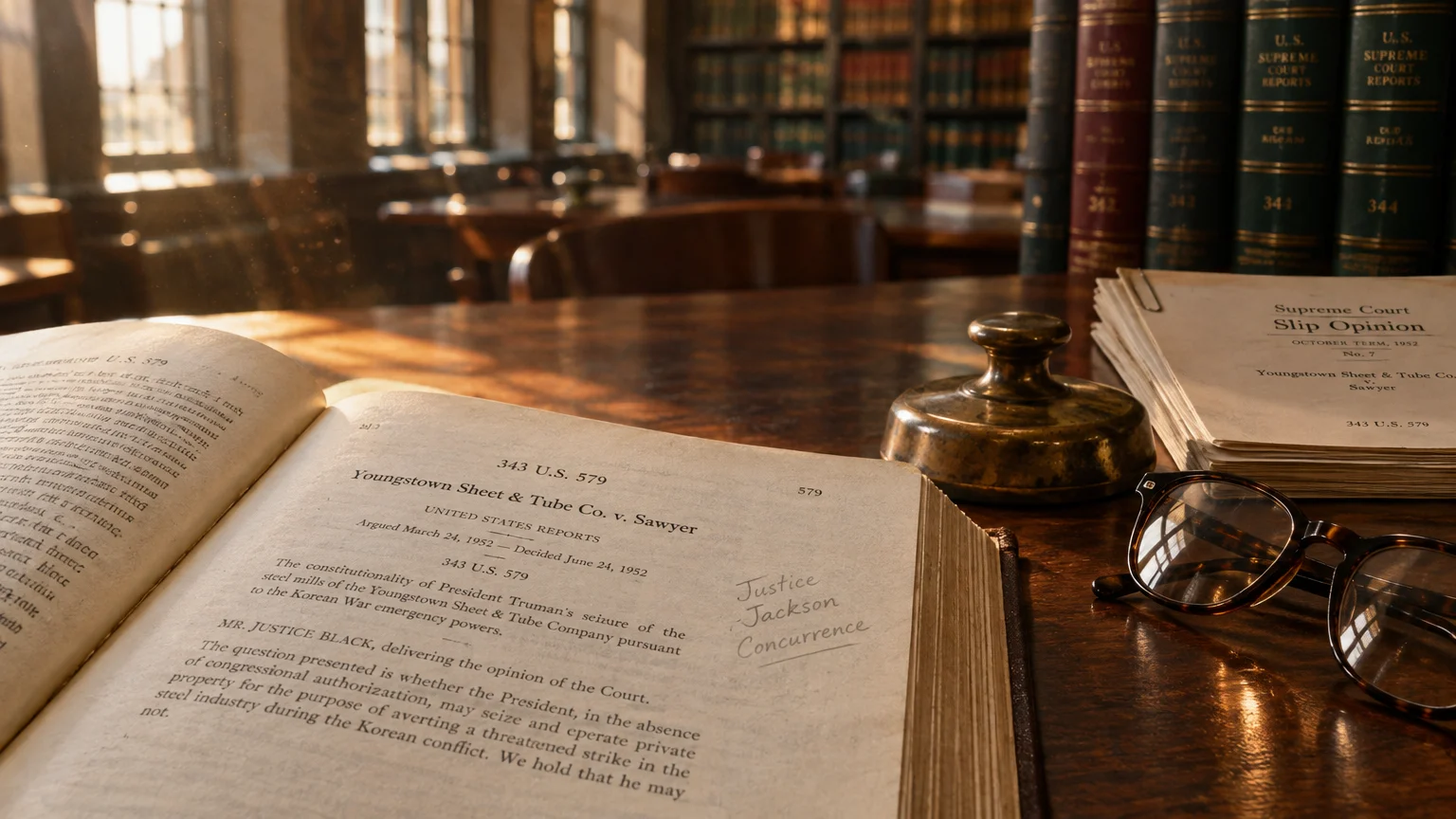
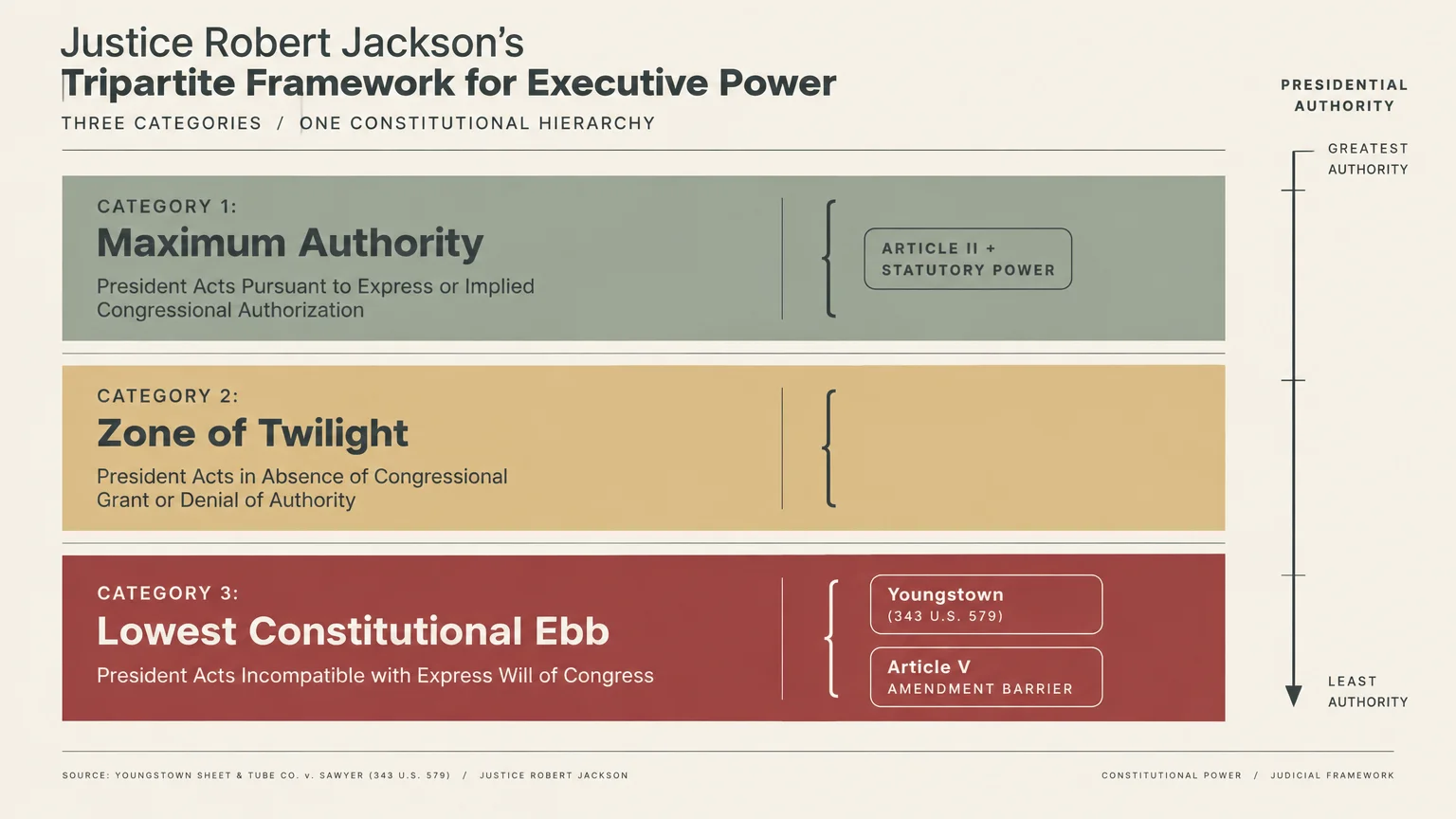
The foundation for this check remains Youngstown Sheet & Tube Co. v. Sawyer, decided June 2, 1952 (343 U.S. 579). In a 6–3 ruling, the Supreme Court struck down Executive Order 10340.
President Harry S. Truman issued the directive during the Korean War to seize commercial steel plants. However, Congress had specifically rejected government seizure authority when passing the Taft-Hartley Act of 1947.
Justice Robert Jackson formulated the tripartite framework that courts apply today. When a president defies federal statutes, executive authority falls to its lowest constitutional ebb.
Spending Funds Without Congressional Appropriation
The Constitution places the power of the purse exclusively in the hands of the legislative branch. A president cannot direct federal agencies to spend money that Congress never appropriated.
Article I, Section 9, Clause 7 explicitly mandates that no money shall leave the Treasury without an appropriation by law. Executive orders attempting to bypass this restriction fail judicial review.
On June 30, 2023, the Supreme Court reaffirmed this rule in Biden v. Nebraska (600 U.S. 477). The 6–3 decision blocked an executive effort to cancel $430 billion in student loan principal.
The Court applied the major questions doctrine, holding that massive financial expenditures require clear statutory authorization. White House officials cannot repurpose statutory waivers to bypass congressional spending controls.
Exercising Non-Delegated Lawmaking Powers
Article I, Section 1 vests all federal legislative powers in Congress, not the executive branch. White House directives cannot create criminal penalties or establish binding civilian codes without statutory authorization.
In A.L.A. Schechter Poultry Corp. v. United States (1935, 295 U.S. 495), the Supreme Court ruled 9–0 against executive fair-competition codes. The Court confirmed that Congress cannot delegate unfettered lawmaking power.
Under the non-delegation doctrine, administrative actions must follow an intelligible statutory principle supplied by Congress. When a presidential decree creates regulatory duties without statutory authority, courts invalidate the action.
Article II grants the president the authority to execute federal laws, while Article I reserves the power to write them to Congress.
Levying Unilateral Taxes and Tariffs Beyond Delegated Authority
The power to levy taxes, duties, and tariffs belongs strictly to Congress under Article I, Section 8. A president cannot unilaterally impose trade tariffs or border fees without statutory delegation.
Congress has granted conditional tariff authority under laws like Section 232 of the Trade Expansion Act of 1962 (19 U.S.C. § 1862). However, the White House must satisfy all statutory conditions first.
If an administration imposes tariffs outside procedural deadlines or national security guidelines, the U.S. Court of International Trade intervenes. Judges vacate trade duties that violate statutory limits.
Proclamations modifying import duties require concrete factual findings by federal agencies under 19 U.S.C. § 1862.
Suspending Constitutional Rights and Due Process
A presidential directive cannot suspend the fundamental civil liberties protected by the Bill of Rights. Even during declared national emergencies or wartime conditions, executive actions must satisfy constitutional due process.
In Ex parte Milligan (1866, 71 U.S. 2), the Supreme Court ruled unanimously against unilateral executive detentions. The Court held that military commissions cannot replace civilian courts while civilian judicial systems remain open.
The Fifth and Fourteenth Amendments guarantee fair legal proceedings before the executive branch deprives any person of liberty or property. Proclamations that attempt to strip civilian trial rights fail constitutional review.
Article I, Section 9, Clause 2 restricts emergency power further by granting only Congress the authority to suspend the writ of habeas corpus during invasion or rebellion.
Modifying Existing Federal Statutes Without Legislative Repeal
The Take Care Clause in Article II, Section 3 requires the president to faithfully execute existing laws. Directives cannot amend, repeal, or suspend statutory provisions passed by Congress.
In Clinton v. City of New York (1998, 524 U.S. 417), the Supreme Court struck down the Line Item Veto Act in a 6–2 decision. The ruling rejected unilateral cancellations of enacted statutory provisions.
The Court held that the Presentment Clause in Article I, Section 7 requires identical statutory text approval by both congressional chambers. A president cannot alter federal statutes by issuing executive memoranda or partial cancellations.
To repeal or amend an existing statute, Congress must pass a new bill and present it to the president under Article I, Section 7.
Bypassing the Administrative Procedure Act
Executive orders directing federal agencies cannot bypass the statutory standards of the Administrative Procedure Act of 1946 (5 U.S.C. § 551 et seq.). Federal agencies must justify administrative shifts with reasoned evidence.
In Department of Homeland Security v. Regents of the University of California (2020, 591 U.S. 1), the Court ruled 5–4 against an arbitrary executive rescission. The decision blocked the abrupt cancellation of DACA.
The Court affirmed that agencies must examine reliance interests and consider regulatory alternatives under 5 U.S.C. § 706. Presidential instructions do not excuse federal administrators from complying with administrative law.
When an order directs an agency to revise regulations, 5 U.S.C. § 553 requires the agency to publish a notice of proposed rulemaking and allow public comment.
Maintaining Indefinite National Emergencies
A presidential proclamation cannot sustain open-ended emergency powers without periodic statutory renewal. Congress enacted the National Emergencies Act of 1976 (50 U.S.C. § 1601 et seq.) to constrain executive declarations.
Under 50 U.S.C. § 1622, declared national emergencies terminate automatically after one calendar year unless the president publishes an extension notice within 90 days before the anniversary. The statute also establishes procedures for congressional review.
Following INS v. Chadha (1983, 462 U.S. 919), Congress can terminate a declared emergency through a joint resolution. That resolution requires a two-thirds override in both chambers if the president issues a veto.
Emergency proclamations do not create new constitutional powers; they unlock specific statutory authorities previously enacted by Congress.
Secret Enactment Without Legal Publication
Executive orders and presidential proclamations cannot impose binding legal duties on private citizens without public notice. The Federal Register Act of 1935 (44 U.S.C.
Chapter 15) requires the publication of all directives carrying general applicability and legal effect.
The Department of State instituted consecutive numbering in 1907, assigning Executive Order 1 retroactively to Abraham Lincoln’s October 20, 1862 directive establishing a provisional court in Louisiana.
Clerks inserted later-discovered historical orders using letter suffixes such as Executive Order 7709-A, while between 1,500 and 50,000 pre-1907 directives remain unnumbered.
Under Title 1, Part 19 of the Code of Federal Regulations—established by John F. Kennedy’s Executive Order 11030 on June 19, 1962—proposed orders must clear the Office of Management and Budget for budgetary review.
The draft then goes to the Attorney General and the Office of Legal Counsel for written constitutional approval.
Once signed, the Office of the Federal Register logs the text, assigns the chronological number, and publishes the document within one to several business days. An order becomes operational against the public only upon Federal Register publication.
Comparing the 10 Limits on Presidential Directives
| Constitutional Limit | Legal Authority | Key Case or Statute | Core Legal Restriction |
|---|---|---|---|
| Constitutional Text | Article V & 14th Amendment | Trump v. Barbara (2026) | Cannot rewrite or narrow explicit constitutional provisions. |
| Statutory Will | Article I Legislative Power | Youngstown Sheet & Tube (1952) | Cannot contradict existing federal legislation passed by Congress. |
| Appropriations | Article I, Section 9 | Biden v. Nebraska (2023) | Cannot expend public funds without explicit congressional allocation. |
| Lawmaking Power | Article I, Section 1 | Schechter Poultry Corp. (1935) | Cannot create novel regulatory codes or criminal penalties unilaterally. |
| Tariffs & Taxes | Article I, Section 8 | 19 U.S.C. § 1862 | Cannot impose duties without meeting strict statutory delegations. |
| Due Process | Fifth Amendment & Article I | Ex parte Milligan (1866) | Cannot replace civilian courts or suspend habeas corpus. |
| Statute Alteration | Article II, Section 3 | Clinton v. City of New York (1998) | Cannot cancel or amend statutory provisions by decree. |
| Administrative Rules | 5 U.S.C. § 706 | DHS v. Regents of California (2020) | Cannot bypass reasoned decision-making or notice requirements. |
| Emergency Powers | 50 U.S.C. § 1601 | National Emergencies Act (1976) | Declarations terminate after one year unless formally renewed. |
| Public Notice | 44 U.S.C. Chapter 15 | Federal Register Act (1935) | Directives carry no legal effect without formal publication. |
The Modern Legal System for Enforcing Executive Limits
Presidential reliance on unilateral orders peaked during the early-to-mid twentieth century. Franklin D.
Roosevelt holds the historical record with 3,721 executive orders (EO 6071 through EO 9537), while William Henry Harrison is the only president who issued zero during his 31 days in 1841.
As of October 15, 2026, President Donald Trump had signed 289 second-term executive orders—225 in 2025 (EO 14147 through EO 14371) and 64 in 2026 through EO 14435—plus 188 proclamations and 89 presidential memoranda.
Combined with 220 first-term orders, his 509 total orders rank ninth in U.S. history.
| President | Years in Office | Total Executive Orders | Federal Register Number Range |
|---|---|---|---|
| Franklin D. Roosevelt | 1933–1945 | 3,721 | EO 6071–EO 9537 |
| Woodrow Wilson | 1913–1921 | 1,803 | Unnumbered & numbered series |
| Calvin Coolidge | 1923–1929 | 1,203 | Unnumbered & numbered series |
| Bill Clinton | 1993–2001 | 364 | EO 12834–EO 13197 |
| George W. Bush | 2001–2009 | 291 | EO 13198–EO 13488 |
| Barack Obama | 2009–2017 | 276 | EO 13489–EO 13764 |
| Donald Trump (1st Term) | 2017–2021 | 220 | EO 13765–EO 13984 |
| Joe Biden | 2021–2025 | 162 | EO 13985–EO 14146 |
| Donald Trump (2nd Term, as of Oct. 2026) | 2025–2026 | 289 (225 in 2025; 64 in 2026) | EO 14147–EO 14435 |
Unlike federal statutes, executive orders lack legislative permanence and can be revoked immediately by a successor. On January 20, 2025, President Trump signed Executive Order 14148, revoking 78 executive orders and memoranda issued by President Joe Biden.
As of October 13, 2026, the Supreme Court had logged 43 emergency applications regarding second-term Trump administration policies. The administration filed 41 of those requests to lift lower-court injunctions, while outside litigants filed two.
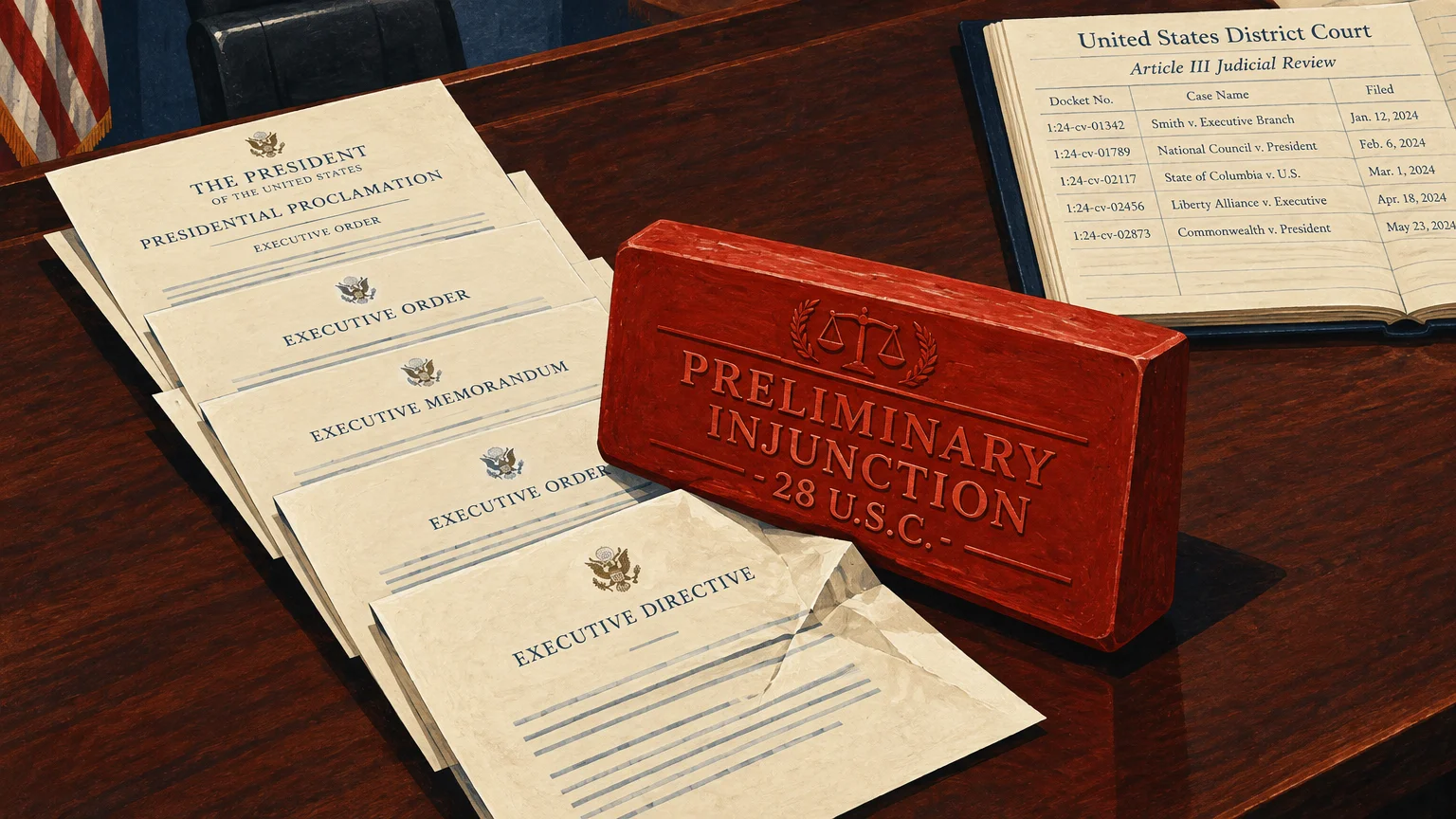
Judicial procedure shifted on June 27, 2025, when the Supreme Court ruled 6–3 in Trump v. CASA, Inc. (606 U.S. 831) that federal judges cannot issue universal injunctions. Writing for the majority, Justice Amy Coney Barrett held that the Judiciary Act of 1789 limits equitable relief to specific named plaintiffs.
Frequently Asked Questions About Executive Limits
Can an executive order overturn a federal statute?
No, an executive order cannot overturn or modify an enacted federal statute. Under the Supreme Court Youngstown framework, presidential power falls to its lowest ebb when contradicting legislative acts.
If a directive clashes directly with a federal statute, federal courts declare the order invalid. Only Congress can amend or repeal statutory language.
How do federal courts block an unlawful executive order?
Federal courts review executive orders when an injured party files a lawsuit under the Administrative Procedure Act or the Constitution. Judges evaluate whether the directive violates statutory authority or fundamental rights.
Following the June 2025 Supreme Court ruling in Trump v. CASA, Inc., injunctions apply strictly to named plaintiffs rather than nationwide non-parties. Challengers rely on class-action certifications under Federal Rule of Civil Procedure 23 to secure broader relief.
What is the difference between an executive order and a proclamation?
Executive orders primarily direct government officials and federal agencies on how to execute statutory duties. They manage administrative personnel and agency operations across the executive branch.
Proclamations address the broader public and international trade matters, such as declaring holidays or imposing tariff schedules. Both instruments carry binding legal effect only when grounded in statutory or constitutional authority.
Can Congress overturn a presidential proclamation or restrict personal presidential conduct?
Yes, Congress can overturn a proclamation by passing legislation that revokes the directive or defunds its enforcement, subject to a two-thirds vote in both chambers to override a presidential veto under Article I, Section 7.
Congress also enforces personal statutory limits under the Foreign Gifts and Decorations Act (5 U.S.C. § 7342) and the Foreign Emoluments Clause (Article I, Section 9, Clause 8).
For the 2023–2025 triennial cycle, any foreign official gift exceeding the $480 minimal value threshold becomes federal property and must be transferred to the National Archives unless the president purchases it at fair market value.