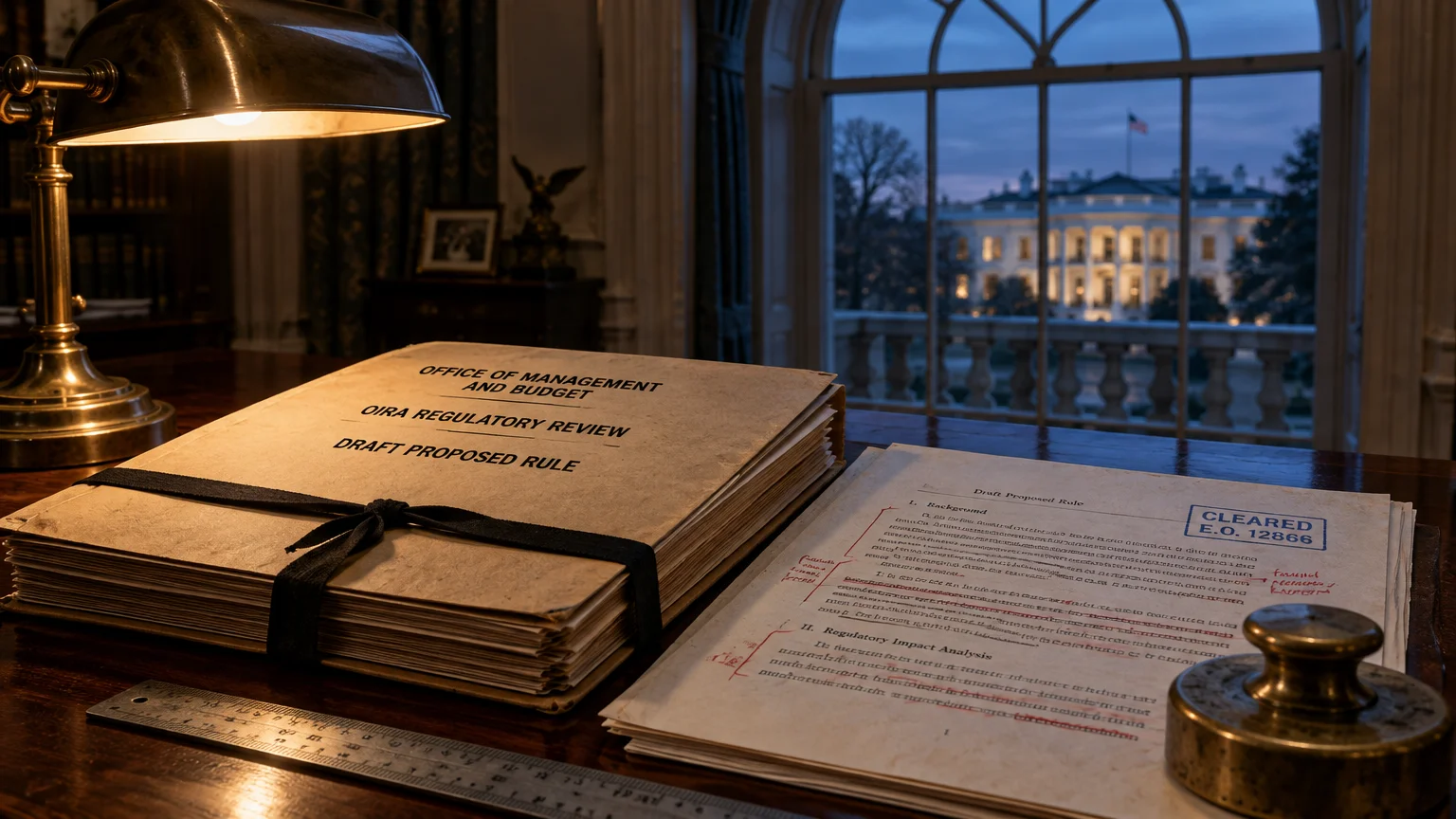
When Congress passes a sweeping law, unelected agency officials write the fine print that directly governs your business, workplace, and daily life. You can trace ultimate authority over those rules to the White House Office of Management and Budget (OMB).
Through its Office of Information and Regulatory Affairs (OIRA), OMB operates as a quiet executive gatekeeper. The office reviews, rewrites, or halts regulations before agencies can legally publish them in the Federal Register.
Understanding this centralized clearance pipeline reveals how presidential policy actually shapes federal enforcement. Here are eight essential facts explaining how OMB exercises veto power across the administrative state.
Evaluating the Evolution of White House Regulatory Clearance
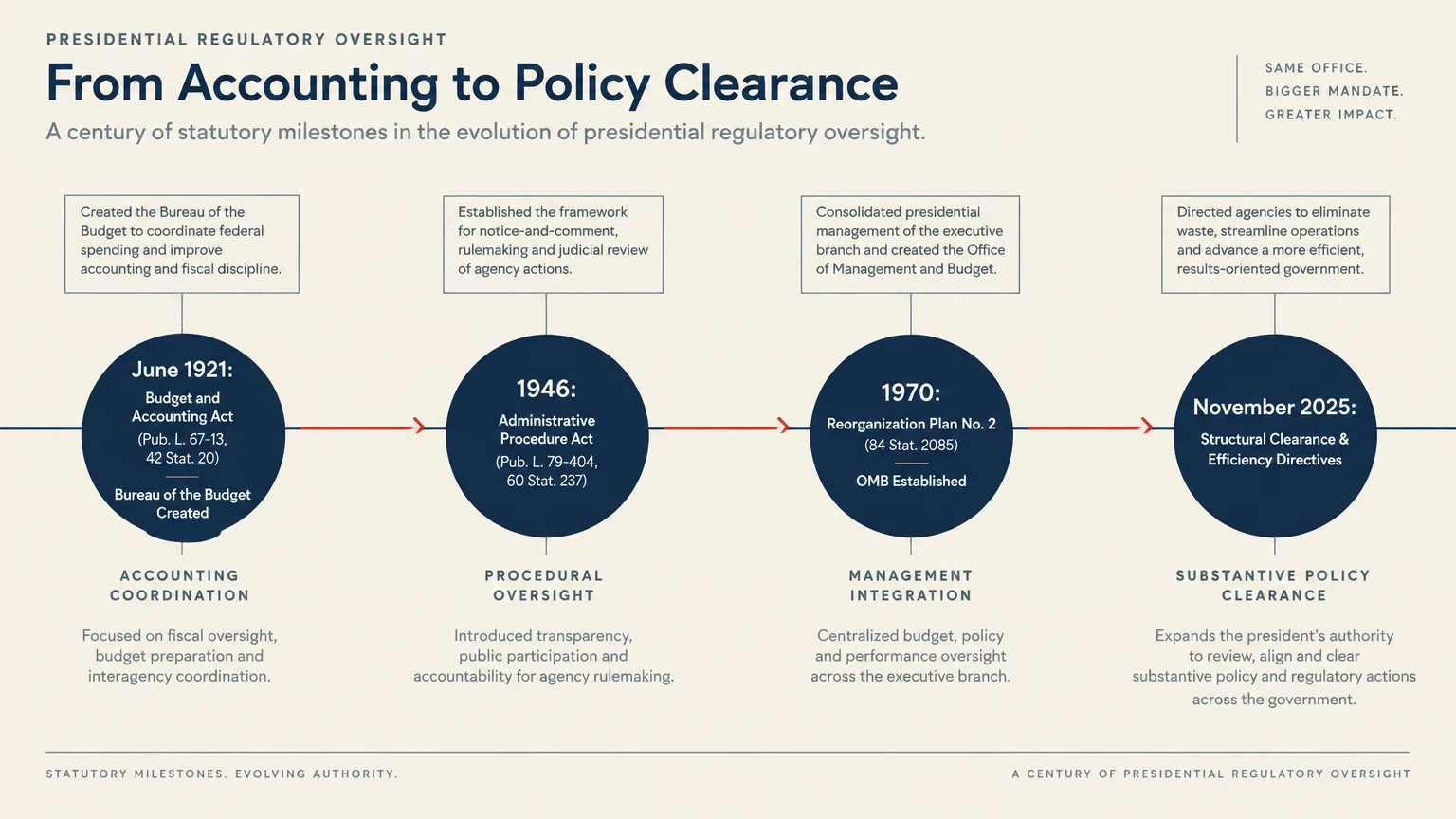
This list tracks eight foundational statutes, executive orders, and administrative directives that built the modern White House regulatory clearance system. It covers major milestones established between June 1921 and November 2025.
Entries were selected by examining binding statutory enactments, published executive orders in the Federal Register, and official OMB policy memoranda. Each item represents a legal turning point in how presidents supervise executive rulemaking.
When federal agencies implement statutory directives, they possess substantial discretion to craft enforceable standards. Over the last century, successive administrations developed centralized review mechanisms to rein in that agency independence.
The review process centers on OIRA, a specialized statutory clearinghouse operating within the Executive Office of the President. OIRA analysts examine agency economic models, policy justifications, and compliance burdens before any draft rule becomes law.
By studying these eight key developments, you can evaluate how executive clearance altered the constitutional separation of powers. What began as simple accounting coordination has become an expansive system of substantive policy control.
The entries also illuminate recent structural changes implemented throughout 2025. These include expedited deregulatory review clocks, the elimination of independent agency exemptions, and coordinated enforcement with external efficiency teams.
Every regulatory action carries direct economic consequences for consumers and businesses. OMB oversight functions as a filter, requiring agencies to quantify those costs before imposing new compliance duties.
Over decades, this review process has sparked intense debate among legal scholars and policymakers. Proponents view OIRA as an essential check against bureaucratic overreach, while critics argue it delays vital public protections.
Understanding how OIRA reviews rules helps you identify where political accountability resides in the modern regulatory state. Cabinet officials must defend their policy choices directly to White House staff.
This guide provides the statutory background, administrative history, and operational rules governing that executive clearance process. Each fact clarifies how the White House directs the federal regulatory machinery.
Statutory Origins of Executive Budget and Administrative Management
Congress established modern presidential administrative management by passing the Budget and Accounting Act of 1921 (Pub. L.
67-13, 42 Stat. 20).
President Warren G. Harding signed the legislation on June 10, 1921.
The 1921 statute created the Bureau of the Budget, which President Richard Nixon expanded into OMB under Reorganization Plan No. 2 of 1970 (84 Stat. 2085).
That reorganization shifted the office toward comprehensive management oversight.
Federal administrative procedure rests upon the Administrative Procedure Act of 1946 (Pub. L.
79-404, 60 Stat. 237).
Codified across 5 U.S.C. Subchapter II, the APA establishes binding notice-and-comment requirements under Section 553.
While the APA guarantees public participation and statutory regularity, it leaves day-to-day policy coordination to the executive branch. OMB uses this statutory space to ensure that agency rulemaking reflects presidential priorities rather than bureaucratic preferences.
Establishment of the Office of Information and Regulatory Affairs
Congress formally established OIRA inside OMB by passing the Paperwork Reduction Act of 1980 (Pub. L.
96-511, 94 Stat. 2812).
President Jimmy Carter signed the landmark measure on December 11, 1980.
Codified at 44 U.S.C. § 3503, the statute tasked OIRA with reviewing and approving all information collections sponsored by federal agencies. Congress intended the office to reduce paperwork burdens on small businesses, citizens, and local governments.
The legislation gave OIRA formidable enforcement teeth through the mandatory control number requirement in 44 U.S.C. § 3507. Agencies cannot conduct surveys, audit forms, or mandate compliance reporting without an active OMB control number.
Under the statute’s public protection provision at 44 U.S.C. § 3512, you possess an absolute legal defense against administrative penalties if an agency collection request lacks valid OMB approval.
Centralized Cost-Benefit Clearance Under Executive Orders 12291 and 12866
President Ronald Reagan fundamentally transformed federal rulemaking on February 17, 1981, by issuing Executive Order 12291 (46 FR 13193). The order required executive branch agencies to submit proposed regulations to OIRA for centralized cost-benefit analysis.
President Bill Clinton replaced that order on September 30, 1993, by signing Executive Order 12866 (58 FR 51735). That directive solidified the modern regulatory clearance architecture that remains binding today.
Executive Order 12866 affirmed that regulations must maximize net societal benefits and choose the least burdensome administrative approach. Under Section 6, agencies must submit detailed Regulatory Impact Analyses for all major regulatory initiatives.
This clearance requirement grants White House policy advisers informal veto power over departmental proposals. OIRA can return a draft rule to an agency for revisions if the underlying cost-benefit calculations fail internal scrutiny.
Restoration of the One-Hundred-Million-Dollar Significance Threshold
Under Section 3(f)(1) of Executive Order 12866, OIRA reviews every significant regulatory action expected to have an annual economic effect of $100 million or more. This includes rules creating significant material costs or market distortions.
In April 2023, President Joe Biden issued Executive Order 14094, which raised that economic threshold to $200 million. That change removed hundreds of medium-sized administrative regulations from routine OIRA analytical review.
President Donald Trump revoked Executive Order 14094 on January 20, 2025, immediately reinstating the historic $100 million cutoff. The revocation reestablished centralized White House scrutiny over broader categories of agency rules.
Under OMB Director Russell Vought and Acting OIRA Administrator Jeffrey Clark, this restored standard captures hundreds of mid-tier environmental, labor, and financial regulations before their final publication.
Reinstatement of Traditional Economic Standards Under Circular A-4
First issued on September 17, 2003, OMB Circular A-4 serves as the executive branch’s binding handbook for conducting regulatory cost-benefit calculations. It establishes the mathematical formulas agencies must apply during economic impact modeling.
On February 12, 2025, OMB Director Russell Vought issued Memorandum M-25-15. The memorandum formally rescinded the Biden administration’s November 2023 revisions to Circular A-4 and reinstated the original 2003 guidelines.
The reinstated guidance restores standard social discount rates of 3% and 7% for assessing future regulatory outcomes. The rescinded 2023 version had lowered baseline rates to approximately 1.7%, which inflated long-term benefit calculations.
By requiring 7% capital discount rates, OMB forces agencies to prove that new mandates deliver immediate, tangible economic returns. This calculation standard prevents departments from justifying expensive mandates through speculative, multi-decade projections.
Extension of White House Regulatory Clearance to Independent Agencies
Since 1981, independent regulatory commissions such as the Federal Communications Commission, Securities and Exchange Commission, and Federal Trade Commission operated outside OIRA review. Past presidents voluntarily exempted them to respect perceived statutory independence.
President Donald Trump terminated that historical exemption on February 18, 2025, by signing Executive Order 14215. Titled “Ensuring Accountability for All Agencies,” the order subjects all independent boards to mandatory OIRA review.
Executive Order 14215 requires independent commissions to submit significant proposed and final rules for formal clearance. The order provides only one narrow exception, protecting the Federal Reserve Board’s traditional monetary policy functions.
This expansion fundamentally alters independent agency governance. Independent commissioners can no longer publish major regulations without first satisfying OMB’s rigorous economic criteria and presidential policy directives.
Enforcement of the Ten-for-One Deregulatory Mandate and Cost Caps
On January 31, 2025, President Donald Trump signed Executive Order 14192, titled “Unleashing Prosperity Through Deregulation.” The directive replaced the previous two-for-one standard with an aggressive ten-for-one deregulatory requirement.
Executive Order 14192 mandates that agencies identify and revoke at least ten existing regulations for every new significant regulation they promulgate. It also imposes strict net regulatory cost caps across all executive departments.
OIRA’s Final Accounting for Fiscal Year 2025 documented 646 deregulatory actions against just 5 significant regulatory actions. This performance produced an extraordinary 129-to-1 ratio across broad administrative rollbacks and guidance revocations.
Looking solely at direct Code of Federal Regulations amendments, agencies completed 218 formal rule rescissions against 5 new rules. This 43-to-1 ratio produced an estimated $211.8 billion in total private-sector compliance savings.
Accelerated Review Clocks and DOGE Team Integration
Executive Order 12866 established a baseline review window of 90 calendar days for OIRA clearance, with a possible 30-day extension. However, new administrative directives established faster review mechanisms for deregulatory actions throughout 2025.
On February 19, 2025, the president signed Executive Order 14219. This order directed agencies to coordinate directly with Department of Government Efficiency (DOGE) Team Leads to identify rules exceeding statutory authority.
OMB Director Russell Vought formalized this accelerated framework on October 21, 2025, by issuing Memorandum M-25-36. The directive compresses OIRA review windows to 28 days for general deregulatory actions.
According to the Congressional Research Service, Memorandum M-25-36 also creates a 14-day clearance track for repealing rules deemed facially unlawful. This mechanism enables unprecedented speed when dismantling agency rules.
| Action or Authority | Issuing Authority | Effective Date | Core Regulatory Standard |
|---|---|---|---|
| Paperwork Reduction Act | Congress (96th) | Dec 11, 1980 | Requires OMB control numbers for collections |
| Executive Order 12866 | President Clinton | Sept 30, 1993 | Mandates net-benefit review for $100M+ rules |
| Circular A-4 Restoration | OMB (Memo M-25-15) | Feb 12, 2025 | Reinstates 3% and 7% baseline discount rates |
| Executive Order 14215 | President Trump | Feb 18, 2025 | Subjects independent agencies to OIRA clearance |
| Executive Order 14192 | President Trump | Jan 31, 2025 | Enforces 10-for-1 deregulation and cost caps |
| Expedited Review Clock | OMB (Memo M-25-36) | Oct 21, 2025 | Sets 28-day and 14-day deregulatory clearance |
How Centralized Clearance Reshapes the Separation of Powers
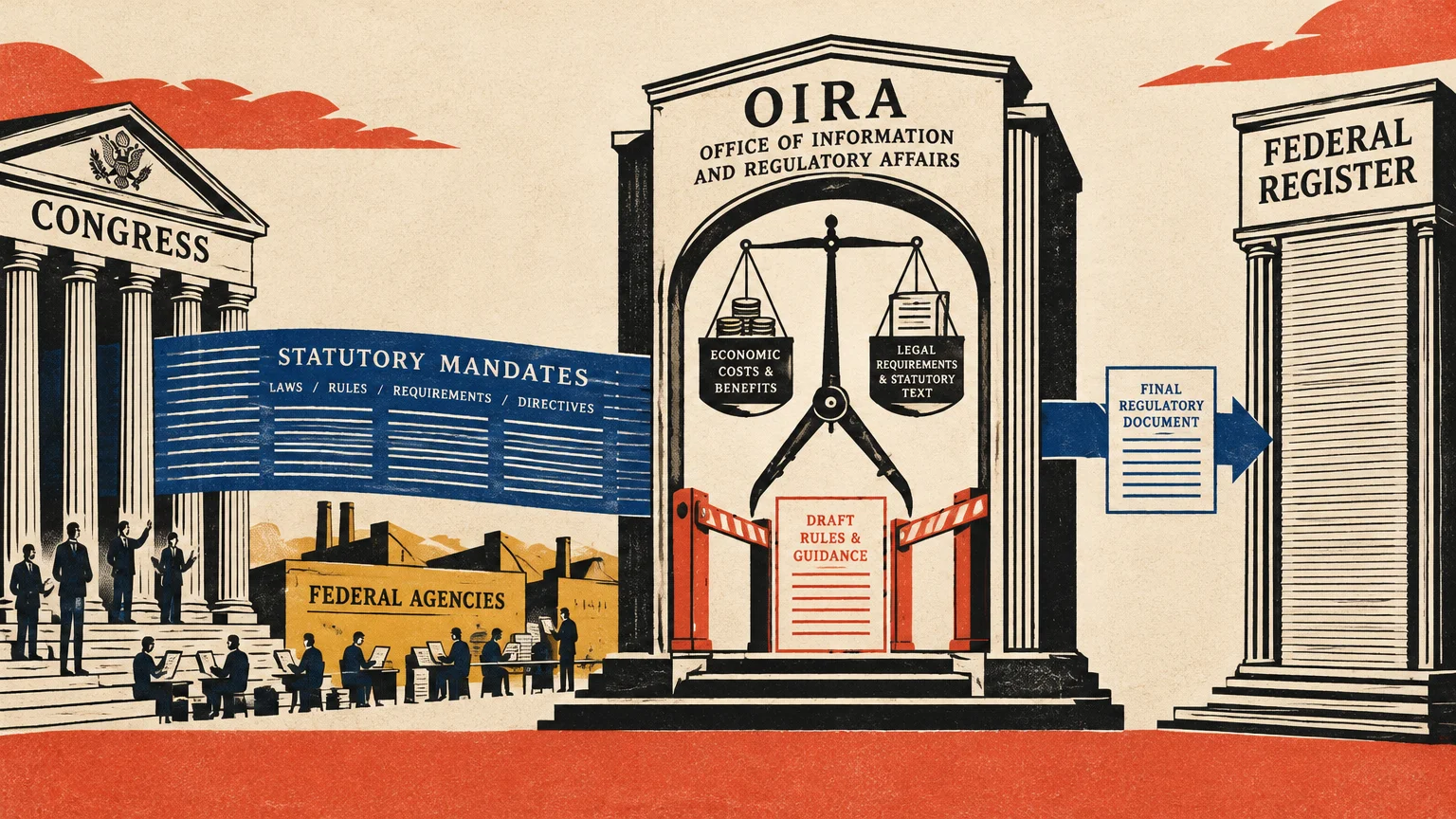
The modern White House regulatory clearance apparatus represents a profound concentration of administrative power in the Executive Office of the President.
When Congress enacts broad statutory directives, it rarely outlines every technical compliance standard or enforcement threshold. Lawmakers delegate that rulemaking responsibility directly to executive branch agencies.
OMB steps directly into this statutory delegation. By controlling the analytical methods, economic assumptions, and clearance timelines, White House officials ensure that agency enforcement aligns with presidential policy.
This centralized oversight fundamentally alters the constitutional dynamic between the legislative and executive branches. Even if Congress passes a protective statute, OMB can limit its economic reach by enforcing strict cost-benefit tests.
The expansion of OIRA review to independent agencies under Executive Order 14215 marks an essential constitutional development. For decades, legal scholars debated whether the president possessed constitutional authority to supervise independent commissions.
By asserting direct clearance power over the FTC, SEC, and FCC, the administration embraced the unitary executive theory. This legal doctrine holds that Article II vests all executive power directly in the president.
Under this doctrine, independent agency commissioners cannot operate as autonomous regulators insulated from executive direction. Instead, their major policies must survive identical White House scrutiny applied to cabinet departments.
The methodological battle over OMB Circular A-4 illustrates how economic technicalities drive real-world outcomes. Changing discount rates or adjusting net-benefit calculations fundamentally alters which rules survive clearance.
A 7% discount rate discounts distant future benefits much more heavily than immediate compliance costs. Consequently, environmental and safety mandates face steep analytical hurdles when agencies attempt to prove net economic gains.
The ten-for-one deregulatory mandate under Executive Order 14192 transforms OIRA from a passive clearance clearinghouse into an active deregulatory enforcement agency.
Agencies can no longer justify new regulations simply by pointing to statutory authorization. They must actively eliminate existing administrative rules to clear regulatory budget space for new initiatives.
Incorporating DOGE teams directly into agency rulemaking under Executive Order 14219 reinforces this institutional focus. Outside efficiency analysts collaborate with OIRA to identify target rules for rapid elimination.
Compressed review windows under Memorandum M-25-36 complete this institutional shift. By reducing review timelines to 28 days or 14 days, OMB enables swift deregulatory action across the executive branch.
The Supreme Court’s 2024 decision in Loper Bright Enterprises ended judicial deference to agency interpretations of ambiguous statutes. This judicial shift significantly increases the legal importance of OIRA’s economic and statutory scrutiny.
Agencies can no longer expect federal courts to defer to expansive regulatory assertions. Consequently, OMB plays a vital gatekeeping role by screening draft rules for statutory vulnerabilities before publication.
When OIRA identifies potential legal vulnerabilities, it forces agencies to narrow the scope of their proposed rules. This preemptive review protects executive actions from immediate judicial invalidation under the Administrative Procedure Act.
Federal regulatory policy also carries profound implications for state and local governments. Under the Unfunded Mandates Reform Act of 1995, OMB monitors intergovernmental costs to prevent federal agencies from imposing unfinanced burdens on states.
The combination of deregulatory cost caps and strict economic modeling fundamentally changes how agencies approach their statutory missions. Civil servants must design targeted solutions rather than sweeping, open-ended mandates.
For businesses, workers, and consumers, this centralized architecture means federal regulations reflect presidential elections far more than bureaucratic tenure. Major administrative shifts can occur overnight through executive memoranda.
As legal challenges to these directives move through the federal judiciary, the core mechanisms of White House regulatory review remain intact. OMB clearance continues to serve as the ultimate administrative choke point.
Ultimately, OMB’s centralized authority demonstrates that control over the regulatory state is the primary instrument of modern presidential governance. Whoever directs OMB effectively directs the everyday operations of the federal government.
Understanding this executive pipeline allows you to see how policy decisions are truly finalized in Washington. The final authority over federal regulations rests firmly inside the White House budget office.
Frequently Asked Questions About OMB Regulatory Control
Can an executive agency publish a major rule without OIRA approval?
In practice, executive agencies cannot publish significant rules without formal OIRA clearance. Executive Order 12866 strictly prohibits agencies from sending draft rules to the Federal Register without OMB approval.
The Office of the Federal Register verifies OMB clearance before scheduling any major regulation for publication. If an agency attempts to circumvent this procedure, OMB can return the rule or withhold funding.
How does OIRA determine whether a rule’s benefits outweigh its costs?
OIRA reviews the Regulatory Impact Analysis that agencies submit under the economic accounting standards established in OMB Circular A-4.
Economists assess direct compliance costs, paperwork burdens, market impacts, and quantified societal benefits using standardized 3% and 7% discount rates.
If an agency fails to demonstrate that its proposed standard maximizes net benefits or chooses the least burdensome approach, OIRA returns the rule for revision.
What is the legal difference between OMB and OIRA?
OMB is the broad cabinet-level agency within the Executive Office of the President responsible for federal budget management, agency performance, and legislative clearance.
OIRA is a specialized statutory sub-agency created inside OMB by Congress under the Paperwork Reduction Act of 1980.
While OMB manages annual federal spending and departmental operations, OIRA focuses specifically on regulatory clearance, paperwork reduction, and statistical policy.
Can the public track which rules OMB is currently reviewing?
You can monitor every regulation currently under White House review using the public OIRA Regulatory Review Dashboard on Reginfo.gov.
The database provides real-time tracking of incoming draft rules, review duration, originating agencies, and formal clearance determinations.
Under Executive Order 12866, interested members of the public and regulated entities can also schedule formal stakeholder meetings with OIRA analysts during the review period.




