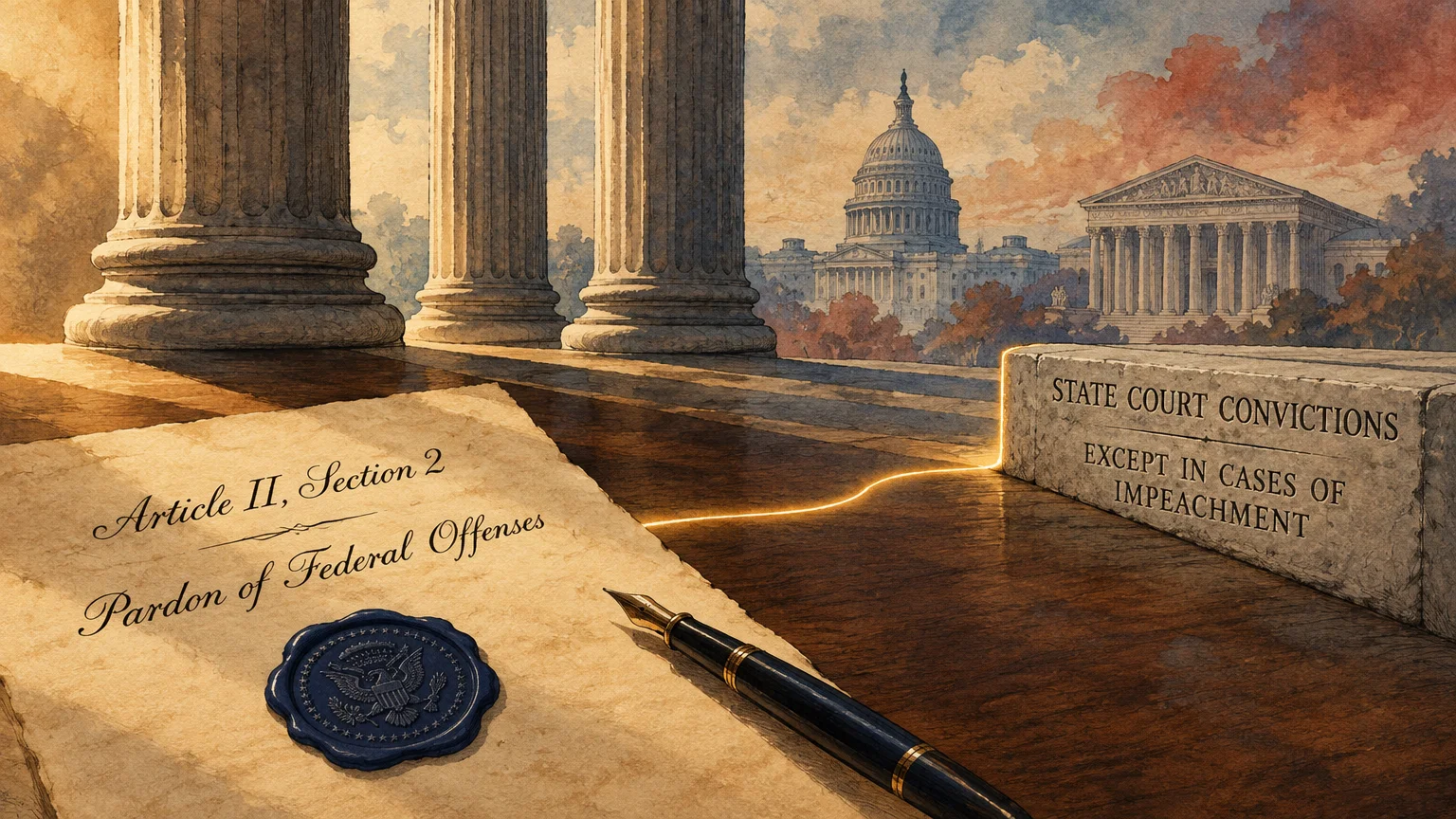
You can understand the limits of presidential pardon power by examining eight binding constitutional principles. Article II grants the president sweeping executive clemency, yet strict legal boundaries prevent absolute authority.
These structural rules dictate which criminal offenses qualify for relief and distinguish full pardons from commutations. They also explain why state court convictions remain entirely beyond the president’s reach.
By reviewing landmark Supreme Court precedents and federal regulations, you can see how clemency functions today. The public record establishes clear standards for how presidents exercise this constitutional power.
Constitutional Framework and Standards for Executive Clemency
Our editorial team analyzed constitutional text, Supreme Court records, and Department of Justice regulations to identify these eight governing rules. Each principle reflects settled federal jurisprudence and documented executive practice through December 2025.
Executive clemency derives from the British Crown’s prerogative of mercy, but American framers intentionally restricted its scope. They created a republic where executive power operates alongside judicial oversight and legislative impeachment checks.
This list focuses on legal mechanics rather than political controversies. You can evaluate how presidential actions comply with constitutional text by reviewing the statutes and docketed cases that define executive mercy.
Whether a president issues an individual pardon or proclaims mass amnesty, these rules establish what the Constitution permits. They reveal both the immense breadth and the immovable borders of presidential clemency.
Federal Offenses Define the Boundary of Executive Reach
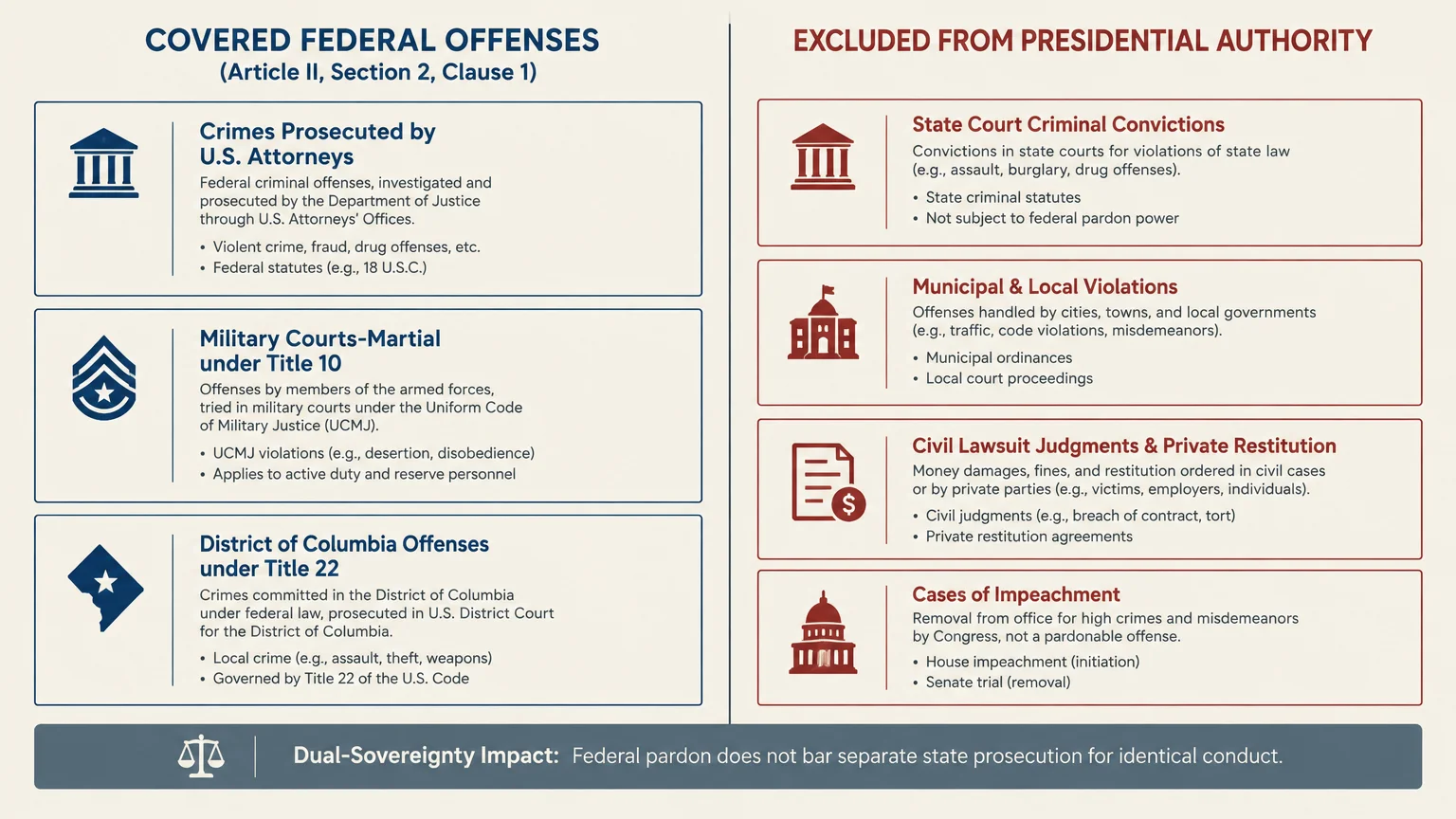
Article II, Section 2, Clause 1 of the United States Constitution limits presidential clemency to “Offenses against the United States.” This specific phrasing restricts executive relief strictly to violations of federal law.
You cannot receive a presidential pardon for state criminal convictions or municipal citations. Under the Constitution Annotated analysis of the Pardon Clause, state governors retain exclusive executive clemency authority over state criminal justice systems.
The clause also bars presidents from intervening in civil litigation. While a president can forgive federal court-martial verdicts and District of Columbia Superior Court offenses, private tort judgments remain completely unaffected by executive action.
This jurisdictional divide preserves the federal balance established by the framers. If a state attorney general secures a criminal conviction, no occupant of the Oval Office possesses the legal authority to erase it.
- Covered convictions: Crimes prosecuted by federal United States Attorneys, military courts-martial under Title 10, and local District of Columbia offenses under Title 22 of the D.C. Code.
- Excluded matters: Criminal verdicts handed down by state courts, municipal violations, civil lawsuit judgments, and administrative restitution orders owed to private parties.
- Dual-sovereignty impact: An individual pardoned for a federal crime remains fully subject to separate state prosecution for the exact same underlying conduct without violating double jeopardy.
Impeachment Cases Remain Explicitly Beyond Presidential Authority
The Pardon Clause includes a single explicit text exception: “except in Cases of Impeachment.” This structural restriction guarantees that presidents cannot shield civil officers, judges, or themselves from congressional removal.
As detailed in Congressional Research Service studies on executive clemency, this clause prevents the executive branch from overriding the legislative branch’s ultimate constitutional sanction. Impeachment serves as an institutional mechanism to disqualify corrupt officials.
Article I, Section 3 confirms that judgments in impeachment cases extend only to removal from office and future disqualification. Because impeachment does not impose criminal penalties, executive pardons have no application to legislative trials.
A president cannot reinstate an official removed by the Senate or wipe away an order of disqualification. The public record shows this restriction protects the separation of powers from executive self-preservation.
- Constitutional origin: Introduced by Alexander Hamilton in Federalist No. 69 to ensure executive officers could not escape congressional accountability for high crimes and misdemeanors.
- Sanction boundaries: The exception applies solely to legislative removal and disqualification votes, leaving the underlying conduct open to ordinary judicial processes.
- Subsequent criminal trials: An official removed through impeachment remains vulnerable to federal indictment; a president can pardon those subsequent criminal charges, but cannot undo the Senate conviction.
Preemptive Grants Can Precede Indictment or Conviction
A recipient does not need a formal indictment, arrest, or criminal conviction to receive presidential clemency. The Supreme Court settled this principle in the landmark 1866 case Ex parte Garland.
The Court held that the pardon power extends to every offense known to law and applies at any time after commission. A president may issue relief the moment an individual commits an unlawful act.
President Gerald Ford applied this precedent on September 8, 1974, by signing Proclamation 4295 for Richard Nixon. Ford granted a full pardon for all federal offenses Nixon committed during his presidency.
President Joe Biden used this power broadly on December 1, 2024, issuing an eleven-year preemptive pardon for Hunter Biden. On January 20, 2025, Biden granted further preemptive pardons to Anthony Fauci and congressional investigators.
- Temporal reach: Clemency takes effect immediately upon execution for past acts, but it cannot authorize or immunize future criminal conduct.
- Historical precedent: George Washington established the preemptive doctrine in 1795 by pardoning participants in the Whiskey Rebellion before federal prosecutors secured indictments.
- Legal consequence: A preemptive grant strips federal prosecutors of jurisdiction to present charges, secure indictments, or execute arrest warrants against the covered individual.
Pardon Recipients Retain the Legal Right of Refusal
A presidential pardon does not operate automatically as a mandatory decree; you possess the legal authority to reject it. The Supreme Court affirmed this principle in the 1833 decision United States v. Wilson.
Chief Justice John Marshall wrote that a pardon is a private deed requiring delivery and formal acceptance. If the intended recipient rejects the pardon in open court, judges cannot force the executive grant upon them.
The Court expanded this principle in the 1915 case Burdick v. United States. Editor George Burdick refused Woodrow Wilson’s pardon because accepting it would strip his Fifth Amendment protection against testifying before a grand jury.
Justice Joseph McKenna noted that accepting a pardon carries an imputation of guilt. However, the Tenth Circuit clarified in 2021 in Lorance v. Commandant that acceptance does not constitute an explicit legal confession.
- Fifth Amendment privilege: Rejecting a pardon permits an individual to maintain their constitutional right against compelled self-incrimination during judicial proceedings.
- Reputational choice: An accused individual can decline executive mercy to demand a public trial where a jury can establish factual innocence.
- Delivery requirement: Until a pardon document reaches the recipient or their authorized attorney, the sitting president retains the legal power to recall and cancel the grant.
Sentence Commutations Take Effect Without Inmate Consent
While you can reject a full pardon, you cannot refuse a presidential sentence commutation. The Supreme Court drew this sharp distinction in the 1927 case Biddle v. Perovich.
Vuco Perovich challenged President William Howard Taft’s decision to commute his death sentence to life imprisonment without his consent. The Court ruled that commutations serve the public welfare rather than private contract rights.
Justice Oliver Wendell Holmes Jr. wrote that the executive determines punishment levels according to national interest. A convicted prisoner cannot demand execution by attempting to decline a presidential reduction of their sentence.
Presidents utilize commutations for broad penal adjustments. President Joe Biden commuted sentences for 37 federal death row inmates on December 23, 2024, and granted relief to nearly 2,500 nonviolent drug offenders on January 17, 2025.
- Legal distinction: Commutations merely substitute a lesser penalty for an existing sentence without erasing the underlying criminal conviction or civil disabilities.
- Immediate enforcement: The Federal Bureau of Prisons adjusts release dates immediately upon receipt of a presidential warrant without requiring prisoner signature.
- Conditional terms: Presidents can attach lawful conditions to commutations, such as community confinement, supervised release terms, or financial restitution obligations.
Congressional Legislation Cannot Restrict or Void Clemency
Congress lacks the constitutional power to regulate, restrict, or modify how a president exercises executive clemency. The Supreme Court established this strict separation of powers in the 1871 ruling United States v. Klein.
Following the Civil War, Congress passed legislation denying pardoned Confederates the right to reclaim seized property. The Supreme Court struck down the statute, ruling that legislators cannot prescribe the legal effect of a pardon.
The Court determined that the Constitution grants the president plenary clemency power free from congressional control. Lawmakers cannot exclude specific offenses, impose procedural vetoes, or dictate who qualifies for executive relief.
Revocation rules follow executive delivery rather than legislative statute. In December 2008, President George W.
Bush successfully recalled a pardon for Isaac Robert Toussie because the document had not yet reached the recipient.
- Statutory limits invalid: Federal courts routinely invalidate congressional attempts to create statutory preconditions or mandatory waiting periods on Article II clemency.
- Appropriations limits: While Congress can withhold funding for clemency processing personnel, it cannot defund the president’s direct constitutional power to grant warrants.
- Finality principle: Once a signed pardon warrant is formally delivered to the recipient or their legal counsel, neither Congress nor a successor president can revoke it.
Executive Relief Encompasses Three Distinct Legal Instruments
Executive clemency operates through distinct mechanisms: full pardons, sentence commutations, and general amnesties. Each legal instrument produces different rights and consequences for the recipient under federal law.
A full pardon restores civil liberties, including voting rights, jury service eligibility, and firearm ownership privileges. A commutation only reduces the remaining sentence length, leaving the underlying felony conviction on your permanent record.
General amnesties address entire classes of individuals without requiring individualized background investigations. President Jimmy Carter executed Proclamation 4483 on January 21, 1977, granting unconditional pardons to over 200,000 Vietnam War draft evaders.
President Donald Trump utilized mass clemency on January 20, 2025, by signing Proclamation 10887. That action issued full pardons to approximately 1,500 individuals charged in connection with the January 6, 2021 Capitol incident.
- Full pardon: Completely forgives the crime, eliminates outstanding judicial punishments, and restores federal civil rights lost upon felony conviction.
- Sentence commutation: Shortens an ongoing prison term or lowers financial penalties while maintaining the official finding of criminal guilt.
- Amnesty proclamation: Extends collective executive forgiveness to a defined group of offenders, typically deployed to resolve national political or military emergencies.
Department of Justice Regulations Serve as Advisory Guidelines
The Department of Justice processes clemency petitions through the Office of the Pardon Attorney, but its rules remain strictly advisory. Under 28 C.F.R. § 1.2, petitioners must typically wait five years post-release before applying.
Federal regulations establish rigorous screening criteria and background checks by the Federal Bureau of Investigation. However, Title 28, Section 1.11 of the Code of Federal Regulations clarifies that these standards do not bind the president.
A president can grant clemency directly without consulting the Pardon Attorney or waiting for an application. Presidents frequently bypass administrative channels to issue unilateral grants based on independent executive review.
President Joe Biden set an all-time individual record by granting 4,245 acts of clemency during his presidency. Department records show Trump granted 237 clemencies in his first term and 261 individual grants through 2025.
- Waiting period rule: Section 1.2 requires five full years of community reintegration following prison release before an individual can formally petition the Pardon Attorney.
- Non-binding mandate: Section 1.11 explicitly specifies that administrative clemency regulations serve solely as internal guidelines for Department of Justice staff.
- Bypass authority: Presidents retain the legal power to grant pardons at their sole discretion, ignoring adverse Department of Justice recommendations or pending paperwork.
| Rule Dimension | Constitutional or Statutory Basis | Foundational Legal Authority | Operational Standard | Checkable Benchmark Case |
|---|---|---|---|---|
| Federal Scope | U.S. Const. art. II, § 2, cl. 1 | Pardon Clause Text | Strictly bars relief for state crimes or civil suits | Excludes all 50 state court criminal jurisdictions |
| Impeachment Ban | U.S. Const. art. II, § 2, cl. 1 | Impeachment Exception | Presidents cannot block legislative trials or removals | Article I, Section 3 disqualification judgments |
| Preemptive Timing | Article II Executive Power | Ex parte Garland (1866) | Applies after an offense occurs, prior to indictment | Proclamation 4295 (Nixon pardon, Sept. 8, 1974) |
| Voluntary Acceptance | Article II Executive Deed Rule | Burdick v. United States (1915) | Recipients may decline a pardon to retain rights | 236 U.S. 79 (Burdick Fifth Amendment refusal) |
| Forced Commutation | Article II Sentence Reduction | Biddle v. Perovich (1927) | Inmate consent is never required to reduce terms | 274 U.S. 480 (Vuco Perovich death penalty reduction) |
| Separation of Powers | Article II Exclusive Power | United States v. Klein (1871) | Congress cannot limit or prescribe pardon effects | 16 Stat. 235 struck down by Supreme Court |
| Categorical Forms | Article II Clemency Types | Proclamation 4483 (1977) | Distinguishes pardons, commutations, and amnesties | 42 Fed. Reg. 4391 (Carter draft evader amnesty) |
| DOJ Regulation Status | 28 C.F.R. § 1.11 | Department Advisory Code | DOJ rules guide staff but do not bind the president | Five-year post-release wait rule in 28 C.F.R. § 1.2 |
How Executive Clemency Balances Constitutional Power
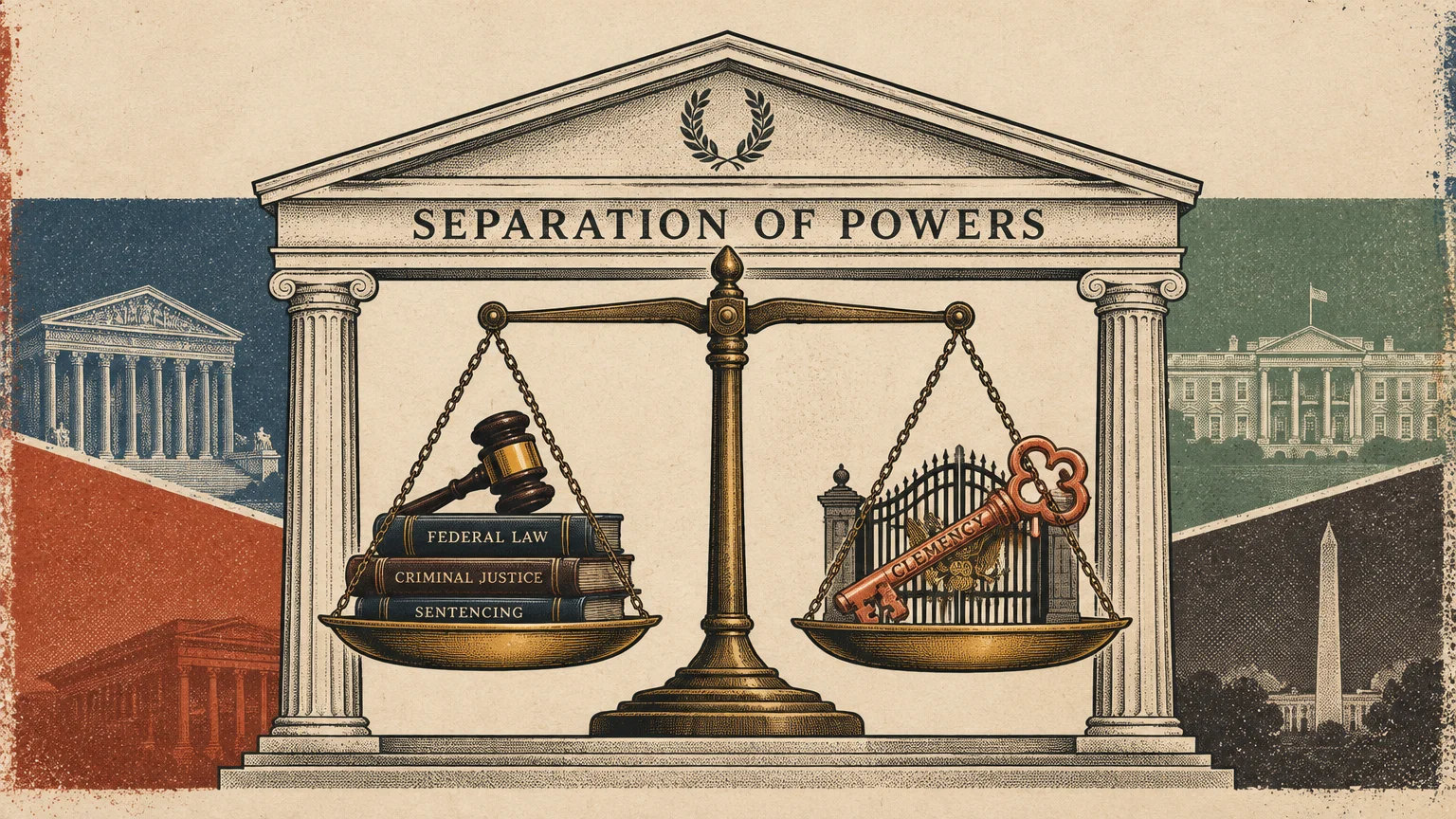
The eight rules governing presidential clemency illustrate an intentional constitutional balance. The framers granted broad unilateral authority to ensure swift mercy during national crises, while restricting its reach to federal offenses.
Modern practice demonstrates that clemency has shifted from an administrative review system to a direct presidential prerogative. While early presidents relied heavily on formal Justice Department dockets, twenty-first-century executives routinely bypass bureaucratic channels.
Recent actions through December 2025 demonstrate this evolving standard. Presidents from both parties have exercised their authority to adjust federal sentencing disparities, pardon political allies, and grant mass relief to entire classes of offenders.
Despite this expansion, the foundational guardrails established in the nineteenth century remain fully intact. State sovereignty shields local prosecutions, congressional impeachment remains inviolate, and recipients maintain their right to refuse full pardons.
Understanding these legal boundaries allows you to evaluate executive actions against established constitutional law. The pardon power remains one of the purest forms of presidential discretion in the American constitutional framework.
Frequently Asked Questions About Presidential Pardons
Can a president pardon someone before they are charged with a crime?
Yes, the president can issue a preemptive pardon at any point after an offense occurs. In Ex parte Garland (1866), the Supreme Court ruled that clemency extends to all federal offenses without requiring prior indictment.
Notable examples include Gerald Ford’s 1974 pardon of Richard Nixon and Joe Biden’s 2024 pardon of Hunter Biden. However, a president cannot pardon conduct that has not yet occurred.
Does accepting a presidential pardon mean you admit guilt?
Accepting a pardon implies an imputation of guilt under the Supreme Court’s 1915 ruling in Burdick v. United States. However, modern federal courts draw a distinction between public perception and formal legal confession.
In 2021, the Tenth Circuit ruled in Lorance v. Commandant that accepting a pardon does not constitute an explicit legal admission of criminal guilt. You regain civil rights without signing a confession.
Can a sitting president pardon state-level criminal convictions?
No, the president possesses zero constitutional authority to pardon state criminal offenses. Article II restricts executive clemency strictly to “Offenses against the United States,” which means federal crimes exclusively.
State governors or specialized state clemency boards hold the sole constitutional power to commute or pardon convictions originating in state courts. Federal pardons leave state penalties completely enforceable.
Can Congress or a new president overturn a delivered pardon?
No, once a presidential pardon is signed and officially delivered to the recipient, it is completely irreversible. Under United States v. Klein, Congress cannot pass legislation invalidating or altering a valid pardon.
Similarly, an incoming president cannot revoke a pardon delivered by a predecessor. A president can only cancel a clemency grant before official delivery occurs, as George W.
Bush did in December 2008.