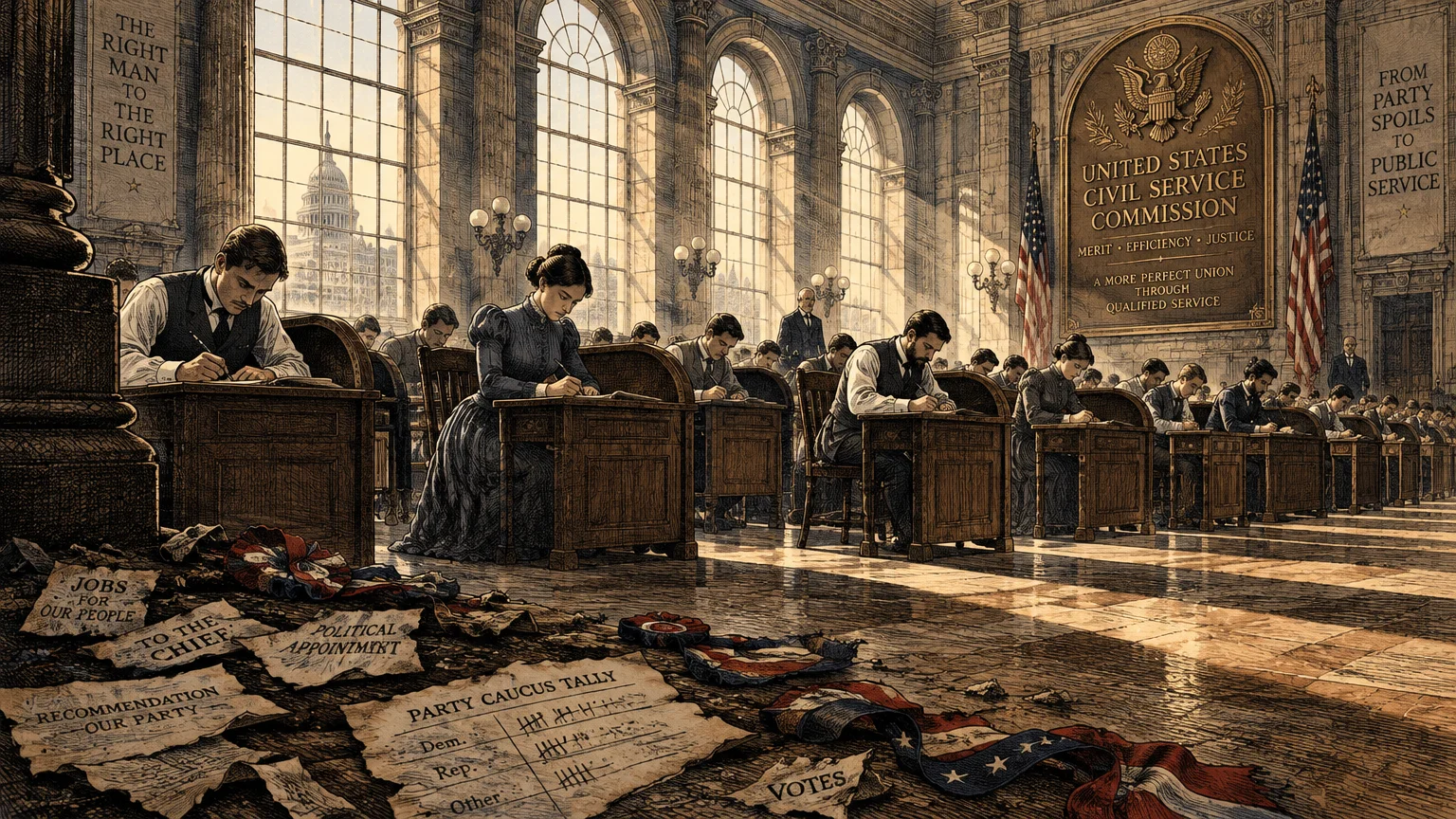
The United States replaced the nineteenth-century spoils system through a sequence of landmark statutes and executive orders. These reforms shifted millions of federal positions from political patronage to competitive, merit-based hiring.
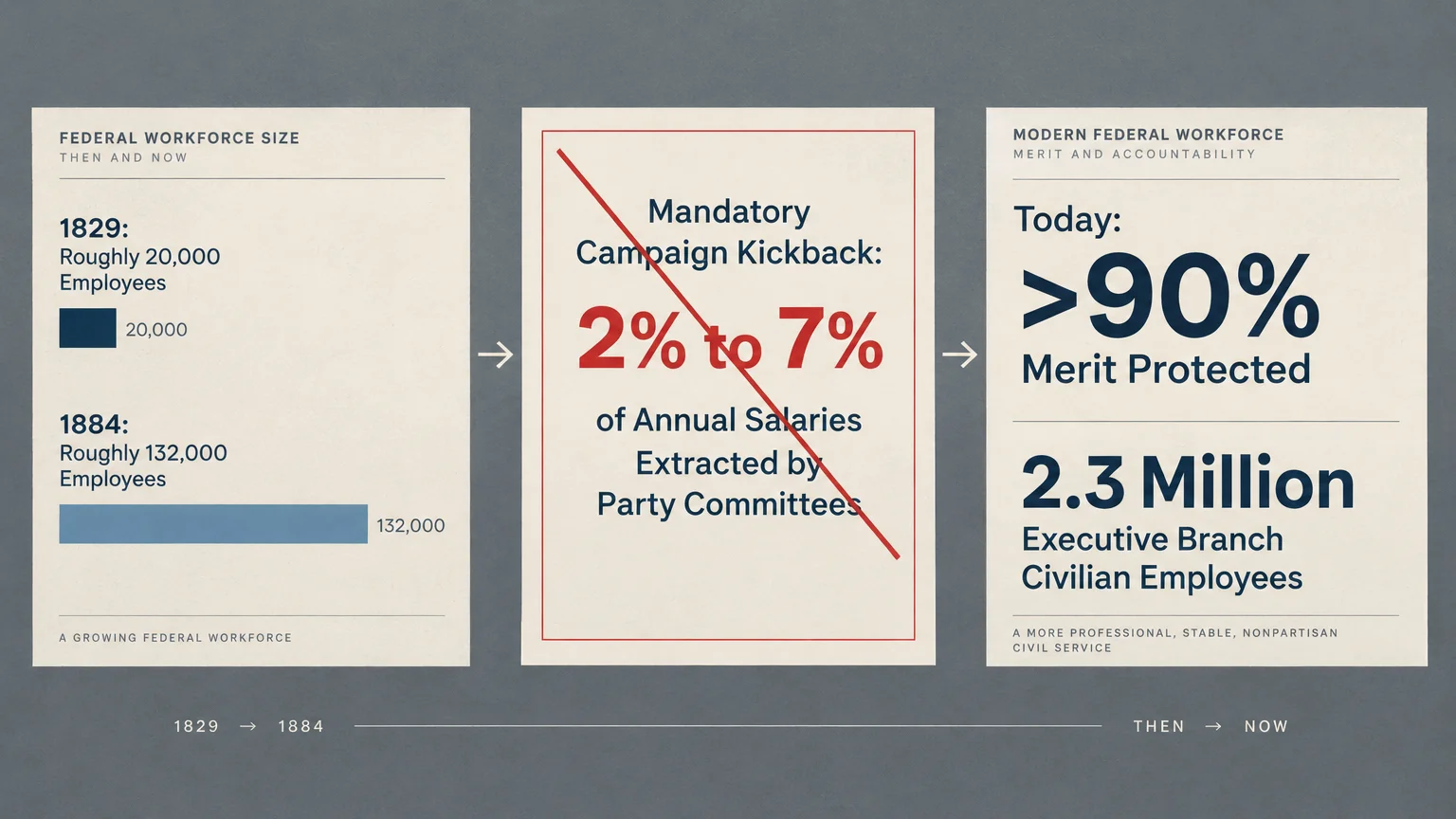
In January 1832, New York Senator William L. Marcy defended President Andrew Jackson’s appointments by declaring that “to the victor belong the spoils.” During Jackson’s presidency from 1829 to 1837, presidents personally distributed roughly 20,000 federal civilian jobs as partisan rewards.
By 1884, the federal workforce had expanded to roughly 132,000 employees, and party committees routinely coerced workers into kicking back 2% to 7% of their salaries. After Congress defunded President Ulysses S.
Grant’s 1871 Civil Service Commission in 1874, durable reform required new statutory authority.
How Merit Replaced Partisan Patronage in the Federal Workforce
This list tracks the seven decisive legislative acts and executive mechanisms enacted between 1883 and 1978 that dismantled federal patronage. Today, more than 90% of the approximately 2.3 million executive branch civilian employees serve under the merit principles established by these measures.
Our editorial team selected these seven milestones based on their direct statutory impact on federal hiring, pay, and tenure. Each entry represents a documented transition from partisan favoritism toward competitive testing, standardized compensation, or statutory removal protections.
The Pendleton Civil Service Reform Act of 1883
The modern federal civil service traces its legal origin to a national crisis in 1881. On July 2, 1881, Charles J.
Guiteau shot President James A. Garfield at the Baltimore and Potomac Railroad Station in Washington after being denied a Paris consulship.
Garfield died on September 19, 1881, and authorities hanged Guiteau on June 30, 1882. Public outrage over the assassination forced Congress to consider reform legislation introduced by Senator George H.
Pendleton, an Ohio Democrat.
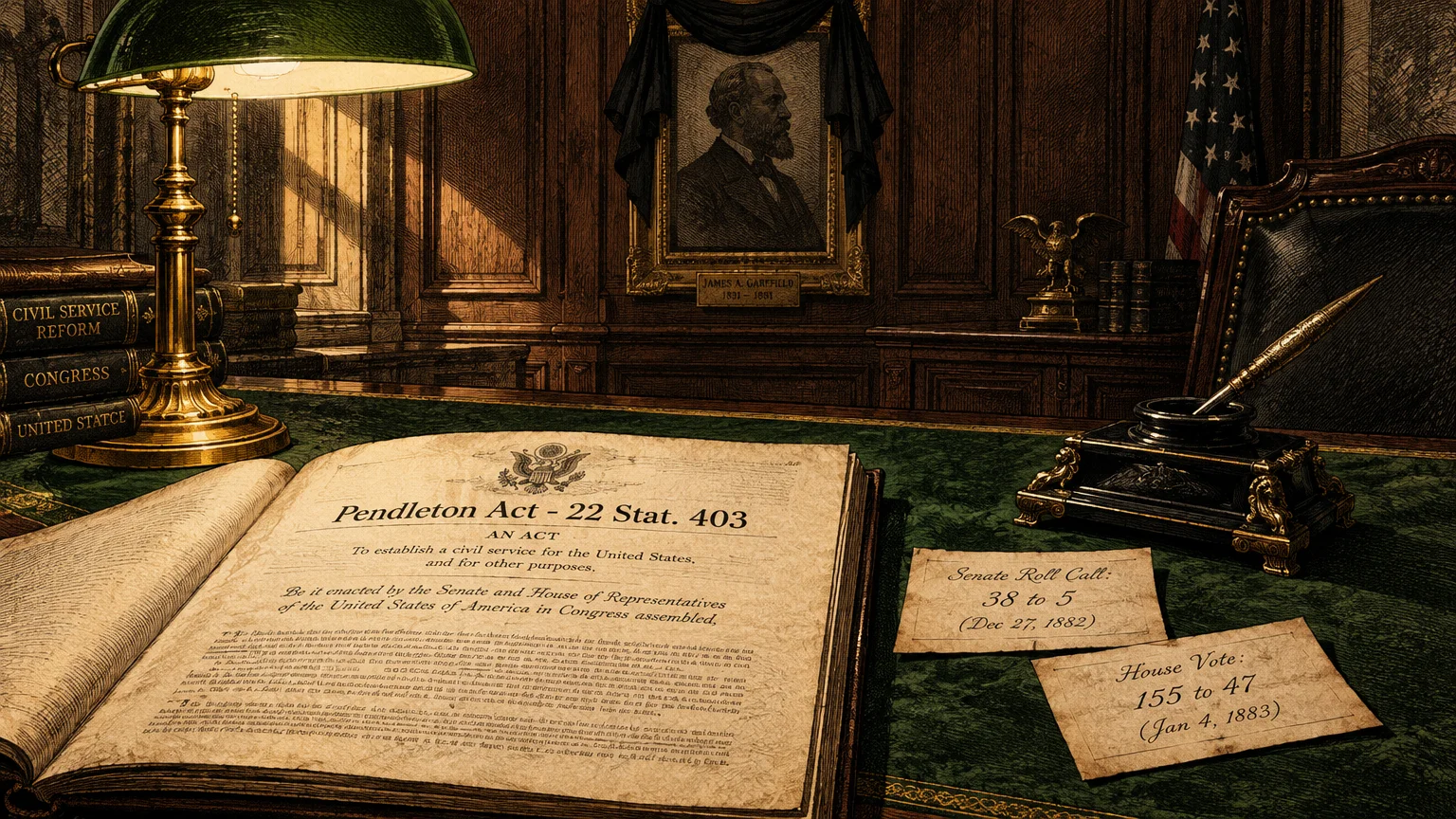
The Senate passed the bill 38 to 5 on December 27, 1882, and the House approved it 155 to 47 on January 4, 1883. President Chester A.
Arthur, a former alumnus of the New York Custom House political machine, signed the Pendleton Act (22 Stat. 403) on January 16, 1883.
The statute established a bipartisan three-member United States Civil Service Commission to administer open, competitive examinations. It also outlawed political assessments, prohibiting supervisors from demoting or discharging employees who refused to make campaign contributions.
The initial act classified about 10% of federal positions, covering 13,924 jobs. Crucially, Section 6 authorized future presidents to expand the competitive merit system by executive action.
Executive Orders for Presidential Blanketing In
While Congress created the merit system’s foundation, presidents drove its numerical growth through an administrative process called “blanketing in.” Section 6 of the Pendleton Act authorized the president to transfer unclassified positions into the competitive service.
Outgoing presidents frequently issued executive orders blanketing their political appointees into protected career positions before leaving office. Once an order classified a position, incoming administrations could no longer replace the incumbent without competitive testing.
President Grover Cleveland blanketed in 7,259 positions during his first term and added 42,511 positions across his second term. President Theodore Roosevelt, who had served as a Civil Service Commissioner from 1889 to 1895, classified 34,766 positions across scientific and technical agencies.
President William Howard Taft executed one of the largest single expansions on October 15, 1912, blanketing in 58,318 fourth-class postmasters. That order severed thousands of local post offices from county party machines and helped push classified coverage past 60% by the 1920s.
The Lloyd–La Follette Act of 1912
As the classified workforce grew, presidents sought to restrict employee lobbying. In 1902, President Theodore Roosevelt issued an executive “gag rule” barring civil servants from petitioning Congress for higher pay, and President Taft broadened the ban in 1909.
These orders prevented postal clerks and federal tradesmen from alerting lawmakers to dangerous railway mail conditions or arbitrary discipline. Congress responded by passing the Lloyd–La Follette Act on August 24, 1912, as Section 6 of the Post Office Appropriations Act (37 Stat.
555).
Sponsored by Representative James T. Lloyd of Missouri and Senator Robert M.
La Follette of Wisconsin, the statute repealed the executive gag orders. It also established the modern legal standard for federal dismissals, now codified at 5 U.S.C. § 7513.
The law mandated that agencies could remove classified employees only for “such cause as will promote the efficiency of the service.” Supervisors had to provide advance written notice of specific charges, allow time for a written answer, and issue a written final decision.
Additionally, the act protected the right of federal workers to join postal and labor organizations without reprisal. It affirmed the right of civil servants to petition Congress and present grievances directly to lawmakers.
The Classification Acts of 1923 and 1949
Competitive examinations established merit-based entry into federal service, but unregulated agency pay scales still allowed supervisors to reward political favorites. Employees performing identical clerical tasks in adjoining departments often received vastly different salaries.
Congress addressed these disparities by passing the Classification Act of 1923 on March 4, 1923 (42 Stat. 1488).
The statute created the Personnel Classification Board to define uniform job descriptions and salary ranges tied to job complexity and qualifications across Washington agencies.
Following World War II, the expansion of federal programs required a broader compensation structure. President Harry S.
Truman signed the Classification Act of 1949 (63 Stat. 954) on October 28, 1949, creating the modern General Schedule (GS) system.
The General Schedule consolidated fragmented agency pay scales into standardized grades from GS-1 to senior administrative levels under the principle of “equal pay for substantially equal work.
The 1949 law also extended uniform classification rules and tenure-based step increases to hundreds of thousands of regional field employees outside Washington.
The Hatch Act of 1939
During the Great Depression, local party machines exploited emergency New Deal relief programs for partisan campaigns. Investigating the 1938 midterm primaries, the Senate Campaign Expenditures Committee chaired by Senator Morris Sheppard issued Senate Report 76-1.
The report documented Works Progress Administration (WPA) officials in Kentucky and Pennsylvania coercing relief workers for campaign donations and threatening to fire non-compliant employees. Senator Carl Hatch of New Mexico responded by introducing legislation to separate civil service administration from electioneering.
President Franklin D. Roosevelt signed the Hatch Act, officially titled An Act to Prevent Pernicious Political Activities (53 Stat.
1147), on August 2, 1939. The law prohibited executive branch employees from using official authority to interfere with elections, running in partisan races, managing campaigns, or soliciting political contributions.
On July 19, 1940, Congress expanded the statute (54 Stat. 767) to cover state and local employees whose positions were funded by federal loans or grants.
The Supreme Court upheld these restrictions against First Amendment challenges in United Public Workers v. Mitchell (1947).
Congress amended the Hatch Act in 1993 to allow most civil servants to participate in off-duty political advocacy. The statute continues to bar partisan political activity while on duty, inside federal buildings, or while wearing official uniforms.
The Ramspeck Act of 1940
Emergency New Deal legislation in the 1930s exempted dozens of new relief agencies from standard Civil Service Commission examination rules. By 1939, roughly 40% of the federal civilian workforce occupied positions outside the competitive service.
Representative Robert Ramspeck, a Georgia Democrat and Chairman of the House Civil Service Committee, drafted legislation to close this patronage loophole. President Franklin D.
Roosevelt signed the Ramspeck Act (54 Stat. 1211) into law on November 26, 1940.
The statute authorized the president to bring roughly 200,000 previously exempt New Deal positions into the classified competitive service. Incumbent workers had to pass non-competitive qualifying examinations administered by the Civil Service Commission to retain their jobs.
The law also mandated standardized efficiency rating systems across covered departments and created independent boards to hear employee evaluation appeals.
By extending competitive rules to regional field installations, the Ramspeck Act raised merit system coverage from roughly 60% to nearly 90% on the eve of World War II.
The Civil Service Reform Act of 1978
The Watergate scandal exposed structural conflicts within the 95-year-old Civil Service Commission, where operatives had circulated manuals on placing partisan loyalists into career jobs.
The Commission functioned simultaneously as the president’s personnel office and as the appellate tribunal for employee complaints against executive branch abuses.
On October 13, 1978, President Jimmy Carter signed the Civil Service Reform Act of 1978, enacted as Public Law 95-454. The statute abolished the Civil Service Commission and divided its responsibilities among independent agencies.
The act created the Office of Personnel Management (OPM) to administer human resources, competitive hiring, and federal benefits.
It established the quasi-judicial Merit Systems Protection Board (MSPB) to adjudicate employee appeals and the independent Office of Special Counsel (OSC) to investigate prohibited personnel practices and protect whistleblowers.
Public Law 95-454 also established the Federal Labor Relations Authority (FLRA) to oversee collective bargaining between agencies and employee unions. Finally, it created the Senior Executive Service (SES), a corps of career and limited-term executives serving directly beneath presidential appointees.
Key Milestones in the Replacement of the Spoils System
| Milestone | Year | Key Sponsor or Actor | Statutory Authority | Systemic Impact |
|---|---|---|---|---|
| Pendleton Act | 1883 | Sen. George Pendleton | 22 Stat. 403 | Mandated competitive exams and banned campaign kickbacks |
| Blanketing In | 1883–1920s | Presidents Cleveland, Roosevelt, Taft | Executive Orders | Expanded merit positions from 10% to over 60% of workforce |
| Lloyd–La Follette Act | 1912 | Rep. Lloyd, Sen. La Follette | 37 Stat. 555 | Established just-cause removal and protected petitioning Congress |
| Classification Acts | 1923, 1949 | Presidents Harding, Truman | 42 Stat. 1488, 63 Stat. 954 | Created standardized pay bands and the General Schedule |
| Hatch Act | 1939 | Sen. Carl Hatch | 53 Stat. 1147 | Barred partisan campaigning and political coercion on duty |
| Ramspeck Act | 1940 | Rep. Robert Ramspeck | 54 Stat. 1211 | Covered 200,000 New Deal jobs, raising merit coverage to 90% |
| Civil Service Reform Act | 1978 | President Jimmy Carter | Pub. L. 95-454 | Divided functions into OPM, MSPB, OSC, and FLRA |
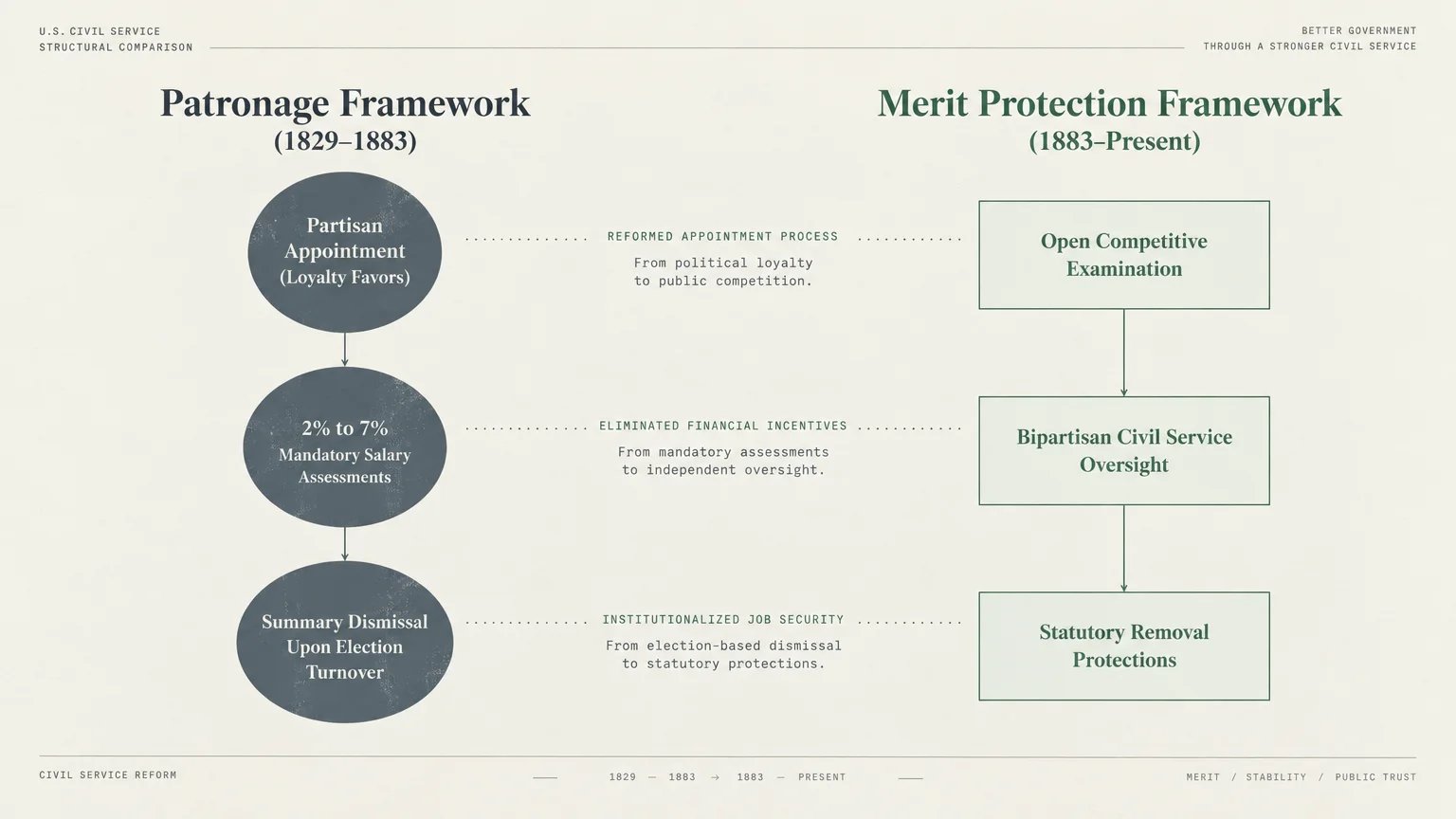
The Structural Shift From Patronage to Merit Protection
The modern federal workforce balances democratic accountability at the top with career continuity across agencies.
According to the United States Government Policy and Supporting Positions, known as the Plum Book, presidents appoint roughly 4,000 political officials, including approximately 1,200 positions requiring Senate confirmation under Article II of the Constitution.
Beneath those political appointees, roughly 2.2 million career civil servants administer daily operations under statutory merit rules. These career employees process disability claims, direct air traffic, inspect food and pharmaceuticals, and staff border ports across presidential transitions.
The boundary between political appointments and career tenure remains a subject of executive and legislative contestation. On January 20, 2025, President Donald Trump signed Executive Order 14171, reviving efforts to reclassify career policy-influencing positions into a schedule exempt from standard adverse-action appeal procedures.
Frequently Asked Questions About the Federal Civil Service
Can federal agencies terminate career civil servants for poor performance?
Yes, federal agencies can remove career civil servants for unacceptable performance or workplace misconduct under Title 5 of the United States Code.
Chapter 43 governs performance-based actions and Chapter 75 governs disciplinary removals, requiring documented deficiencies, written notice, and an opportunity to respond before MSPB review.
What is the difference between competitive service and excepted service positions?
Competitive service positions require applicants to pass standardized examinations and merit evaluations administered under OPM rules.
Excepted service positions—such as roles in intelligence agencies, the Foreign Service, and federal medical systems—use agency-specific hiring procedures outside standard OPM registers while generally adhering to statutory merit principles.
How does the Hatch Act affect political participation by civil servants?
Under the 1993 Hatch Act amendments, most career civil servants may vote, attend political rallies, express political opinions, and donate personal funds while off duty.
Employees remain barred from engaging in partisan political activity on duty, inside federal facilities, or by using official authority to influence elections or solicit contributions.
Why did President Chester A. Arthur support civil service reform?
President Garfield’s 1881 assassination by a rejected office-seeker turned public opinion sharply against the patronage system that had previously advanced Arthur’s career in New York.
Breaking with his former Stalwart faction, Arthur urged Congress to pass reform legislation and signed the Pendleton Act in January 1883.