When a federal election ends, candidate committees do not simply disappear. Winning and losing candidates alike often control millions of dollars in surplus donations or carry substantial campaign debts.
Federal campaign finance laws dictate precise pathways for every unspent dollar. Candidates must either return money to donors, settle obligations, donate to charity, or shift funds into political action committees.
Regulatory Standards for Dissolving Committees and Managing Residual Funds
The Federal Election Campaign Act establishes strict boundaries for closing authorized campaign committees. Every dollar raised or spent after Election Day must appear on regular Federal Election Commission (FEC) disclosure reports until the account terminates.
This nine-part list covers the statutory rules, court rulings, and FEC regulations that govern post-election debt retirement, surplus asset disposal, and committee conversions.
Strict Prohibition on Personal Use of Campaign Funds
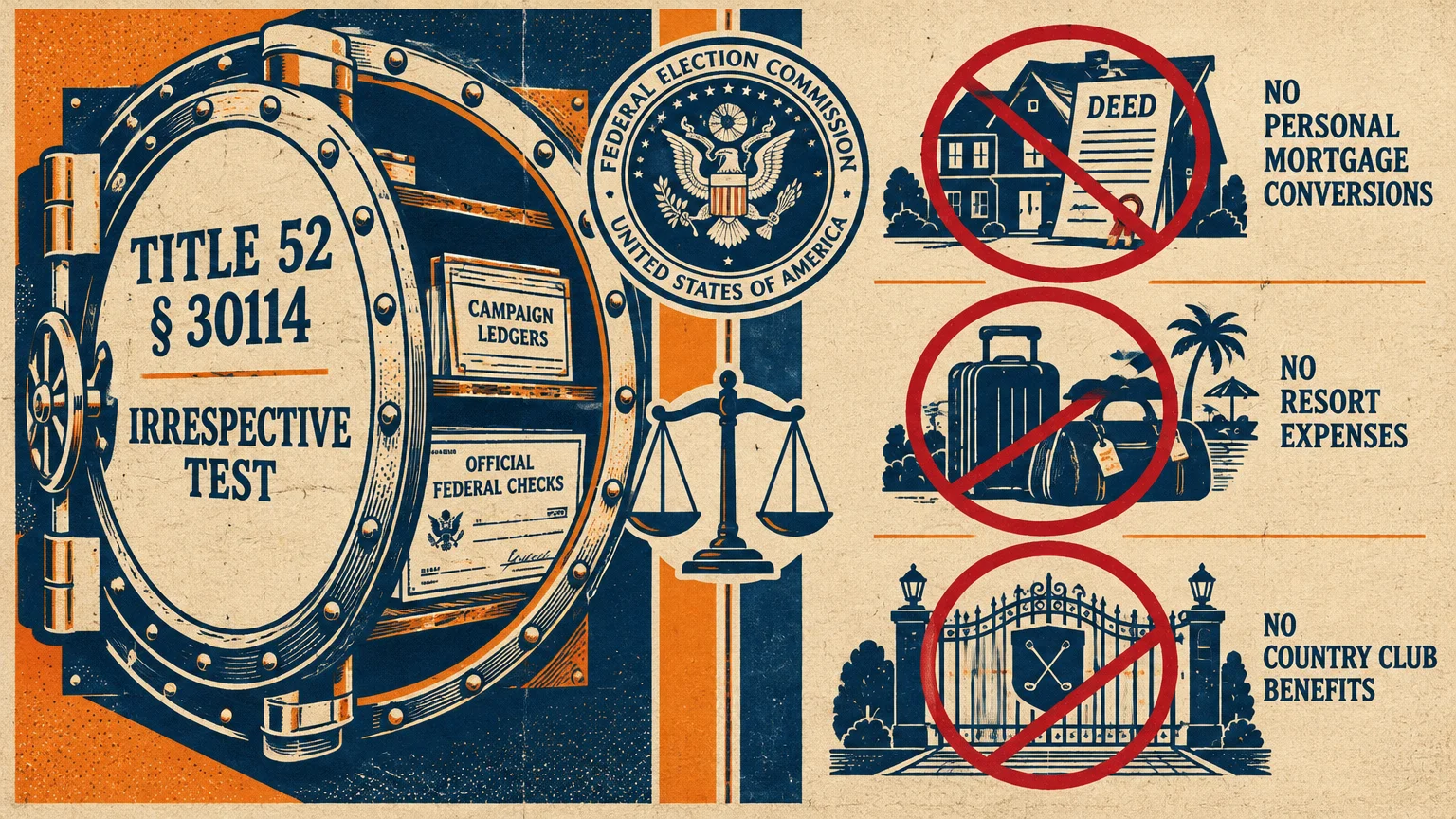
Federal law strictly prohibits candidates from converting leftover campaign funds to personal use. Under Title 52, Section 30114 of the U.S. Code, campaign funds must never enrich a candidate personally.
The FEC applies the objective “irrespective test” to evaluate post-election spending. If an expense would exist irrespective of the candidate’s campaign or official duties, campaign funds cannot cover it.
This standard bars using remaining donations for personal mortgages, clothing, vacations, or country club memberships. Regulators review post-election disbursements to identify improper conversions of contributor money.
Members of Congress serving on January 8, 1980, originally received an exemption allowing them to pocket leftover cash upon retirement.
Congress repealed that grandfather clause through the Ethics Reform Act of 1989, which took full effect in January 1993 at the start of the 103rd Congress.
Since 1993, every retiring or defeated federal lawmaker faces the same absolute restriction. Violations of the personal use ban carry civil administrative fines or criminal referral to the Department of Justice.
Post-Election Debt Retirement Under Statutory Contribution Limits
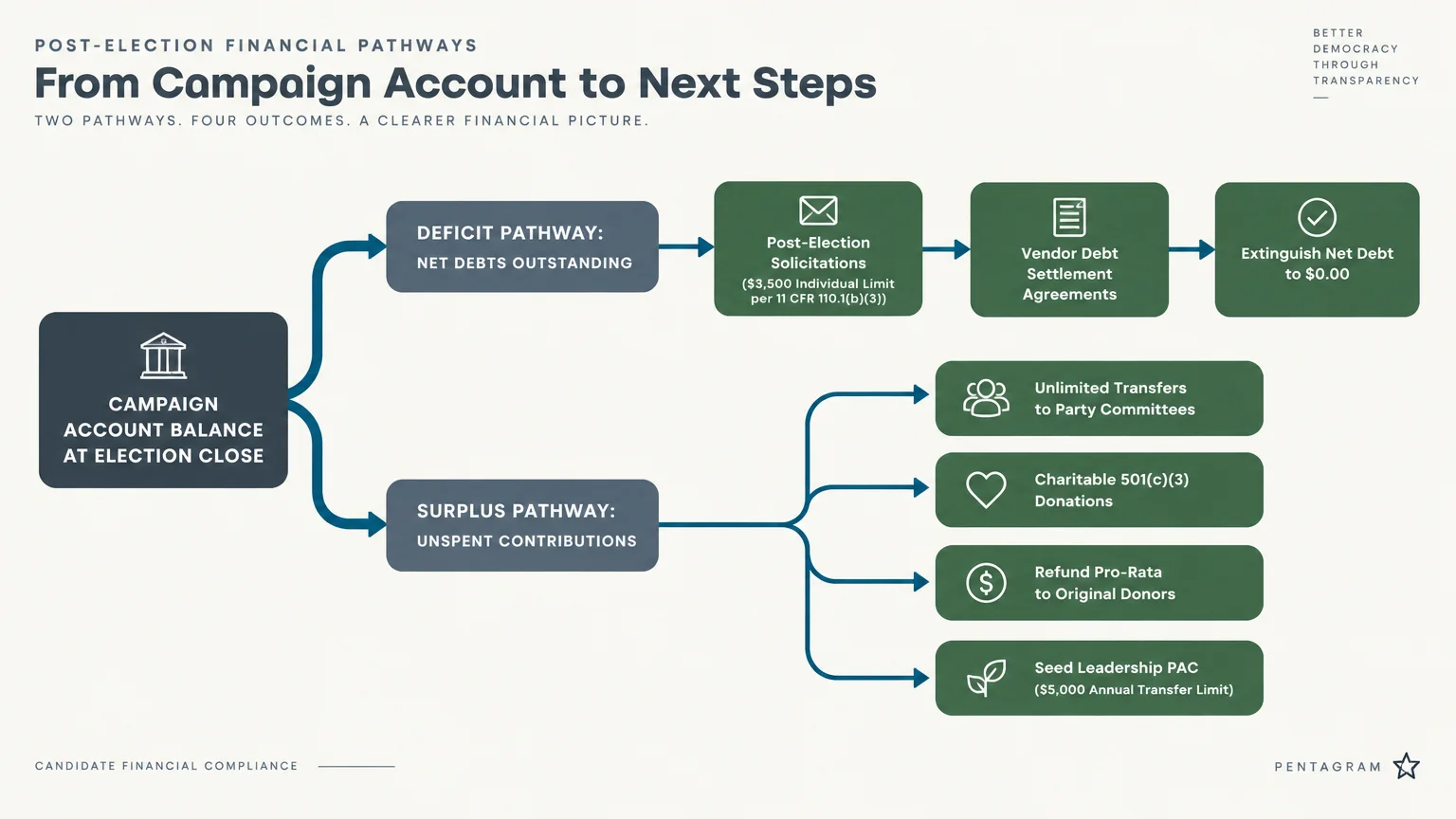
Campaigns that conclude an election cycle with unpaid bills may continue fundraising specifically to retire debt. Committees must calculate their exact “net debts outstanding” before accepting any post-election contributions.
Under FEC regulations at 11 CFR 110.1(b)(3), a campaign cannot raise more money than necessary to extinguish its obligations. Solicitations must explicitly designate contributions for the specific past election that generated the debt.
Post-election donors remain bound by individual election contribution limits. For the 2025–2026 election cycle, the FEC set the individual contribution limit at $3,500 per election.
A donor who already contributed $3,500 to a candidate for the general election cannot give additional funds for general election debt retirement. Donors may only contribute up to their remaining limit for that specific election.
Campaigns must adjust their debt totals downward as accounts receivable arrive or disputed bills settle. Once net debt reaches zero, the legal authorization to solicit debt retirement contributions terminates immediately, and any excess funds must be refunded to donors and itemized on Schedule C.
Removal of the Statutory Repayment Cap on Personal Candidate Loans
Candidates frequently loan personal money to their campaign committees to fund operations. Section 304 of the Bipartisan Campaign Reform Act of 2002 originally capped post-election personal loan repayments at $250,000 from post-election contributions.
Under that statute, any unpaid loan balance exceeding $250,000 converted into a permanent, non-repayable campaign contribution 20 days after the election. Congress enacted the rule to prevent donors from currying favor with victorious officeholders by paying off their personal debts.
The legal framework changed on May 16, 2022. In FEC v. Ted Cruz for Senate, the Supreme Court struck down the loan repayment restriction by a 6–3 vote.
Writing for the majority, Chief Justice John Roberts held that Section 304 burdened political speech under the First Amendment without proving that the cap prevented actual quid pro quo corruption.
Following the Cruz ruling, campaigns can raise unlimited post-election funds from donors (subject to the $3,500 per-donor limit) to repay a candidate’s personal loans in full.
The Six-Month Operational Window for Closing Congressional Offices
Official congressional allowances cease shortly after a lawmaker’s term expires. Under 11 CFR 113.2, departing lawmakers may use campaign committee funds to cover the ordinary expenses of winding down their congressional offices.
The standard regulatory window for winding down official offices covers six months after leaving federal service. During this period, committees may pay moving costs, office lease terminations, and transition staff salaries.
Former lawmakers may also use these funds to ship official papers, furnishings, and constituent correspondence home. The commission classifies these expenditures as ordinary and necessary transition costs rather than personal use.
The FEC occasionally grants formal extensions beyond the six-month window. In Advisory Opinion 2013-05, the commission permitted a retired 26-year lawmaker up to one year to archive official papers.
Once the winding-down period expires, remaining committee spending must shift strictly to political or charitable purposes, ending all subsidies for office rent or administrative staff.
Converting a Principal Campaign Committee into a Leadership PAC
A candidate who steps away from active campaigning is not required to dissolve their political committee. Instead of liquidating, an authorized committee can convert into a multicandidate political action committee.
To execute this transition, the committee treasurer files an amended Statement of Organization using FEC Form 1. This filing changes the committee’s regulatory classification while preserving its original FEC identification number.
To qualify as a multicandidate PAC, an entity must maintain active registration for six months, receive donations from more than 50 individuals, and contribute to at least five federal candidates.
When a principal campaign committee converts, its prior donors, contributions, and registration history count directly toward meeting all three thresholds.
Once certified as a multicandidate PAC, the committee can donate up to $5,000 per election to other federal candidate committees, compared to the $2,000 limit placed on unconverted principal campaign committees.
Statutory Caps on Surplus Transfers to Other Federal Candidates
Federal statutes strictly restrict direct transfers between authorized candidate committees. Under 52 U.S.C. § 30102(e)(3)(B), an authorized committee can give no more than $2,000 per election to another federal candidate’s committee.
Even if a winding-down campaign holds millions of dollars, this statutory ceiling prevents retiring candidates from acting as conduits for large campaign war chests. A committee cannot circumvent this limitation by reclassifying donations as miscellaneous gifts.
The transfer threshold increases only if the committee converts into a PAC. Multicandidate PACs operate under a limit of $5,000 per candidate per election, while non-multicandidate PACs follow the standard individual limit of $3,500 per election.
Individuals contributing to these converted nonconnected PACs face a separate statutory boundary of $5,000 per calendar year, an amount not indexed to inflation.
Unlimited Dispersal to Political Parties and Qualified Charities
While donations to individual candidate committees face strict caps, federal law treats national, state, and local political parties differently. Under 52 U.S.C. § 30114(a)(4), an authorized campaign committee may transfer unlimited surplus funds to recognized party committees.
A departing member can transfer millions of unspent dollars directly to a national, state, or local party committee to fund party operations, independent expenditures, and voter turnout drives.
Charitable giving provides another channel for liquidating residual campaign balances. Under Section 30114(a)(3), committees may donate unlimited sums to organizations tax-exempt under Section 501(c)(3) of the Internal Revenue Code.
Federal law enforces conflict-of-interest guardrails on these charitable donations: the departing candidate cannot receive any direct or indirect compensation from the receiving nonprofit before the charity expends the entire amount donated by the campaign.
The Regulatory Leadership PAC Personal Use Exemption
While the personal use ban tightly governs authorized campaign committees, a major regulatory divergence exists for Leadership PACs—separate political committees established by officeholders to support other candidates.
The statutory text of 52 U.S.C. § 30114 explicitly applies the personal use prohibition to “contributions accepted by a candidate,” which the FEC has historically interpreted as applying only to authorized candidate committees.
Under current agency regulations, the formal personal use prohibition does not extend to nonconnected PACs or Leadership PACs. Watchdog organizations, including the Campaign Legal Center and Issue One, have repeatedly petitioned the FEC and Congress to close this loophole.
Although the commission has held public hearings on extending personal use rules to non-campaign entities, the FEC has not enacted regulations applying Section 30114 to Leadership PAC disbursements.
Mandatory Debt Settlement Plans Prior to Committee Termination
A campaign committee cannot unilaterally dissolve simply because its candidate leaves politics. Under FEC regulations at 11 CFR 102.3, a committee can only file a final Termination Report when its cash balance reaches zero and it carries no outstanding debts, loans, or obligations.
If a committee lacks the funds to pay its vendors in full, it must initiate formal debt settlement. If a commercial vendor forgives a campaign balance without following ordinary business practices, the FEC treats the write-off as an illegal corporate contribution.
To settle unpaid balances legally, the committee must file FEC Form 8 (Debt Settlement Plan), demonstrating that creditors made genuine collection efforts and accepted terms comparable to non-political commercial settlements.
Only after the FEC formally reviews and approves the Form 8 settlement plan can the committee report zero liabilities and terminate.
Comparison of Post-Election Fund Disposal and Debt Options
The table below summarizes the statutes, financial limits, and administrative requirements for disposing of residual campaign assets or settling committee obligations.
| Action | Primary Rule or Statute | 2025–2026 Limit | Key Administrative Requirement |
|---|---|---|---|
| Debt Retirement Donations | 11 CFR 110.1(b)(3) | $3,500 per election | Restricted to verified net debts outstanding |
| Candidate Loan Repayment | 52 U.S.C. § 30114 / Cruz ruling | Unlimited post-election funds | Must reflect verified candidate personal loans |
| Office Winding-Down | 11 CFR 113.2 | Unlimited surplus cash | Standard 6-month window post-tenure |
| Candidate-to-Candidate Gift | 52 U.S.C. § 30102(e)(3)(B) | $2,000 per election | Applies directly to principal campaign accounts |
| Multicandidate PAC Gift | 52 U.S.C. § 30116(a)(2)(A) | $5,000 per election | Requires 6 months, 50 donors, 5 candidates |
| Party Committee Transfer | 52 U.S.C. § 30114(a)(4) | Unlimited transfers | Must transfer to recognized party entities |
| Charitable Donation | 52 U.S.C. § 30114(a)(3) | Unlimited donations | Candidate cannot receive compensation from charity |
| Formal Debt Settlement | 11 CFR Part 116 / FEC Form 8 | Settled commercial amount | Requires FEC review to prevent corporate gifts |
How Post-Election Campaign Rules Preserve Political Transparency
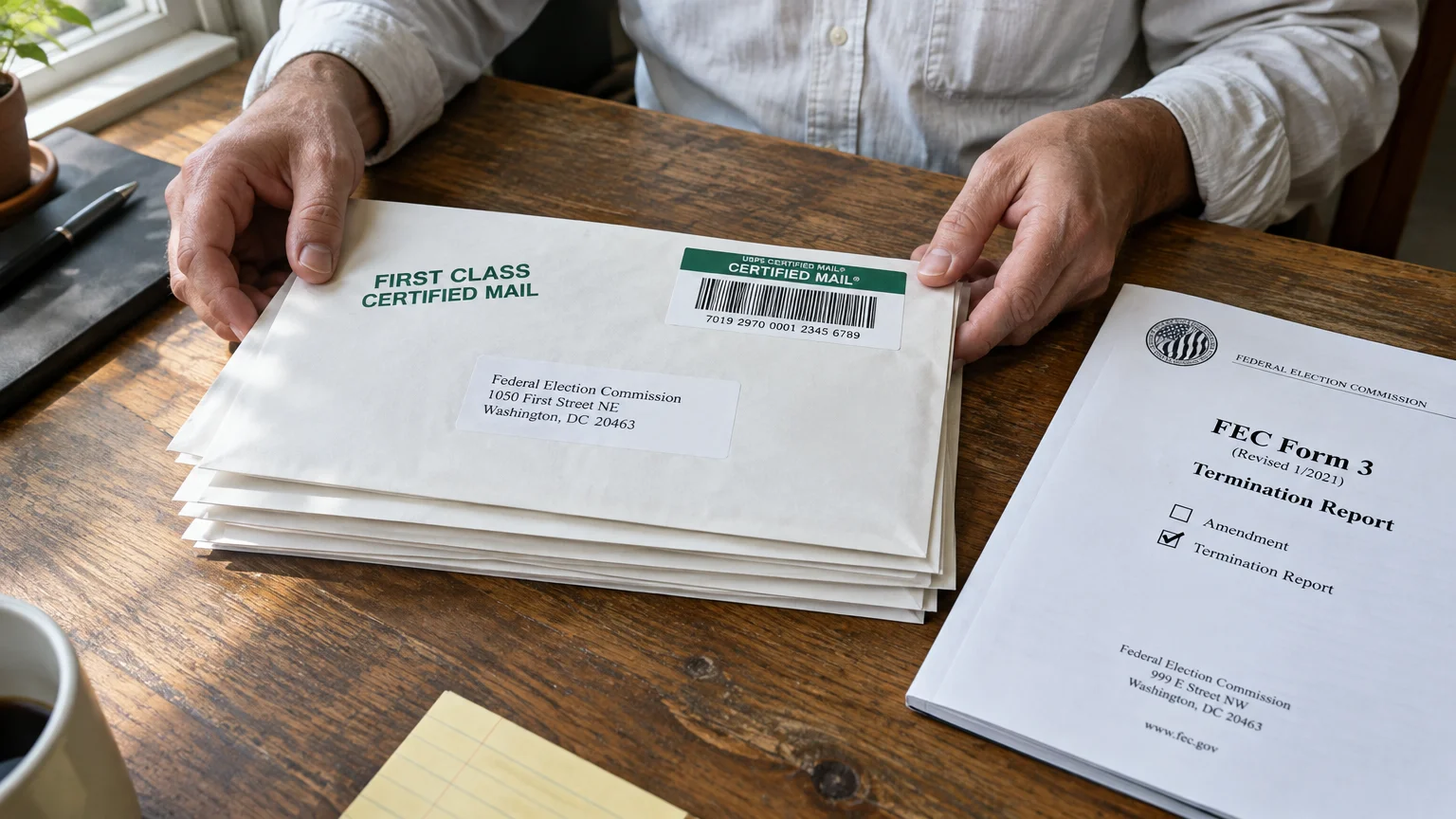
By requiring continuous quarterly reporting until committees reach a zero balance, the FEC subjects post-election transactions to public scrutiny. Every committee conversion, debt settlement, and final disbursement is recorded on FEC Form 1, Form 3, and Form 8 filings.
While Section 30114 bars candidates from converting principal campaign accounts into personal income, the Supreme Court’s 2022 Cruz decision and the regulatory exclusion of Leadership PACs from the personal use ban leave distinct pathways for post-election fundraising and spending.
Frequently Asked Questions About Campaign Committee Closures
Can a candidate keep leftover campaign money as personal income?
No. Federal statute 52 U.S.C. § 30114 expressly forbids converting campaign contributions to personal use.
The FEC enforces this ban using the “irrespective test,” prohibiting spending on personal residences, vacations, vehicles, or personal debts.
What happens to campaign funds if a candidate dies?
The committee treasurer retains legal custody of remaining funds and must continue filing disclosure reports.
The treasurer may wind down the committee by refunding donors, paying debts, transferring funds to party committees, or contributing to qualified 501(c)(3) charities.
Can an unpaid campaign vendor simply write off an outstanding balance?
Commercial vendors cannot erase campaign debts without following standard business collection practices, as improper debt forgiveness constitutes an illegal corporate campaign contribution.
The committee and vendor must submit a formal Debt Settlement Plan on FEC Form 8 for agency approval before the debt can be extinguished.
Why do so many former candidates keep “zombie campaigns” open for years?
Federal law does not impose a mandatory deadline for terminating a campaign committee after an election loss or retirement.
Former candidates often maintain active committees to pay ongoing legal expenses, donate to allies, or preserve funds for future federal candidacies.