The morning after Election Day often shows nearly complete results from Florida, while counts in Pennsylvania and California barely cross 60 percent. State election laws—not administrative incompetence—dictate this counting speed.
The United States runs decentralized elections across 50 separate statutory frameworks. These state codes establish when clerks open envelopes, how long voters have to fix signature errors, and how long officials wait for mailed ballots.
Statutory Timelines and the Mechanics of Modern Ballot Canvassing
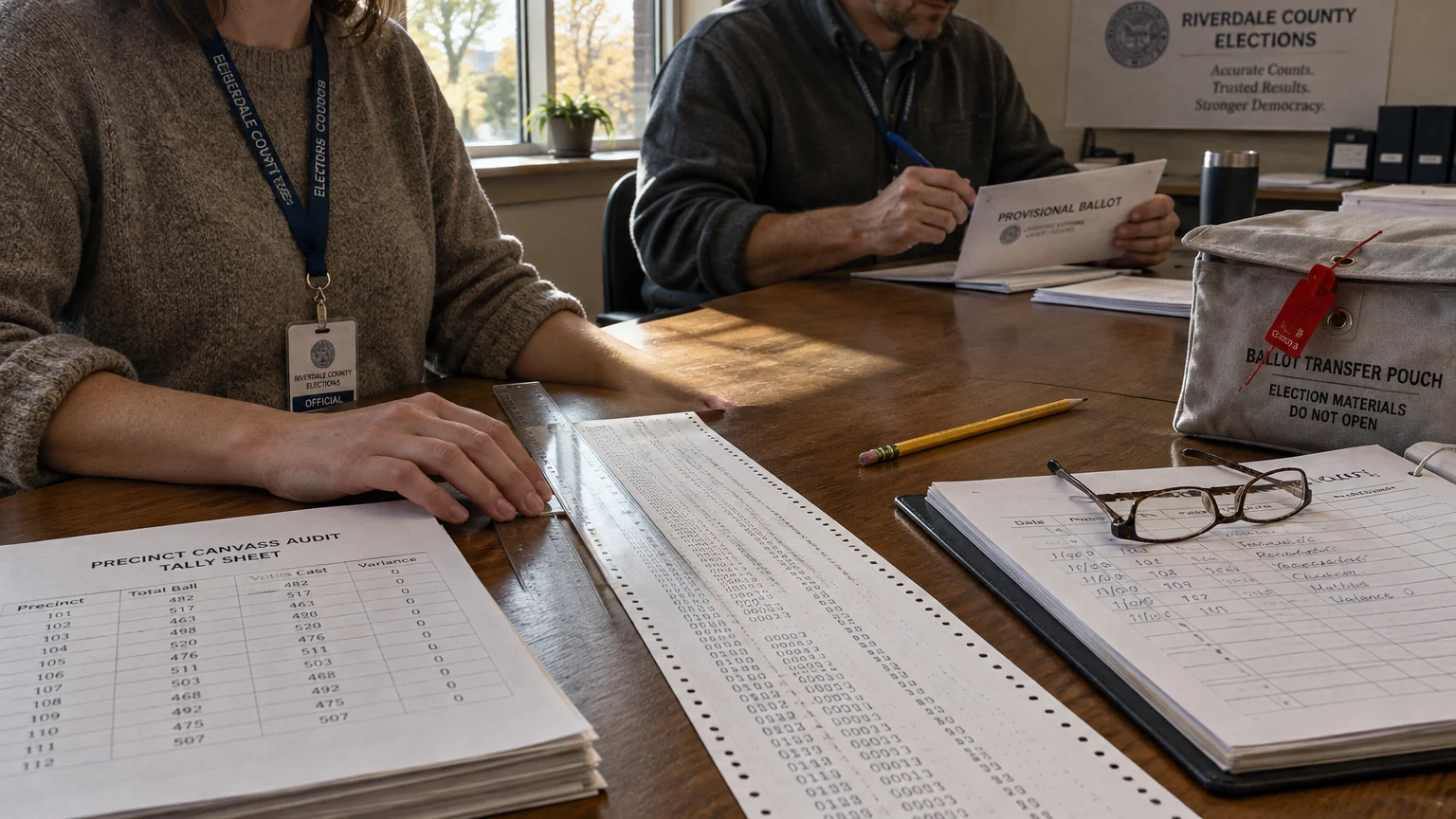
Article I, Section 4 of the U.S. Constitution grants state legislatures primary authority over election timing, places, and administrative procedures. Every state establishes a post-election canvass period lasting between one and four weeks to audit paper tallies and certify official figures.
This list examines the six primary statutory mechanisms across all 50 states that determine how quickly jurisdictions report unofficial returns. Entries were selected based on state election codes, statutory deadlines, and federal voting mandates.
1. Statutory Bans on Mail Ballot Pre-Processing
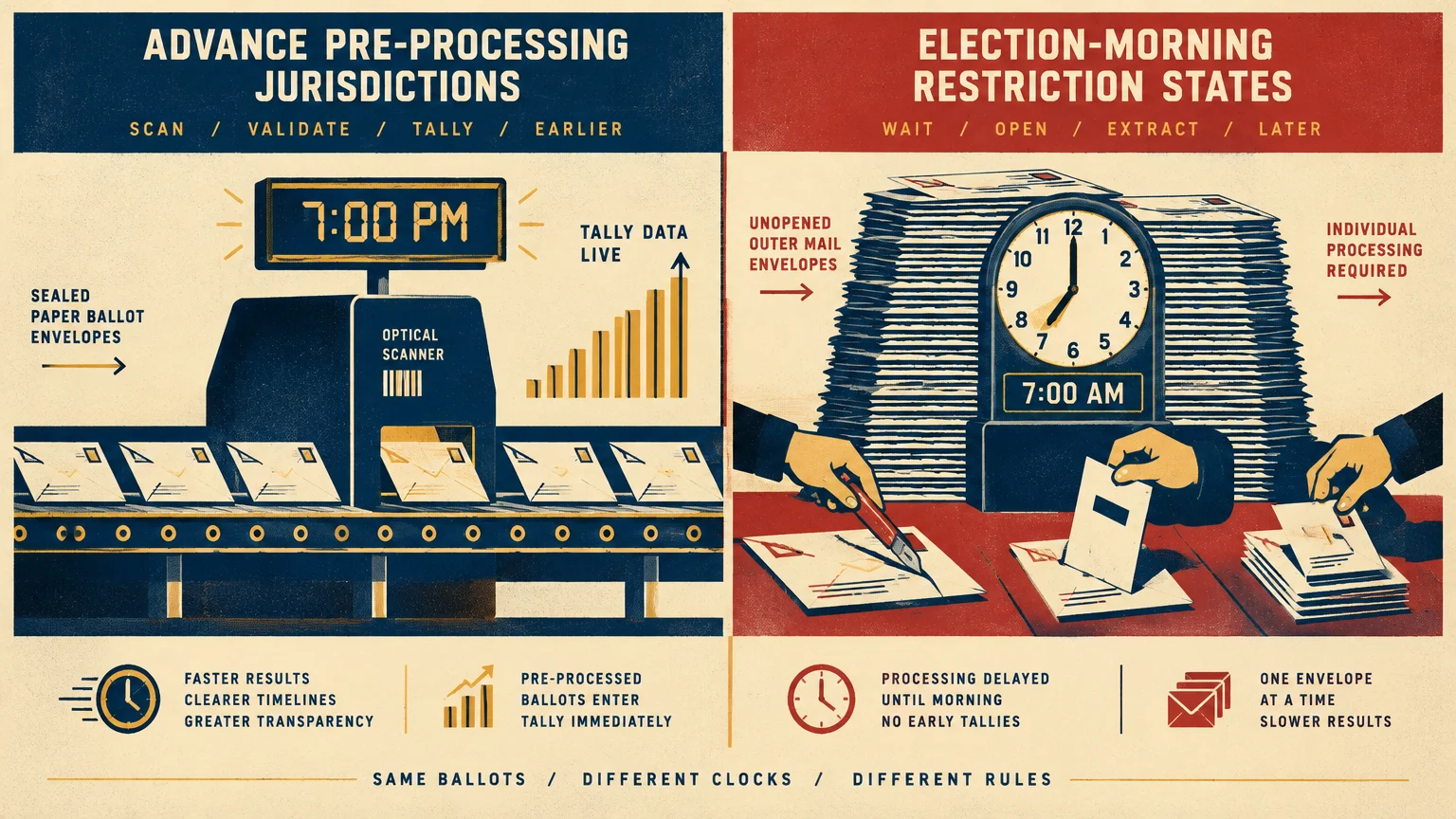
The single largest determinant of election-night reporting speed is whether state law allows clerks to pre-process mail ballots before Election Day. At least 45 states and Washington, D.C., authorize election workers to examine and verify ballots ahead of time.
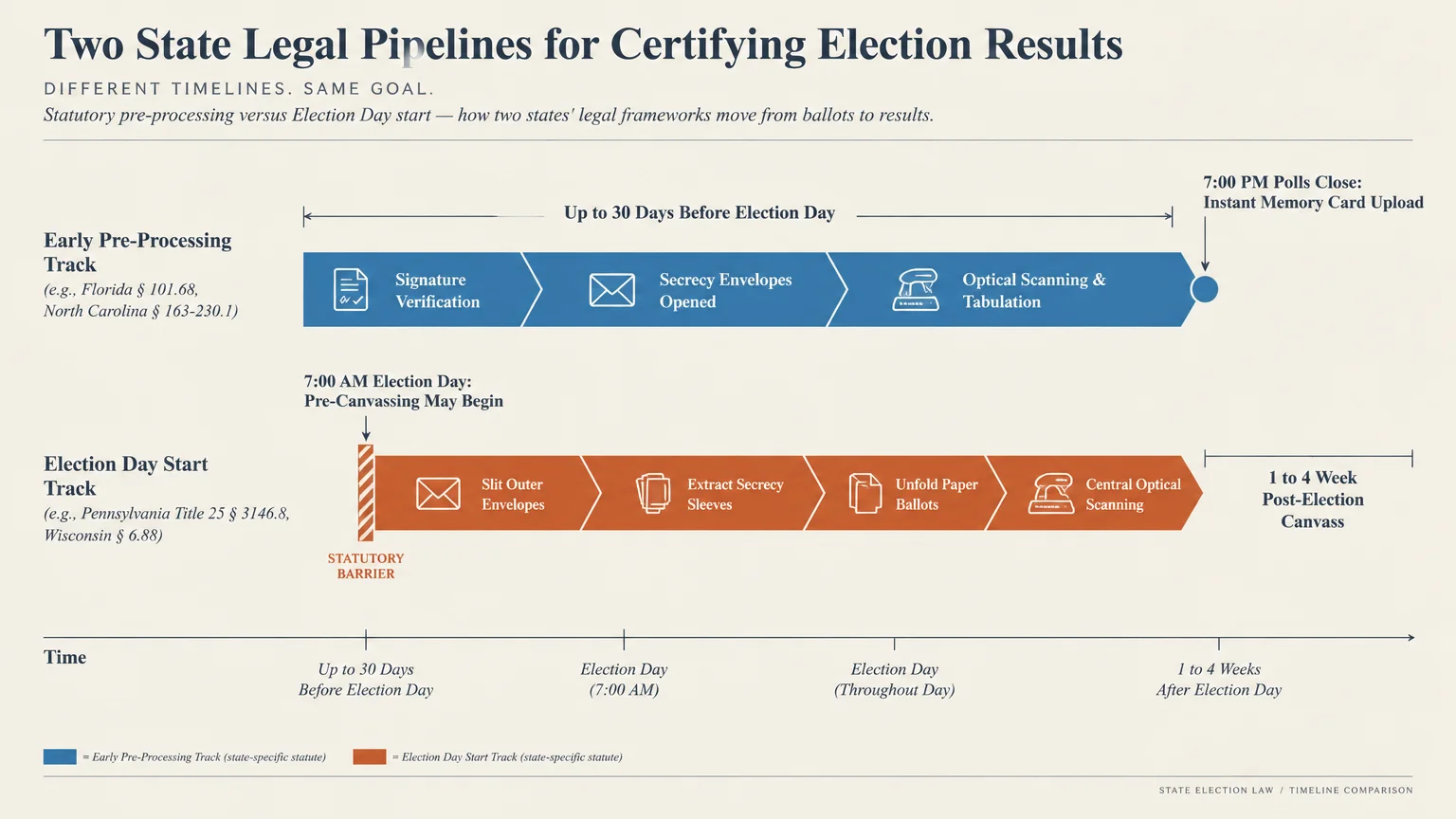
According to the National Conference of State Legislatures, pre-processing includes signature verification, opening secrecy envelopes, and feeding paper ballots into optical scanners.
In Florida, election boards begin pre-processing and tabulating returned ballots up to 30 days before Election Day under Florida Statutes § 101.68. Election workers feed scanned ballots into optical readers weeks in advance.
Because Florida workers store these tabulations on secured memory cards, officials press a button when polls close at 7:00 p.m. to report millions of votes within minutes.
North Carolina follows a similar approach under General Statutes § 163-230.1. County boards meet weekly before Election Day to approve absentee ballots and scan them into central tabulators.
Conversely, Pennsylvania and Wisconsin legally prohibit clerks from opening a single mail-in envelope before 7:00 a.m. on Election Day. Election workers must process hundreds of thousands of mail envelopes while simultaneously managing in-person precincts.
Under Pennsylvania Title 25, Section 3146.8, county boards cannot begin pre-canvassing absentee and mail-in ballots until the morning of the election. Workers must verify outer envelopes, extract inner privacy sleeves, and flatten paper ballots one by one.
Wisconsin Statute § 6.88 imposes identical operational hurdles on municipal clerks. Workers cannot slit open outer envelopes or feed ballots into municipal tabulators until local polling locations officially open.
Bipartisan coalitions in Pennsylvania and Wisconsin have repeatedly introduced bills to permit early pre-processing, but legislative disagreements over broader voting rules left both statutes unchanged.
2. Postmark Deadlines and Late-Arriving Mail Windows
States enforce two fundamentally different approaches to absentee ballot deadlines: physical receipt rules and postmark-by-Election-Day provisions. This procedural divide creates vastly different reporting timelines across the country.
In strict receipt states like Florida, Georgia, Michigan, and Pennsylvania, election officials must physically receive mail ballots by poll close on Election Day. Ballots arriving the following morning are rejected by law and never enter the count.
Roughly one-third of states permit election boards to accept ballots arriving days after Election Day, provided the carrier postmarked them on or before Tuesday. These laws prevent ballot rejection caused by postal transit delays.
Under California Elections Code § 3020, county officials must accept and process any valid mail ballot postmarked by Election Day that arrives within seven days of the election. This extended statutory window guarantees that California tallies cannot finish on election night.
The California Secretary of State cannot certify or report complete results until county registrars receive, verify, and scan these late-arriving deliveries.
Nevada Revised Statutes § 293.269921 establishes a four-day post-election window for mail ballots postmarked by Election Day. Election clerks must wait until 5:00 p.m. on the fourth day to process final arrivals.
Alaska Statute § 15.20.081 permits an even wider receipt buffer. State officials count postmarked domestic absentee ballots arriving up to 10 days post-election, and overseas or military ballots arriving within 15 days.
3. Multi-Day Signature Verification and Curing Periods
All 50 states mandate that voters sign the declaration envelope containing their absentee or mail-in ballot. However, state election codes treat missing, flawed, or non-matching signatures in sharply contrasting ways.
Thirty-five states require election clerks to notify voters when signature discrepancies arise, granting them a statutory window to fix the error. Fifteen states offer no statewide cure period, rejecting unsigned or unmatched envelopes upon review.
In Arizona, Arizona Revised Statutes § 16-550 mandates that election officials give voters until 5:00 p.m. on the fifth calendar day after an election to confirm their signatures. Voters may verify their identity by phone, text, or in person.
Election officials cannot open, process, or tabulate these flagged ballots until voters submit verified identification or affidavit confirmations. According to Arizona Secretary of State canvassing procedures, counties update their tallies with cured ballots throughout the five-day window.
Nevada Revised Statutes § 293.269927 provides an even longer window. Nevada voters have until 5:00 p.m. on the sixth day following Election Day to resolve signature questions with their county clerk.
Pennsylvania and Wisconsin lack uniform statewide curing statutes, leaving notice and remediation policies to the discretion of individual county and municipal election boards.
4. Universal Mail Voting Volumes and Election-Day Drop-Off Waves
The method voters use to return their ballots directly influences processing speed. Eight states—California, Colorado, Hawaii, Nevada, Oregon, Utah, Vermont, and Washington—and Washington, D.C., conduct universal all-mail elections, automatically mailing ballots to every active registered voter.
In California, between 80% and 90% of all ballots cast arrive by mail or secure drop box. Processing millions of paper envelopes requires intensive physical handling that precinct scanners do not require.
Every mail ballot must pass through automated sorting equipment, undergo individual signature verification against voter registration files, and be manually extracted from secrecy sleeves. Election workers then inspect paper ballots for physical tears or stray marks before scanning.
This workflow creates a bottleneck when voters hold their ballots until the final hours. In Arizona, hundreds of thousands of voters drop off completed mail-in ballots directly at polling places on Election Day.
Election workers call these ballots “late early” returns. In Maricopa County, Arizona, election officials received more than 290,000 mail ballots dropped off at voting locations on Election Day in 2022.
Precinct tabulators cannot scan these sealed envelopes on site. Workers must pack them into tamper-evident containers and transport them to central counting facilities for chain-of-custody logging, signature verification, and envelope extraction.
States with primarily in-person voting avoid this post-election pipeline because voters feed their own ballots directly into precinct optical scanners before leaving the polling place.
5. Provisional Ballot Adjudication and Same-Day Registrations
Provisional ballots provide a statutory fallback when a voter’s registration status is uncertain, requiring post-election verification before tabulation. Congress mandated nationwide provisional voting under Section 302 of the Help America Vote Act of 2002 (52 U.S.C. § 21082).
Under Public Law 107-252, poll workers must provide a provisional ballot whenever a voter’s name does not appear on the precinct roster or their eligibility is challenged. Election staff seal these ballots inside separate verification envelopes.
Election workers cannot feed provisional ballots into precinct tabulators on Election Day. Instead, county registrars must research each provisional envelope individually during the post-election canvass.
Staff cross-reference state registration databases, verify residency records, and confirm that the voter did not cast another ballot in a different precinct or by mail.
States with Same-Day Voter Registration experience particularly high volumes of provisional or conditional ballots. More than 20 states and Washington, D.C., allow eligible residents to register and cast a ballot on Election Day.
Under California Elections Code § 2170, voters who miss the standard 15-day registration cutoff can complete a conditional voter registration at any polling place or county election office. County staff hold these ballots until state database checks confirm eligibility and rule out duplicate voting.
6. Razor-Thin Margins and Statutory Recount Triggers
When national media networks project a race winner within an hour of poll closings, they rely on statistical modeling and early precinct returns rather than completed vote counts.
Analysts project wide-margin victories early because the trailing candidate cannot mathematically overtake the leader with the remaining uncounted ballots.
When competitive races feature narrow margins, networks withhold projections until clerks count the final batches of mail, provisional, and military ballots. A state counting at normal speed can appear delayed simply because the contest is too close to call.
State laws governing recounts also shape how election administrators handle narrow margins. Forty-eight states authorize recounts under specific conditions, and 29 states plus Washington, D.C., mandate automatic recounts when margins fall below a statutory threshold.
The median automatic recount threshold across the country is 0.5%. Under Pennsylvania Title 25, Section 3154(g), the Secretary of the Commonwealth must order an automatic statewide recount whenever the margin between the top two candidates is 0.5% or less.
Under Georgia Code § 21-2-495, a trailing candidate may request a publicly funded recount within two business days of certification if the margin is 0.5% or less.
Despite public attention on recounts, they rarely alter certified outcomes. A FairVote study of 6,929 statewide general elections between 2000 and 2023 identified 36 statewide recounts, only three of which reversed the initial result—all in races with initial margins under 0.06%.
| State | Pre-Processing Begins | Mail Receipt Cutoff | Cure Window Deadline | Recount Trigger |
|---|---|---|---|---|
| Florida | Up to 30 days prior | Poll close on Election Day | 5:00 p.m. 2nd day post-election | 0.5% automatic |
| North Carolina | 5th Tuesday prior | Poll close on Election Day | Business day before canvass | 0.5% candidate request |
| Pennsylvania | 7:00 a.m. Election Day | Poll close on Election Day | County discretion only | 0.5% automatic |
| Wisconsin | 7:00 a.m. Election Day | Poll close on Election Day | County discretion only | 0.25% candidate request |
| Arizona | Upon receipt of ballot | Poll close on Election Day | 5:00 p.m. 5th day post-election | 0.5% automatic |
| California | 29 days prior | 7 days post-election (postmarked) | 2 days before certification | Voter/candidate request |
| Nevada | 15 days prior | 4 days post-election (postmarked) | 5:00 p.m. 6th day post-election | Candidate request |
Why Canvassing Variations Protect Ballot Integrity and Access
Differences in state counting speeds reflect distinct legislative trade-offs. States like Florida prioritize rapid election-night reporting through early pre-processing and strict Election Day receipt cutoffs.
States like California and Nevada prioritize voter access by allowing universal mail voting, multi-day postmark receipt windows, and extended signature cure periods. These rules are codified in state statutes well in advance of each election cycle.
No state certifies official results on election night. Media tallies remain unofficial until bipartisan county boards audit paper records, reconcile poll books, and adjudicate provisional ballots during the statutory canvass period.
Frequently Asked Questions About State Ballot Counting
Does a slow ballot count indicate fraudulent activity?
No. Slower counts reflect compliance with state statutes governing pre-processing bans, postmark windows, provisional verification, and signature cure periods.
Every stage of ballot processing follows chain-of-custody logs open to credentialed bipartisan observers under state law.
Why can news networks project some states immediately while others take days?
Networks project winners based on statistical models and early returns rather than complete vote counts. When one candidate leads by a wide margin, analysts can project the winner even with millions of ballots still uncounted.
In closely divided states, networks must wait for clerks to tabulate late-arriving mail, cured envelopes, and provisional ballots because the remaining votes could decide the race.
Why doesn’t Congress create a uniform national counting deadline?
Article I, Section 4 of the U.S. Constitution gives state legislatures primary authority to regulate the times, places, and manner of holding federal elections.
While Congress sets baseline federal requirements—such as the Electoral Count Reform Act deadlines for presidential electors—states retain broad control over ballot processing rules.
What is the difference between unofficial election results and official certification?
Unofficial results are preliminary tallies reported by county election offices and aggregated by news organizations beginning on election night. Official certification occurs weeks later after county canvassing boards complete statutory audits, verify provisional ballots, and sign final abstracts.