When an election outcome hinges on narrow margins, state statutory safeguards govern how officials verify the tallies. State election codes dictate exact percentage triggers, deposit schedules, and auditing standards across every jurisdiction.
Forty-eight states maintain statutory procedures to recount initial returns, while federal law sets strict deadlines for presidential contests. These nine rules govern what triggers automatic recounts, who pays for candidate petitions, and how post-election audits verify paper ballots.
How State Laws and Federal Statutes Standardize Post-Election Scrutiny
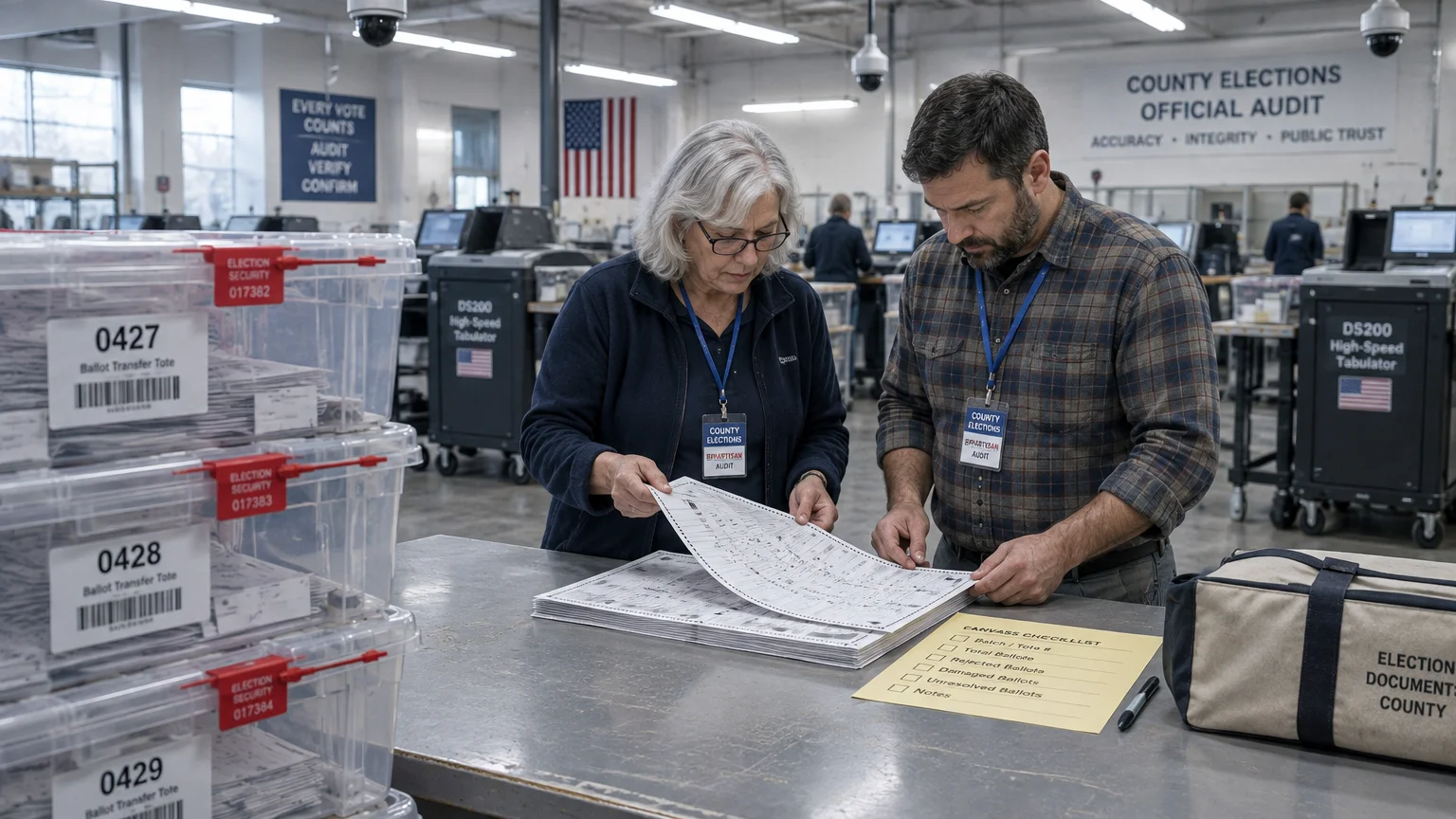
State legislatures establish binding codes that dictate when local clerks rerun tabulation equipment, when candidates post cash bonds, and how canvassing boards audit vote records. These nine rules cover the statutory thresholds, petition caps, cost-allocation formulas, audit mechanisms, and federal deadlines that govern post-election verification.
Each entry is selected from state election statutes, certified state election returns, nonpartisan research datasets, and federal law. Together, they trace how narrow margins move from unofficial election-night totals to certified finality.
1. Statutory Thresholds for Automatic Recounts
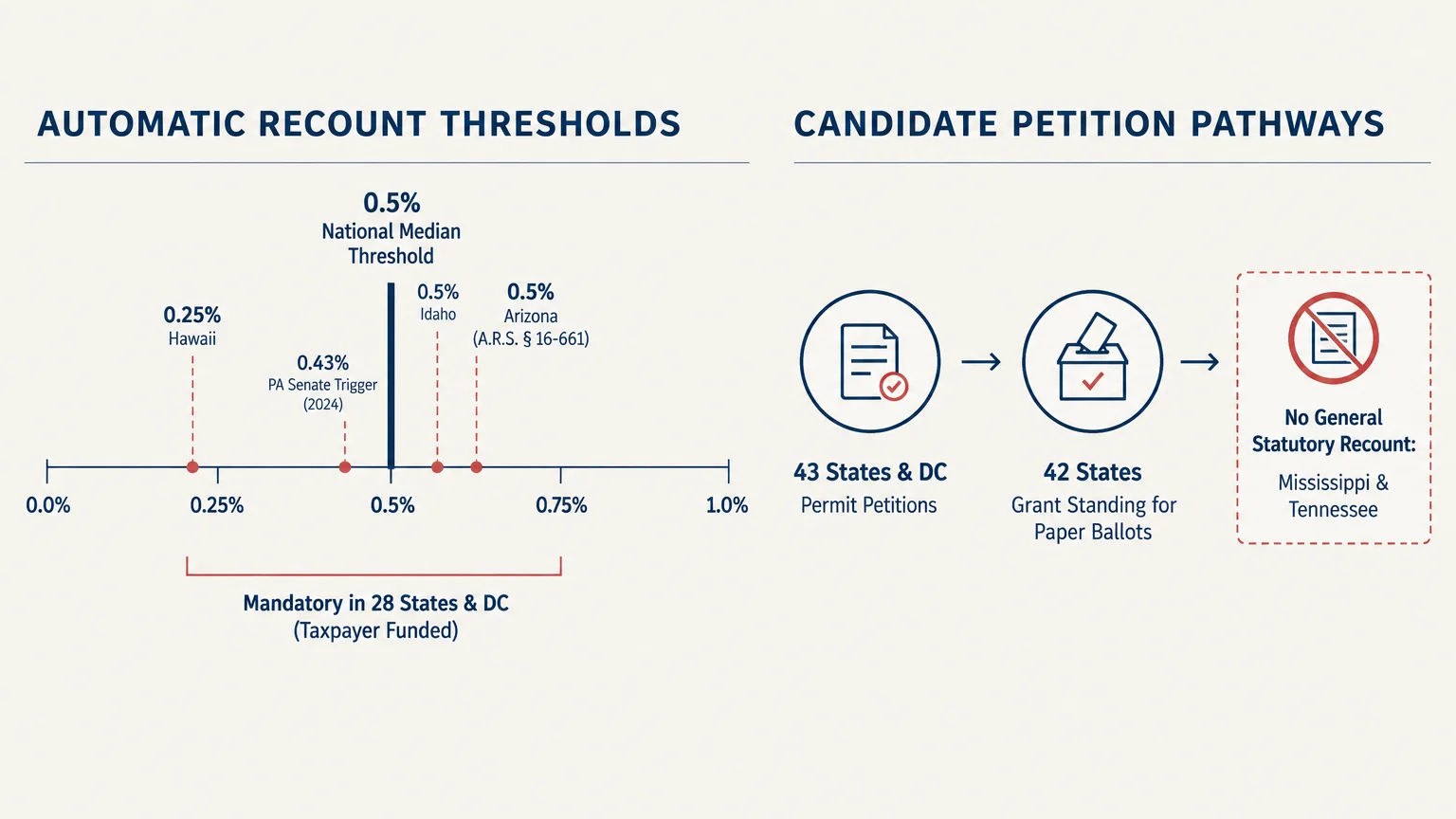
State law automatically triggers a retabulation when the margin between the top two candidates falls within a statutory window. Twenty-eight states and the District of Columbia mandate automatic recounts, removing administrative discretion from county officials.
These automatic triggers range nationwide from an exact tie up to one full percentage point. Across all states with automatic recount laws, the median threshold is 0.5 percent of total votes cast.
States periodically adjust these statutory boundaries. Arizona expanded its automatic recount trigger to 0.5 percent under Arizona Revised Statutes Section 16-661, while Idaho Code Section 34-2309 sets a state-funded recount trigger at 0.1 percent or five votes.
When an election falls inside the statutory boundary, taxpayers cover the cost of the retabulation. County boards configure tabulators, convene bipartisan counting boards, and process ballots without requiring candidates to submit legal petitions.
In the November 2024 Pennsylvania U.S. Senate election, Republican Dave McCormick led incumbent Democrat Bob Casey Jr. by 0.43 percent, inside the state’s 0.5 percent trigger.
The Pennsylvania Department of State halted the recount on November 21, 2024, when Casey conceded with McCormick leading by 16,299 votes (0.23 percent).
2. Petition Requirements and Closeness Caps for Candidate Requests
If an election falls outside the automatic threshold, forty-three states and the District of Columbia permit candidates or voters to request a recount. In contrast, Mississippi and Tennessee provide no general statutory recount provisions, requiring candidates to file election contests in court.
Twenty-one states restrict candidate-requested recounts by imposing statutory closeness caps. Election administrators must dismiss recount applications if the vote margin exceeds the state’s cap, which generally ranges between 0.25 percent and 2 percent.
State legislatures have also tightened petition eligibility to clarify administrative scope. Under Michigan Public Act 74 of 2024, which took effect in 2025, recount petitions cannot function as general forensic investigations and must allege good-faith errors sufficient to change the outcome.
Michigan’s statute also raised per-precinct deposit fees on a graduated scale tied to the vote margin, setting fees up to $500 per precinct when the margin exceeds 5 percent.
3. Deposit Schedules and the Mechanism of Cost Allocation
In twenty-three states, a candidate requesting a recount must advance the estimated cost through cash or surety bonds before boards unseal ballot containers. Seven states absorb recount costs regardless of who petitions, while eleven states use tiered cost formulas based on the margin.
State boards calculate deposits from county staff overtime, machine testing, security escorts, and facility expenses. Large multi-county recounts routinely require seven-figure deposits.
In November 2020, Donald Trump’s presidential campaign requested a partial recount in Wisconsin under Wisconsin Statutes Section 9.01, depositing $3 million to recount Dane and Milwaukee counties. Certified totals from the Wisconsin Elections Commission showed the recount netted 87 additional votes for Joe Biden.
Statewide automatic recounts carry comparable price tags for state treasuries. The Pennsylvania Department of State estimated the November 2024 statewide Senate recount at more than $1 million across the commonwealth’s 67 counties.
4. The Reversal Refund Rule
When campaigns advance private funds for a discretionary recount, state statutes define strict conditions for refunds. Twenty-seven states guarantee a full refund of the petitioner’s deposit if the retabulation reverses the certified election outcome.
Four additional states authorize refunds if the recount narrows the margin below a statutory percentage or uncovers substantial administrative error. When a refund applies, the state or county treasury absorbs the administrative expenses.
If the recount narrows a deficit without meeting the statutory reversal or error threshold, the petitioner forfeits the deposit. County fiscal officers transfer the forfeited escrow funds into local accounts to reimburse election worker wages and operational costs.
5. Precinct-Level Voter Recount Petitions
Thirty-one states grant registered voters legal standing to petition for recounts in ballot measure elections or specific candidate contests. Four states allow voters to petition for a recount in any race, while twenty-seven limit voter petitions to initiatives, referenda, or local offices.
Pennsylvania maintains one of the oldest citizen-petition provisions in the country under its 1927 Election Code. Under 25 P.S.
Section 3261, any three qualified electors in an election district can petition the court of common pleas to open ballot boxes or recanvass voting machines.
The three electors must verify by affidavit that they believe fraud or error occurred and post a $50 cash deposit or $100 bond per precinct. Under Pennsylvania law, petitioners must file within five days after the county board completes its computation of the returns.
6. Traditional Fixed-Percentage Tabulation Audits
Post-election tabulation audits operate independently of candidate or automatic recounts. Thirty-four states and the District of Columbia require traditional post-election tabulation audits, where bipartisan teams hand-count a sample of paper ballots to check scanner accuracy.
According to the U.S. Election Assistance Commission, traditional audits examine a fixed share of ballots—typically between 1 percent and 10 percent of precincts or voting machines—selected at random after Election Day.
Traditional audits check the same statutory percentage regardless of the victory margin. Bipartisan audit boards retrieve sealed paper ballots, tally the selections by hand, and compare their totals against the electronic scanner tapes.
If audit teams uncover discrepancies beyond statutory tolerances, state law authorizes election boards to expand the sample size. In states such as Minnesota and New York, unresolved discrepancies across escalating audit tiers trigger a full manual recount of the jurisdiction.
7. Statistical Mechanics of Risk-Limiting Audits
Fifteen states either mandate or authorize Risk-Limiting Audits (RLAs) as their primary post-election check or through statutory pilot programs. Colorado conducted the nation’s first statewide RLA in November 2017 under Colorado Revised Statutes Section 1-7-515.
Rather than inspecting a fixed percentage of precincts, an RLA examines a statistically calculated sample of individual paper ballots. The sample size scales directly with the victory margin: wide margins require checking dozens of ballots, while narrow margins require inspecting thousands.
State rules set a maximum “risk limit”—commonly between 5 percent and 10 percent—representing the largest chance that the audit will fail to detect an incorrect outcome.
That risk limit provides a 90 to 95 percent statistical probability of escalating to a full hand count if the reported winner actually lost.
Election officials conduct RLAs using either ballot-polling audits or ballot-level comparison audits. In a ballot-level comparison audit, officials match individual paper ballots directly against the cast-vote records exported from the optical scanner before certification.
8. The Historical Reversal Threshold and Average Margin Shifts
Empirical studies of modern elections show that recounts rarely alter certified winners. Between 2000 and 2023, states held 6,929 statewide general elections across the United States.
FairVote researchers documented 36 statewide recounts during that 24-year period, occurring in roughly one out of every 192 statewide contests. Those 36 recounts produced an average margin shift of 551 votes, or 0.03 percent of total ballots cast.
Only three of the 36 recounts reversed the initial election outcome, a reversal rate of one in every 2,310 statewide elections. Every reversal occurred when the initial margin was below 0.06 percent of the total vote.
In 2004, Washington Democrat Christine Gregoire overturned Republican Dino Rossi’s initial 261-vote lead during a manual recount to win the governorship by 129 votes.
In 2006, Vermont state auditor challenger Thomas Salmon overcame a 102-vote deficit, and in 2008, Democrat Al Franken won Minnesota’s U.S. Senate race by 225 votes after trailing Republican Norm Coleman by 215 votes.
9. Federal Certification Deadlines and Electoral Count Reform Act Constraints
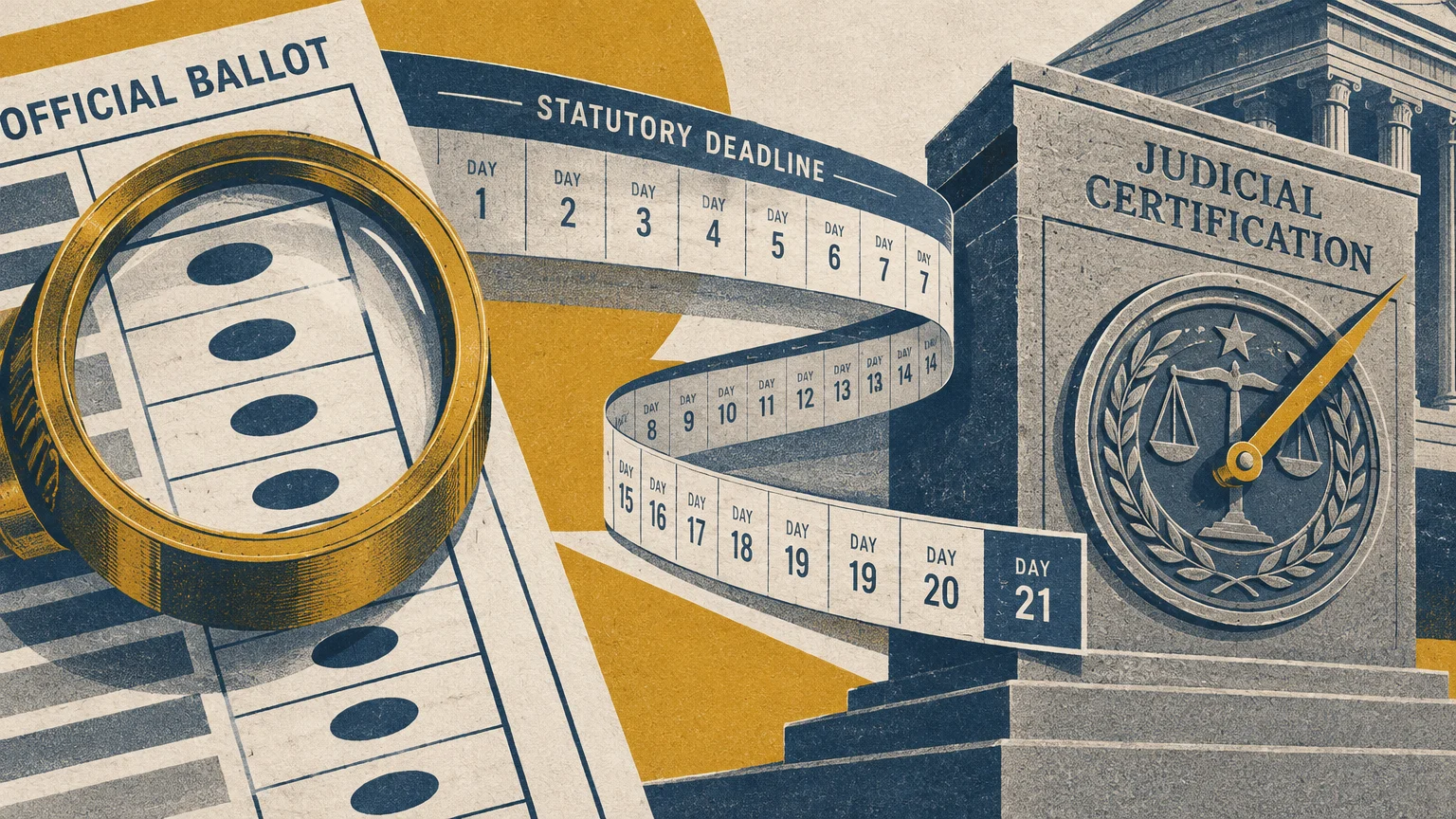
State recount procedures in presidential contests must finish within federal statutory deadlines. Congress revised those timelines in the Electoral Count Reform Act of 2022 (ECRA), codified in Title 3 of the United States Code.
The ECRA replaced the 1887 Electoral Count Act’s safe-harbor provision with a mandatory deadline: state executives must issue their Certificate of Ascertainment at least six days before presidential electors meet.
Because electors convene on the first Tuesday after the second Wednesday in December, state recounts in presidential races must conclude before that December cutoff.
The statute also created an expedited federal judicial review mechanism for presidential certification disputes, heard by a three-judge federal district court panel with direct appeal to the U.S. Supreme Court.
Congressional elections follow separate rules detailed in the Congressional Research Service report on contested elections, as Article I, Section 5 makes each chamber the final judge of its members’ elections.
State judicial contests are not bound by the ECRA calendar.
Following the November 2024 North Carolina Supreme Court election, machine and partial hand recounts confirmed incumbent Allison Riggs led challenger Jefferson Griffin by 734 votes out of 5.5 million cast, and ballot litigation prevented certification until May 2025.
| Procedure | Statutory Trigger | Cost Responsibility | Primary Objective | Operational Scope |
|---|---|---|---|---|
| Automatic Recount | Margin ≤ 0.5% (median) | State / County Taxpayers | Re-tally all ballots | Full contest jurisdiction |
| Candidate Recount | Petition within closeness cap | Petitioner deposit (refundable) | Verify narrow deficit | Requested precincts or statewide |
| Voter Petition | Qualifying electors (e.g., 3 in PA) | Flat deposit or bond | Check precinct returns | Individual precincts or contest |
| Tabulation Audit | Mandatory statute (34 states + D.C.) | Public election budget | Verify scanner accuracy | Fixed 1% to 10% sample |
| Risk-Limiting Audit | Statute or pilot (15 states) | Public election budget | Statistically verify outcome | Dynamic margin-based sample |
How Modern Recount Rules Balance Tabulation Accuracy and Finality
State election codes balance complete tabulation accuracy against administrative finality. Automatic triggers and post-election audits ensure that scanner errors do not alter close races, while closeness caps, deposit requirements, and ECRA deadlines prevent indefinite delays in certifying winners.
Historical data across nearly 7,000 statewide races confirms that recounts validate machine totals far more often than they reverse outcomes. Every documented statewide reversal since 2000 began with an initial margin smaller than 0.06 percent.
Frequently Asked Questions About Recounts and Audits
Can a candidate request a recount in any state if they pay for it?
No. Mississippi and Tennessee have no statutory recount provisions, requiring candidates to file formal election contests in state court.
Additionally, twenty-one states enforce closeness caps on candidate-initiated recounts. If a candidate trails by more than the statutory margin, election officials must reject the petition even if the campaign offers full payment.
What happens if a recount confirms an exact tie?
When a recount confirms an exact tie, most state election codes direct canvassing boards to break the deadlock by lot, such as flipping a coin or drawing a name.
In the 2017 Virginia House of Delegates District 94 race, a recount resulted in an exact 11,608-to-11,608 tie, which the State Board of Elections resolved by drawing a film canister from a ceramic bowl.
In federal races, the Office of the Historian of the U.S. House documents that contested or tied outcomes can be referred to Congress under Article I, Section 5 of the U.S. Constitution.
How do election audits differ from formal recounts?
Post-election audits check voting system accuracy by hand-counting a sample of paper ballots before certification, regardless of the vote margin. A recount re-tallies every ballot cast across a contest to determine the legal winner of a specific race.
Can federal courts stop a state-mandated recount?
Federal courts can intervene when state recount procedures violate federal statutes or the U.S. Constitution.
In Bush v. Gore (2000), the U.S. Supreme Court halted Florida’s manual recount on the ground that varying county standards for judging dimpled ballots violated the Fourteenth Amendment’s Equal Protection Clause.