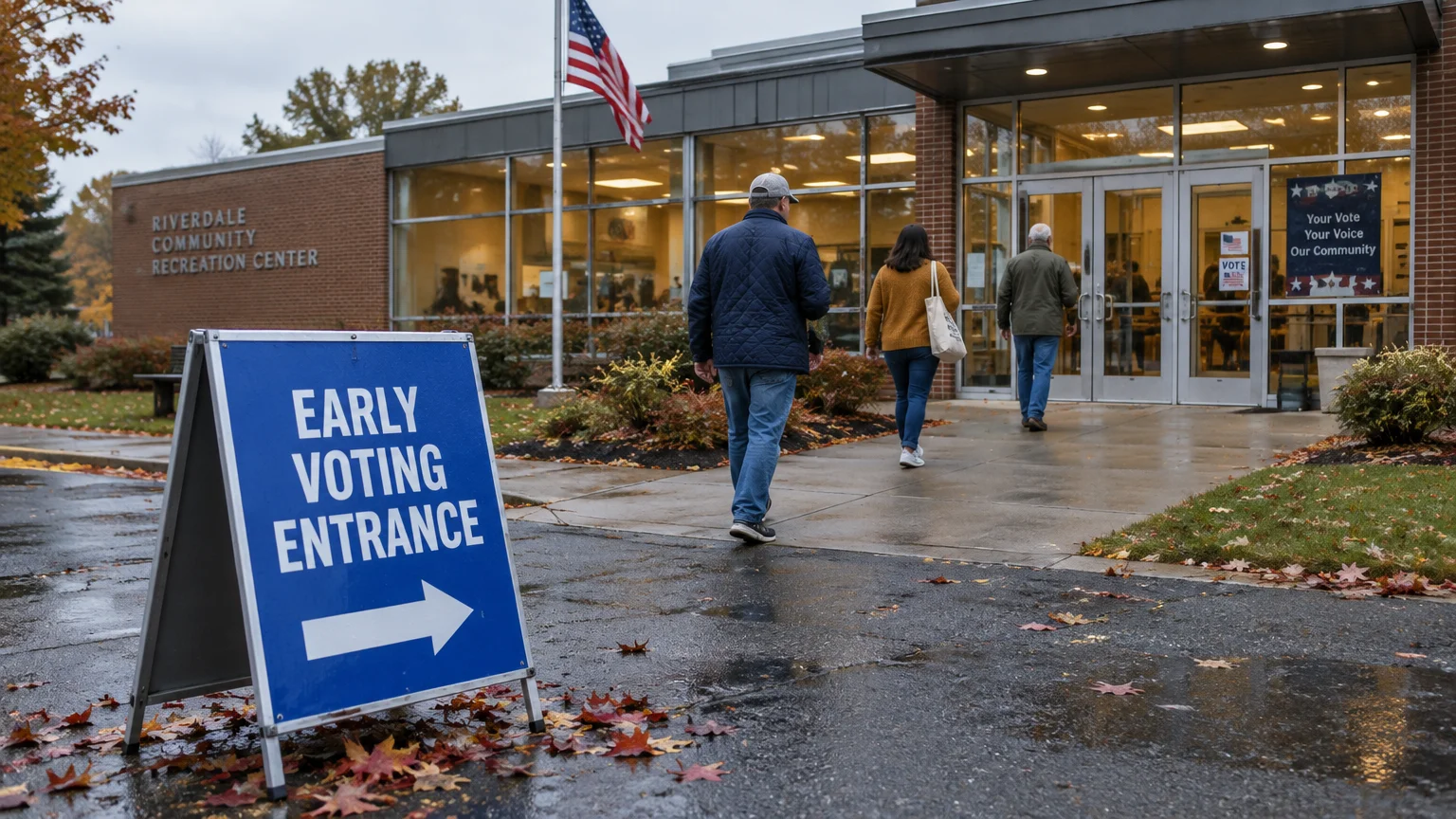
Voters can cast a general election ballot before Election Day in 47 states and Washington, D.C., without providing an excuse to election administrators. State legislatures establish distinct timetables, identification mandates, and ballot-handling rules across state borders.
While some jurisdictions open polling places for more than six weeks, others restrict early access to a three-day window. Administrative codes also dictate whether a ballot drops directly into a digital scanner or remains sealed in an affidavit envelope until final tabulation.
Statutory Frameworks Governing Early Balloting Across State Lines
This list examines the eight primary regulatory categories that govern how jurisdictions administer in-person voting before federal and state general elections.
Entries were selected from state statutory enactments, administrative election codes, and federal guidance documents in effect across all 50 states as of October 2026.
Early Voting Windows and Minimum Calendar Days
Texas established the modern framework for early in-person voting in 1987 when the Texas Legislature passed Senate Bill 671, launching no-excuse early voting statewide for the 1988 general election.
Between 2000 and 2024, the number of states offering universal early voting grew from 24 to 47.
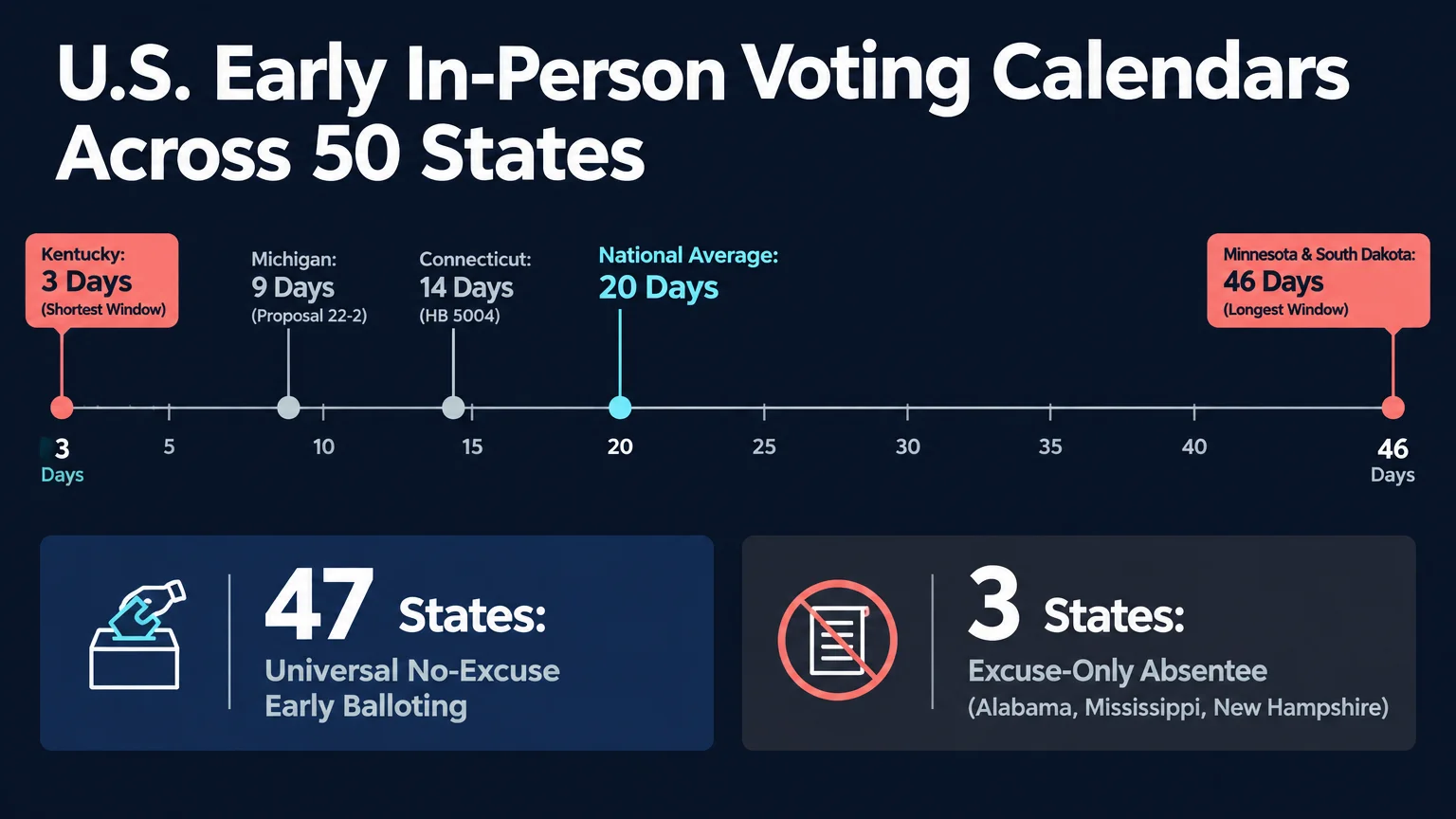
According to datasets tracked by the National Conference of State Legislatures, early voting calendars span from three days to 46 days across the country, with a national average of 20 days.
Across all states, early voting begins an average of 27 days before the general election.
Kentucky provides one of the shortest statutory windows at three days of early balloting. Conversely, Minnesota and South Dakota permit in-person voting up to 46 days before Election Day, and some jurisdictions open polling centers 50 days out.
Michigan voters established a constitutional right to early voting by approving Proposal 22-2 in 2022, mandating at least nine consecutive days of early voting starting in 2024.
Connecticut adopted a 14-day early voting window for the 2024 general election after lawmakers passed House Bill 5004 in 2023.
Only three states maintain strict excuse-only policies for in-person voting before Election Day: Alabama, Mississippi, and New Hampshire. Voters in those jurisdictions must qualify under statutory absentee criteria to cast a ballot prior to Election Day.
Direct Tabulation Versus In-Person Absentee Envelopes
States administer early voting through two distinct legal mechanisms: traditional early voting or in-person absentee voting.
Under traditional early voting, the voter inserts a paper ballot directly into an optical scanner or digital tabulator that logs the vote and drops the sheet into a locked bin.
In-person absentee voting requires the voter to complete an absentee application at the polling counter before receiving a ballot. States such as Missouri and Montana use this framework.
Under Missouri Revised Statutes § 115.277, a voter must sign an affidavit envelope certifying eligibility before casting an in-person absentee ballot. The completed ballot is sealed inside the privacy envelope and stored in a secure repository until official processing begins.
The U.S. Election Assistance Commission outlines chain-of-custody protocols for these sealed envelopes, requiring bipartisan inspection teams to reconcile daily envelope counts against check-in rosters.
If election clerks flag a signature discrepancy on an affidavit envelope, state laws govern the notice and statutory cure period provided before county certification.
Mandatory and Discretionary Weekend Polling Hours
Excluding all-mail election jurisdictions, 22 states mandate early voting on the Saturday immediately preceding Election Day. Another seven states leave Saturday polling hours to the discretion of county election boards, which can result in varying schedules between rural and metropolitan counties.
Sunday voting is more restricted under state election laws, with 17 states authorizing local election directors to open early voting sites on Sundays. Civic and community organizations frequently schedule voter turnout drives on these designated Sundays.
Georgia statutory code § 21-2-385 mandates two full Saturdays of early voting while granting counties discretion over two Sundays. Several state statutes also pair weekend mandates with extended weekday hours, requiring sites to remain open until at least 7:00 p.m. on select days.
State statutes require county election commissions to publish official lists of designated early polling sites and weekend operating hours in local newspapers and online weeks before voting begins.
Photo Identification and Identity Verification Standards
State voter identification laws apply identically during early voting and on Election Day, falling into strict photo, non-strict photo, and non-photo verification systems. Strict states require government-issued photo identification and generally offer free voter ID cards through motor vehicle agencies.
Under Missouri Revised Statutes § 115.427, voters must present an unexpired state driver’s license, nondriver ID card, or other specified government photo ID, or else cast a provisional ballot.
Iowa also tightened its in-person identification statutes by eliminating the provision that allowed another registered voter in the precinct to sign an oath attesting to a voter’s identity.
State statutes vary on whether student identification cards from public universities qualify for early voting, though federal and state laws uniformly accept active-duty military ID cards.
In non-photo ID states, voters may present a utility bill, bank statement, or signed affidavit while clerks compare signatures against the electronic poll book.
When a voter’s identification does not meet statutory requirements, poll workers must issue a provisional ballot and specify the number of days permitted under state law to cure the documentation.
Same-Day Voter Registration Deadlines
Nineteen states and Washington, D.C., permit same-day registration during both early voting and on Election Day. Electronic poll books update centralized state voter files in real time and verify addresses against motor vehicle or tax databases to prevent duplicate registrations.
North Carolina and Montana enforce a distinct statutory cutoff: both permit same-day registration during the early voting window but end the option on Election Day.
Under North Carolina General Statutes § 163-82.6A, an individual can register and vote simultaneously at any county early voting site by providing proof of residence.
If an unregistered individual waits until Election Day in North Carolina or Montana, state law bars precinct registration and restricts the voter to a provisional ballot. If electronic address verification fails during early voting, poll workers also issue a provisional ballot for subsequent review.
North Dakota remains the sole outlier in the nation, maintaining no voter registration system under North Dakota Century Code § 16.1-01-04 and requiring voters only to prove identity and local residency at the polls.
Overnight Ballot Security and Chain of Custody Seals
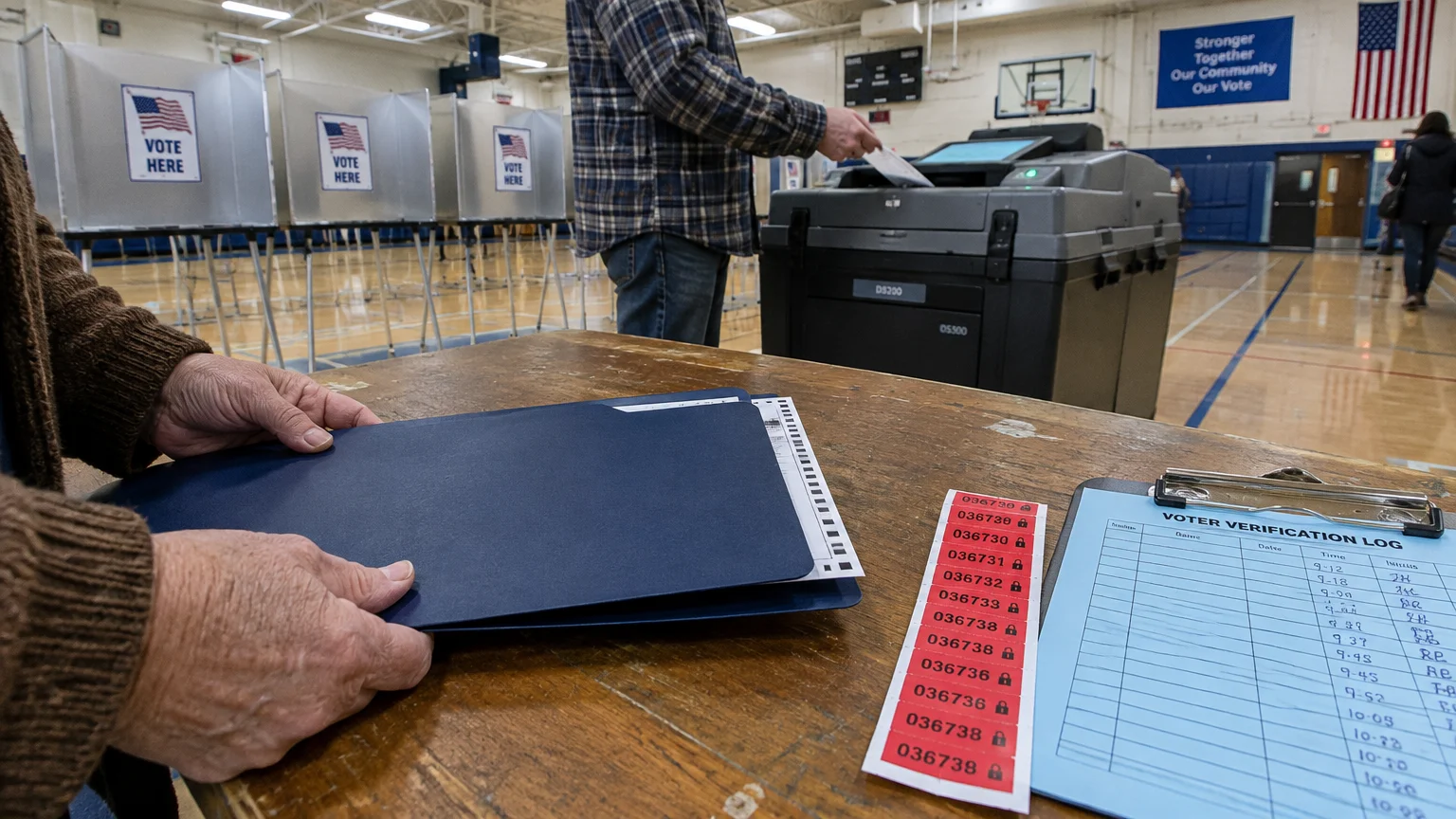
Because early polling places operate across consecutive days or weeks, jurisdictions enforce multi-day physical chain-of-custody protocols. At the close of each day, bipartisan teams of election judges record the public vote counter readings from each tabulator onto official logs.
Election workers place serialized tamper-evident seals across scanner memory ports, encrypted memory card compartments, and ballot bin doors.
Two workers representing opposing political parties must sign the daily security log verifying that seal numbers match morning records and documenting every time a key box is opened.
Voted paper ballots are transferred into locked containers each evening and moved under dual custody to secure election vaults equipped with keycard access controls and security cameras.
If a tamper seal shows signs of peeling or a serial number mismatch, technicians isolate the machine and conduct a statutory audit before tabulating affected ballots.
State election laws routinely designate daily opening and closing seal verifications at early voting sites as public proceedings open to partisan and nonpartisan observers.
In-Person Voting Center Mandates in Universal Mail States
Eight states—California, Colorado, Hawaii, Nevada, Oregon, Utah, Vermont, and Washington—along with Washington, D.C., conduct elections primarily by mail by automatically sending a ballot to every registered voter. Even in these universal mail jurisdictions, state statutes mandate in-person early voting networks.
Under the California Voter’s Choice Act, codified in California Elections Code § 4005, participating counties must operate centralized vote centers open to all county voters for at least 10 days before Election Day.
These countywide centers allow any registered resident to vote regardless of neighborhood precinct.
Voters can use these centers to deposit completed mail envelopes into monitored drop boxes, spoil a damaged mail ballot in exchange for a fresh replacement, or vote in person on standard tabulators.
Vote centers also house audio-tactile interfaces and sip-and-puff devices required to comply with federal disability accessibility statutes.
Pre-Canvassing and Early Ballot Tabulation Timelines
State statutes dictate when election officials may conduct logic and accuracy testing, pre-canvass envelopes, and tabulate early votes. Pre-canvassing includes opening affidavit envelopes, verifying voter signatures, and flattening paper ballots for optical scanning.
Under Florida Statutes § 101.5612, county canvassing boards may pre-canvass and tabulate early ballots following public equipment testing, enabling prompt reporting on Election Night. Conversely, several states prohibit pre-canvassing before Election Day morning, keeping early ballots locked in vaults until polls open.
Delaware established a 10-day early voting window in 2022 that faced legal challenges. In 2024, the Delaware Supreme Court upheld the state’s early voting statutes, preserving direct scanning for early voters.
Across all states, statutory rules prohibit election officials from generating vote tally reports before polls close on Election Day. Tabulation machines store votes in encrypted memory, and state laws impose felony penalties on workers or observers who disclose early vote totals prior to poll closing.
| Regulatory Category | Applicable States | Operational Standard | Impact on Voter |
|---|---|---|---|
| Universal Early Voting | 47 states & D.C. | No excuse required | Casts ballot before Election Day |
| Envelope Processing | Missouri, Montana | Sealed affidavit envelopes | Requires verification before scan |
| Saturday Polling | 22 states mandated | Open Saturday before election | Guarantees weekend voting access |
| Sunday Polling | 17 states permitted | County board discretion | Authorizes Sunday community drives |
| Exclusive Early SDR | North Carolina, Montana | Early voting period only | Bars Election Day registration |
| Vote Center Systems | 8 universal mail states | Centralized county hubs | Provides ADA voting equipment |
| Early Pre-Canvassing | Florida, Arizona | Begins prior to Election Day | Yields prompt Election Night counts |
| Strict Identification | Missouri, Iowa | Government ID verified | Provisional ballot if ID missing |
How State Early Voting Rules Shape Ballot Access and Security
The decentralized administration of American elections creates 50 distinct statutory environments for early in-person balloting. Spreading voter volume across multi-week windows reduces congestion at neighborhood precincts on Election Day.
While the U.S. Election Assistance Commission provides baseline physical security and chain-of-custody models, state election codes govern how local boards enforce them. Bipartisan inspection pairs, serialized tamper seals, and signed daily logs secure both direct-scanned ballots and sealed affidavit envelopes until final canvassing.
Frequently Asked Questions About Early In-Person Voting
Can you change your vote after casting an early in-person ballot?
No. Once an optical tabulator accepts a paper ballot or election judges receive a sealed in-person absentee envelope, state election codes deem the vote final and prohibit ballot cancellation. Electronic poll books immediately update the statewide voter file to block duplicate voting.
Why do some states report early votes immediately while others take days?
Reporting speeds depend on whether state statutes authorize county boards to pre-canvass early ballots before Election Day.
States such as Florida process ballots ahead of time and release totals shortly after polls close, whereas states barring early pre-canvassing must open, verify, and scan early ballots alongside Election Day precinct returns.
What happens if an early voting machine malfunctions while scanning your ballot?
When an optical scanner malfunctions, poll workers direct voters to deposit completed ballots into a locked auxiliary bin built into the tabulator base.
Bipartisan election teams later empty the auxiliary bin under documented chain-of-custody protocols and feed the paper ballots through a repaired or replacement scanner.
Do you have to visit your specific home precinct to vote early?
In most states, counties operate centralized early voting centers that serve any registered voter residing within the county. Electronic poll books connect to statewide voter databases to print or issue the specific ballot style tied to the voter’s home precinct.