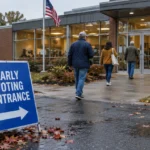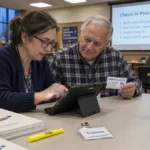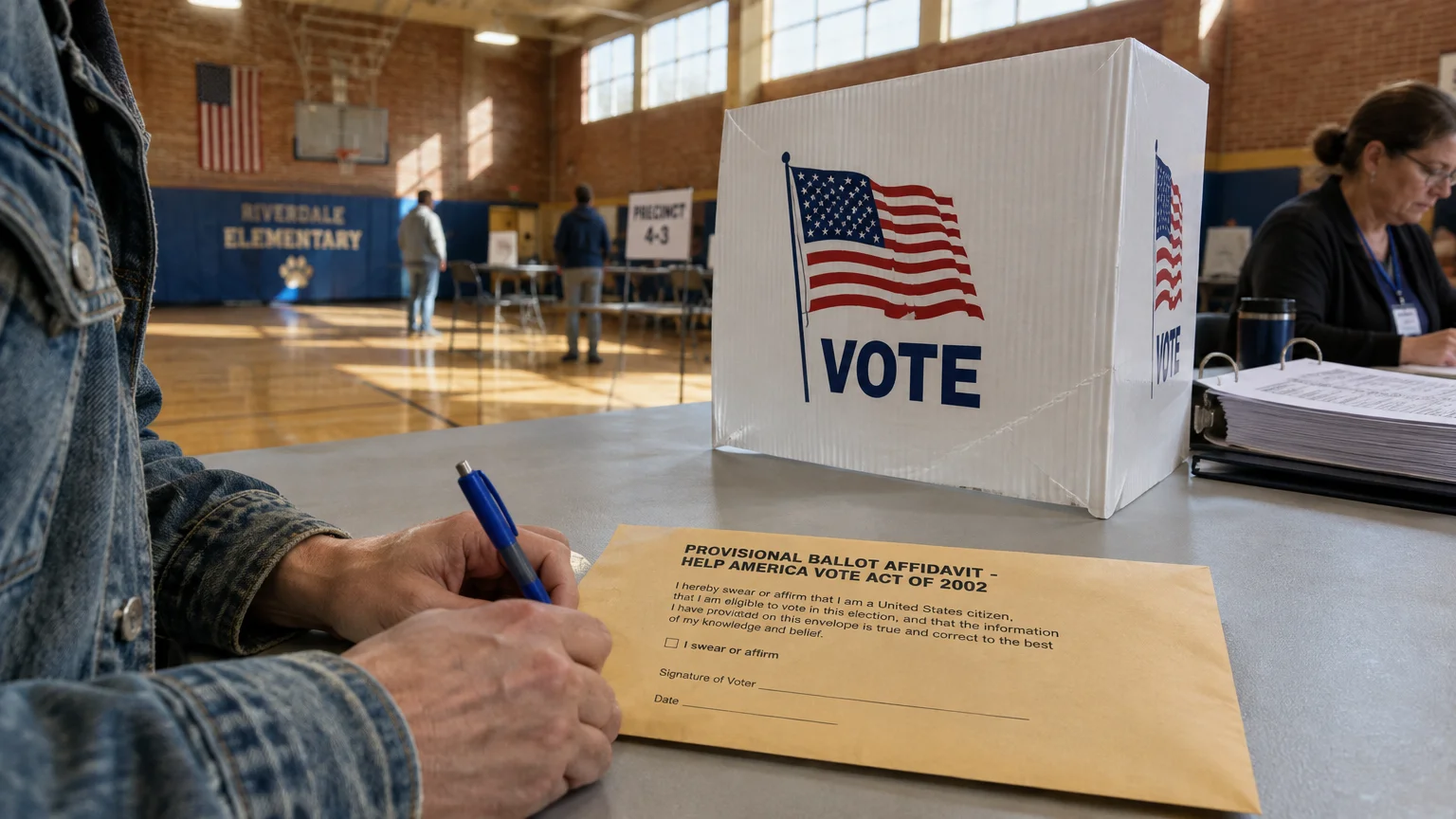
When a voter arrives at a precinct on Election Day and election workers cannot locate their name on the official rolls, federal law guarantees that poll workers cannot turn the voter away without offering a provisional ballot.
Congress established this fail-safe procedure to protect registered citizens from administrative errors, registration backlogs, and recent address updates. It ensures that poll workers record the vote while county officials verify legal eligibility during the post-election canvass.
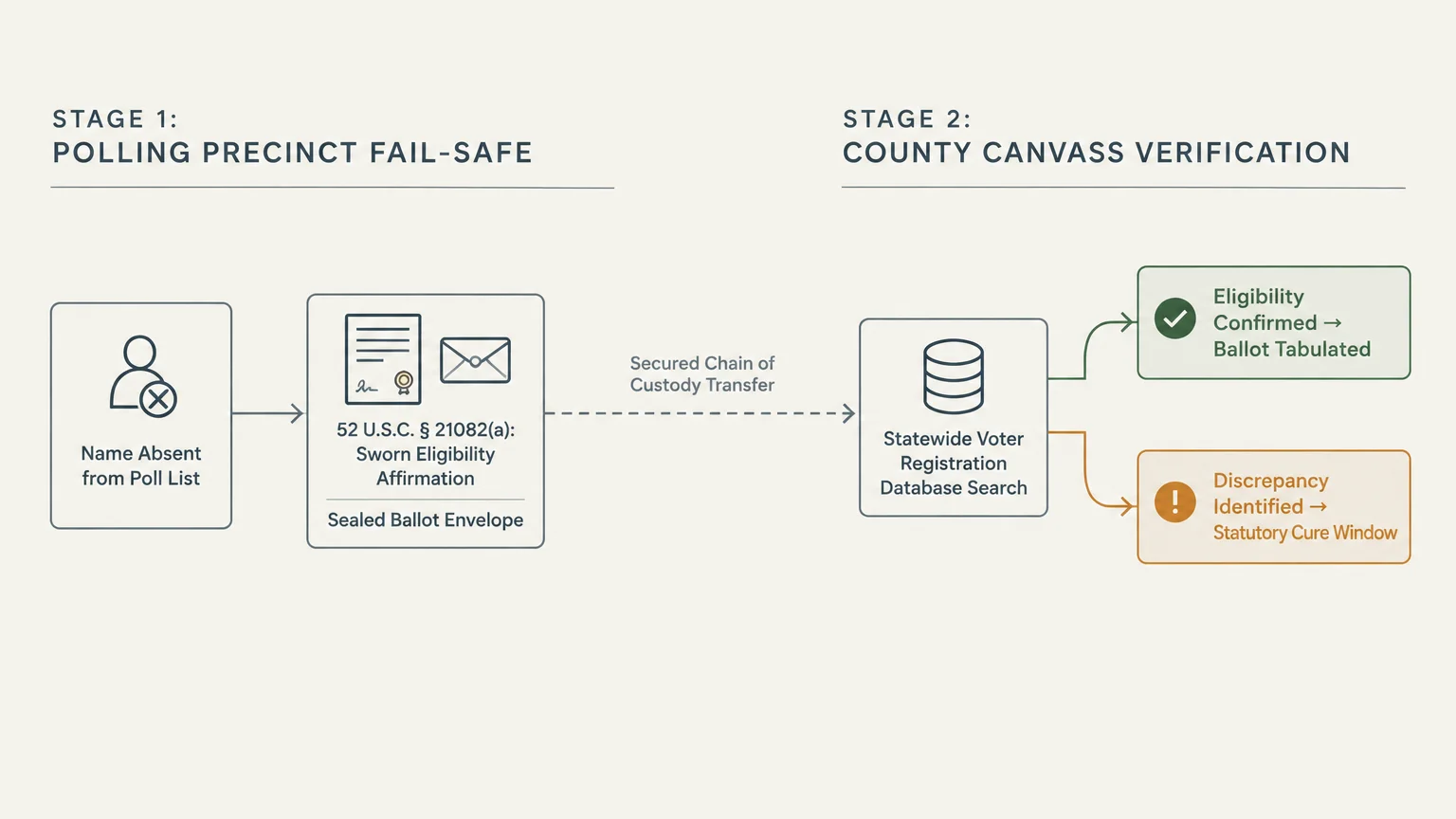
How Federal Law Governs the Provisional Voting Process
This list covers the six core federal rules governing provisional voting under Title III of the Help America Vote Act of 2002 (Public Law 107-252).
Each entry corresponds to a mandatory statutory requirement in 52 U.S.C. §§ 21082–21083 governing ballot issuance, voter affirmations, identification safeguards, canvassing standards, ballot tracking, and state exemptions.
While federal law guarantees the right to cast a provisional ballot at the polling place, Article I, Section 4 of the U.S. Constitution leaves post-election counting rules to state legislatures.
The comparative table below outlines the statutory citation, precinct trigger, and county canvass procedure for each rule.
| Rule and Scope | Statutory Citation | Polling Place Trigger | Post-Election Canvass Action | Legal Protection Provided |
|---|---|---|---|---|
| Universal Fail-Safe Ballot | 52 U.S.C. § 21082(a) | Name absent from official poll list | Canvassers search statewide voter database | Prohibits poll workers from turning voters away |
| Sworn Eligibility Affirmation | 52 U.S.C. § 21082(a)(2) | Official challenges voter qualifications | Election staff verify signature against state files | Creates a legally binding audit trail |
| First-Time Mail Registrant ID | 52 U.S.C. § 21083(b) | First-time voter lacks required ID documents | Board reviews submitted cure paperwork | Prevents immediate disenfranchisement at check-in |
| Canvassing and Precinct Rules | 52 U.S.C. § 21082(a)(4) | Ballot cast outside assigned precinct | Board applies state statutory counting rules | Guarantees non-arbitrary post-election review |
| Free Access Tracking System | 52 U.S.C. § 21082(a)(5) | Voter deposits sealed provisional envelope | Clerks upload ballot disposition and rationale | Provides transparent public tracking access |
| Federal Statutory Exemptions | 52 U.S.C. § 21082(a) | Voter checks in within exempt state | Officials apply state-specific alternative laws | Preserves existing same-day registration systems |
1. Universal Fail-Safe Ballot Issuance
President George W. Bush signed the Help America Vote Act into law on October 29, 2002.
Enacted as Public Law 107-252, the measure instituted structural reforms following the disputed 2000 presidential election recount.
Section 302(a) of the act, codified at 52 U.S.C. § 21082, established the federal provisional ballot mandate. This provision guarantees a backup ballot to any individual whose name is missing from precinct rolls or whom an election official asserts is ineligible.
The House approved the bipartisan conference report by a vote of 357 to 48 on October 10, 2002. The Senate followed on October 16, 2002, passing the legislation by a 92 to 2 margin.
This rule strips individual poll workers of the authority to deny a ballot unilaterally. Once a voter declares that they are registered and eligible in the jurisdiction, election judges must furnish a provisional ballot and written verification instructions immediately.
2. Execution of the Sworn Eligibility Affirmation
To obtain a provisional ballot under Section 302(a)(2), the voter must execute a written affirmation before an election official at the polling place. Federal law requires this signed attestation directly on the provisional ballot envelope or an accompanying form.
In this statement, the individual swears under penalty of law that they are a registered voter in the jurisdiction and are eligible to vote in that election. Submitting a knowingly false declaration exposes an individual to criminal prosecution under federal and state election perjury statutes.
County canvassing boards use this signed affirmation as the primary investigative document during the post-election review. Canvassers compare the voter’s name, residential address, date of birth, and signature against official records in the centralized statewide voter registration database required under Title III.
3. First-Time Mail Registrant Identification Safeguard
Section 303(b) of the Help America Vote Act established specific identification standards for individuals who register to vote by mail. These requirements apply to registrants who have not previously voted in a federal election in that state.
Under 52 U.S.C. § 21083(b), covered voters must present current and valid photographic identification or an authorized document showing their name and address. Acceptable non-photo documents include a current utility bill, bank statement, government check, paycheck, or other government document.
If a first-time mail registrant cannot produce qualifying identification at check-in, Section 303(b)(2)(B) guarantees the right to cast a provisional ballot.
State election rules establish the post-election cure window during which the voter may submit missing identification to the county election office to validate the ballot.
4. County Board Canvassing and Out-of-Precinct Rules
Section 302(a)(4) dictates that state or local election officials determine provisional ballot validity strictly according to state law. If the election board certifies that the individual is eligible under state law, the ballot must be counted as a regular vote in that election.
Contrary to the common misconception that provisional ballots are only examined in close elections, county canvassing boards inspect and adjudicate every provisional envelope before certifying final election returns.
State statutes also govern whether canvassers reject out-of-precinct ballots entirely or partially count them for federal and statewide offices.
Data from the U.S. Election Assistance Commission’s Election Administration and Voting Survey shows that millions of provisional ballots are processed in federal general elections, with roughly three-quarters accepted in full or in part.
Across national surveys, the single largest reason for provisional ballot rejection is that the individual was not registered to vote in the state.
5. Mandatory Free Access Tracking System
Section 302(a)(5) mandates that state and local election authorities establish a free access system—such as a toll-free telephone number or an internet website—for every provisional voter.
When a voter casts a provisional ballot, the election official must hand the voter written information explaining how to use the tracking system.
Under 52 U.S.C. § 21082(a)(5)(B), the tracking portal must inform the individual whether their vote was counted and, if the vote was not counted, the specific legal reason for the rejection.
State and local authorities must maintain policies that protect the confidentiality of the voter’s personal information.
Section 302(a)(5)(C) specifically provides that access to information about an individual provisional ballot must be restricted to the individual who cast the ballot. Poll workers accomplish this by issuing a receipt bearing a unique tracking number or personal identification code.
6. Statutory Exemptions and State-Level Variations
When Congress enacted the Help America Vote Act in 2002, Section 302(a) incorporated the statutory exemptions previously established under Section 4(b) of the National Voter Registration Act of 1993 (52 U.S.C. § 20503(b)).
Six states qualified for this exemption because they either had no voter registration requirement or offered Election Day registration at the polling place continuously since 1994: Idaho, Minnesota, New Hampshire, North Dakota, Wisconsin, and Wyoming.
Over time, three of those exempt states—North Dakota, Wisconsin, and Wyoming—adopted limited provisional ballot procedures under state law to handle specific identification or eligibility disputes. As a result, 47 states and the District of Columbia utilize provisional ballots in some capacity.
Only three states—Idaho, Minnesota, and New Hampshire—do not issue provisional ballots at all. In those jurisdictions, voters whose names do not appear on the precinct poll list resolve discrepancies immediately at the polling place through same-day voter registration.
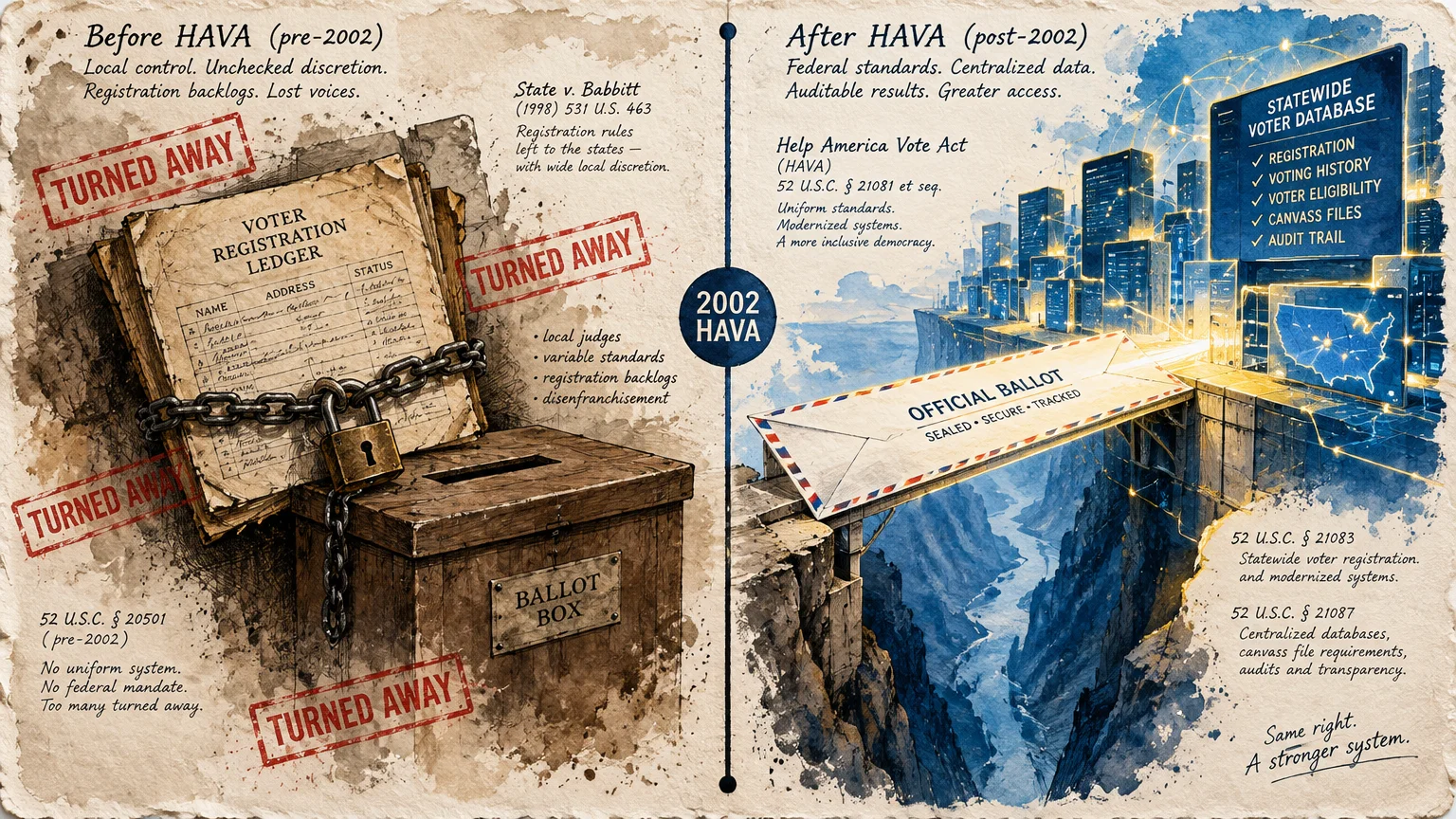
How Provisional Ballots Transformed American Election Administration
Before Congress enacted the Help America Vote Act in 2002, clerical errors in paper poll books or delayed address transfers at motor vehicle agencies regularly prevented registered citizens from voting on Election Day.
By decoupling the physical act of marking a ballot from the administrative verification of voter eligibility, Title III shifted complex registration investigations from busy precinct tables to post-election county canvassing boards.
During the statutory canvassing window, election officials cross-reference provisional ballot affirmations against interactive statewide voter registration lists, motor vehicle records, and signature files.
The federal tracking mandate also requires jurisdictions to document every rejection rationale, creating an auditable record that helps administrators identify registration transmission failures.
Because Section 302(a)(4) leaves counting rules to state law, provisional ballot acceptance rates vary widely across state lines. States that reject out-of-precinct ballots in full record substantially higher rejection rates than states that count out-of-precinct ballots for statewide and federal races on the up-ballot ticket.
Frequently Asked Questions About Provisional Ballots
Are provisional ballots only counted in close elections?
No. Under federal and state election statutes, county canvassing boards must verify and count every eligible provisional ballot before certifying final election returns, regardless of the margin of victory between candidates.
What happens if you cast a provisional ballot in the wrong precinct?
The disposition of an out-of-precinct provisional ballot depends on state law under Section 302(a)(4) of the Help America Vote Act.
A majority of states disqualify ballots cast outside the voter’s assigned precinct completely, while roughly two dozen states partially count them for federal and statewide contests.
How do you track the status of your provisional ballot?
Federal law requires poll workers to give every provisional voter written instructions for accessing a free toll-free hotline or website using a unique receipt number.
The tracking system discloses whether the county board counted the ballot in full, counted it partially, or rejected it, along with the specific reason for any rejection.
Can you fix an issue with your provisional ballot after Election Day?
Many states provide a statutory post-election cure period—typically lasting several days after Election Day—allowing voters to submit missing identification or resolve signature discrepancies with the county election office.
If the voter does not provide the required documentation before the state deadline, the canvassing board rejects the provisional ballot.