Thanksgiving is observed each November as a statutory federal holiday, yet its permanent date resulted from decades of political friction, executive proclamations, and legislative bargaining. The holiday evolved from wartime declarations into an economic battleground before Congress locked it into federal law in 1941.
Presidents originally treated the observance as a discretionary, faith-based tradition rather than a permanent civic right for workers. That custom sparked partisan resistance and deep calendar confusion across state lines.
Tracking the Evolution of Thanksgiving Through Executive and Statutory Action
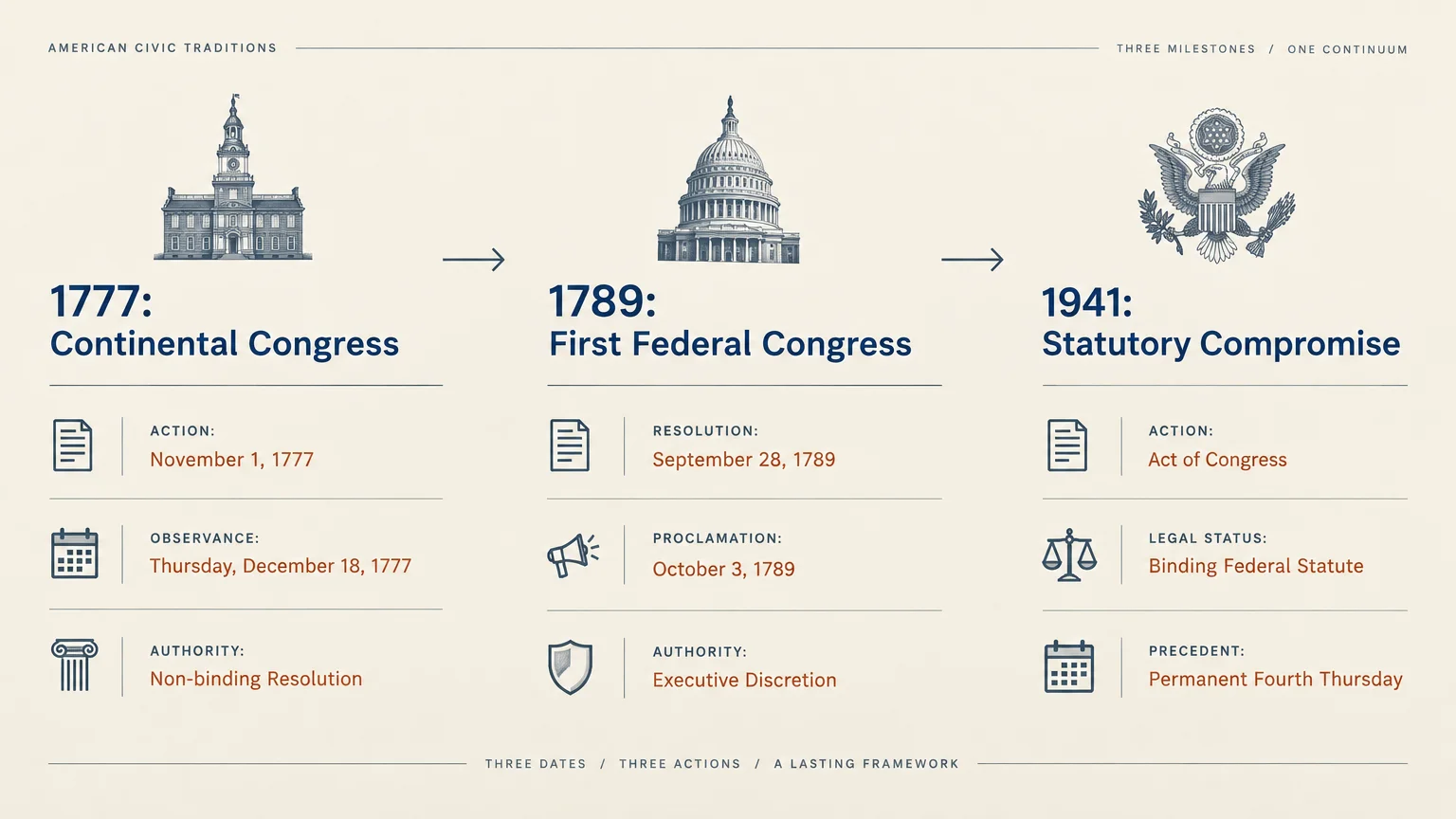
This list chronicles the nine legal steps from 1777 to 1941 that transformed Thanksgiving from an ad hoc executive proclamation into a binding federal statute, chosen for each entry’s formal shift in constitutional authority, executive precedent, or calendar designation.
Continental Congress Proclamation of 1777
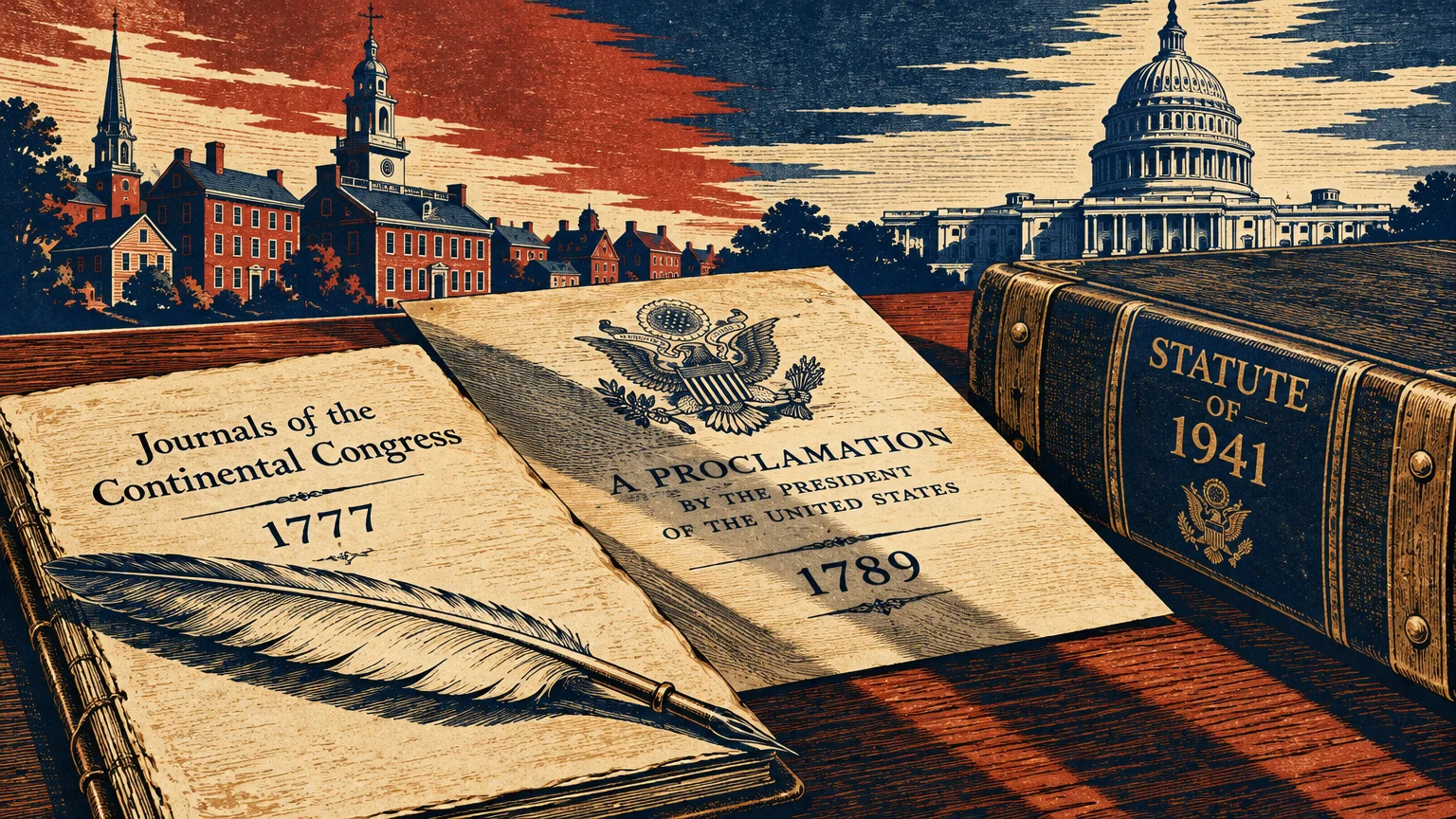
On November 1, 1777, the Continental Congress approved the first national Thanksgiving proclamation in American history. The resolution set aside Thursday, December 18, 1777, as a coordinated day of solemn praise across the thirteen states.
The proclamation responded directly to the American military victory over British forces at the Battle of Saratoga in October 1777. Congressional delegates sought to unify the colonies under a shared civic observance during wartime hardship.
A committee including Samuel Adams drafted the text, which urged citizens to express gratitude while seeking national independence. The text appears in the Journals of the Continental Congress preserved at the National Archives.
This wartime decree established the precedent of national leaders designating specific Thursdays for gratitude, though the Continental Congress lacked constitutional enforcement power and left compliance to individual state governors.
George Washington’s National Day of Thanksgiving in 1789
On September 28, 1789, the First Federal Congress passed a joint resolution requesting a presidential proclamation. Representative Elias Boudinot of New Jersey introduced the measure to give citizens an opportunity to acknowledge the newly ratified United States Constitution.
Representative Thomas Tudor Tucker of South Carolina vigorously opposed the proposal on constitutional grounds. He argued that holiday declarations infringed upon state authority and entangled civil government with religious practice.
President George Washington overrode those legislative concerns on October 3, 1789, by issuing the first presidential Thanksgiving proclamation. He designated Thursday, November 26, 1789, as a day devoted to public thanksgiving and prayer.
Washington framed the proclamation around civic gratitude for the peaceful establishment of constitutional government and transmitted copies to state governors, establishing an executive precedent under Article II without creating an annual mandate.
Thomas Jefferson’s Constitutional Boycott and the Early Interregnum
President John Adams maintained Washington’s precedent by proclaiming national fast and thanksgiving days on May 9, 1798, and April 25, 1799. His proclamations drew intense partisan condemnation from Democratic-Republicans, who viewed them as monarchical overreach.
When Thomas Jefferson assumed the presidency in 1801, he halted presidential Thanksgiving proclamations entirely. Jefferson argued that executive religious proclamations violated the Establishment Clause of the First Amendment and infringed upon state sovereignty.
Jefferson articulated this strict constitutional position in his January 1, 1802 letter to the Danbury Baptist Association—the same day he received a 1,235-pound “Mammoth Cheese” gift from Democratic-Republican dairy farmers in Cheshire, Massachusetts.
President James Madison briefly revived the practice at the end of the War of 1812, proclaiming an observance in April 1815, after which no president issued a Thanksgiving decree for forty-eight consecutive years.
Sarah Josepha Hale’s Seventeen-Year Civic Campaign
During the nineteenth century, individual states celebrated Thanksgiving on disconnected dates selected by their respective governors. Southern governors frequently rejected the observance, viewing it as a New England custom tied to Northern abolitionist politics.
In 1846, Sarah Josepha Hale, the editor of Godey’s Lady’s Book, launched a national campaign for a single date. She argued that a synchronized holiday would foster national fraternity and help preserve the Union against sectional disintegration.
Hale spent seventeen years publishing editorials and writing letters to governors, cabinet officials, and five successive presidents. Presidents Zachary Taylor, Millard Fillmore, Franklin Pierce, and James Buchanan each rejected or ignored her petitions.
On September 28, 1863, Hale sent a letter to President Abraham Lincoln and Secretary of State William H. Seward urging executive action to establish a uniform national day on the last Thursday of November.
Abraham Lincoln’s 1863 Civil War Proclamation
Five days after receiving Sarah Josepha Hale’s appeal, President Abraham Lincoln acted. On October 3, 1863, Lincoln issued Proclamation 106, inviting Americans to celebrate a national day of Thanksgiving on Thursday, November 26, 1863.
Secretary of State William H. Seward authored the official text amidst the casualties of the American Civil War.
The handwritten manuscript is preserved in the Library of Congress historical collection.
The proclamation highlighted agricultural bounties and military progress, including the Union victory at Gettysburg, while asking citizens to care for widows, orphans, and wounded soldiers.
Lincoln’s decree established an annual tradition that every subsequent president followed, though the proclamation remained an executive request lacking statutory enforcement or paid leave for workers.
Andrew Johnson and Ulysses S. Grant’s Calendar Variations
Following Lincoln’s assassination, succeeding administrations tested the boundaries of executive discretion by altering the holiday’s timing. Because Congress had passed no statute, sitting presidents retained full authority to designate any date they chose.
In 1865, President Andrew Johnson moved Thanksgiving out of November, proclaiming Thursday, December 7, 1865, as the national day to mark the conclusion of the Civil War.
Four years later, President Ulysses S. Grant shifted the holiday in the opposite direction.
By presidential proclamation on October 7, 1869, Grant designated the third Thursday of the month, November 18, 1869, for public observance.
After these shifts disrupted interstate railroad timetables, school calendars, and commercial accounting schedules, both Johnson and Grant returned to Lincoln’s last-Thursday formula.
The Holidays Act of 1870 and Expansion of Holiday Pay
On June 28, 1870, President Ulysses S. Grant signed the Holidays Act (16 Stat.
168) passed by the 41st Congress. The law formally recognized Thanksgiving, New Year’s Day, Independence Day, and Christmas as legal federal holidays.
The 1870 statute applied strictly to federal civil servants and commercial bank employees within the District of Columbia. Unlike the other holidays, Congress did not fix a calendar date, recognizing whatever day the president proclaimed.
Federal employees initially received these statutory holidays without pay, causing wage losses for per diem manual laborers. Congress remedied this on January 6, 1885 (23 Stat.
516), by guaranteeing holiday pay for per diem federal employees nationwide.
Although the 1885 statute protected federal workers’ wages, the calendar date itself remained uncodified and subject to presidential selection each autumn.
Franklin D. Roosevelt’s 1939 “Franksgiving” Controversy
In 1939, November had five Thursdays, placing the traditional Thanksgiving date on November 30. Retail groups warned President Franklin D.
Roosevelt that a late holiday would shorten the Christmas shopping season during the Great Depression.
Urged by Lew Hahn, general manager of the National Retail Dry Goods Association, Roosevelt announced on August 14, 1939, that he would advance Thanksgiving by one week to November 23.
The announcement triggered sharp resistance from college football conferences, calendar publishers, and political critics who labeled the new date “Franksgiving.” Contemporary telegrams and citizen complaints are preserved at the Franklin D. Roosevelt Presidential Library.
The country split along partisan lines: twenty-three states observed November 23, twenty-two states kept November 30, and Colorado, Mississippi, and Texas observed both days as separate state holidays.
House Joint Resolution 41 and the Act of December 26, 1941
To end two years of calendar split, Congress intervened to remove the president’s unilateral scheduling power. On October 6, 1941, the House of Representatives passed House Joint Resolution 41, sponsored by Representative Pete Jarman of Alabama.
As documented by the Office of the Historian of the U.S. House, the initial House resolution fixed the holiday as the “last Thursday” of November. The Senate Judiciary Committee noted that this wording would recreate the 1939 five-Thursday problem.
Senator Carl Hatch of New Mexico steered an amendment through the Senate on December 9, 1941, changing the date to the “fourth Thursday” of November. The House concurred in the Senate amendment without debate on December 19, 1941.
President Roosevelt signed the measure on December 26, 1941, enacting Public Law 77-379 (55 Stat. 862).
The National Archives preserves the signed joint resolution, now codified at 5 U.S.C. § 6103(a).
| Milestone | Year | Governing Authority | Official Action | Statutory or Calendar Result |
|---|---|---|---|---|
| Continental Congress | 1777 | Continental Congress | Wartime Resolution | Observed December 18, 1777; first national observance |
| Washington Proclamation | 1789 | George Washington | Executive Proclamation | Observed November 26, 1789; established executive precedent |
| Jefferson Boycott | 1801 | Thomas Jefferson | Executive Policy | Halted proclamations on First Amendment grounds |
| Hale Civic Campaign | 1846 | Sarah Josepha Hale | Editorial Lobbying | Mobilized 17-year campaign for a fixed national date |
| Lincoln Proclamation | 1863 | Abraham Lincoln | Proclamation 106 | Established the annual last-Thursday national observance |
| Post-War Variations | 1865 | Andrew Johnson | Executive Proclamation | Shifted holiday to December 7; exposed date vulnerability |
| First Holidays Act | 1870 | 41st U.S. Congress | 16 Stat. 168 | Created federal legal holiday without fixing the date |
| “Franksgiving” Shift | 1939 | Franklin D. Roosevelt | Executive Proclamation | Moved date forward one week; divided 48 states |
| Joint Resolution 41 | 1941 | 77th U.S. Congress | Public Law 77-379 | Fixed Thanksgiving as fourth Thursday under 5 U.S.C. § 6103 |
How Thanksgiving Shifted from Executive Discretion to Statutory Law
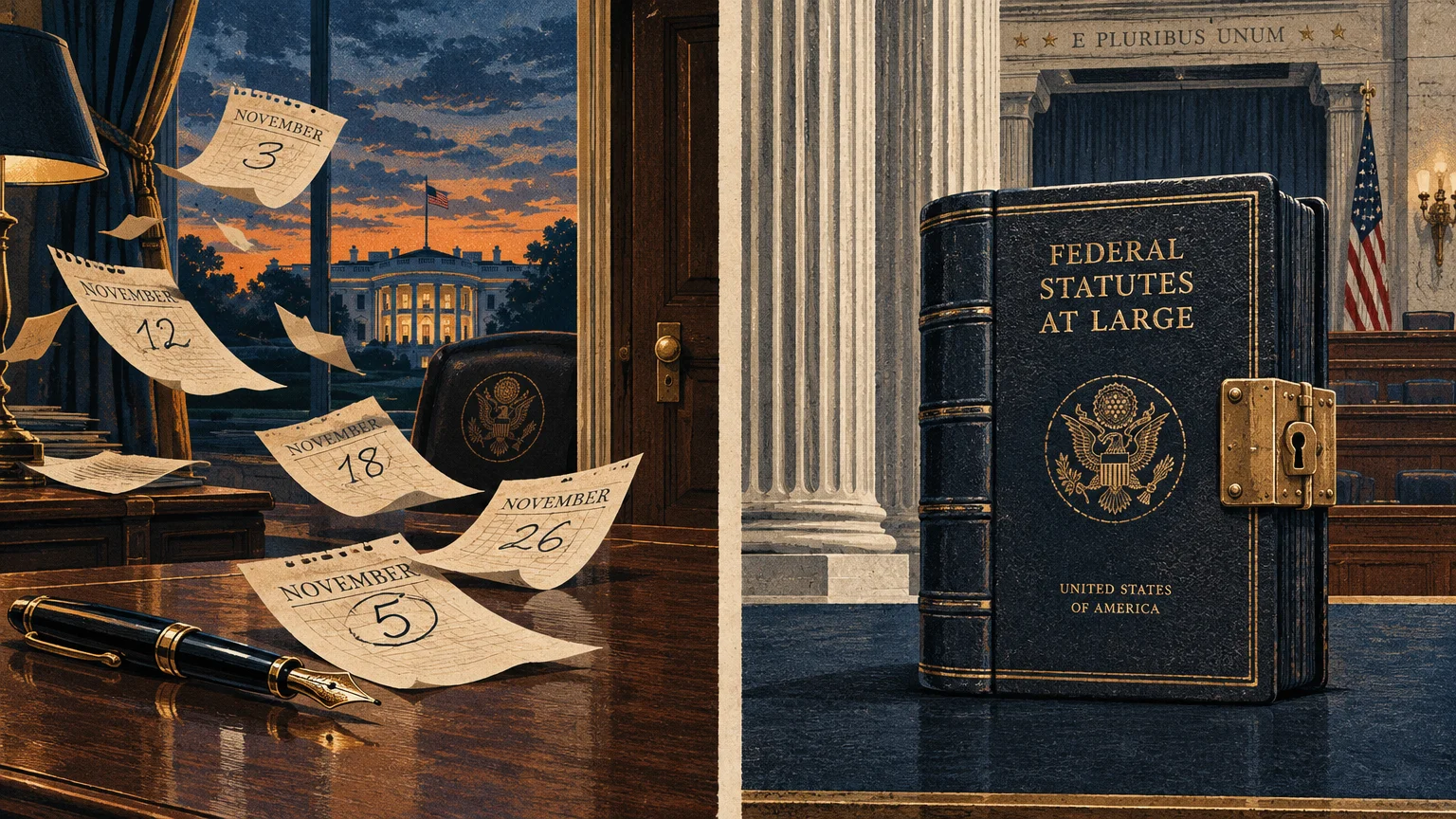
The history of Thanksgiving marks a constitutional shift from unilateral executive proclamations to binding statutory law. For more than a century, the national calendar depended on the constitutional views and policy choices of sitting presidents.
Unchecked scheduling discretion provoked partisan boycotts, regional splits, and commercial disruption. Thomas Jefferson’s refusal to issue proclamations and Franklin D.
Roosevelt’s 1939 calendar shift showed how easily an uncodified tradition could fracture.
Today, 5 U.S.C. § 6103(a) fixes Thanksgiving on the fourth Thursday of November and governs holiday leave for federal employees nationwide. While presidents still issue ceremonial proclamations each autumn, only an act of Congress can alter the date.
Frequently Asked Questions About Thanksgiving as a Federal Holiday
Can the president unilaterally change the date of Thanksgiving today?
No, the president lacks the legal authority to alter the date of Thanksgiving. Public Law 77-379 established the fourth Thursday of November as permanent statutory law, now codified at 5 U.S.C. § 6103(a).
A sitting president cannot repeal or modify a federal statute by executive order or proclamation; changing the date would require new legislation passed by Congress and signed into law.
Does federal holiday law force private companies to close on Thanksgiving?
Federal holiday statutes under 5 U.S.C. § 6103 apply directly only to federal government agencies, federal employees, and the District of Columbia. Private employers retain legal discretion under federal law over whether to close or offer paid holiday leave.
In practice, state holiday statutes, financial markets, school districts, and collective bargaining agreements align their schedules with the federal fourth-Thursday standard.
Why did the Senate choose the fourth Thursday instead of the last Thursday?
November contains five Thursdays in roughly two out of every seven years. Using the last Thursday in those years places Thanksgiving on November 29 or November 30, compressing the pre-Christmas retail season.
The Senate amended House Joint Resolution 41 on December 9, 1941, to specify the fourth Thursday, guaranteeing that Thanksgiving always falls between November 22 and November 28.
Which states resisted President Roosevelt’s 1939 Thanksgiving proclamation?
Twenty-two states refused to recognize Roosevelt’s November 23 date and celebrated Thanksgiving on the traditional final Thursday, November 30. Colorado, Mississippi, and Texas observed both dates as official holidays in 1939.
The resulting two-year split disrupted interstate rail schedules and college football rivalries, prompting the 77th Congress to enact a uniform statutory date in December 1941.
How did the White House National Thanksgiving Turkey presentation and “pardon” begin?
White House animal reprieve lore stretches back to an 1865 dispatch by journalist Noah Brooks reporting that Abraham Lincoln spared his son Tad’s pet Christmas turkey, Jack, in 1863, and to November 1926, when Calvin and Grace Coolidge spared a live Mississippi raccoon named Rebecca sent for Thanksgiving dinner and later donated her to the National Zoo.
The formal industry presentation began in 1947, when the National Turkey Federation and the Poultry and Egg National Board presented a live bird to President Harry S. Truman; while John F.
Kennedy spared a gift turkey in November 1963 and Ronald Reagan joked about “pardoning” a bird named Charlie in 1987, President George H.W. Bush issued the first formal Rose Garden turkey “pardon” on November 17, 1989.