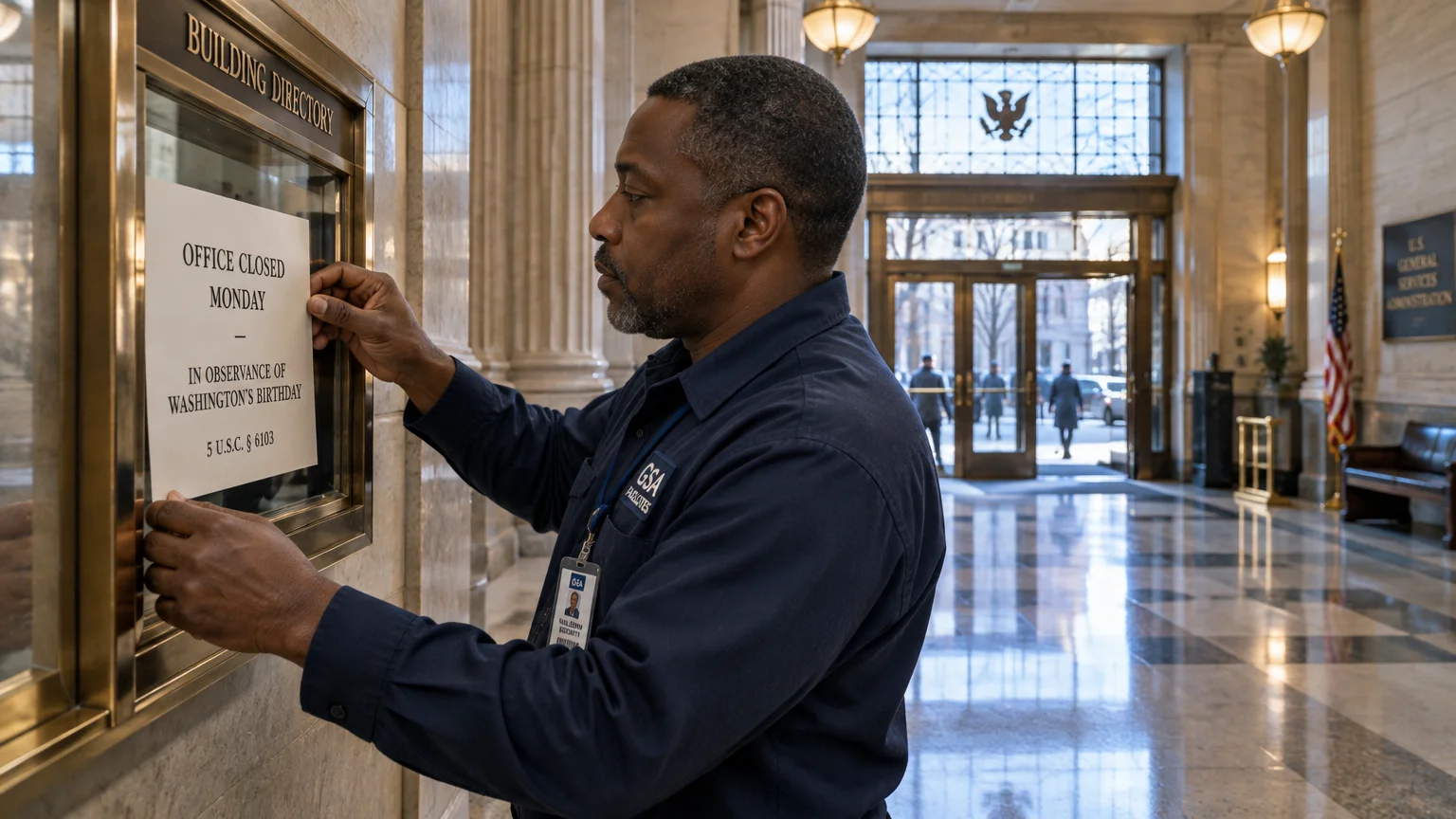
You will not find the term “Presidents’ Day” anywhere in federal law. Under Title 5 of the United States Code, your federal government still officially observes “Washington’s Birthday.”
Congress created this legal holiday in 1879 to honor our first president exclusively. Despite popular belief and retail marketing campaigns, lawmakers never expanded the federal designation to honor Abraham Lincoln or all chief executives.
Understanding how this statutory name survived decades of reform clarifies how federalism and congressional rulemaking shape your civic calendar. Here is what the public record reveals about the holiday’s true legal status.
The Statutory and Archival Record Behind the Third Monday in February
Our editorial team examined statutory records, floor debates, and historical government publications to separate legislative fact from commercial convention. We evaluated federal legal codes dating back to 1879 alongside executive directives and congressional reports.
This review tracks how an individual day of remembrance evolved into a modern three-day weekend. It also details why George Washington remains the sole constitutional officer honored by name in the statutory text.
Each entry relies on verified records from the National Archives, the Congressional Research Service, and the Office of the Law Revision Counsel. You can check each citation directly against the public record.
We selected these seven truths to address the most persistent legal and historical misunderstandings surrounding the holiday. They cover statutory drafting, calendar mechanics, legislative compromises, and modern administrative reality.
Together, these entries trace the legal architecture governing federal work schedules, state legislative independence, and public commemorative traditions across nearly two centuries.
Federal Law Explicitly Retains the Name Washington’s Birthday
If you check your federal payroll calendar, you will see a holiday that popular culture regularly misnames. The official schedule published by the U.S. Office of Personnel Management lists the third Monday in February exclusively as Washington’s Birthday.
The underlying legal authority resides in 5 U.S.C. § 6103(a). This statute establishes legal public holidays for federal employees and explicitly names “Washington’s Birthday” as one of them.
Neither Congress nor any sitting president has ever enacted legislation changing that federal statutory label. The phrase “Presidents’ Day” does not appear in federal law books or executive orders establishing work closures.
The Congressional Research Service repeatedly clarifies this distinction for lawmakers. In its statutory guides, the agency confirms that federal law honors only George Washington on this date.
You should note that Congress possesses sole constitutional authority to create or rename federal holidays. Without a new act of Congress signed by the president, the legal designation remains fixed.
This statutory precision matters when you interpret government contracts, federal court filing deadlines, and statutory agency closures. All official federal documents reference Washington’s Birthday rather than an umbrella presidential celebration.
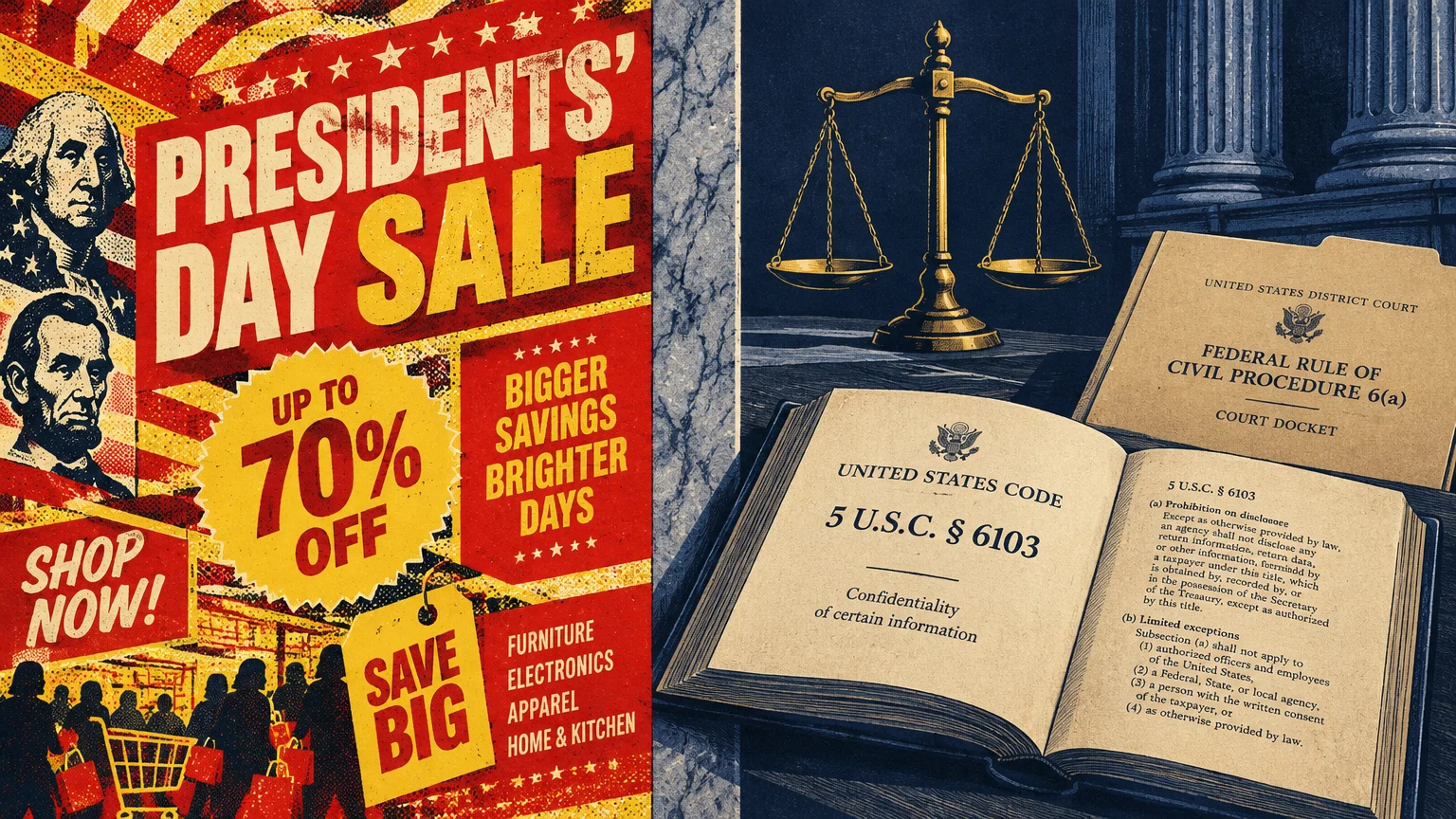
Federal courts also enforce this statutory terminology when calculating procedural timelines. Federal Rule of Civil Procedure 6(a) lists Washington’s Birthday among the official legal holidays that alter filing deadlines.
You can confirm this designation whenever executive agencies announce their holiday operating hours. From the Federal Reserve to the Department of Defense, official bulletins use the statutory name established by Congress.
Even White House proclamations routinely acknowledge the statutory title. While administrations may praise multiple presidents in public statements, their administrative personnel directives strictly adhere to Title 5.
The Statutory Calendar Prevents the Holiday from Landing on Washington’s Birthday
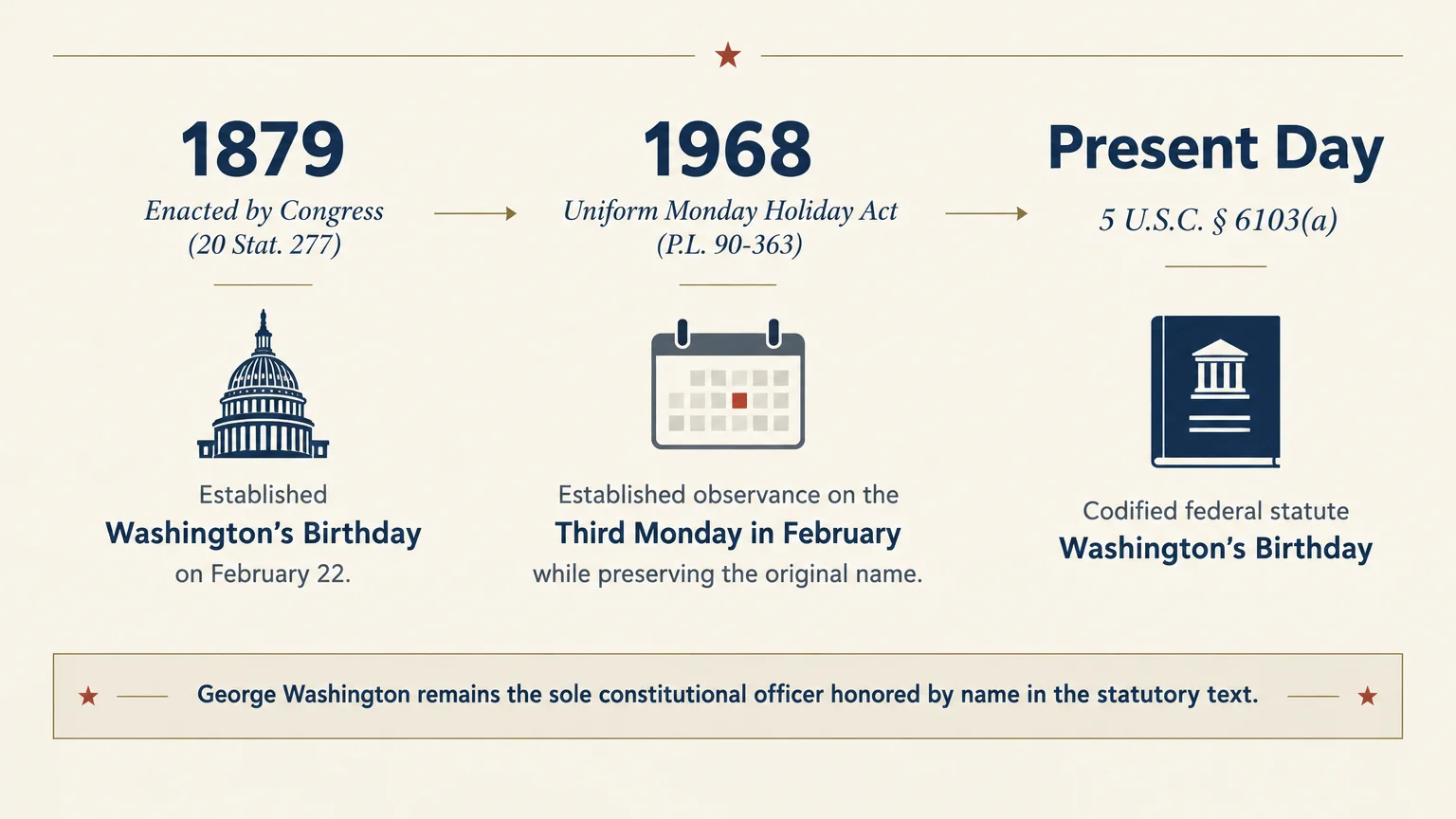
When Congress updated federal work schedules in 1968, lawmakers created an unusual chronological paradox. Because of the statute’s mathematical structure, the federal holiday can never fall on George Washington’s actual Gregorian birthday of February 22.
The Uniform Monday Holiday Act mandates that the federal government observe the holiday on the third Monday in February. Simple calendar arithmetic governs this placement every year.
The third Monday of any month can only occur between the 15th and the 21st day of that month. If February begins on a Monday, the third Monday falls on February 15.
If February begins on a Tuesday, the third Monday lands on February 21, which represents the latest possible date. Consequently, February 22 never serves as the federal observance date.
Before the 1968 law took effect, federal employees celebrated Washington’s Birthday on February 22 regardless of which day of the week it occurred. The shift prioritized uniform travel and recreation over chronological accuracy.
This statutory disconnect means you will always celebrate the federal holiday at least one day before Washington’s actual modern-calendar birth date. The calendar guarantees that the federal government remains open on his historical birthday whenever it lands on a weekday.
For example, if February 22 falls on a Tuesday, federal agencies operate normally while having closed the previous day. You experience a statutory commemorative day that is structurally divorced from the historical anniversary itself.
This chronological separation highlights how twentieth-century economic priorities superseded traditional commemorative accuracy. Lawmakers knowingly chose predictable commerce over the exact anniversary of Washington’s birth.
You will find a similar dynamic with Memorial Day, which moved to the last Monday in May. However, Washington’s Birthday remains the only federal holiday structurally barred from coinciding with its honoree’s true birth date.
A Historic Calendar Shift Gave George Washington Two Legitimate Birthdays
Historical records show that George Washington actually celebrated two different birth dates during his lifetime. This peculiar circumstance stemmed from an international calendar reform executed during the eighteenth century.
Washington was born at Pope’s Creek in Westmoreland County, Virginia, on February 11, 1731. At that time, Great Britain and its American colonies still operated under the ancient Julian calendar.
Under that Old Style calendar system, the official British legal year began on March 25 rather than January 1. This calendar lag also caused astronomical dates to drift out of alignment with the solar year.
To resolve this discrepancy, the British Parliament enacted the Calendar (New Style) Act 1750. In 1752, the British Empire formally adopted the Gregorian calendar, advancing dates forward by eleven days.
The reform also moved New Year’s Day to January 1. Because Washington was born before March 25, his birth year advanced from 1731 to 1732, and his birthday moved to February 22.
According to the Library of Congress, Washington recognized February 22 as his birthday for the rest of his adult life. Yet family bibles recorded his birth on February 11 under the Julian reckoning.
When you study early celebrations of Washington’s life, you will find towns holding festivities on February 11 well into the nineteenth century. The dual dates reflect an empire adapting to scientific timekeeping.
French officers serving in the Continental Army famously celebrated his birthday on February 11, 1781, in Newport, Rhode Island. Washington wrote letters acknowledging both dates depending on the correspondent’s calendar preference.
Therefore, if you observe the holiday on the third Monday, you may land closer to his Julian birth date than his Gregorian one. The historical record confirms that Washington himself understood this calendar duality.
President Rutherford B. Hayes Made Washington’s Birthday the First Individual Holiday
Congress did not establish federal holidays until nearly a century after the American Revolution. In 1870, lawmakers enacted the first four federal holidays: New Year’s Day, Independence Day, Thanksgiving, and Christmas.
Those original holidays applied only to federal workers within the District of Columbia. None of them honored an individual historical figure.
Senator Stephen Wallace Dorsey, a Republican from Arkansas, altered that practice by introducing legislation to commemorate George Washington. On January 31, 1879, President Rutherford B.
Hayes signed the measure into law.
The 1879 statute created Washington’s Birthday as the first federal holiday honoring an individual American citizen. Like its predecessors, however, the law applied solely to federal workers stationed within Washington, D.C.
Federal employees working outside the national capital quickly petitioned Congress for equal treatment. Private businesses and municipal offices across the country already observed the day through local traditions.
Congress addressed this disparity on January 6, 1885, by expanding holiday coverage to all federal workers nationwide. That act codified Washington’s Birthday as a universal benefit across the entire federal civil service.
You can trace modern federal holiday benefits back to this statutory expansion. Washington’s standing as a unifying national figure made him the sole individual lawmakers agreed to honor with paid public leave.
Lawmakers debated whether creating such holidays exceeded federal power or burdened the Treasury with unworked wages. Ultimately, Washington’s status as the founder of the constitutional republic convinced a divided Congress to approve the expenditure.
The 1885 statute set a vital precedent for future individual commemorations. Nearly a century passed before Congress created another federal holiday honoring an individual American when it established Martin Luther King Jr. Day in 1983.
Congress Rejected Formal Proposals to Add Abraham Lincoln to the Holiday
The widespread belief that the holiday honors both Washington and Abraham Lincoln stems from a legislative battle that took place in 1968. Representative Robert McClory, an Illinois Republican, spearheaded the Uniform Monday Holiday Act.
McClory initially proposed merging the February observances of Washington and Lincoln into a single holiday called “Presidents’ Day.” Lincoln was born on February 12, 1809, and several northern states observed his birthday separately.
According to research published by the National Archives, lawmakers from Virginia mounted fierce opposition to McClory’s proposal. They argued that replacing Washington’s name would dilute the unique legacy of the nation’s founding father.
Virginia Representative John O. Marsh Jr. defended Washington’s exclusive statutory billing during committee deliberations.
Southern and conservative lawmakers refused to support any measure that struck Washington’s name from the federal code.
Faced with a potential filibuster and floor defeat, proponents dropped the name change. The compromise retained the statutory title “Washington’s Birthday” while shifting its observance to the third Monday in February.
Congress passed the finalized measure, Public Law 90-363, and President Lyndon B. Johnson signed it on June 28, 1968.
The law took effect on January 1, 1971, without altering Washington’s official status.
When you hear that Congress created “Presidents’ Day” to honor Lincoln alongside Washington, you are encountering a persistent myth. Congress considered that exact reform, rejected it, and kept Washington’s name intact.
Lincoln’s Birthday remains an official holiday in several states, including Illinois, Connecticut, and New York. However, Lincoln has never received recognition in federal statutory holiday law.
The legislative record shows that preserving Washington’s solitary name was the political price for passing three-day weekend legislation. Without that concession, the bill would have failed in committee.
Supporters of Lincoln accepted the compromise to secure the commercial advantages of predictable three-day weekends. Yet the statutory text continues to honor Washington alone.
Retail Marketers and Diverse State Codes Invented the Modern Popular Name
If Congress never altered the federal name, how did “Presidents’ Day” become the universal term in American life? The transition resulted from grassroots advocacy, state legislative autonomy, and commercial retail marketing.
In 1951, activist Harold Stonebridge Fischer established the “President’s Day National Committee.” Fischer lobbied governors and school boards to create a broad holiday honoring the office of the presidency.
Because the third Monday in February falls neatly between Lincoln’s February 12 birthday and Washington’s February 22 birthday, states began experimenting. States possess full constitutional authority to designate their own public holidays independently of federal law.
Several states combined the two commemorations into an official state holiday honoring both leaders or all presidents. Other states developed unique combinations that reflect local historical priorities.
For example, Alabama code designates the third Monday in February as “George Washington/Thomas Jefferson Birthday.” Meanwhile, Arkansas law combines George Washington’s Birthday with civil rights leader Daisy Gatson Bates Day.
During the 1980s, corporate advertisers capitalized on this calendar alignment. Department stores, car dealerships, and national retail chains launched massive “Presidents’ Day” sales to stimulate mid-winter consumer spending.
Punctuation also split across commercial and state boundaries. Some entities write “President’s Day” (singular), others use “Presidents’ Day” (plural possessive), and many retailers omit the apostrophe entirely as “Presidents Day.”
Commercial circulars quickly overshadowed statutory text in the public imagination. Advertisers effectively rebranded a federal observance that federal lawmakers had intentionally preserved for Washington alone.
You experience this division whenever state offices close under a state name while adjacent federal courts observe Washington’s Birthday. The terminology depends entirely on which sovereign government pays the workforce.
State autonomy ensures that no single definition dominates the legal landscape. While the federal government remains anchored to Washington, the states have built a patchwork of commemorative statutes.
The Senate Maintains an Annual Tradition of Reading Washington’s Farewell Address
While popular culture treats the holiday as an occasion for retail discounts, the U.S. Senate observes it with solemn legislative ritual. Each year, senators assemble to hear a complete reading of Washington’s 1796 Farewell Address.
According to the U.S. Senate Historical Office, this tradition began during the darkest days of the American Civil War. Citizens of Philadelphia petitioned Congress to read the 7,641-word address on February 22, 1862, to restore national morale.
Both chambers of Congress gathered in the House chamber for that initial wartime reading. Members listened as the clerk recited Washington’s warnings against geographic factionalism, foreign entanglements, and destructive political partisanship.
The practice lapsed until 1896, when the Senate revived the reading to commemorate Washington’s birthday anniversary. Senators found the exercise so constructive that they established it as a mandatory annual custom.
The Senate Historical Office records that party leadership alternates the reading assignment between Democrats and Republicans each year. The selected senator reads the entire text from the Senate floor into the Congressional Record.
Following the delivery, the presiding senator signs a leather-bound keepsake book that records every reader since 1896. This registry documents over a century of bipartisan adherence to Washington’s original civic counsel.
This ceremony demonstrates how the federal government continues to center George Washington during February. Even as public perception shifts toward a general celebration, Senate rules keep Washington’s specific political philosophy at the forefront.
The reading takes approximately forty-five minutes on the Senate floor. It provides lawmakers with an institutional pause to reflect on constitutional governance before resuming routine legislative business.
You can watch this annual proceeding through public Senate broadcasts or read the transcript in the Congressional Record. It remains one of the oldest continuous traditions observed in the upper chamber of Congress.
| Year | Milestone Event | Governing Authority | Statutory or Cultural Impact |
|---|---|---|---|
| 1752 | Gregorian Calendar Shift | British Parliament | Moved Washington’s birthday from Feb 11 to Feb 22. |
| 1862 | First Farewell Reading | Joint Session of Congress | Recited 7,641-word address to restore wartime morale. |
| 1879 | First Individual Holiday | President Rutherford B. Hayes | Created D.C. federal holiday for Washington’s Birthday. |
| 1885 | Nationwide Expansion | 48th United States Congress | Expanded holiday to all federal employees nationwide. |
| 1896 | Annual Senate Tradition | U.S. Senate Resolution | Established annual bipartisan reading of Farewell Address. |
| 1968 | Uniform Monday Holiday Act | President Lyndon B. Johnson | Shifted date to third Monday; rejected renaming proposal. |
| 1971 | Law Takes Effect | Federal Civil Service | Permanently barred holiday from falling on February 22. |
Why the Distinction Between Federal Law and Popular Culture Matters
The enduring divergence between federal law and popular terminology illustrates the decentralized nature of American federalism. The federal government possesses no constitutional authority to dictate official state holidays or private retail practices.
When Congress enacted the Uniform Monday Holiday Act, lawmakers deliberately limited its reach to federal agencies and the District of Columbia. States retained full sovereignty to designate their own commemorative calendars.
This separation of powers explains why you encounter conflicting names on calendars, school schedules, and government websites. Your state legislature decides whether you celebrate Washington alone, Washington and Lincoln together, or all American presidents.
The statutory durability of Washington’s Birthday also reflects congressional reluctance to alter historic national symbols. Once a legal precedent becomes entrenched in Title 5, overcoming regional and ideological objections proves exceptionally difficult.
Lawmakers understand that adding or renaming federal holidays invites contentious debates over historical interpretation and representation. By keeping the statutory focus on Washington, Congress avoids recurring controversies over which chief executives merit inclusion.
Meanwhile, the private sector operates under economic incentives rather than statutory definitions. Retailers adopted “Presidents’ Day” because a generic, multi-day marketing event generates greater consumer engagement than an observance tied to one historical figure.
This commercial adaptation transformed how Americans conceptualize the third Monday in February. Yet behind the advertising circulars and commercial promotions lies an unamended statute that still honors the republic’s first commander-in-chief.
Recognizing this legal reality helps you distinguish between cultural trends and governing statutes. In the eyes of federal law, the holiday remains what Congress declared it to be over a century ago.
Frequently Asked Questions About Washington’s Birthday and Presidents’ Day
Does the federal government close for Abraham Lincoln’s birthday?
No, the federal government does not close for Abraham Lincoln’s birthday. Congress has never established a federal legal holiday honoring Lincoln, who was born on February 12, 1809.
While several individual states observe Lincoln’s birthday as a paid state holiday, federal offices remain open. The federal holiday on the third Monday in February honors George Washington alone under 5 U.S.C. § 6103(a).
Federal employees report to work on February 12 unless it coincides with a normal weekend or an unrelated administrative closure. You must consult individual state statutes to determine whether state offices close for Lincoln.
Which apostrophe placement is grammatically and legally correct?
Because “Presidents’ Day” does not exist in federal law, there is no single official legal spelling. The correct punctuation depends entirely on the state statute or publishing style guide you consult.
If your state code honors all presidents collectively, “Presidents’ Day” with a plural possessive apostrophe is standard. If a statute honors the office of the presidency itself, “President’s Day” with a singular apostrophe applies.
Many major news outlets and commercial advertisers omit the apostrophe entirely, writing “Presidents Day.” In federal legal filings, you avoid this grammatical dilemma entirely by using the statutory title: Washington’s Birthday.
Can a president change the holiday’s name by executive order?
No, a president cannot rename a federal holiday through an executive order. The authority to establish, name, or amend federal public holidays belongs exclusively to Congress under Article I of the Constitution.
While a president can issue ceremonial proclamations praising various historical figures, those statements lack statutory force. Altering Title 5 of the United States Code requires bicameral congressional approval and presidential signature.
A chief executive can grant federal workers administrative leave by executive order on specific occasions. However, executive orders cannot permanently rewrite the statutory names established by congressional legislation.
Are private employers required to provide paid leave on Washington’s Birthday?
Federal holiday laws apply only to federal government employees and designated institutions like federal courts. Private employers face no statutory requirement under federal law to provide paid time off on Washington’s Birthday.
Private businesses determine their own holiday leave policies through employment contracts, company policies, or collective bargaining agreements. Consequently, many private sector workers remain on duty despite federal closures.
State laws governing private sector holiday pay also vary, though most states leave holiday scheduling to employer discretion. You should review your employee handbook to verify your specific workplace holiday benefits.