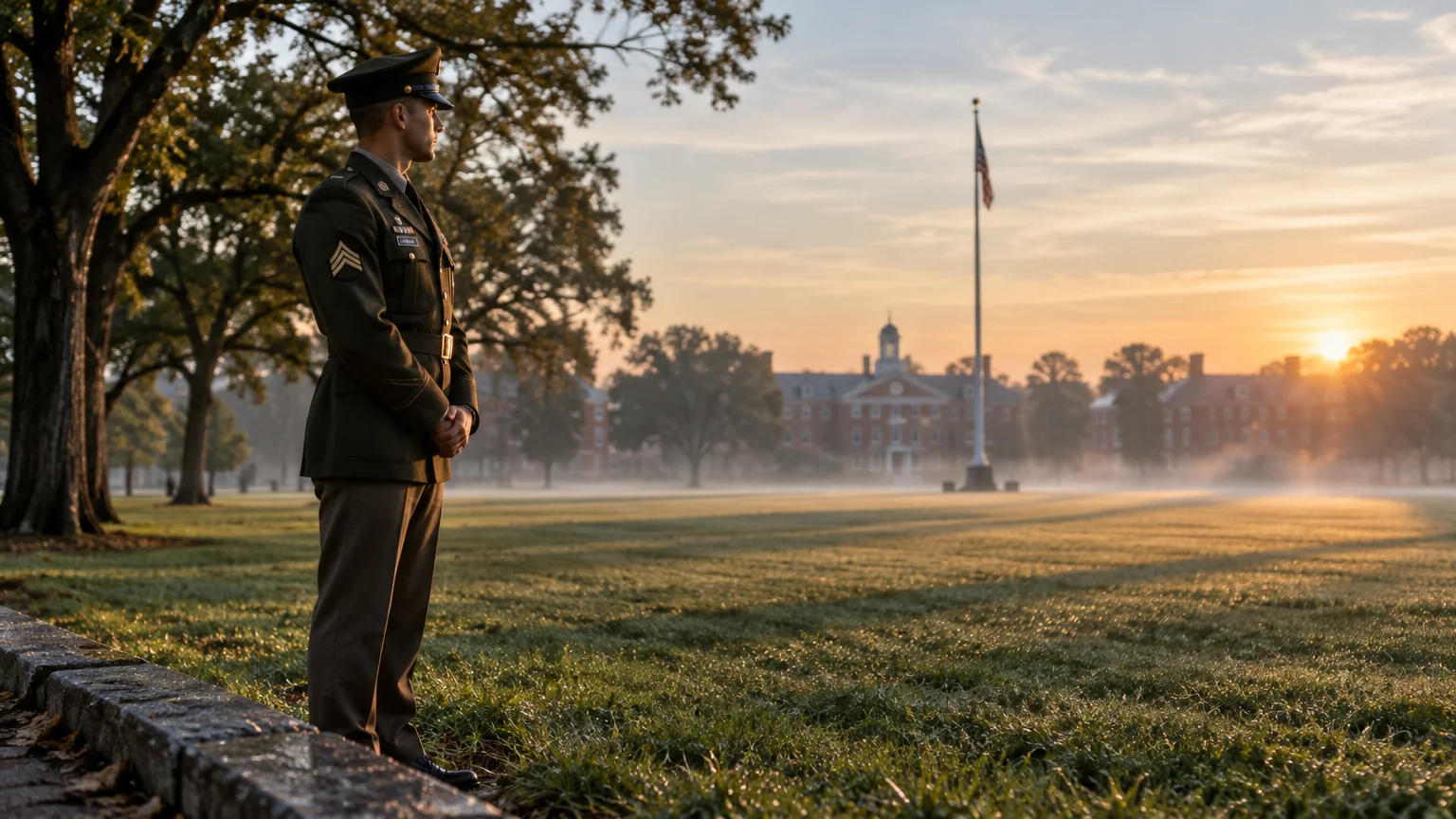
May’s military observances sit nine days apart on the calendar, but federal law draws a strict boundary between Armed Forces Day and Memorial Day.
Armed Forces Day celebrates personnel currently wearing the uniform across all military branches, whereas Memorial Day honors service members who died during military service.
Both occasions shape civic calendars, workplace schedules, and national flag etiquette. Tracing their statutory rules reveals how Congress and the Department of Defense created two distinct civic traditions.
Federal Statutes and Executive Directives Shaping May Military Observances
This list counts eight legal, scheduling, and ceremonial differences between Armed Forces Day and Memorial Day. Congress and the executive branch built these two observances on separate legal foundations over a century apart, distinguishing post-Civil War mourning rituals from post-World War II defense unification.
Entries were selected from federal statutes in Titles 4, 5, and 36 of the United States Code, presidential proclamations, and Department of Defense directives. These provisions govern how federal agencies, active military units, and state governments observe each date.
1. Legal Status Under Federal Holiday Law
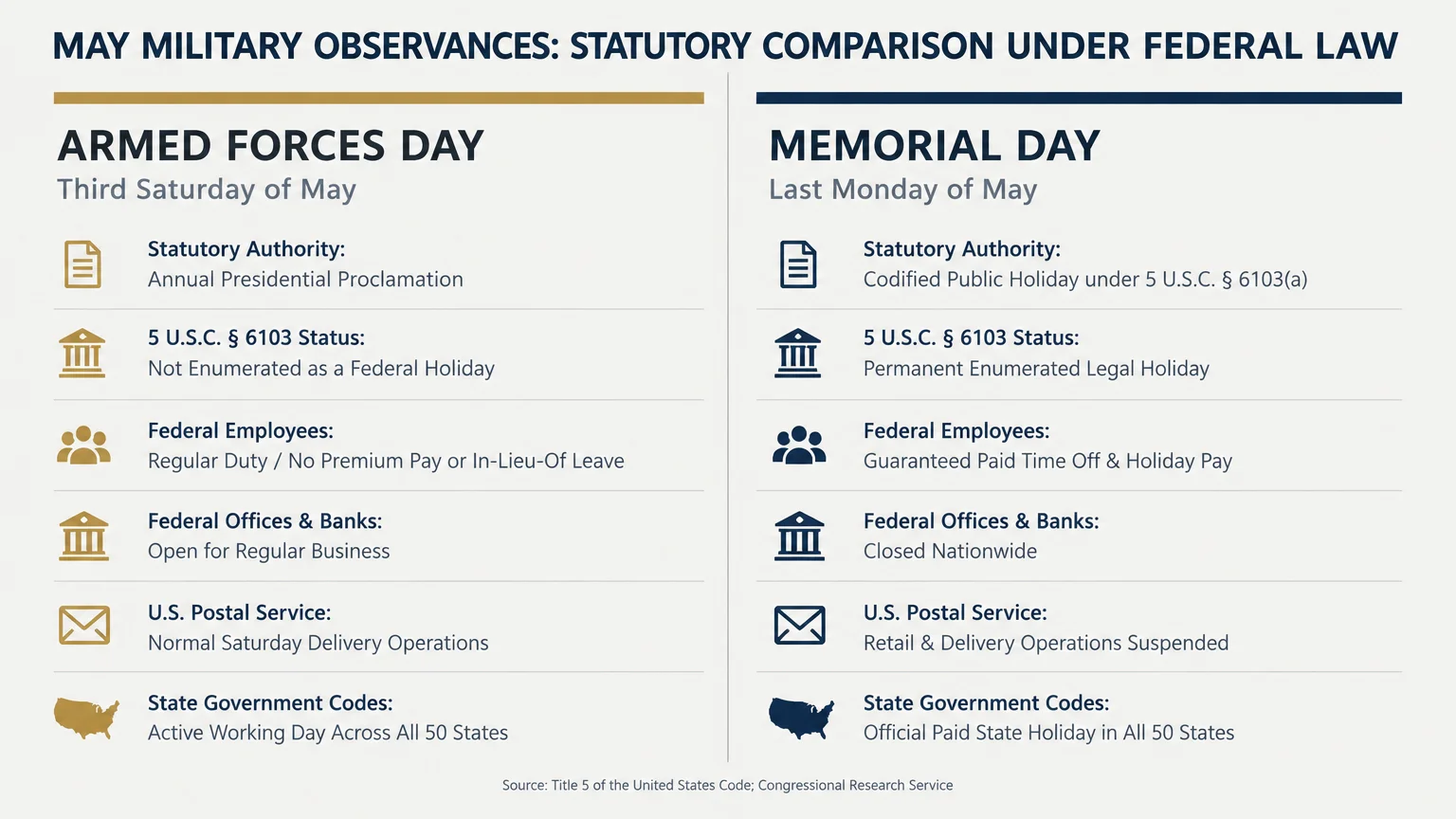
Congress established Memorial Day as a legal public holiday under Title 5 of the United States Code, as detailed in CRS Report R41990. Section 6103(a) guarantees paid leave for federal civil service workers across the nation.
Non-essential federal offices, commercial banks, and U.S. District Courts close on Memorial Day. Armed Forces Day holds no statutory holiday standing because Congress never added the observance to Section 6103’s enumerated holiday list.
Instead, Armed Forces Day functions as an official patriotic observance recognized by annual presidential proclamation. Federal offices remain open, postal carriers deliver mail, and public agencies operate under normal business hours.
Under 5 U.S.C. § 6103(b), federal holidays falling on non-workdays shift to an alternate paid day off for federal employees.
Because Armed Forces Day is not a Title 5 holiday and always falls on a Saturday, it never triggers an “in lieu of” Friday holiday or holiday premium pay.
All fifty states follow the federal model by designating Memorial Day as an official state employee holiday with paid office closures. State and municipal offices operate without interruption on Armed Forces Day.
2. The Target Population of Honored Service Members
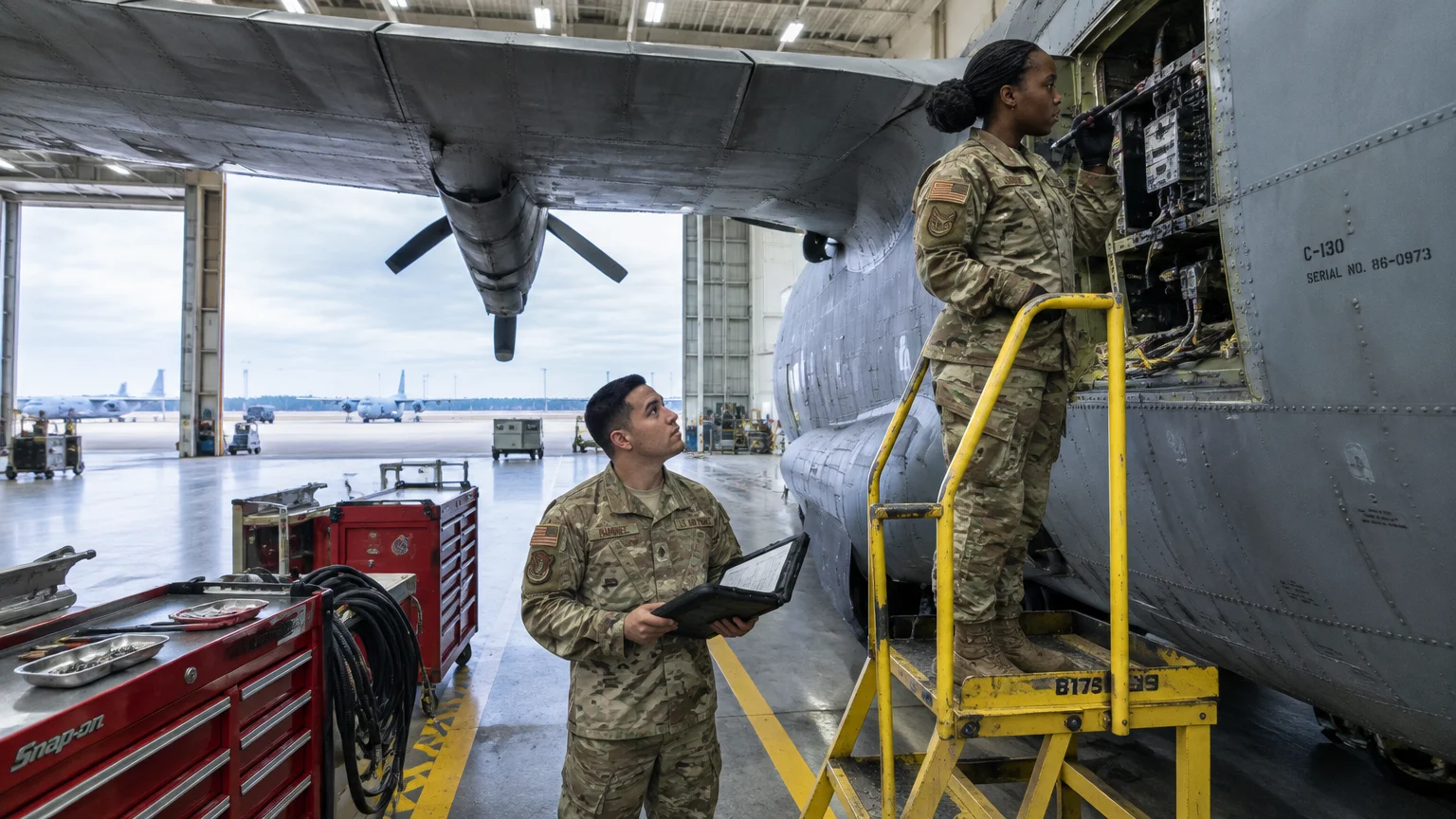
Armed Forces Day focuses entirely on the men and women who currently wear the uniform of the United States. It celebrates active-duty personnel across the Army, Marine Corps, Navy, Air Force, Space Force, and Coast Guard, alongside active National Guard and Reserve members.
Memorial Day serves a somber statutory mission. The holiday honors only those service members who died in the line of duty during American conflicts.
Federal law reserves Veterans Day, codified separately for November 11, to honor all living former service members. More than 1.3 million American service members have died in military conflicts since the Revolutionary War, and Memorial Day provides the exclusive national occasion to mourn that loss.
Gold Star families—relatives of service members killed in action—receive formal recognition during Memorial Day ceremonies. Armed Forces Day events center instead on active service members and their current command structures.
3. Executive Defense Consolidation Versus Post-Civil War Commemoration
Memorial Day grew from widespread post-Civil War communal mourning in northern and southern communities. On May 5, 1868, Grand Army of the Republic Commander-in-Chief John A.
Logan issued General Order No. 11, designating May 30, 1868, as Decoration Day to decorate fallen Union soldiers’ graves with spring flowers.
Nearly a century later, President Lyndon B. Johnson signed Presidential Proclamation 3727 on May 26, 1966.
Following House Concurrent Resolution 587, the proclamation recognized Waterloo, New York—which held a village-wide grave-decorating observance on May 5, 1866—as Memorial Day’s official birthplace.
Armed Forces Day emerged from administrative restructuring after World War II. President Harry S.
Truman signed the National Security Act of 1947 to unify the military branches under the Department of Defense.
On August 31, 1949, Secretary of Defense Louis Johnson announced the creation of Armed Forces Day to replace the separate holidays previously celebrated by the Army, Navy, and Air Force.
President Truman signed Presidential Proclamation 2873 on February 27, 1950, and the nation celebrated the first unified Armed Forces Day on May 20, 1950, under the theme “Teamed for Defense.”
4. Statutory Calendar Placement and the Uniform Monday Holiday Act
For more than a century, communities observed Memorial Day on May 30 regardless of the day of the week. That fixed date changed when Congress passed the Uniform Monday Holiday Act of 1968.
President Lyndon B. Johnson signed Public Law 90-363 on June 28, 1968, taking effect on January 1, 1971.
The statute permanently moved Memorial Day to the last Monday in May to create three-day holiday weekends for federal workers.
Several veteran organizations opposed the move, and lawmakers like Senator Daniel Inouye repeatedly introduced bills to restore the May 30 date. Armed Forces Day follows a different calendar rule established on March 18, 1961, when President John F.
Kennedy issued Presidential Proclamation 3399 setting the observance on the third Saturday in May.
Saturday scheduling allows civilian families and active-duty personnel to attend base events without taking workday leave, culminating Armed Forces Week, which begins on May’s second Saturday. In 2026, Armed Forces Day took place on Saturday, May 16, and Memorial Day fell on Monday, May 25.
5. Flag Display Protocols and Half-Staff Mandates
Federal flag rules in Title 4 of the United States Code establish different display protocols for each observance. While 4 U.S.C. § 6(d) lists both days as patriotic occasions for displaying the flag, 4 U.S.C. § 7(m) mandates distinct flagpole positions.
On Armed Forces Day, the American flag flies at full-staff from sunrise until sunset. Flying the flag at half-staff on Armed Forces Day violates the U.S. Flag Code.
On Memorial Day, the flag must fly at half-staff from sunrise until noon local time to honor fallen service personnel. Groundskeepers hoist the flag to the peak for an instant before lowering it to half-staff in the morning.
At noon, the flag is briskly hoisted to full-staff until sunset to symbolize the living nation’s endurance. Fixed wall brackets that cannot lower display a black mourning streamer attached above the flag until noon.
6. The Peace Officers Memorial Day Conflict Rule
Federal law contains an explicit statutory hierarchy rule when May observances overlap on the calendar. Under 4 U.S.C. § 7(m), flags fly at half-staff on May 15 for Peace Officers Memorial Day “unless that day is also Armed Forces Day.”
Whenever May 15 falls on the third Saturday of May, Armed Forces Day protocol legally supersedes Peace Officers Memorial Day half-staff rules. Federal installations and public buildings fly the flag at full-staff for the entire day.
Memorial Day never triggers this statutory exception because the last Monday of May cannot fall on May 15. The calendar overlap between May 15 and Armed Forces Day occurred on Saturday, May 15, 2021, and recurs on Saturday, May 15, 2027.
7. Congressionally Mandated Moments of Prayer and Remembrance
Memorial Day carries two statutory mandates for nationwide pauses of prayer and reflection, whereas Armed Forces Day has none.
Under 36 U.S.C. § 116, enacted by joint resolution on May 11, 1950, the President issues an annual proclamation calling on Americans to unite in prayer for permanent peace at 11:00 a.m. local time on Memorial Day.
Congress added a second pause on December 28, 2000, by passing the National Moment of Remembrance Act (Public Law 106-579, codified at 36 U.S.C. § 116 note).
The law asks Americans to pause voluntarily at 3:00 p.m. local time on Memorial Day for one minute of silence.
Major League Baseball games halt play and Amtrak trains sound their horns across the national rail network at 3:00 p.m. to mark the observance. Armed Forces Day statutes omit moments of silence, focusing instead on public demonstrations and military exhibitions.
8. Ceremonial Traditions and Branch Participation
Memorial Day traditions center on national cemeteries and honors for the deceased.
Since 1948, soldiers from the 3rd U.S. Infantry Regiment (“The Old Guard”) have conducted the “Flags In” mission at Arlington National Cemetery, placing flags one boot-length in front of more than 260,000 headstones and roughly 7,000 columbarium niche rows in four hours.
On Memorial Day morning, the President or Vice President lays a wreath at the Tomb of the Unknown Soldier while a bugler plays “Taps.
Armed Forces Day traditions feature base open houses, naval ship tours, and public air shows headlined by the Navy’s Blue Angels and the Air Force’s Thunderbirds.
Branch participation carries a historical exception from Defense Secretary Louis Johnson’s 1949 unification request.
While the Army, Navy, and Air Force leagues agreed to drop their separate branch holidays, the Marine Corps League declined, and Marines still celebrate the Corps’ November 10, 1775 founding separately alongside participating in Armed Forces Day.
Congress also linked both May dates in 36 U.S.C. § 902. Before the National POW/MIA Flag Act of 2019 mandated daily display at federal locations, Armed Forces Day and Memorial Day were two of the six annual dates requiring POW/MIA flag display.
| Feature | Armed Forces Day | Memorial Day |
|---|---|---|
| Legal Authority | Presidential Proclamation 3399 | 5 U.S.C. § 6103(a) |
| Calendar Date | Third Saturday in May | Last Monday in May |
| Federal Work Status | Standard workday; offices open | Official paid holiday; offices closed |
| Primary Honorees | Currently serving military personnel | Fallen military service members |
| Flag Protocol | Full-staff from sunrise to sunset | Half-staff until noon; full-staff to sunset |
| Statutory Silent Pause | None codified in federal law | 3:00 p.m. local time (PL 106-579) |
| Core Public Events | Base open houses and air shows | Cemetery tributes and wreath-layings |
How Statutory Distinctions Preserve Military Heritage
Together, Titles 4, 5, and 36 of the U.S. Code separate the celebration of active military readiness on the third Saturday of May from the national mourning observed on the last Monday of the month.
Keeping Armed Forces Day on a weekend allows military installations to host public open houses without closing federal offices, while Memorial Day’s Title 5 public holiday status reserves a paid day off for cemetery commemorations and the 3:00 p.m. National Moment of Remembrance.
Frequently Asked Questions About May Military Observances
Can you wish someone a happy Memorial Day?
Etiquette experts and veteran service organizations advise against saying “Happy Memorial Day” because the holiday is a solemn memorial for personnel who died in service. Upbeat greetings are reserved for Armed Forces Day in May or Veterans Day in November.
Why does the Marine Corps celebrate its birthday separately from Armed Forces Day?
In 1949, Defense Secretary Louis Johnson asked service branch leagues to discontinue separate branch holidays in favor of Armed Forces Day, but the Marine Corps League declined.
The Marine Corps participates in joint Armed Forces Day events while continuing to celebrate its November 10 founding with traditional cake-cutting ceremonies.
Do active-duty service members get a day off for Armed Forces Day?
Armed Forces Day does not grant automatic federal leave because it is a patriotic observance rather than a Title 5 public holiday, and it always falls on a Saturday. Base commanders may grant special liberty or compensatory time to personnel who work weekend open-house events.
How did Waterloo, New York become recognized as the birthplace of Memorial Day?
Waterloo, New York held a documented, village-wide commemoration on May 5, 1866, closing local businesses and decorating Civil War soldiers’ graves. In 1966, Congress passed House Concurrent Resolution 587 and President Lyndon B.
Johnson signed Presidential Proclamation 3727 recognizing Waterloo’s centennial claim.