You can wear a flag shirt or display a weathered banner on your front porch without risking a fine or federal arrest. While federal law outlines strict rules for display, the United States Flag Code functions entirely as voluntary etiquette rather than enforceable criminal law.
Congress and the White House spent nearly two centuries standardizing banner dimensions, star arrangements, and procurement standards to replace an era of chaotic variations. Today, Title 4 of the United States Code guides how you honor the national colors.
Before you raise your banner this Flag Day, explore how federal lawmakers turned patriotic custom into statutory guidelines and where constitutional free speech draws the line.
How Federal Enactments Transformed Patriotic Custom into Statutory Guidance
This guide traces the ten definitive legal milestones that standardized the American flag from the Revolutionary War through 2026. We examine statutory enactments, executive orders, and landmark Supreme Court decisions drawn directly from primary legal archives.
Before federal standardization took hold, private manufacturers and military commanders created dozens of conflicting star patterns and fabric proportions. Early lawmakers left flag specifications vague, which created confusion whenever new territories entered the Union.
Each entry highlights specific statutory citations, executive orders, or constitutional precedents that define modern banner etiquette. You will discover how statutory standards evolved from flexible wartime symbols into precise legal codes.
Use these documented facts to separate mandatory federal procurement mandates from advisory civilian customs. You can evaluate your own flag display practices against official federal standards.
Continental Congress Established the Thirteen-Stripe Foundation
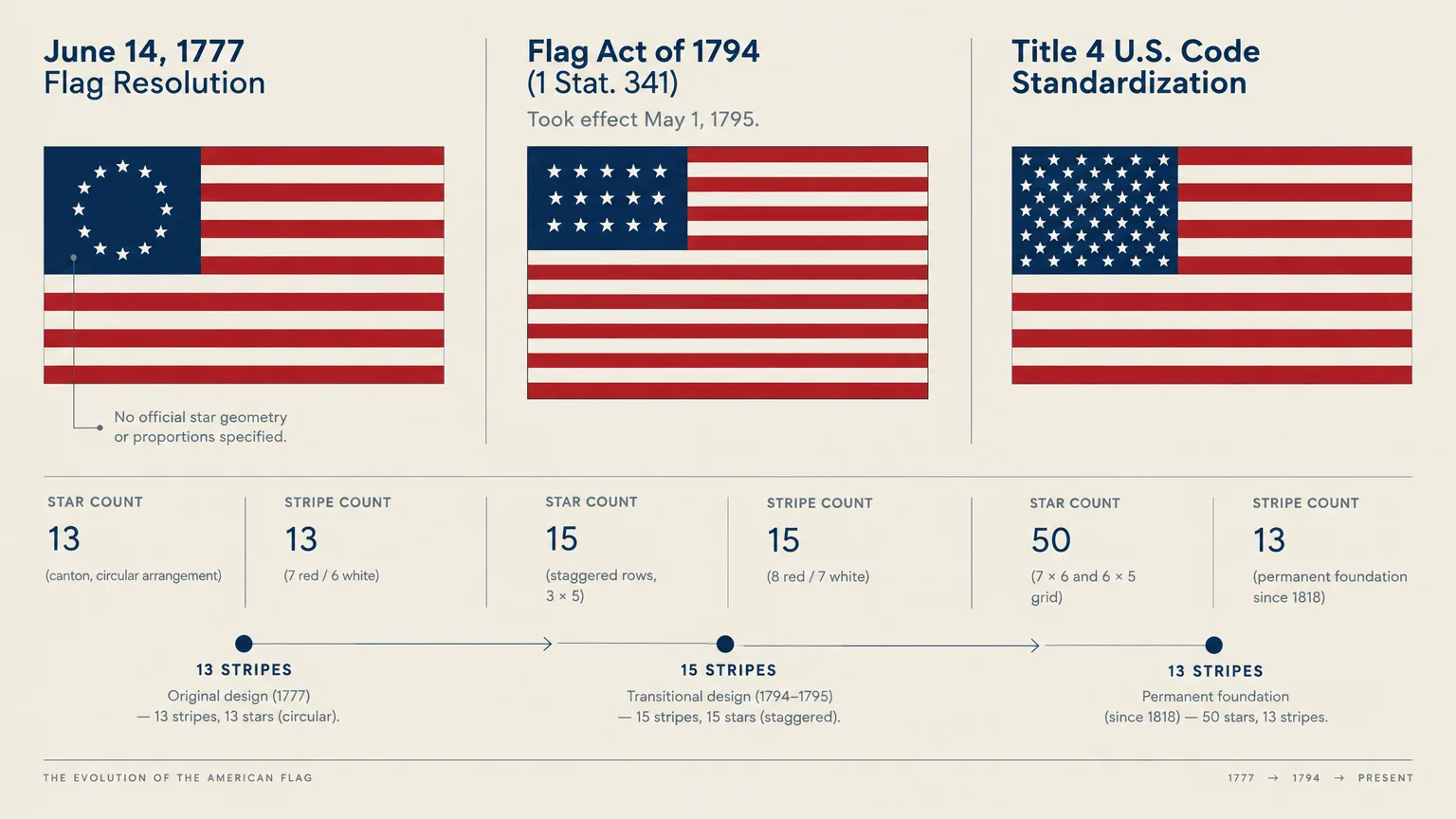
On June 14, 1777, the Second Continental Congress passed the nation’s foundational Flag Resolution in Philadelphia. Delegates resolved that the flag contain thirteen horizontal stripes alternating red and white, paired with thirteen white stars on a blue field.
The Continental Congress recorded this resolution in the official Journals of the Continental Congress without establishing precise star placements. As documented by the Library of Congress, lawmakers described the stars as representing a new constellation.
Because the resolution omitted manufacturing specifications, seamstresses arranged the stars in circles, staggered rows, or concentric arcs. This vagueness sparked more than a century of decentralized flag designs across commercial markets and state militias.
You still observe this foundational 1777 mandate every time you view the modern thirteen alternating stripes. Those alternating bars remain the permanent structural anchor for all fifty stars.
- The 1777 resolution omitted exact flag dimensions and star geometry.
- President Woodrow Wilson officially proclaimed June 14 as Flag Day in 1916.
- Congress permanently established national Flag Day observance by statute in 1949.
Congress Expanded Both Stripes and Stars for New States
When Vermont entered the Union in 1791 and Kentucky followed in 1792, Congress faced an immediate visual dilemma. Lawmakers decided that new states required both new stars and new stripes to ensure equal representation.
On January 13, 1794, the Third Congress passed the Flag Act of 1794 (1 Stat. 341), which President George Washington signed into law.
The statute took effect on May 1, 1795, mandating fifteen alternating stripes and fifteen stars.
This fifteen-stripe design flew over Fort McHenry during the War of 1812 Battle of Baltimore. Francis Scott Key viewed that specific banner before composing the verses that became the national anthem.
Lawmakers soon recognized that adding a stripe for every newly admitted state would clutter the canton and distort the banner. As five more states prepared for statehood, Congress abandoned this expanding-stripe design.
- The 1794 act marked the only official flag with more than thirteen stripes.
- Mary Pickersgill hand-stitched the famous 30-by-42-foot Fort McHenry banner.
- Congress realized fifteen stripes pushed production limits for nautical and military use.
The Flag Act of 1818 Permanently Fixed the Thirteen Stripes
By 1818, the Union contained twenty states, making the fifteen-stripe configuration visually unwieldy. Representative Peter H.
Wendover of New York introduced legislation to solve the aesthetic dilemma once and for all.
President James Monroe signed the Flag Act of 1818 (3 Stat. 415) into law on April 4, 1818.
Codified today at 4 U.S.C. §§ 1–2, the statute permanently reduced the stripes to thirteen horizontal bars.
The act mandated that lawmakers add a new star for each admitted state exclusively on the Fourth of July following admission. Naval Captain Samuel Chester Reid helped draft the plan to preserve the historic thirteen colonies.
You can calculate the exact historical era of any antique flag simply by counting its stars. New stars take legal effect only on Independence Day, never on the day statehood bills clear Congress.
- Title 4 U.S.C. § 1 fixes the thirteen horizontal stripes in perpetuity.
- Title 4 U.S.C. § 2 governs the statutory July 4 addition of new stars.
- The 1818 framework accommodates future admissions without altering the flag foundation.
William Howard Taft Mandated Strict Flag Proportions
Throughout the nineteenth century, Congress neglected to establish standardized proportions or star positions. As a result, federal agencies flew banners with wildly mismatched length-to-width dimensions and erratic star placements.
President William Howard Taft resolved the disorder on October 29, 1912, by signing Executive Order 1637. Available through the American Presidency Project, this order created the first uniform government flag proportions.
Taft established a precise hoist-to-fly ratio of 1:1.9, meaning the flag’s length measures nearly double its width. He also standardized the 48-star arrangement into six uniform horizontal rows of eight stars each.
Commercial fabricators quickly adopted these proportions across the private market to align with military specifications. When you buy a modern standard outdoor flag, its dimensions derive directly from Taft’s executive formula.
- Executive Order 1637 eliminated odd circular and diamond star configurations.
- The order established twelve specific dimension ratios for government agencies.
- The 1:1.9 ratio remains the official federal proportion for executive display.
Dwight D. Eisenhower Standardized the Modern Fifty-Star Arrangement
When Alaska and Hawaii achieved statehood in 1959, the executive branch had to redesign the blue canton twice within eight months. President Dwight D.
Eisenhower oversaw this transition to maintain optical balance across fifty stars.
Eisenhower issued Executive Order 10834 on August 21, 1959, establishing the active fifty-star design. Preserved in the National Archives, the order mandates five rows of six stars alternating with four rows of five stars.
The order took official effect on July 4, 1960, exactly as required by the Flag Act of 1818. Executive Order 10834 also reaffirmed the 1:1.9 hoist-to-fly proportion established during the Taft administration.
This fifty-star design has flown longer than any other version in American history. Any future design changes following the admission of a fifty-first state will require a similar executive order.
- Executive Order 10834 governs all active federal flag manufacturing specifications.
- The layout created nine staggered horizontal rows containing fifty total stars.
- The fifty-star design surpassed the 48-star design’s longevity record in 2007.
Lawmakers Codified Voluntary Etiquette During World War II
For decades, flag etiquette existed solely as custom promoted by patriotic and veteran organizations. In 1923, the National Flag Conference gathered 68 patriotic organizations in Washington to draft a unified national civilian code.
Congress formally enacted those civilian guidelines into federal law on June 22, 1942, through Public Law 77-623. President Franklin D.
Roosevelt signed the statute during the height of World War II to foster civilian unity.
Lawmakers later clarified the code on December 22, 1942, passing Public Law 77-829, codified in Title 4 of the U.S. Code. Congress placed the rules in Chapter 1 alongside provisions governing the Great Seal and state seats.
The code outlines respectful handling, including proper illumination during nighttime display and dignified retirement when worn. You can follow these statutory customs to maintain traditional flag decorum on your own property.
- Public Law 77-623 transformed civic customs into codified federal law.
- The statute formalized display rules for civilian buildings and parades.
- Title 4 Chapter 1 houses the comprehensive guidelines for civilian respect.
Federal Flag Rules Carry Zero Criminal or Civil Penalties
Many Americans believe violating the Flag Code exposes them to fines or criminal charges. However, Title 4 of the United States Code functions strictly as an advisory guide for civilian conduct.
Congress deliberately employed precatory words such as “should” and “custom” rather than mandatory commands like “shall.” According to analysis by the Congressional Research Service, Title 4 contains zero enforcement provisions or legal penalties.
Under 4 U.S.C. § 8(d), the code states that the flag should never be used as wearing apparel, bedding, or drapery. Yet manufacturers sell flag t-shirts, swimsuits, and paper plates daily without facing legal consequences.
You cannot be arrested, cited, or fined by any civilian authority for violating federal flag customs. The rules express congressional preferences for respectful treatment rather than enforceable criminal statutes.
- Title 4 contains no enforcement clauses, fines, or jail terms.
- The code guides federal property managers rather than private citizens.
- Wearing flag-patterned clothing violates advisory etiquette, not criminal law.
The Supreme Court Protected Desecration as Symbolic Speech
Congress and state legislatures previously enacted criminal statutes to penalize individuals who physically desecrated the American flag. The federal Flag Protection Act of 1968 imposed fines and up to one year in prison for violations.
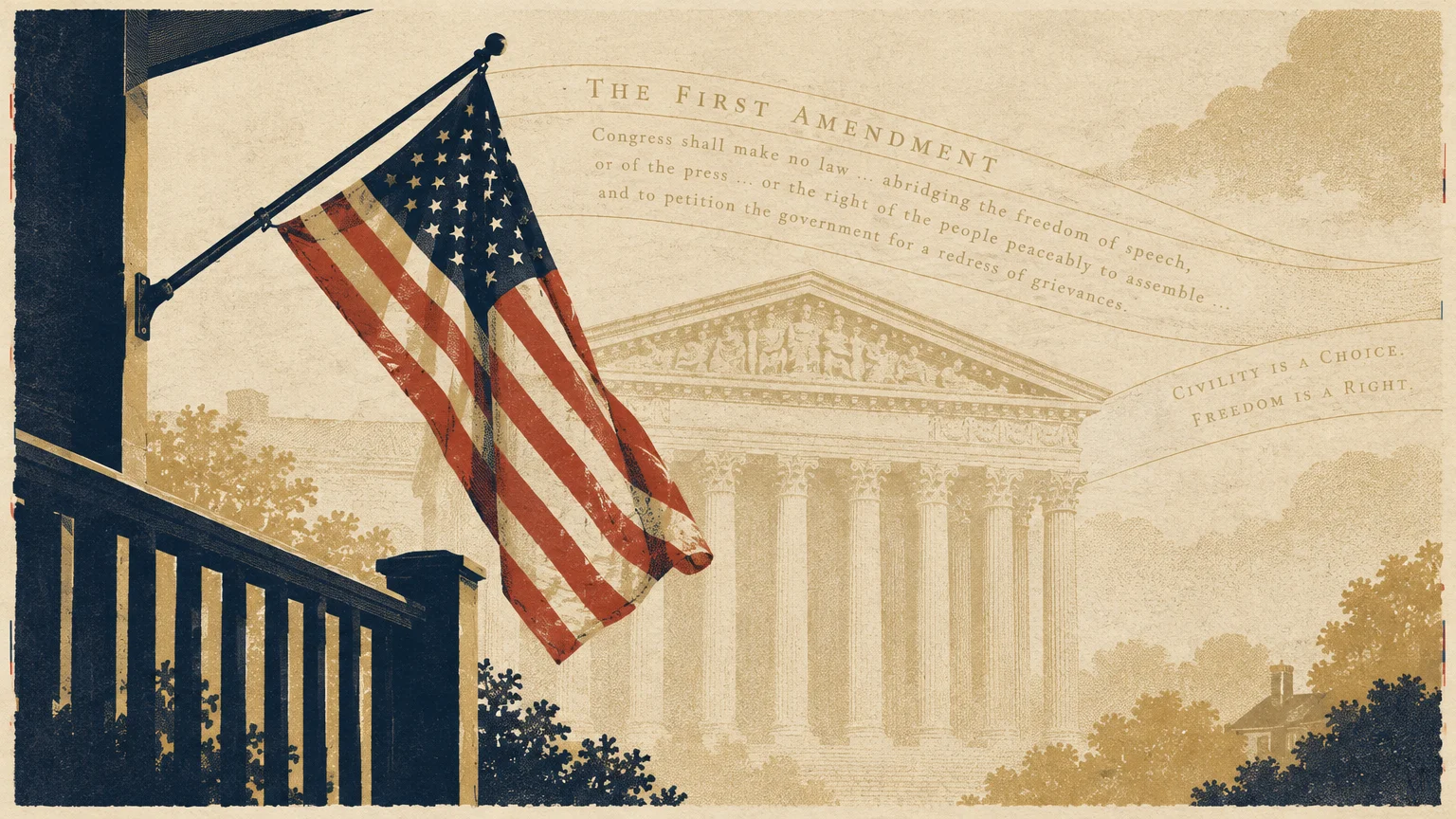
The Supreme Court dismantled those criminal bans in the landmark ruling Texas v. Johnson, 491 U.S. 397 (1989). In a 5–4 decision, the Court ruled that flag burning constitutes protected symbolic speech under the First Amendment.
When Congress responded by passing the Flag Protection Act of 1989 (18 U.S.C. § 700), the Court struck it down. In United States v. Eichman, 496 U.S. 310 (1990), Justice William J.
Brennan Jr. reaffirmed that the government cannot criminalize political dissent.
These rulings establish that your right to expressive speech overrides statutory efforts to mandate flag veneration. While burning a flag offends many observers, constitutional free speech safeguards peaceful political protest.
- Both landmark Supreme Court decisions were decided by narrow 5–4 majorities.
- Justice Antonin Scalia joined the majority to protect First Amendment expression.
- Subsequent constitutional amendment proposals to ban flag desecration failed to pass the Senate.
Statutory Deadlines Regulate Half-Staff Mourning Periods
Title 4 U.S.C. § 7(m) sets precise protocols for lowering the flag to half-staff to honor deceased government leaders. These statutory schedules establish uniform mourning periods across all federal buildings and naval installations.
The statute mandates that federal facilities fly the flag at half-staff for thirty days following the death of a president or former president. The code requires a ten-day mourning period for a sitting vice president, Chief Justice, or Speaker of the House.
For associate Supreme Court justices, cabinet secretaries, and members of Congress, the flag remains lowered from death until interment. In 2007, Congress enacted Public Law 110-41, authorizing state governors to order half-staff displays for fallen military service members and first responders.
When displaying your flag at half-staff, custom dictates hoisting it briskly to the peak for an instant before lowering it slowly. You should hoist it to the peak once more before retiring the banner at sunset.
- Former presidents receive the maximum statutory period of thirty days at half-staff.
- Congressional leaders and Supreme Court justices receive specific mourning intervals.
- State governors hold federal statutory authority to order half-staff displays locally.
Federal Procurement Laws Demand Purely Domestic Manufacturing
For decades, federal agencies purchased American flags made with foreign fibers under lax domestic procurement waivers. Prior federal procurement rules allowed government agencies to purchase banners containing only fifty percent domestic components.
Lawmakers ended that loophole on July 30, 2024, when President Joe Biden signed the All-American Flag Act into law. Enacted as Public Law 118-74 and codified at 41 U.S.C. § 6310, the statute mandates one hundred percent domestic production.
Sponsored by Senators Sherrod Brown and Susan Collins under Senate Bill 1973, the legislation passed both chambers with overwhelming bipartisan support. The statute requires that all federal flags be manufactured entirely in the United States from materials completely grown or produced domestically.
Lawmakers followed up in 2025 and 2026 by proposing the Make American Flags in America Act to eliminate remaining commercial acquisition loopholes. This ongoing legislative push ensures that every flag flying over federal buildings represents pure domestic manufacturing.
- Public Law 118-74 requires 100% domestic materials for all federal agency flag purchases.
- The mandate applies to the Department of Defense, Department of Veterans Affairs, and civilian agencies.
- Recent 2025 and 2026 bills target remaining exceptions on federally leased commercial properties.
| Year | Milestone Event | Legal Vehicle | Statutory Mandate |
|---|---|---|---|
| 1777 | First Flag Act | Continental Congress Resolution | Established 13 alternating stripes and 13 stars |
| 1794 | Fifteen-Stripe Act | 1 Stat. 341 | Added two stripes and two stars for VT and KY |
| 1818 | Permanent Design Act | 4 U.S.C. §§ 1–2 | Fixed 13 stripes; added stars on July 4th |
| 1912 | Proportion Standards | Executive Order 1637 | Established 1:1.9 ratio and 48-star grid |
| 1942 | Civilian Flag Code | Public Law 77-623 | Codified advisory civilian etiquette rules |
| 1959 | Fifty-Star Standard | Executive Order 10834 | Established active staggered 50-star arrangement |
| 1989 | Desecration Ruling | Texas v. Johnson | Shielded flag burning under First Amendment |
| 2007 | Micks Amendment Act | Public Law 110-41 | Granted governors half-staff authority for heroes |
| 2024 | All-American Flag Act | 41 U.S.C. § 6310 | Mandated 100% domestic supply chain for agencies |
What Modern Flag Jurisprudence Means for Civilian Displays
The evolution of the Flag Code demonstrates how federal policy balances patriotic tradition with constitutional liberties. Congress deliberately created an advisory code for private citizens while imposing binding procurement and display mandates on federal agencies.
This dual structure protects your right to express yourself freely on your own private property. While the government strictly regulates its own flags, it avoids policing civilian flag etiquette through criminal sanctions.
Understanding these statutory distinctions prevents unnecessary disputes between neighbors and civic groups. When you see someone wearing a flag shirt or leaving a banner out in bad weather, you recognize an etiquette choice rather than a crime.
Meanwhile, Congress continues to focus its legislative authority where the Constitution permits: internal government operations. Recent procurement statutes prove that lawmakers prioritize domestic industrial supply chains over penalizing citizen conduct.
By honoring the advisory customs in Title 4, you voluntarily connect your home display to two centuries of American history. You can display your banner with confidence, knowing the law protects your personal freedom.
Frequently Asked Questions About the U.S. Flag Code
Can you be fined or arrested for violating the U.S. Flag Code?
No, you cannot face fines, citations, or jail time for violating the U.S. Flag Code. Title 4 of the United States Code functions as an advisory standard of etiquette rather than enforceable criminal law.
Congress purposefully drafted the Flag Code without enforcement mechanisms or punitive clauses. Local police officers and federal agents have no legal authority to cite citizens for improper flag etiquette.
Is it illegal to wear clothing that features the American flag?
Wearing clothing decorated with the American flag is completely legal under federal law. Although 4 U.S.C. § 8(d) advises that the flag should never be used as wearing apparel, this provision represents voluntary etiquette.
Furthermore, etiquette experts and legal scholars distinguish between actual repurposed flags and clothing printed with patriotic motifs. Wearing a commercially manufactured shirt with a flag graphic violates neither custom nor federal law.
How should you dispose of an American flag that is worn or torn?
Under 4 U.S.C. § 8(k), you should destroy a flag that is no longer fit for display in a dignified way, preferably by burning. This private, respectful ceremony represents traditional flag retirement rather than desecration.
Many local American Legion posts, Veterans of Foreign Wars facilities, and Boy Scout troops host annual disposal ceremonies on Flag Day. You can drop off your damaged banners at these community collection boxes for proper retirement.
Can private homeowners fly the flag at half-staff whenever they choose?
Private citizens may legally fly their flags at half-staff whenever they wish on their personal property. The statutory half-staff schedules in 4 U.S.C. § 7(m) legally bind only federal government installations and military bases.
However, flag etiquette organizations encourage homeowners to follow presidential and gubernatorial proclamations to maintain national uniformity. Following official executive directives ensures clear, unified community mourning during periods of national loss.



