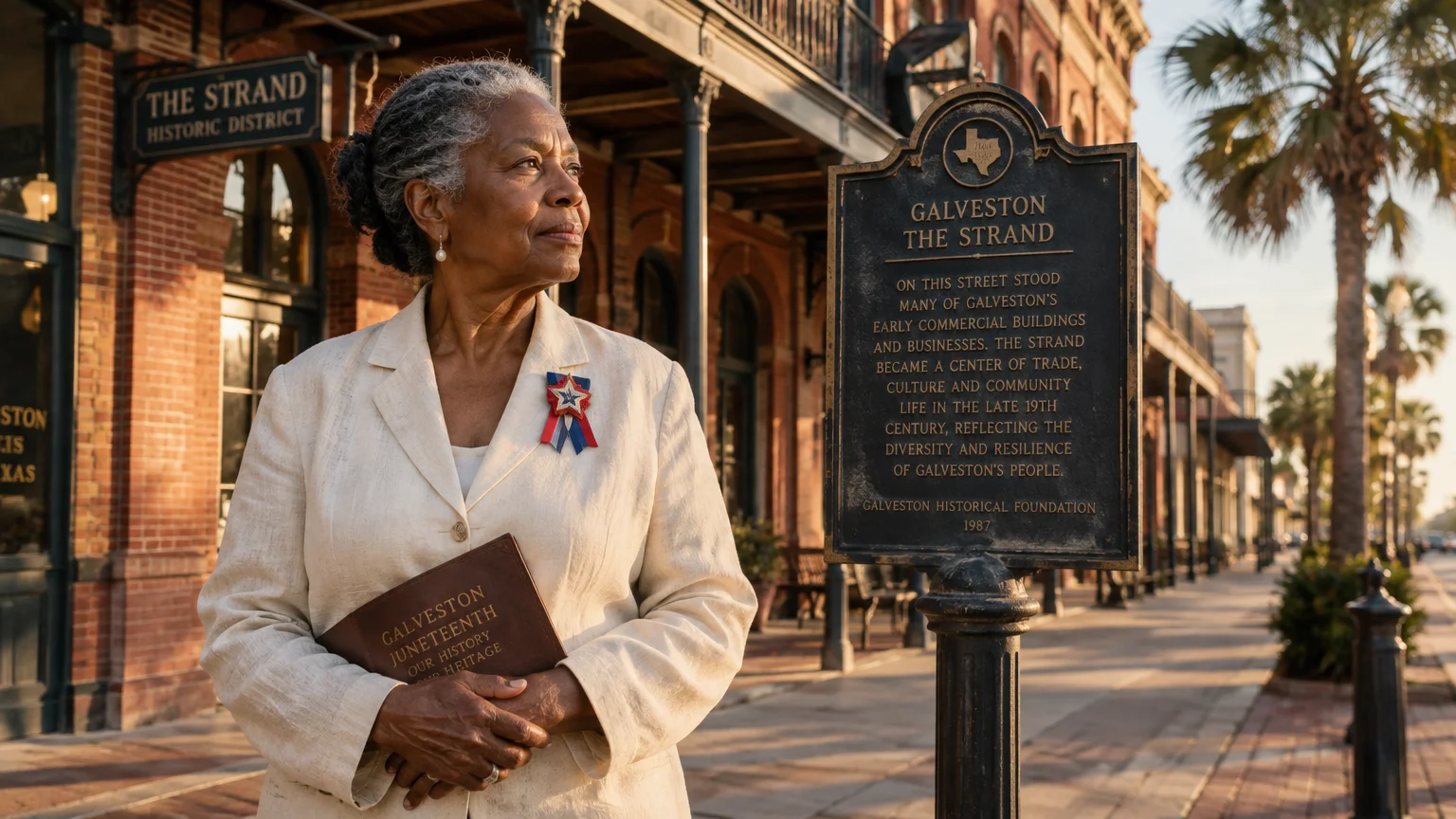
When President Joe Biden signed the Juneteenth National Independence Day Act into law, he codified a major turning point in American legislative history. You can trace this federal recognition across decades of grassroots persistence, state statutes, and intense congressional debate.
The journey began in Galveston in 1865, advanced through the Texas legislature in 1979, and culminated in a sweeping bipartisan vote in 2021.
Understanding this statutory timeline reveals how an enduring regional commemoration transformed into an official paid day off for millions of federal employees.
Tracking the Legislative Journey from Galveston to the Federal Register
You can better navigate modern federal calendar debates by reviewing the legislative steps that established Juneteenth. This explainer covers the key statutory milestones, administrative actions, and vote counts between June 1865 and June 2021.
Our editorial team selected each milestone based on its verified legal impact on state or federal statutes. Every entry reflects documented primary records from federal repositories, legislative journals, and certified roll-call tallies.
The selection excludes informal regional celebrations to focus strictly on binding executive directives, state legislation, and federal statutes. You will discover how procedural rules, economic estimates, and grassroots organizing shaped the final law.
This record demonstrates how congressional coalitions build over generations to enact major additions to the federal calendar. You can evaluate how these historic debates continue to influence federal personnel policy today.
General Order No. 3 Enforced Emancipation in Galveston Two Years Late
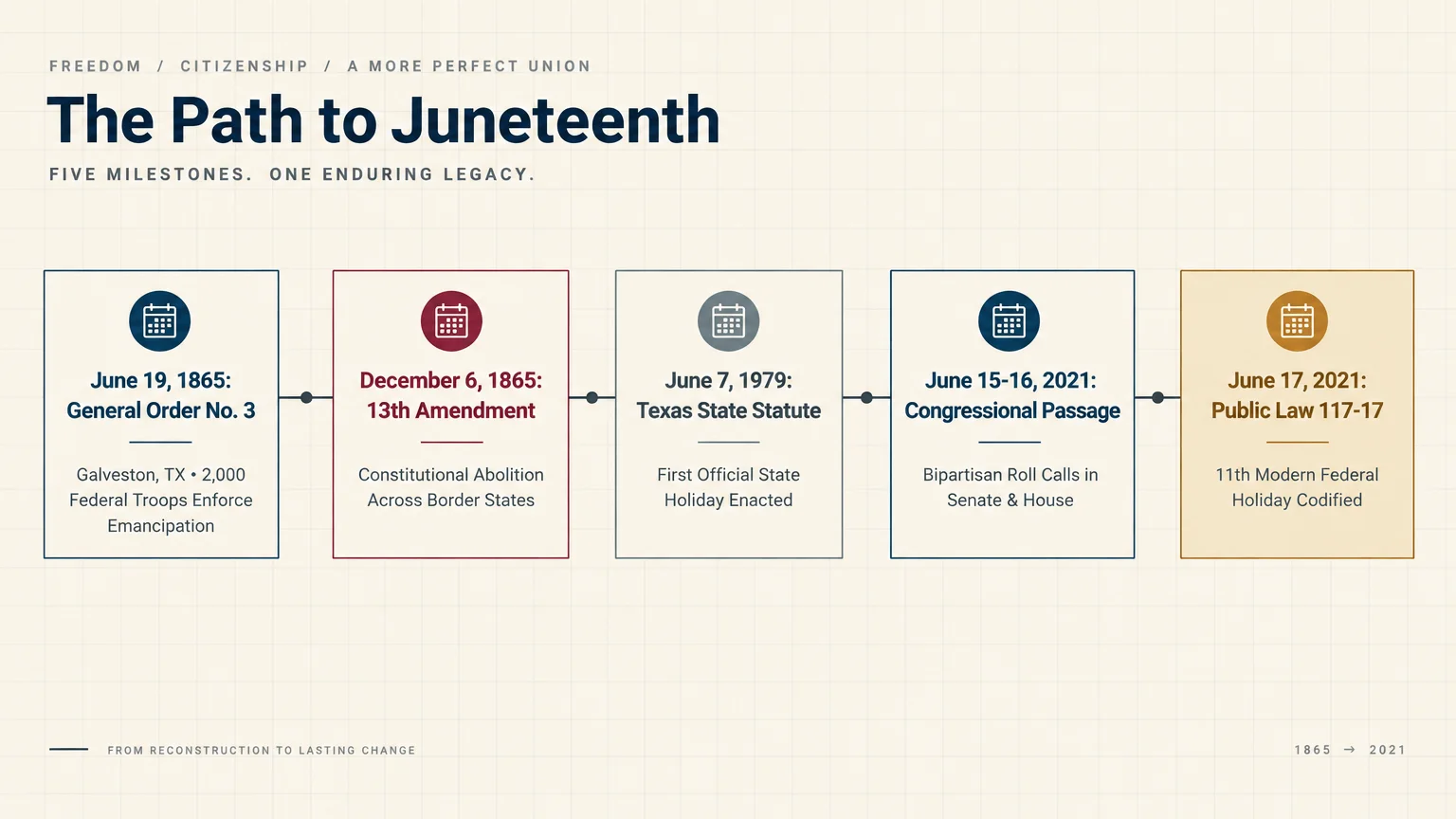
On June 19, 1865, Union Major General Gordon Granger landed at the island city of Galveston, Texas. He arrived with roughly 2,000 federal troops to secure military control over the state after the collapse of the Confederacy.
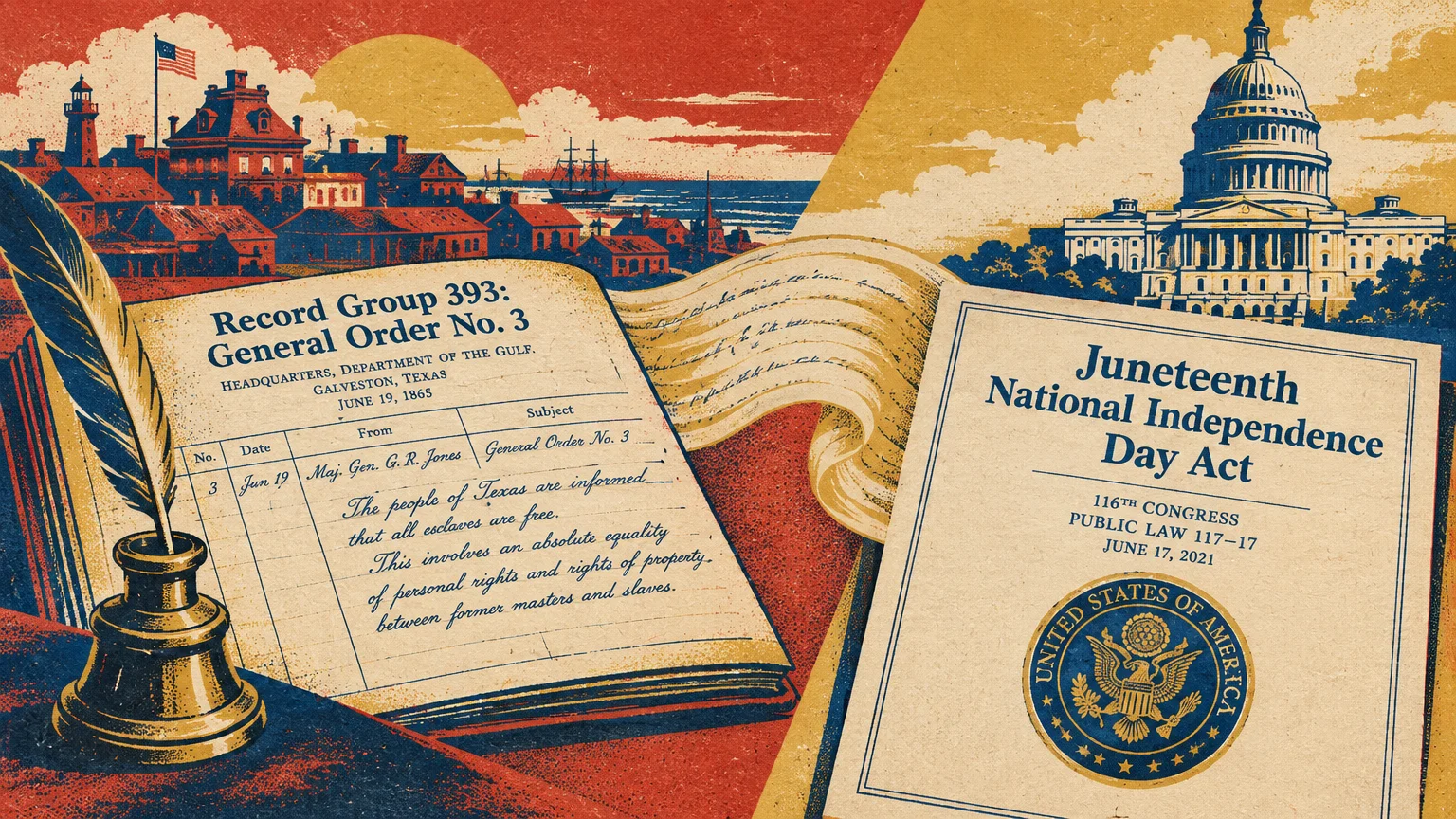
Granger immediately issued General Order No. 3, which proclaimed that all enslaved people in Texas were legally free. The directive declared absolute equality of personal rights and property rights between former owners and newly freed individuals.
This enforcement action arrived roughly two and a half years after President Abraham Lincoln issued the Emancipation Proclamation. Lincoln had issued that executive order on January 1, 1863, during the height of the Civil War.
The Confederacy had largely shielded Texas from federal troop presence during the war. Consequently, Texas served as a refuge for slaveholders moving west to escape advancing Union armies.
Granger’s military order affected approximately 250,000 enslaved people living across Texas in 1865. The proclamation instructed newly freed people to remain peacefully at their present homes and work for wages.
You can examine the original, handwritten military records of the order preserved by the National Archives in Record Group 393. This military directive provided the foundational date for what community members initially celebrated as Emancipation Day.
Freed communities across Texas soon organized annual June 19 gatherings to commemorate Granger’s arrival. These early celebrations blended religious services, political organizing, and family reunions into an enduring cultural tradition.
The Thirteenth Amendment Actually Ended Slavery in the Border States
A frequent modern misconception suggests that Juneteenth marked the legal end of all chattel slavery nationwide. You can consult the historical record to see that General Order No. 3 applied only to Confederate territory.
Lincoln issued the Emancipation Proclamation as a wartime military measure under his constitutional powers as commander in chief. The proclamation applied exclusively to states in active rebellion against the federal government.
Because the proclamation omitted loyal Union territory, slavery remained legal in border states that never seceded. Enslaved people in Kentucky and Delaware remained in legal bondage throughout the summer of 1865.
Constitutional abolition required a formal constitutional amendment rather than an executive order or military decree. Congress approved the proposed amendment in early 1865 and sent the measure to state legislatures for ratification.
Slavery ended nationwide on December 6, 1865, when Georgia became the twenty-seventh state to ratify the measure. Ratification by three-fourths of the thirty-six states officially added the Thirteenth Amendment to the United States Constitution.
The official text preserved in the National Archives record shows that the amendment abolished slavery across every jurisdiction. Juneteenth commemorates the arrival of freedom in the most remote Confederate state, rather than final constitutional abolition.
Distinguishing Granger’s order from the Thirteenth Amendment helps you understand the complex mechanics of American emancipation. Military enforcement liberated Confederate territory, while formal constitutional amendment eliminated legal enslavement across the remaining border states.
Texas Created the First Paid State Holiday Under House Bill 1016
Texas became the first state in the nation to convert Juneteenth from a cultural observance into an official holiday. Freshmen Democratic Representative Al Edwards authored House Bill 1016 during the 1979 regular legislative session.
Edwards represented Houston’s House District 85 and earned the nickname “The Father of Juneteenth” for his persistent legislative advocacy. He navigated intense committee debates and several procedural obstacles to secure floor votes in Austin.
The Texas House of Representatives passed the bill by a wide bipartisan margin after contentious floor debate. Supporters emphasized that official recognition honored the historic contributions and struggles of African American citizens.
Republican Governor William P. Clements Jr. signed House Bill 1016 into state law in June 1979.
The statute established Juneteenth as an official state holiday effective January 1, 1980.
You can review the legislative history maintained by the Texas State Library and Archives Commission. The records demonstrate that the statute granted state employees an official paid day of leave every June 19.
The Texas law established a model that dozens of other state legislatures gradually adopted over the next four decades. By early 2021, forty-nine states and the District of Columbia recognized Juneteenth as an official holiday or ceremonial day.
Edwards used his legislative triumph to encourage leaders nationwide to introduce complementary bills in their home legislatures. His 1979 victory proved that a regional African American commemoration could gain formal statutory recognition through sustained legislative work.
Opal Lee Marched Across the Country to Force Congressional Action
Grassroots organizing drove the national push to transform state observances into a uniform federal holiday. Retired Texas educator Dr. Opal Lee led this grassroots movement during the final decade of the national campaign.
Community organizers often refer to Lee as the “Grandmother of Juneteenth” due to her decades of local activism in Fort Worth. At age eighty-nine, she concluded that state-by-state progress had stalled short of complete national recognition.
Lee launched her “Walk 2 DC” campaign in September 2016 from her home church in Texas. She set out to travel roughly 1,400 miles to the nation’s capital to deliver a direct plea to Congress.
She organized her campaign by walking 2.5 miles each morning and 2.5 miles each afternoon in cities along her route. These five-mile daily segments represented the two and a half years it took for emancipation orders to reach Texas.
Her walk captured national media coverage and mobilized civil rights organizations behind a unified statutory proposal. Lee simultaneously sponsored an online petition on Change.org that accumulated over 1.6 million verified signatures from American voters.
She delivered these petition signatures directly to congressional leaders and urged lawmakers to draft a bipartisan holiday statute. Her public campaign kept the issue visible in national media outlets and pressured congressional committees to act.
In May 2024, President Biden awarded Lee the Presidential Medal of Freedom to honor her persistence. Her tactical use of physical demonstrations and petition campaigns offers an effective blueprint for modern grassroots legislative change.
A Single Senator Blocked the Measure Over a 600 Million Dollar Estimate
Congressional momentum behind federal recognition expanded rapidly in mid-2020 following nationwide racial justice protests. Lawmakers in both chambers sought to pass legislation by unanimous consent ahead of the 2020 recess.
The Senate operates under procedural rules where a single lawmaker can object to unanimous consent and freeze legislation. In July 2020, Republican Senator Ron Johnson of Wisconsin formally objected to passing the Juneteenth bill.
Johnson justified his objection using fiscal arguments rather than opposition to the underlying meaning of the commemoration. He cited economic data showing that paid federal holidays carry significant costs for American taxpayers.
Federal agencies employ approximately two million civilian workers across domestic and international installations. Johnson estimated that granting these civilian employees an additional paid day off cost taxpayers roughly $600 million annually.
To eliminate this budgetary impact, Johnson drafted an amendment that proposed replacing Columbus Day with Juneteenth. His amendment sought to keep the total number of paid federal holidays constant each fiscal year.
Italian American advocacy groups and traditional congressional coalitions immediately rejected Johnson’s proposal to eliminate Columbus Day. As a result, the legislative compromise stalled for the remainder of the 116th Congress.
Johnson eventually dropped his procedural hold in June 2021 after recognizing the overwhelming bipartisan support behind the standalone bill. His resistance highlighted how fiscal concerns and holiday swaps often slow non-defense legislation in the Senate.
The Senate and House Passed the Legislation With Overwhelming Majorities
Sponsors reintroduced the measure as the Juneteenth National Independence Day Act (S. 475) in the 117th Congress.
Democratic Senator Edward Markey of Massachusetts served as the bill’s primary author in the Senate.
Republican Senator John Cornyn of Texas joined Markey as the lead Republican co-sponsor to build bipartisan support. In the House, Democratic Representative Sheila Jackson Lee of Houston managed the companion bill through the legislative process.
The Senate took up S. 475 on June 15, 2021, under an expedited unanimous consent agreement.
When presiding officers called for objections, no senator spoke, and the bill passed the upper chamber without a recorded roll-call vote.
You can trace the rapid movement of the legislation through the Congress.gov tracking record. House leadership placed the measure directly onto the suspension calendar the very next day.
On June 16, 2021, the House approved S. 475 by a lopsided roll-call tally of 415 to 14.
All 220 voting Democrats and 195 Republicans voted to approve the legislation.
Fourteen House Republicans cast the only dissenting votes recorded against the measure during final passage. You can examine their individual roll-call votes in the official House roll call tally maintained by the Clerk of the House.
Dissenting members argued that the statutory name “Juneteenth National Independence Day” created unnecessary friction with July 4 celebrations. Despite these objections, the overwhelming vote sent the bill to the White House within twenty-four hours.
Public Law 117-17 Created the First New Holiday in Thirty-Eight Years
President Joe Biden signed the enrolled bill into law on the afternoon of June 17, 2021. With Opal Lee sitting in the front row, the measure officially became Public Law 117-17.
This presidential signature established the first new federal holiday in thirty-eight years. The federal government had not added a new recurring holiday since the enactment of Martin Luther King Jr. Day in 1983.
President Ronald Reagan signed the Martin Luther King Jr. holiday into law on November 2, 1983. That measure endured decades of contentious debate before taking full effect across federal agencies in 1986.
Public Law 117-17 created immediate operational challenges for the federal government because June 19 fell on a Saturday in 2021. Standard administrative rules dictate how agencies handle calendar days that fall on a weekend.
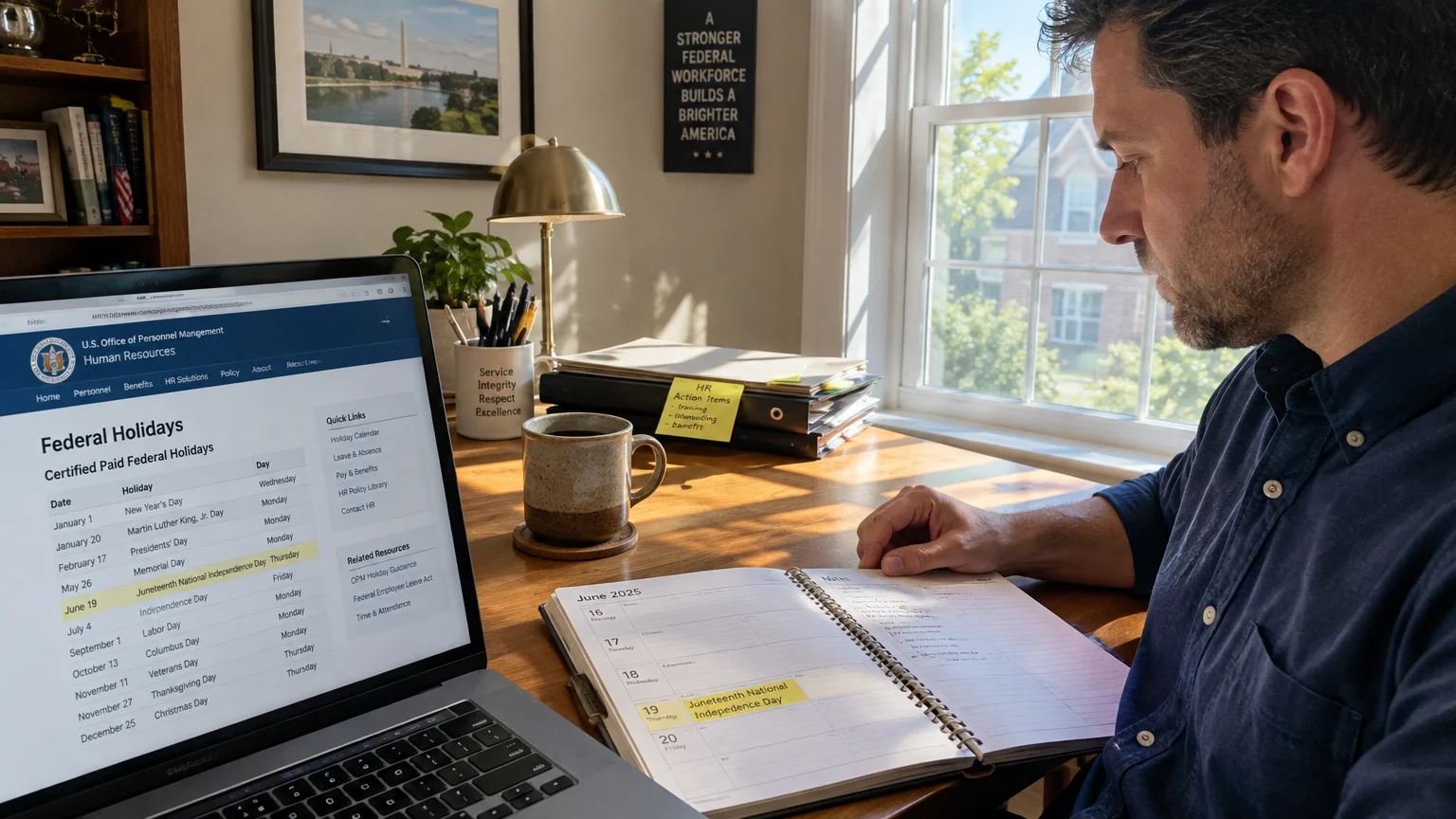
The Office of Personnel Management (OPM) enforces executive branch payroll rules under federal labor guidelines. Under OPM regulations, when a federal holiday falls on a Saturday, employees observe the holiday on the preceding Friday.
Because the president signed the bill late Thursday afternoon, OPM directed federal offices to close the following morning. Federal workers received their first paid Juneteenth holiday on Friday, June 18, 2021, less than twenty-four hours after enactment.
This rapid rollout forced federal courts, mail delivery operations, and financial systems to alter their operations overnight. The swift execution underscored the broad administrative authority the president wields when signing federal calendar laws.
Federal Code Classifies Juneteenth as the Eleventh Annual Holiday
Congress codified Public Law 117-17 into federal law under Title 5 of the United States Code. Specifically, the statute amended Section 6103, which enumerates legal public holidays for federal employees.
Section 6103 lists eleven annual nationwide holidays, placing Juneteenth alongside long-standing observances like New Year’s Day and Memorial Day. The statute provides federal workers with paid leave while maintaining essential government operations through premium holiday pay.
Government publications sometimes cause confusion by referring to Juneteenth as the twelfth federal holiday rather than the eleventh. This numerical discrepancy stems from a specific statutory provision that applies solely to the national capital region.
Section 6103(c) designates Quadrennial Inauguration Day on January 20 as an official paid holiday. However, this holiday applies only to federal employees working in the District of Columbia and surrounding suburban jurisdictions.
Because Inauguration Day occurs once every four years in a localized area, legal analysts consider Juneteenth the eleventh permanent annual holiday. It remains the only modern addition to the annual national calendar since the early 1980s.
You should note that federal holiday statutes do not mandate paid leave for private-sector workers. The legal authority of Title 5 governs executive branch personnel, federal courts, and banking transactions handled by the Federal Reserve.
Private corporations, state courts, and school districts make independent determinations regarding whether to close or offer paid leave. Consequently, the commercial adoption of Juneteenth continues to expand across regional markets through collective bargaining agreements and corporate policies.
Statutory Milestones in the Legal Recognition of Juneteenth
You can evaluate the key dates and legal mechanisms that shaped Juneteenth by reviewing the historical milestones in sequence. The table below traces the shift from wartime military field orders to permanent federal codification.
| Milestone Event | Year | Key Figures | Vote or Action | Statutory Result |
|---|---|---|---|---|
| General Order No. 3 | 1865 | Maj. Gen. Gordon Granger | Military Field Directive | Enforced emancipation in Texas |
| Thirteenth Amendment | 1865 | 38th U.S. Congress | Ratified by 27 states | Abolished slavery nationwide |
| Texas House Bill 1016 | 1979 | Rep. Al Edwards | Passed TX House and Senate | Created first paid state holiday |
| Walk 2 DC Campaign | 2016 | Dr. Opal Lee | 1.6M petition signatures | Mobilized national public support |
| Senate Procedure Hold | 2020 | Sen. Ron Johnson | Single-member UC objection | Delayed bill over $600M cost |
| Senate Passage (S. 475) | 2021 | Sens. Markey and Cornyn | Unanimous consent approval | Cleared Senate without dissent |
| House Passage (S. 475) | 2021 | Rep. Sheila Jackson Lee | 415–14 roll-call vote | Secured bicameral approval |
| Public Law 117-17 | 2021 | President Joe Biden | Presidential signature | Codified under 5 U.S.C. § 6103 |
How Congressional Consensus and Holiday Statutes Reshape the Federal System
The passage of the Juneteenth National Independence Day Act demonstrates how procedural rules govern the federal calendar. You can observe clear structural patterns that define how major social movements translate into statutory results.
First, national recognition consistently requires prior proof of concept across state legislatures. Just as Texas passed House Bill 1016 decades before Washington acted, state-level adoption built the administrative foundation for federal lawmakers.
Second, unanimous consent procedures in the Senate grant exceptional leverage to individual lawmakers. Senator Johnson’s single objection delayed the statute for an entire year until leadership resolved the procedural dispute.
Third, federal holiday statutes carry significant economic and budgetary consequences. The debate over the estimated $600 million annual cost shows how personnel expenditures shape congressional negotiations on the calendar.
Finally, statutory designations under Title 5 operate within strict constitutional limits regarding private commerce. Congress can close federal agencies and banking windows, but it leaves private workplace policies to market forces.
Understanding these procedural realities helps you evaluate future legislative debates surrounding the federal calendar. You can observe the exact legal mechanisms required to convert grassroots activism into lasting statutory law.
Frequently Asked Questions About Juneteenth’s Legislative Path
Why did Congress name the federal holiday Juneteenth National Independence Day?
Bill sponsors chose the name to link the end of slavery directly to the broader concept of American liberty. Representative Sheila Jackson Lee argued that freedom for Black Americans fulfilled the founding ideals established on July 4, 1776.
Some lawmakers opposed the phrasing because they worried it would create competition with Independence Day. However, sponsors maintained the dual title to emphasize that emancipation completed the constitutional promise of national independence.
Are private businesses legally required to close on Juneteenth?
No federal law requires private companies or private employers to observe federal holidays or provide paid leave. Title 5 of the United States Code applies strictly to federal government employees, federal courts, and executive agencies.
Private employers determine their holiday closures, premium pay rates, and paid time-off benefits through company policies or collective bargaining. However, many private institutions align their operating calendars with the federal schedule to coordinate with banking systems.
How does the federal government calculate the financial cost of a new holiday?
The Congressional Budget Office and legislative analysts calculate holiday costs by evaluating paid civilian personnel leave. When the government closes executive branch offices, salaried employees receive their regular compensation without performing work.
In addition, essential federal personnel—such as law enforcement and hospital staff—receive premium holiday pay to maintain vital operations. Multiplying these hours by average federal hourly wage rates yields estimated annual expenditures near $600 million.
Why did fourteen House members vote against the legislation in 2021?
The fourteen dissenting House Republicans cited concerns regarding terminology, cultural division, and rushed legislative procedure. Several dissenting lawmakers issued statements arguing that the term “National Independence Day” undermined the traditional primacy of July 4.
Other dissenting members objected to voting on the bill under suspension of the rules without committee hearings. Despite these dissenting floor votes, the bill earned 415 votes, making it one of the most bipartisan measures of the 117th Congress.



