Franklin D. Roosevelt transformed modern political communication when he delivered his first evening radio address on March 12, 1933.
Across thirty broadcasts, he bypassed print media gatekeepers to explain executive actions and stabilize a collapsing banking system.
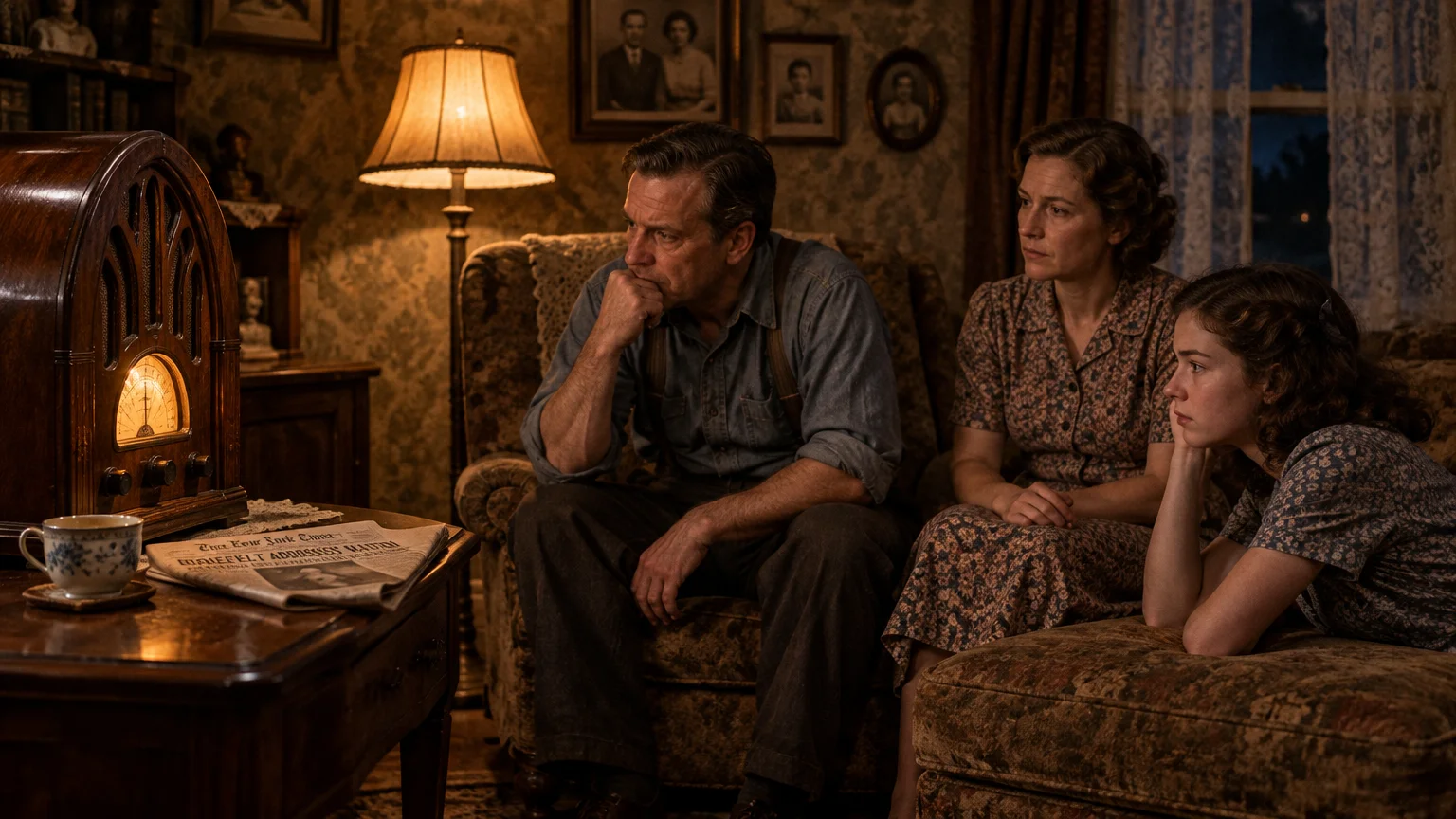
Speaking directly into American living rooms, Roosevelt built a direct connection between citizens and the executive branch. His broadcasts translated complex economic statutes and wartime logistics into clear household discussions.
Chronology and Strategic Impact of FDR’s Radio Addresses
This list tracks ten milestones, rhetorical techniques, and administrative outcomes from Franklin D. Roosevelt’s radio broadcasts between March 12, 1933, and June 12, 1944.
The entries cover statutory milestones, network rating records, White House architectural changes, and federal audio preservation laws that defined the series.
The Emergency Banking Act Address Reopened the Nation’s Financial System
On March 12, 1933, Roosevelt confronted a systemic banking panic eight days after his inauguration through a live 10:00 p.m. radio broadcast.
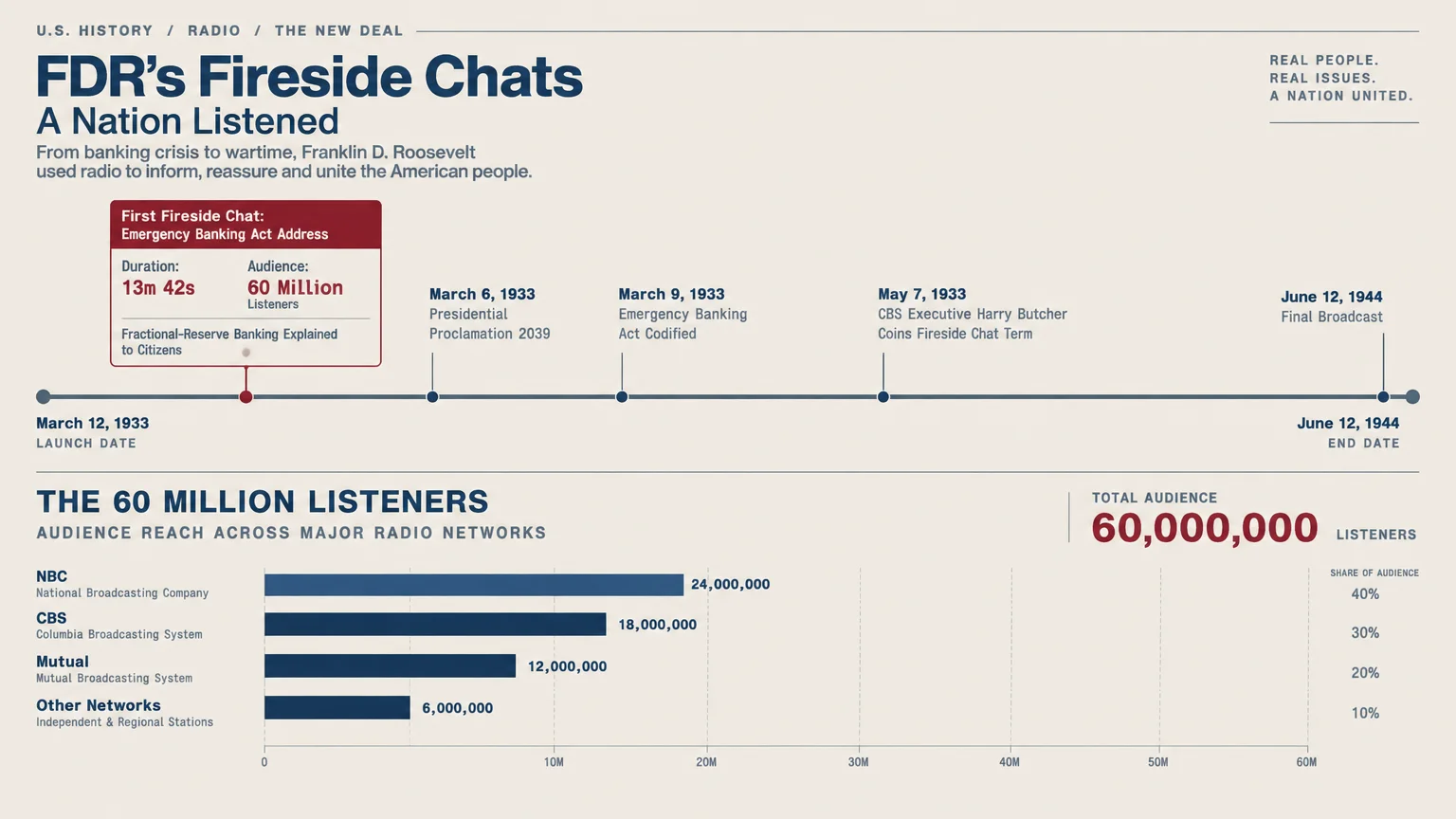
He had declared a national bank holiday on March 6 under Presidential Proclamation 2039, which Congress codified in the Emergency Banking Act on March 9.
Rather than reading statutory text, Roosevelt explained the mechanics of fractional-reserve banking in plain terms. The address lasted 13 minutes and 42 seconds, reaching an estimated 60 million listeners across national networks, as preserved by the American Presidency Project.
Roosevelt assured Americans that depositing cash in sound, reopened institutions was safer than hiding currency under mattresses. Within two weeks, citizens redeposited more than half of the currency they had previously withdrawn during the panic.
Harry Butcher Coined the Fireside Moniker for CBS
Popular accounts often credit radio reporter Robert Trout with inventing the phrase “fireside chat.” While Trout was the first broadcaster to utter the phrase on the air, CBS Washington bureau manager Harry C. Butcher created it.
Butcher devised the term in a network press release distributed on May 7, 1933, ahead of Roosevelt’s second radio address. Seeing that families gathered around living room receivers on Sunday evenings, he chose a title that suggested an informal, neighborly consultation.
The White House press office soon adopted Butcher’s terminology in its own official releases. Butcher later served as naval aide to General Dwight D.
Eisenhower during World War II.
The White House Diplomatic Reception Room Lacked a Working Fireplace
Popular imagery depicts Roosevelt speaking beside a roaring hearth, but his earliest broadcasts relied entirely on audio staging. Roosevelt delivered his initial 1933 addresses from the ground-floor Diplomatic Reception Room, which had an ornate mantelpiece over a sealed, non-functioning chimney flue.
Broadcasting equipment and production lamps generated heavy heat in the confined space. Roosevelt frequently delivered his remarks in shirtsleeves at a desk crowded with microphones, cables, and a pitcher of ice water.
In 1935, Roosevelt instructed White House maintenance staff to unseal the flue and make the fireplace functional. Records from the White House Historical Association document how this renovation aligned the room with the broadcast’s public name.
Deliberate Pacing Kept Broadcasts Under 120 Words Per Minute
Commercial radio announcers in the 1930s typically spoke at rates exceeding 150 words per minute. Roosevelt rejected rapid commercial delivery in favor of a slow cadence between 100 and 120 words per minute, helping his voice cut through static on vacuum-tube receivers.
His addresses varied in duration from 11 minutes to 44 minutes depending on the policy topic. He relied on conversational vocabulary and active verbs while inserting pauses between major arguments.
Audio recordings preserved by the Franklin D. Roosevelt Presidential Library confirm this steady delivery across twelve years of broadcasts. His acoustic pacing contrasted sharply with the faster, formal speeches of his predecessor, Herbert Hoover.
Direct Airwaves Bypassed Hostile Newspaper Publishers
During the 1930s, roughly 85 percent of major American newspapers were owned by publishers who opposed New Deal legislation on their editorial pages. Publishers such as William Randolph Hearst and Colonel Robert McCormick regularly challenged the administration’s economic recovery programs in print.
Roosevelt cultivated working reporters by holding 998 press conferences throughout his presidency, yet newspaper owners retained final control over headlines and framing. Radio provided the White House with an unfiltered channel directly into millions of homes.
Listeners heard the president’s complete arguments and vocal inflection without intermediate newspaper editing. This broadcast strategy broke the monopoly that print publishers had previously held over national political communication.
Constituent Mail Exploded from Five Thousand to Fifty Thousand Letters Weekly
During the Herbert Hoover administration, the White House received roughly 5,000 constituent letters per week, handled by a single mail clerk, Ira R. T.
Smith. Following Roosevelt’s initial radio chats, weekly White House mail volume surged past 50,000 letters.
To process the correspondence, Smith’s staff expanded from one employee to fifty clerks, as documented in the National Archives White House Record Group. Citizens mailed household budgets, eviction notices, and accounts of unemployment directly to the executive mansion.
White House staff routed urgent appeals to newly created emergency relief agencies for intervention. Summaries of this correspondence also allowed administrators to track economic conditions across specific counties between census surveys.
Wartime Audiences Set Unbroken Hooper Rating Records
During the 1930s and 1940s, radio audience measurement relied on telephone surveys conducted by C. E.
Hooper, where top commercial entertainment shows rarely exceeded 30 to 35 percent ratings. Roosevelt’s peacetime radio chats drew an average rating of 18 percent among available listeners.
During World War II, his fireside chats reached an average audience rating of 58 percent as families tuned in for military mobilization updates. On December 9, 1941, two days after the attack on Pearl Harbor, Roosevelt addressed an estimated 62.1 million adult listeners.
The Hooper organization recorded a 79 percent audience rating for the December 9 broadcast. That figure remains the highest audience share ever recorded for a presidential radio address.
The 1942 Map Address Sparked a Nationwide Retail Run
On February 23, 1942, Roosevelt delivered a wartime address to an estimated 61,365,000 adult listeners. Days before the broadcast, he asked Americans to buy or borrow a world map so they could follow his overview of global military operations.
His request triggered the largest single-week run on maps and atlases in American retail history. Stationers, bookstores, and department stores sold out their entire inventory of world maps within forty-eight hours.
Major newspapers printed supplementary theater maps so readers without atlases could follow along. During the 36-minute broadcast, Roosevelt guided listeners across supply lines and combat zones from the Russian steppes to the Coral Sea.
Official Catalogs Disagree on the Exact Count of Broadcasts
Standard historical references state that Roosevelt delivered thirty fireside chats between 1933 and 1944, though archival catalogs vary on the precise count. The White House press office stopped formally numbering the addresses after the twenty-first broadcast in 1942.
Curators at the FDR Presidential Library classify 28 broadcasts as undisputed and recognize 30 as the standard historical consensus. Other scholarly catalogs count 31 or 33 addresses by including war bond appeals and campaign broadcasts.
Historians evaluate each speech by its originating venue, network scheduling, and conversational tone. The June 12, 1944 address opening the Fifth War Loan Drive serves as the final entry on the standard thirty-speech list.
The Library of Congress Preserved the Series in Its Inaugural Audio Registry
In 2000, Congress enacted the National Recording Preservation Act (Public Law 106-474, 2 U.S.C. 1701 note), establishing the National Recording Registry to safeguard historically significant sound recordings.
In 2002, the Librarian of Congress selected Roosevelt’s fireside chats for the registry’s inaugural class of fifty works.
The citation on the Library of Congress National Recording Registry recognizes the complete series for its cultural and historical significance. Federal audio engineers restored the speeches from original aluminum master discs and network transcription records.
| Broadcast Date | Topic & Focus | Runtime | Estimated Audience | Key Document or Metric |
|---|---|---|---|---|
| March 12, 1933 | Emergency Banking Act | 13m 42s | 60 Million | 48 Stat. 1 (Reopened banks) |
| May 7, 1933 | New Deal Recovery Programs | 29m 30s | 50 Million | First use of “Fireside Chat” |
| December 29, 1940 | “Arsenal of Democracy” | 36m 53s | 55 Million | Hooper Rating: 59% |
| December 9, 1941 | Pearl Harbor Mobilization | 21m 18s | 62.1 Million | Hooper Rating: 79% (Record) |
| February 23, 1942 | Progress of the War (Map Address) | 36m 34s | 61.4 Million | Nationwide retail map run |
| June 12, 1944 | Opening 5th War Loan Drive | 13m 02s | 45 Million | Final consensus chat (No. 30) |
How FDR’s Media Strategy Redefined Executive Power
Roosevelt’s radio broadcasts shifted the balance of influence between the presidency and Congress. By speaking directly to voters, the president could mobilize constituent pressure on lawmakers before committee debates began.
Prior to network radio, executive communication relied primarily on written messages sent to Capitol Hill or speeches summarized by newspapers. Radio allowed the president to enter millions of homes simultaneously without intermediary editing.
This shift coincided with rapid hardware adoption across the country. Roughly 60 percent of American households owned a radio receiver in 1932, and ownership exceeded 80 percent by the start of World War II.
Subsequent administrations adapted Roosevelt’s broadcast model to new media platforms. Harry Truman, Dwight Eisenhower, and John F.
Kennedy carried the direct-address format from network radio onto evening television.
Frequently Asked Questions About FDR’s Radio Addresses
Did Franklin Roosevelt write his fireside chats alone?
Roosevelt collaborated with speechwriters and advisors, including Samuel Rosenman, Raymond Moley, and playwright Robert Sherwood, who assembled economic data and initial drafts. Roosevelt then edited every draft aloud, replacing bureaucratic phrasing with conversational language to match his speaking cadence.
How often did Roosevelt deliver a fireside chat?
Roosevelt delivered the addresses sparingly, averaging two to three broadcasts per year across his twelve years in office. Reserving the format for major policy announcements and wartime updates prevented audience fatigue and kept listener ratings high.
Which radio networks carried the presidential broadcasts?
NBC Red, NBC Blue, CBS, and later the Mutual Broadcasting System carried the broadcasts simultaneously across hundreds of regional affiliate stations. The commercial networks provided the evening airtime without charge as a public service, preempting sponsored entertainment programs.
How did ordinary Americans listen to the broadcasts?
Most families listened together in their living rooms around wooden console receivers. In rural areas or neighborhoods where home radios were scarce, residents gathered at local businesses, union halls, and post offices to hear the addresses.