You can trace modern presidential campaigns directly to the moment broadcast cameras turned political debates into mass television spectacles. These broadcasts permanently altered how candidates speak, move, and project authority before millions of voters.
Behind every broadcast lies a strict framework of federal communications law, shifting network rules, and negotiated stage production standards. Minor technical adjustments on camera have repeatedly altered national election outcomes.
Examining these historic broadcasts shows how visual performance replaced traditional stump speeches on your television screen. Here is how nine pivotal debates transformed American political campaigns.
How Broadcast Regulations and Visual Production Shaped Presidential Debates
This list tracks nine general election debates between 1960 and 2024 that altered television production standards and campaign strategy. We selected each broadcast based on documented changes in federal communications rules, staging innovations, or measurable voter behavior.
Before 1960, presidential campaigns relied heavily on radio broadcasts, newsreels, and local whistle-stop train rallies. Federal broadcast law treated candidates equally under strict statutory requirements that made multi-candidate television broadcasts legally risky for networks.
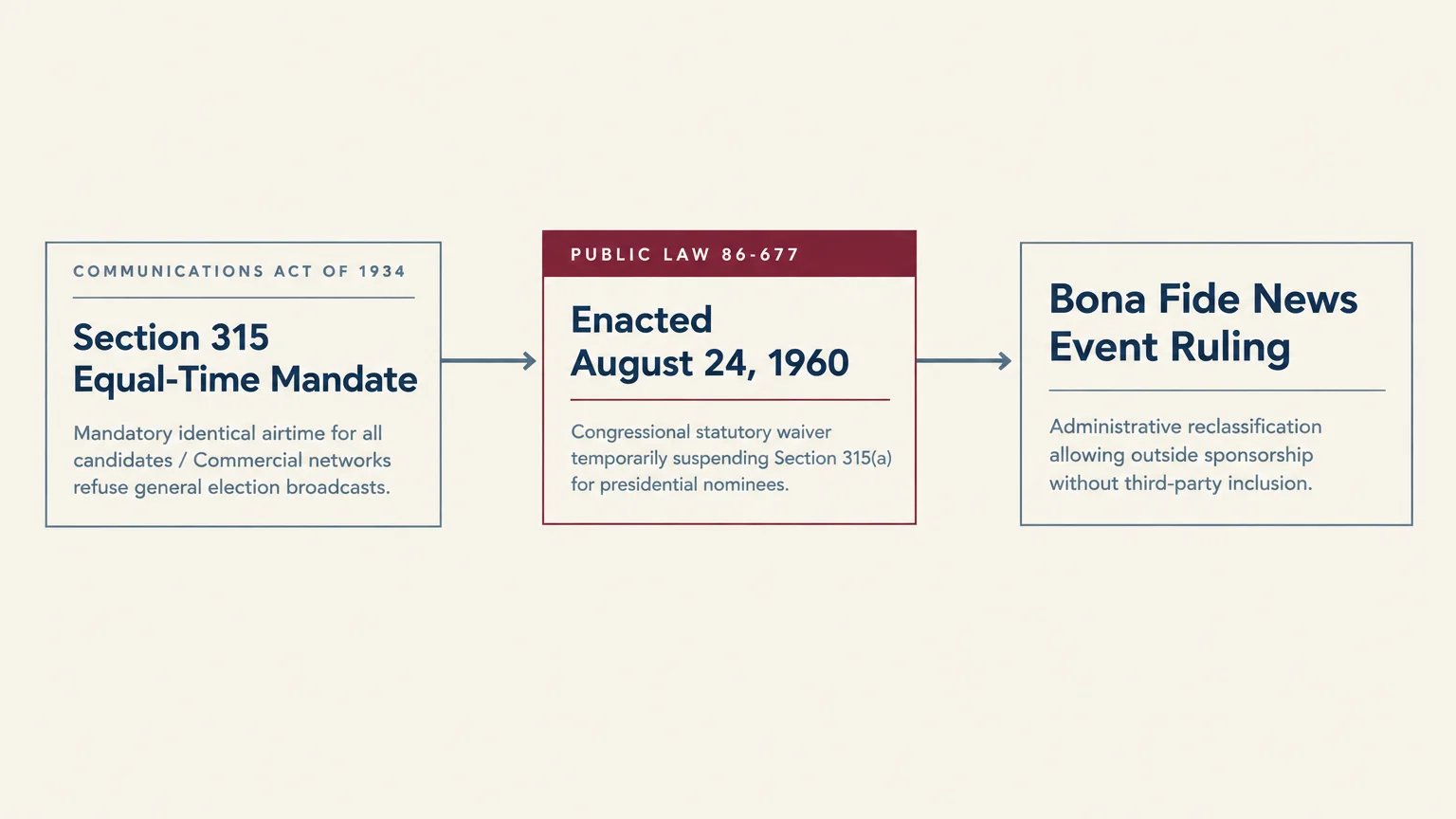
Under Section 315 of the Communications Act of 1934, any station granting airtime to a major nominee had to offer identical airtime to fringe contenders. Commercial television networks refused to stage general election debates under those burdensome conditions.
Congress broke this regulatory deadlock by passing temporary legislation that waived federal equal-time restrictions for presidential nominees. That statutory suspension opened an influential new era of visual campaign management.
Federal regulators later redefined live debates as bona fide news events, allowing outside sponsors to stage events without inviting third-party candidates. These administrative decisions determined exactly which political voices entered your home.
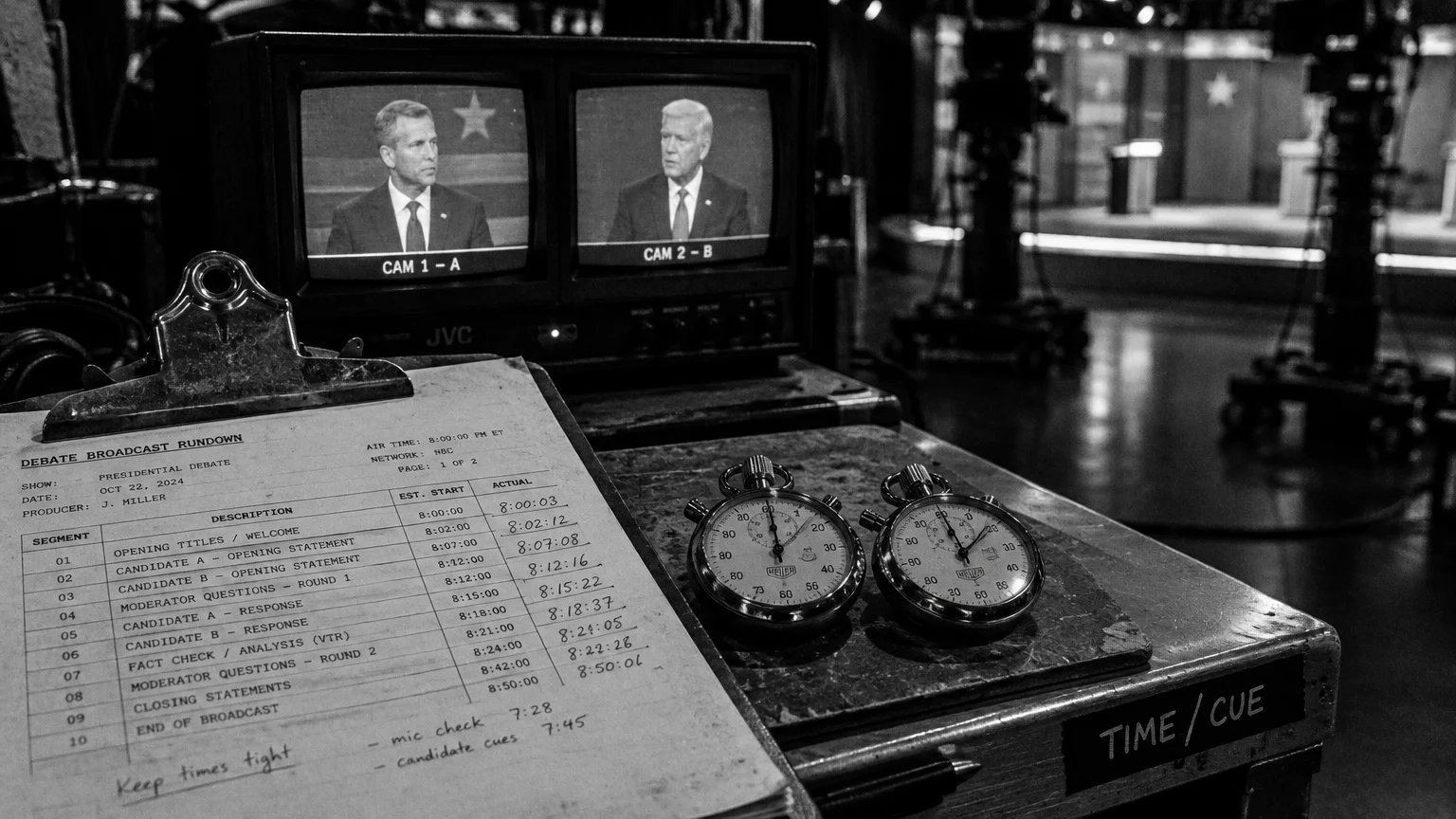
Over time, technical innovations such as split screens, lapel microphones, and roving cameras forced candidates to master physical body language. Every grimace, glance, or nervous posture became immediately legible to tens of millions of viewers.
Television networks and political parties gradually turned spontaneous political arguments into tightly choreographed, high-stakes studio productions. The following broadcasts established the operational rules that govern modern television campaigning today.
Kennedy vs. Nixon First Debate in Chicago
On September 26, 1960, CBS broadcast the first general election presidential debate from its WBBM-TV studios in Chicago. Senator John F.
Kennedy debated Vice President Richard M. Nixon before an audience of 66.4 million viewers.
The broadcast required emergency congressional intervention. Congress enacted Public Law 86-677 on August 24, 1960, temporarily suspending Section 315(a) of the Communications Act of 1934 (47 U.S.C. § 315) for presidential nominees.
As detailed by the John F. Kennedy Presidential Library, Kennedy arrived rested, wore stage makeup tailored for CBS lighting, and addressed the broadcast camera directly. Nixon, recovering from a recent hospitalization, wore a light gray suit that blended into the background and refused professional cosmetics.
While radio listeners viewed the contest as a draw, television viewers judged Kennedy the decisive winner. This visual contrast forced presidential campaigns to hire television directors and treat stage lighting as a primary strategic priority.
- Air date: September 26, 1960
- Statutory authorization: Public Law 86-677 (Senate Joint Resolution 207)
- Audience reach: 66.4 million viewers across a national population of 179 million
- Production precedent: First studio-controlled lighting and cosmetic staging
Kennedy vs. Nixon Split-Screen Debate
On October 13, 1960, ABC broadcast the third Kennedy-Nixon debate using a revolutionary split-screen telecast spanning 3,000 miles. Nixon spoke from ABC studios in Los Angeles, while Kennedy appeared from an ABC studio in New York.
Network technicians utilized split-screen electronic mats to display both candidates simultaneously in equal proportions on television screens. The broadcast captured 61 percent of all U.S. television-equipped households, setting an all-time household share record.
The production demonstrated that electronic presence could replace physical co-location in national campaigns. Campaign operatives recognized that television networks could isolate facial expressions and physical gestures even when a candidate was not actively speaking.
This technical breakthrough established continuous visual surveillance as a standard expectation for presidential broadcasts. Candidates could no longer drop their guard while an opponent answered questions.
- Air date: October 13, 1960
- Household rating: 61 percent of all television-equipped American households
- Technical innovation: First transcontinental split-screen political debate
- Production network: ABC News technical operations
Ford vs. Carter Philadelphia Audio Blackout Debate
On September 23, 1976, President Gerald Ford and challenger Jimmy Carter met at the Walnut Street Theatre in Philadelphia. This broadcast ended a 16-year televised general election debate hiatus and marked the first debate featuring an incumbent president.
The broadcast proceeded under the Federal Communications Commission’s 1975 Aspen Institute ruling in Docket No. 20562 (55 F.C.C.2d 697). The FCC classified non-studio debates hosted by outside civic organizations as exempt “bona fide news events” under Section 315.
Nine minutes before the scheduled conclusion, a 25-cent capacitor failed in the pool audio amplifier system. The resulting 27-minute sound outage left an audience of roughly 70 million viewers watching two silent candidates frozen at their podiums.
Neither Ford nor Carter spoke, sat down, or adjusted their posture during the prolonged silence, fearing an unpresidential image on television. The incident demonstrated how intensely candidates feared breaking television protocol during unexpected technical crises.
- Air date: September 23, 1976
- Regulatory basis: FCC Docket No. 20562 (55 F.C.C.2d 697)
- Technical disruption: 27-minute audio capacitor failure
- Sponsor organization: League of Women Voters Education Fund
Ford vs. Carter San Francisco Foreign Policy Debate
On October 6, 1976, Ford and Carter met for their second debate at the Palace of Fine Arts in San Francisco. Moderated by Max Frankel of The New York Times, the broadcast focused on national security and foreign policy.
Ford asserted that “there is no Soviet domination of Eastern Europe, and there never will be under a Ford administration.” When Frankel offered an opportunity to clarify, Ford reiterated that Romania, Yugoslavia, and Poland remained independent of Soviet control.
Commercial networks repeatedly broadcast the videotape clip over the following week, cementing the statement as a major strategic blunder. Instant post-debate television analysis established that network commentary could influence public perception far more than the live debate itself.
This broadcast forced campaigns to recognize that single verbal mistakes could dominate the entire media narrative. Campaign managers responded by training candidates to deliver cautious, scripted answers rather than spontaneous foreign policy assessments.
- Air date: October 6, 1976
- Location: Palace of Fine Arts, San Francisco
- Primary issue: United States-Soviet geopolitical relations in Eastern Europe
- Media consequence: Rise of 24-hour network post-debate narrative cycles
Reagan vs. Carter Cleveland Soundbite Debate
On October 28, 1980, President Jimmy Carter and Republican nominee Ronald Reagan held their sole debate at the Cleveland Music Hall. Broadcast one week before Election Day, the event drew 80.6 million viewers across ABC, CBS, and NBC.
The broadcast achieved a 58.9 percent household rating, making it the second most-watched debate in American history. The League of Women Voters sponsored the 90-minute forum after independent candidate John Anderson failed to meet polling thresholds.
Reagan deflected Carter’s policy criticisms by deploying conversational, camera-ready retorts designed specifically for evening television news clips. His phrase, “There you go again,” and his question, “Are you better off than you were four years ago?”, dominated post-debate broadcasts.
Reagan proved that comfortable screen presence and modular soundbites defeated detailed statistical arguments on television. Campaigns subsequently restructured candidate preparation around delivering memorable, self-contained phrases engineered for news soundbites.
- Air date: October 28, 1980
- Audience measurement: 80.6 million viewers (58.9 percent household rating)
- Venue: Cleveland Music Hall, Cleveland, Ohio
- Strategic breakthrough: Primacy of camera-friendly soundbites over exhaustive policy data
Bush vs. Dukakis Los Angeles Television Debate
On October 13, 1988, Vice President George H.W. Bush debated Massachusetts Governor Michael Dukakis at UCLA’s Pauley Pavilion in Los Angeles.
This broadcast was the second presidential debate organized by the Commission on Presidential Debates.
Moderator Bernard Shaw opened the broadcast with a blunt question asking whether Dukakis would support an irrevocable death penalty if his wife, Kitty, were raped and murdered. Dukakis offered an emotionless, technical defense of his opposition to capital punishment.
The visual presentation damaged Dukakis, conveying an impression of cold detachment to an audience expecting human emotion. Television commentators immediately framed his dispassionate demeanor as evidence of an inability to connect with ordinary voters.
The exchange proved that television audiences evaluate presidential candidates based on perceived emotional authenticity rather than legal precision. Campaign strategists incorporated intense emotional conditioning into televised debate rehearsals following this broadcast.
- Air date: October 13, 1988
- Sponsoring body: Commission on Presidential Debates
- Opening question: Bernard Shaw capital punishment hypothetical
- Television lesson: Visual and emotional resonance supersedes legalistic reasoning
Bush vs. Clinton vs. Perot Richmond Town Hall Debate
On October 15, 1992, the University of Richmond hosted the first televised town hall presidential debate. The broadcast included President George H.W.
Bush, Arkansas Governor Bill Clinton, and independent candidate Ross Perot before 69.9 million viewers.
The Commission on Presidential Debates seated 209 uncommitted voters selected by the Gallup Organization to question candidates directly. The format eliminated traditional press panels and allowed broadcast cameras to track candidate movement across an open stage.
A cutaway camera captured President Bush glancing at his wristwatch while an audience member asked about the national debt’s personal toll. That brief visual gesture framed Bush as detached and impatient with ordinary citizens.
Clinton stepped away from his stool, approached voter Marisa Hall, and spoke directly into her eyeline to project personal empathy. The broadcast established physical staging, proximity, and body language as decisive factors in presidential television production.
- Air date: October 15, 1992
- Participants: George H.W. Bush, Bill Clinton, Ross Perot
- Format innovation: First uncommitted voter town hall setup (209 participants)
- Audience reach: 69.9 million television viewers
Clinton vs. Trump Record Viewership Debate
On September 26, 2016, Hillary Clinton and Donald Trump met at Hofstra University in Hempstead, New York. Broadcast live across 13 networks, the encounter drew 84.4 million television viewers, setting an all-time Nielsen viewership record.
The broadcast occurred under the permanent guidelines of the Commission on Presidential Debates. High-definition split-screen camera feeds ran continuously throughout the 90-minute debate without commercial interruption.
The unbroken split-screen coverage subjected both candidates to uninterrupted television scrutiny. Viewers monitored every physical reaction, smirk, nod, and interruption, creating continuous visual content for real-time online commentary.
The broadcast demonstrated how modern television production transforms political debates into high-pressure cultural spectacles. Second-screen smartphone apps and cable analysis amplified every micro-expression into viral campaign narratives.
- Air date: September 26, 2016
- Audience record: 84.4 million live viewers across 13 broadcast and cable networks
- Venue: Hofstra University, Hempstead, New York
- Visual mechanic: Continuous high-definition split-screen reaction surveillance
Biden vs. Trump Atlanta Studio Debate
On June 27, 2024, President Joe Biden and former President Donald Trump debated inside CNN studios in Atlanta. Both campaigns completely bypassed the Commission on Presidential Debates, negotiating production rules directly with the commercial network.
Broadcast prior to either party’s national nominating convention, the meeting stood as the earliest general election debate in American history. Nielsen recorded 51.3 million television viewers across multiple simulcast networks.
CNN introduced stringent production controls: no studio audience, two commercial breaks, and automated microphone muting outside assigned speaking windows. The muted microphones eliminated verbal cross-talk and focused total visual and auditory attention on the speaker.
Biden displayed a raspy voice, hesitations, and faltering verbal delivery that drew immediate concern on television screens nationwide. The televised performance triggered profound political repercussions, leading Biden to withdraw his candidacy on July 21, 2024.
- Air date: June 27, 2024
- Production framework: Direct campaign-network agreement bypassing the CPD
- Staging rules: Muted microphones, absent studio audience, commercial breaks
- Political outcome: Earliest debate timeline led to Biden’s withdrawal on July 21, 2024
| Debate | Date | Format & Technical Innovation | Audience / Share | Key Precedent Set |
|---|---|---|---|---|
| Kennedy vs. Nixon I | Sept. 26, 1960 | Studio lighting, podium staging, cosmetic prep | 66.4M viewers | Public Law 86-677 waives equal time |
| Kennedy vs. Nixon III | Oct. 13, 1960 | Bi-coastal split-screen telecast | 61.0% TV share | Proves physical co-location is unnecessary |
| Ford vs. Carter I | Sept. 23, 1976 | Theatre setting, 27-minute audio blackout | ~70.0M viewers | FCC Aspen ruling restarts debates |
| Ford vs. Carter II | Oct. 6, 1976 | Foreign policy press panel format | ~64.0M viewers | Verbal gaffe replays dominate news cycles |
| Reagan vs. Carter | Oct. 28, 1980 | Single late-cycle debate, rehearsed retorts | 80.6M viewers | Modular soundbites replace policy discourse |
| Bush vs. Dukakis II | Oct. 13, 1988 | First CPD cycle, intense personal questioning | 67.3M viewers | Demands emotional authenticity on camera |
| Bush vs. Clinton vs. Perot II | Oct. 15, 1992 | Uncommitted voter town hall, mobile staging | 69.9M viewers | Open stagecraft highlights body language |
| Clinton vs. Trump I | Sept. 26, 2016 | Dual continuous split-screen coverage | 84.4M viewers | All-time broadcast viewership record |
| Biden vs. Trump I | June 27, 2024 | Muted microphones, no audience, network deal | 51.3M viewers | Earliest debate bypasses CPD framework |
The Evolution of Television Debates as Campaign Instruments
Presidential debates operate at the intersection of federal broadcast statutes, First Amendment campaign rights, and commercial television production. Over six decades, broadcast technology altered campaigns from verbal policy exchanges into tightly orchestrated visual showcases.
Statutory frameworks dictated when and how debates occurred. Congress used temporary legislative waivers under Section 315 of the Communications Act to permit the 1960 broadcasts without extending airtime to third parties.
When Congress failed to renew that statutory relief, general election debates ceased for 16 years. Debates resumed only after the Federal Communications Commission reinterpreted regulatory exemptions to accommodate nonpartisan civic sponsors.
From 1988 to 2020, the Commission on Presidential Debates provided a predictable, standardized framework for general election encounters. The nonpartisan commission protected candidates from erratic commercial terms and maintained uniform staging criteria across 33 general election broadcasts.
The collapse of that consensus in 2024 transferred operational authority back to commercial broadcast networks and campaign managers. That structural realignment allowed campaigns to demand earlier broadcast dates, commercial breaks, and automated audio controls.
Television mechanics directly dictate candidate behavior. Muted microphones, roaming cameras, and persistent split-screen feeds mean that nonverbal reactions carry equal weight with spoken policy proposals.
Campaigns now treat televised debates as live performance arenas where single gestures, hesitations, or scripted one-liners reshape national polls. A candidate’s visual command of the screen often overrides detailed programmatic platforms.
Broadcast television remains the only medium capable of commanding the synchronized attention of tens of millions of American voters. How campaigns manage broadcast production rules will continue to decide the presidency.
Frequently Asked Questions About Presidential Debates
Why did presidential debates disappear between 1960 and 1976?
The 16-year absence occurred because of Section 315 of the Communications Act of 1934. The statute required broadcast stations offering free time to major nominees to provide identical airtime to every third-party candidate.
Congress passed a temporary waiver for the 1960 debates through Public Law 86-677 but refused to renew the waiver in 1964 and 1968. Neither Lyndon Johnson nor Richard Nixon wished to give television exposure to their general election challengers.
Debates returned only after the FCC issued its 1975 Aspen Institute ruling, which recognized debates sponsored by outside organizations as exempt news events. That regulatory shift permitted the League of Women Voters to sponsor the 1976 debates.
What legal authority governs equal time for political broadcasts?
Section 315 of the Communications Act of 1934, codified at 47 U.S.C. § 315, governs equal broadcast access. It mandates that broadcast licensees provide equal opportunities to all legally qualified candidates for the same office.
Congress established four specific exceptions in 1959 under Public Law 86-274. These exemptions cover bona fide newscasts, bona fide news interviews, bona fide news documentaries, and on-the-spot coverage of bona fide news events.
Modern presidential debates qualify under the on-the-spot coverage of bona fide news events exemption. This administrative classification enables television networks to broadcast debates without providing equal time to minor-party candidates.
Why did campaigns bypass the Commission on Presidential Debates in 2024?
Both the Biden and Trump campaigns expressed severe frustration with the Commission on Presidential Debates over scheduling, format control, and candidate criteria. Strategists argued that the Commission’s late autumn schedule ignored the growth of early and mail-in voting.
By negotiating directly with networks such as CNN and ABC, campaigns secured earlier summer debate dates and customized studio rules. The direct agreements introduced muted microphones, excluded live studio audiences, and ended the Commission’s 36-year operational monopoly.
How do television networks measure presidential debate viewership?
Nielsen Media Research measures television debate audiences using electronic meters installed in a scientifically selected cross-section of American households. These meters record viewing behavior minute by minute to establish national ratings and total viewer figures.
Nielsen compiles data across all broadcast and cable networks simulcasting the debate to calculate the cumulative national audience. While linear television numbers remain official benchmarks, networks increasingly track separate digital streaming data across smart televisions, apps, and video platforms.