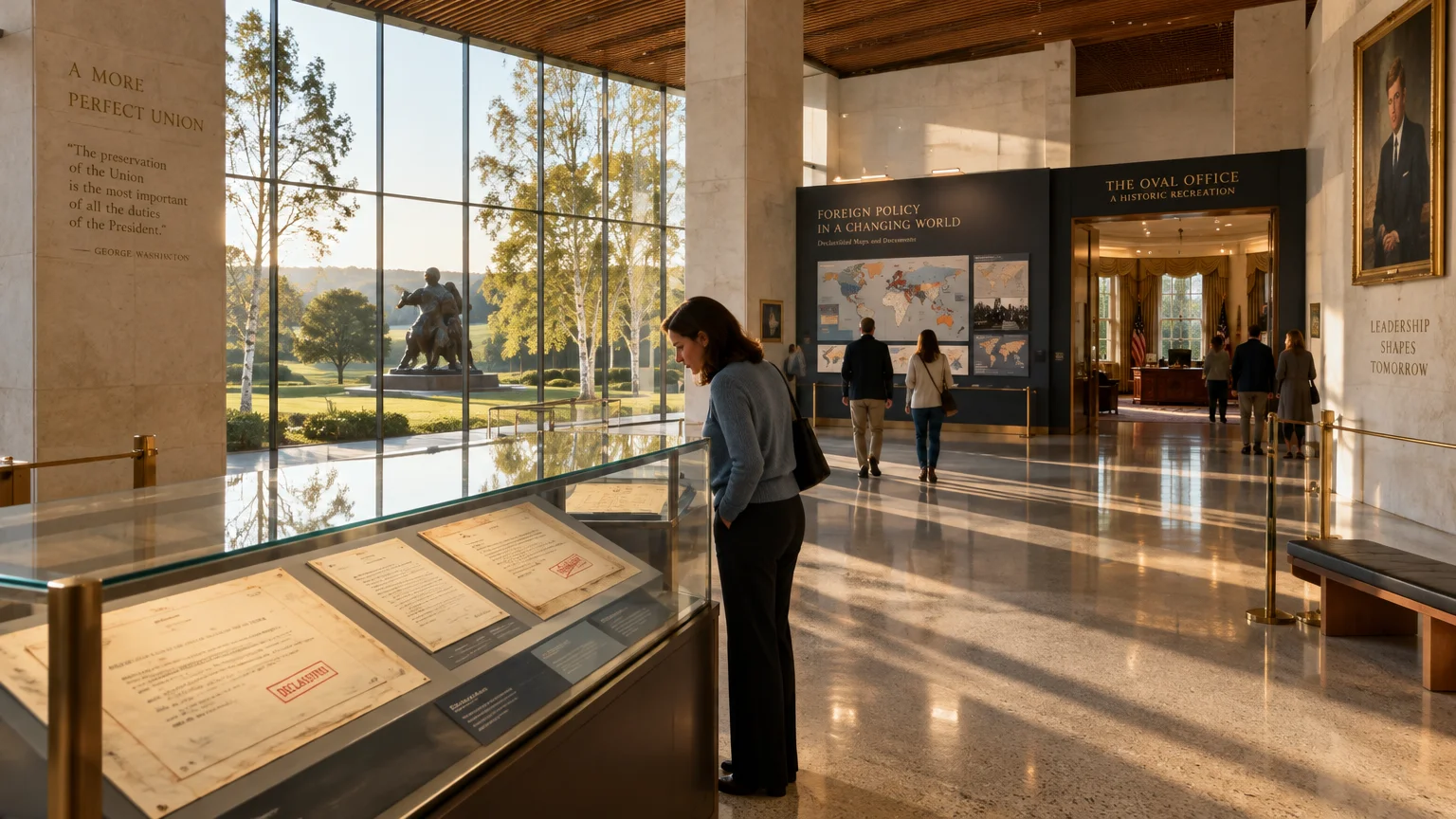
You can visit presidential libraries across the country to examine declassified memos, treaty drafts, and historic artifacts. These institutions show you how commanders-in-chief governed and made crucial decisions.
For more than a century, departing presidents treated their administrative correspondence as private personal property. Many early leaders discarded, sold, or burned their files after leaving the White House.
A series of landmark federal statutes transformed those private papers into protected public collections. Today, these facilities allow you to trace executive power through verified archival records.
How Federal Law Governs Presidential Records and How We Selected These Sites
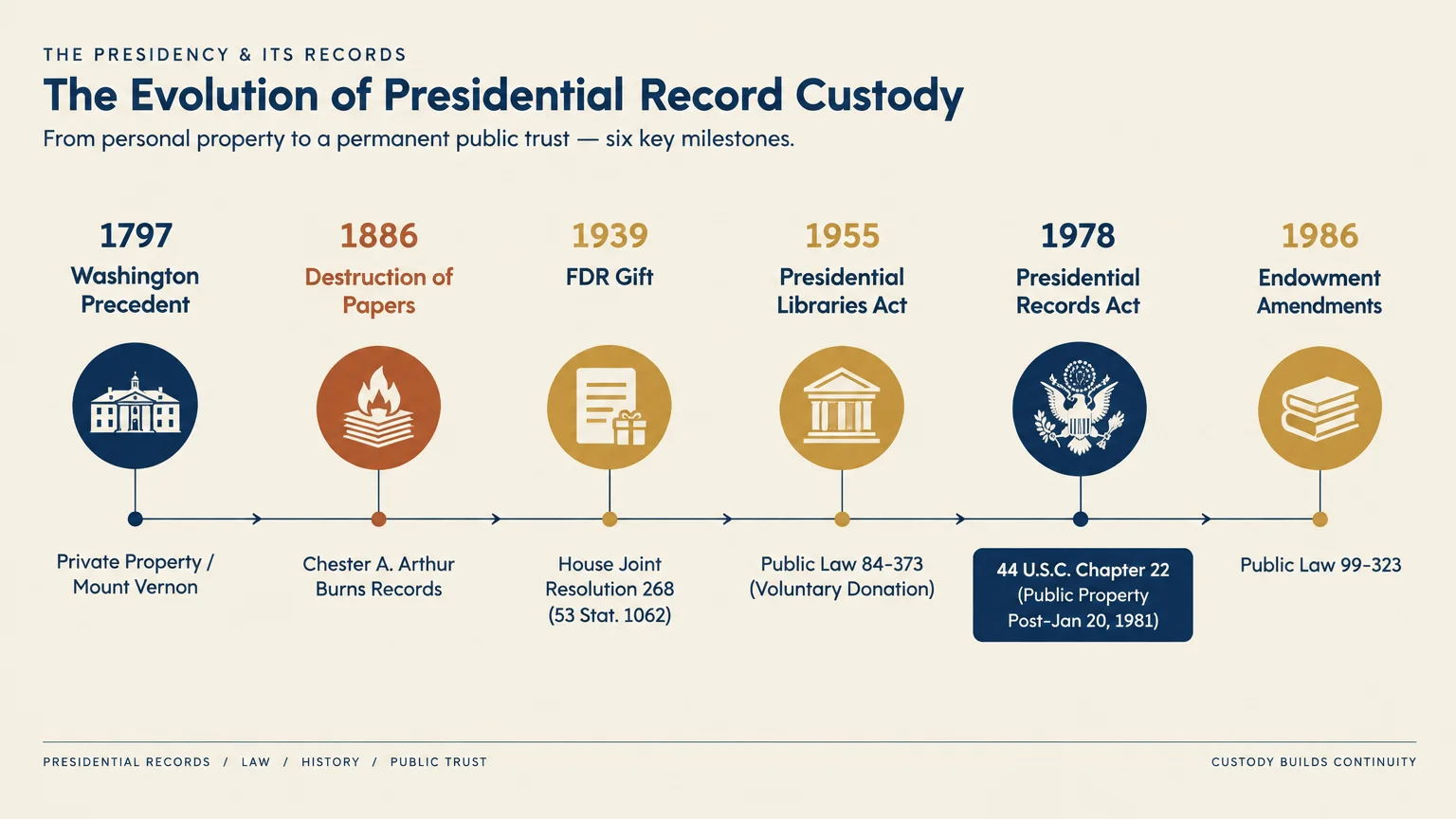
George Washington established the early precedent that executive papers belonged to the president personally. When he left office in 1797, Washington shipped his official correspondence back to Mount Vernon as private property.
This tradition caused severe gaps in the historical record over the next 140 years. Former presidents frequently destroyed their White House records or left them to heirs who neglected them.
President Chester A. Arthur ordered three garbage cans full of his administration papers burned before his death in 1886.
In addition, fires destroyed large portions of William Henry Harrison’s files.
The son of President Millard Fillmore directed in his will that his father’s executive correspondence be burned. These widespread losses left historians without essential primary sources regarding crucial cabinet deliberations.
Franklin D. Roosevelt disrupted this chaotic pattern by announcing plans in 1938 to donate his papers to the federal government.
He also deeded 16 acres of his family estate in Hyde Park to house the collection.
Congress formally accepted FDR’s gift through House Joint Resolution 268 on July 18, 1939 (53 Stat. 1062).
This joint resolution established the first federally administered presidential archival repository.
Following World War II, Congress enacted the Presidential Libraries Act of 1955 to standardize these donations. President Dwight D.
Eisenhower signed Public Law 84-373 into law on August 12, 1955.
As documented by the History, Art & Archives of the U.S. House of Representatives, lawmakers passed the bill to create a systematic archival partnership. It authorized the government to accept privately funded library buildings.
The 1955 statute established a formal framework for the National Archives and Records Administration (archives.gov) to operate facilities constructed with private funds. It relieved taxpayers of initial building costs while ensuring professional preservation.
A widespread misconception holds that the 1955 Act made White House files government property. In reality, the statute left ownership entirely private and made document donations completely voluntary.
The Watergate crisis shattered that voluntary framework in 1974. Following Richard Nixon’s resignation, the former president attempted to retain custody of his tapes and documents under a private agreement.
Congress intervened by passing the Presidential Records Act of 1978, codified at 44 U.S.C. Chapter 22. That statute declared all official presidential records created after January 20, 1981, to be public property.
Congress updated this system again through the Presidential Libraries Act of 1986 (Public Law 99-323). The 1986 amendments required private foundation partners to provide operational endowments before NARA accepts new facilities.
Today, NARA oversees 16 presidential research facilities spanning Herbert Hoover through Joe Biden. Each center documents executive branch decision-making while hosting public museum exhibits.
Our editorial team selected these eight destinations to illustrate every major phase of this statutory evolution. You will find early pioneers, foundational 1955 Act centers, modern digital facilities, and state-chartered repositories.
| Site | Location | Governing Legal Authority | Record Ownership Model |
|---|---|---|---|
| Franklin D. Roosevelt Library | Hyde Park, NY | 53 Stat. 1062 (1939) | Voluntary Private Gift |
| Harry S. Truman Library | Independence, MO | P.L. 84-373 (1955 Act) | Voluntary Private Gift |
| Lyndon B. Johnson Library | Austin, TX | P.L. 84-373 (1955 Act) | Voluntary Private Gift |
| Ronald Reagan Library | Simi Valley, CA | 44 U.S.C. § 2201 (1978 PRA) | Mandatory Public Property |
| William J. Clinton Library | Little Rock, AR | P.L. 99-323 (1986 Endowment) | Mandatory Public Property |
| Barack Obama Presidential Center | Chicago, IL | P.L. 113-187 (2014 PRA Update) | Digitized Public Property |
| Abraham Lincoln Library | Springfield, IL | 20 ILCS 3425 (State Charter) | State and Private Custody |
| Theodore Roosevelt Library | Medora, ND | ND Century Code § 54-60-29 | Private Non-Profit Trust |
Franklin D. Roosevelt Presidential Library and Museum
President Franklin D. Roosevelt created the blueprint for modern presidential libraries when he deeded his papers to the public.
He dedicated the Hyde Park facility on June 30, 1941, establishing the first federally run presidential archive.
Congress authorized the acceptance of the library and grounds through House Joint Resolution 268 on July 18, 1939 (53 Stat. 1062).
Archivist of the United States R.D.W. Connor assumed custody of the historic documents.
FDR’s voluntary gift preserved crucial New Deal memos and World War II diplomatic cables. You can review draft speeches and original correspondence on the Franklin D. Roosevelt Presidential Library and Museum historical portal.
You can tour the museum daily from 9:00 a.m. to 6:00 p.m. between April and October, and until 5:00 p.m. during winter months. General admission costs $15 for adults, $10 for seniors, and nothing for youth under 16.
Harry S. Truman Presidential Library and Museum
The Truman Library in Independence, Missouri, represents the inaugural institution built under the landmark Presidential Libraries Act of 1955. President Dwight D.
Eisenhower signed the enabling legislation, Public Law 84-373, on August 12, 1955.
Congress enacted the measure without a roll-call division after the House passed H.J. Res.
330 by voice vote on July 5, 1955. The statute, codified at 44 U.S.C. § 2112, authorized the federal government to accept donated buildings.
Former President Harry S. Truman dedicated the facility on July 6, 1957, alongside former Chief Justice Earl Warren and Herbert Hoover.
Truman maintained an active personal office inside the building until his death in 1972.
The museum welcomes visitors Monday through Saturday from 9:00 a.m. to 5:00 p.m. and Sunday afternoons. Adult admission costs $12, seniors and veterans pay $10, college students pay $8, and children 12 and under enter free.
Lyndon B. Johnson Presidential Library and Museum
Located on the campus of the University of Texas at Austin, this repository opened its doors on May 22, 1971. President Richard Nixon delivered the dedication address alongside Lyndon and Lady Bird Johnson.
The facility holds more than 45 million pages of executive records created during the passage of landmark Great Society legislation. Johnson donated his materials pursuant to 44 U.S.C. § 2112, preserving his unredacted telephone recordings.
Those recorded phone conversations gave historians unprecedented insight into congressional negotiations over the Civil Rights Act of 1964. You can explore a 4,500-square-foot permanent fourth-floor exhibit that details Johnson’s legislative battles and domestic policy achievements.
The facility opens daily from 9:00 a.m. to 5:00 p.m., with standard adult tickets priced at $16 and seniors charged $12. Admission is half-price on Tuesdays and entirely free for visitors legally named Lyndon or Claudia.
Ronald Reagan Presidential Library and Museum
The Reagan Library in Simi Valley, California, marked a legal turning point for executive archives. Dedicated on November 4, 1991, it became the first repository governed by the Presidential Records Act of 1978 (44 U.S.C. §§ 2201–2209).
Unlike collections from earlier administrations, Reagan’s White House files entered the facility as public property from the moment he left office. The law ended presidential claims to personal ownership of executive communications.
The 1978 Act passed the House on October 10, 1978, by a vote of 333 to 24 (92 Stat. 2523).
It forced incoming administrations to catalog and transfer electronic memos, foreign cables, and domestic correspondence directly to NARA.
The museum operates daily between 10:00 a.m. and 5:00 p.m., displaying an authentic Air Force One aircraft and Berlin Wall segment. Regular tickets cost $16 for adults, $13 for seniors, and $9 for youth ages 11 to 17.
William J. Clinton Presidential Library and Museum
The William J. Clinton Presidential Library in Little Rock, Arkansas, opened to the public on November 18, 2004.
It holds the largest collection of early digital executive communications in the federal archival system.
This facility complies with the Presidential Libraries Act of 1986 (Public Law 99-323; 100 Stat. 495).
That statute amended 44 U.S.C. § 2112(g) to require private presidential foundations to establish endowment funds for ongoing operations.
Congress passed the 1986 reform after rising maintenance costs burdened the National Archives budget. The Clinton Foundation provided an endowment to help offset the federal government’s operational costs for the 152,000-square-foot cantilevered structure.
Operating hours run Monday through Saturday from 9:00 a.m. to 5:00 p.m. and Sunday afternoons. Adult tickets cost $12, seniors and college students pay $10, and children under six receive free entry.
Barack Obama Presidential Center
The Barack Obama Presidential Center in Chicago, Illinois, pioneered a completely new operational model for modern White House archives. The Obama Foundation chose not to build a traditional federal archival repository under the 1955 Act.
Instead, NARA maintains and digitizes all official textual records at an existing federal facility under 44 U.S.C. § 2203. This decision created the first fully digital presidential archive in United States history.
Congress reinforced this digital transition through the Presidential and Federal Records Act Amendments of 2014 (Public Law 113-187). The statute explicitly required executive agencies to manage electronic messages and emails as formal public records.
The center features a 19.3-acre community campus alongside a public library branch that you can visit without charge. Standard museum admission costs $30 for adults, with Illinois residents receiving discounted $26 tickets.
Abraham Lincoln Presidential Library and Museum
The Abraham Lincoln Presidential Library and Museum in Springfield, Illinois, functions completely outside the federal National Archives system. Opened on April 19, 2005, the complex operates as an official agency of the State of Illinois.
Because Lincoln served before the 1955 Act, his private correspondence scattered among various collectors and government departments. Robert Todd Lincoln deposited the core collection of his father’s papers with the Library of Congress under a 1923 deed.
The Illinois General Assembly chartered the Springfield facility under 20 ILCS 3425 to preserve Lincoln artifacts and state history. The museum displays original copies of the Emancipation Proclamation and the Gettysburg Address.
Visitors can tour the campus daily from 9:00 a.m. to 5:00 p.m. to view interactive exhibits and historic stage presentations. Tickets cost $15 for adults, $12 for seniors and students, and $6 for children ages 5 to 15.
Theodore Roosevelt Presidential Library
Located in Medora, North Dakota, the Theodore Roosevelt Presidential Library showcases executive history across a 93-acre Badlands butte. This institution operates as a private foundation independent of the federal NARA network.
Because Roosevelt governed decades before federal archival statutes existed, the Library of Congress holds his primary official papers in manuscript collection MSS38270. The Medora institution gathers digital copies alongside conserved physical artifacts.
The North Dakota Legislative Assembly supported construction through House Bill 1018 in 2019, providing a $50 million state endowment fund. The law required project organizers to raise $100 million in private charitable contributions first.
You can explore exhibits celebrating Roosevelt’s conservation policies, national park expansion, and naval history. General timed-entry admission costs $26 for adults and $16 for youth ages 3 through 12.
How Legal Custody Transformed from Private Ownership to Public Trust
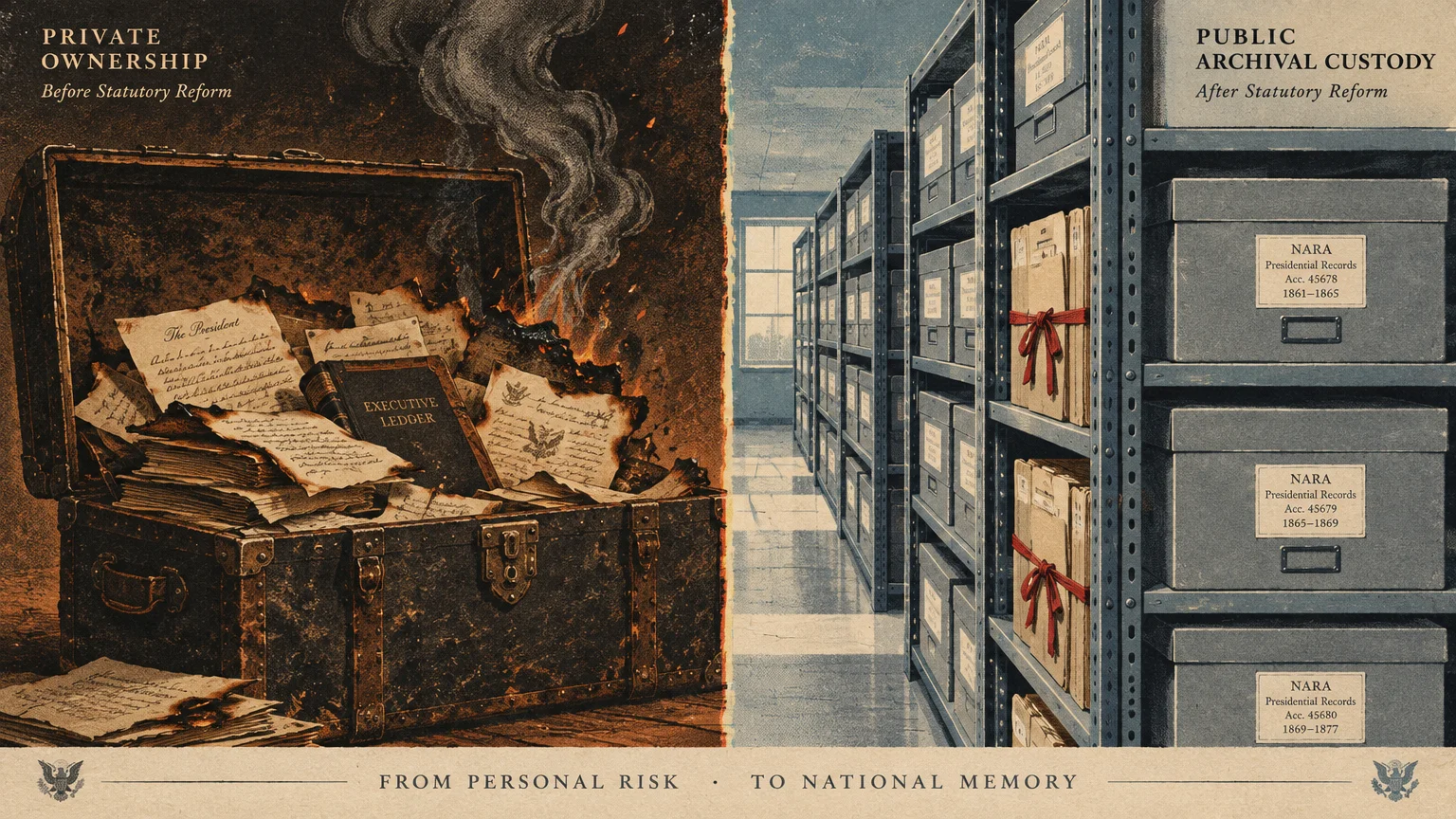
The evolution of White House records policy reflects a continuous battle between executive secrecy and democratic accountability. For roughly 180 years, outgoing commanders-in-chief exercised absolute control over the documents they produced while in office.
That unchecked authority ended when President Richard Nixon resigned in August 1974. Nixon signed an agreement with the General Services Administration that granted him ownership of his secret White House tape recordings.
The agreement would have allowed Nixon to order the eventual destruction of his recordings after September 1, 1979. Outraged lawmakers swiftly passed the Presidential Recordings and Materials Preservation Act of 1974 to seize the tapes.
Nixon challenged the emergency seizure as an unconstitutional bill of attainder and a violation of executive privilege. The Supreme Court rejected his argument in Nixon v. Administrator of General Services, 433 U.S. 425 (1977).
Justice William J. Brennan Jr. wrote for the 7–2 majority that executive records belong to the public rather than to the individual officeholder.
That decision cleared the path for the Presidential Records Act of 1978.
Codified under Title 44 of the United States Code, the 1978 Act established that the United States holds complete ownership of all presidential records. The Archivist takes immediate custody when a president leaves office.
According to analysis by the Congressional Research Service, the statute categorizes materials into official presidential records and purely personal records. Section 2201 explicitly excludes campaign literature and private diaries from public custody.
Official records remain closed to Freedom of Information Act (FOIA) requests for five years following the end of an administration. A former president may invoke statutory restrictions on confidential advice for up to 12 years.
Once that 12-year statutory restriction window expires, citizens and journalists can file formal FOIA requests for executive documents. NARA career archivists process these requests without political interference.
Growing taxpayer expenses also prompted Congress to pass the Presidential Libraries Act of 1986. That statute required private foundations to establish operational endowments before NARA could accept new facilities.
Today, the digital transition has fundamentally changed how records are archived. Millions of emails, texts, and electronic records now shift immediately into secure NARA digital servers the instant an administration concludes.
The shift toward digital-first presidential archiving reduces the need for massive brick-and-mortar storage facilities. Researchers can increasingly examine declassified executive branch communications from home rather than traveling to regional archives.
Despite these digital advancements, physical presidential libraries remain vital educational centers. Visiting these institutions gives you direct contact with executive artifacts, treaty documents, and the physical spaces where history occurred.
Frequently Asked Questions About Presidential Libraries and Records
Who pays to construct and operate presidential libraries?
Private presidential foundations raise charitable donations to design and construct the physical library building. Once construction concludes, the foundation deeds the facility to the federal government under 44 U.S.C. § 2112.
The National Archives and Records Administration then manages the archival vaults using annual federal appropriations. Foundations must also provide cash endowments under the 1986 Act to offset ongoing maintenance costs.
Can a former president withhold executive records from the public?
Former presidents cannot claim private ownership over official government records created after January 20, 1981. Under the Presidential Records Act, the federal government owns all executive documents immediately upon production.
A former president can request confidentiality for national defense secrets or personnel files for up to 12 years. After that period, NARA must release the records unless an active FOIA exemption applies.
Why are some presidential libraries operated outside the National Archives network?
NARA only maintains official federal presidential libraries for commanders-in-chief who served from Herbert Hoover onward. Presidents who governed before the mid-twentieth century retired before modern preservation statutes existed.
As a result, states, universities, and private historical societies built standalone museums for leaders like Abraham Lincoln and Theodore Roosevelt. These independent museums rely entirely on state appropriations and private endowments.
How can you request unreleased files from a presidential library?
You can submit an electronic FOIA request directly through the National Archives website for records older than five years. Archivists will review the requested boxes, redact sensitive national security data, and release unclassified pages.
If an agency denies your request or withholds documents under executive privilege, you have the right to file an administrative appeal. You can also monitor public reading rooms for newly declassified collections.