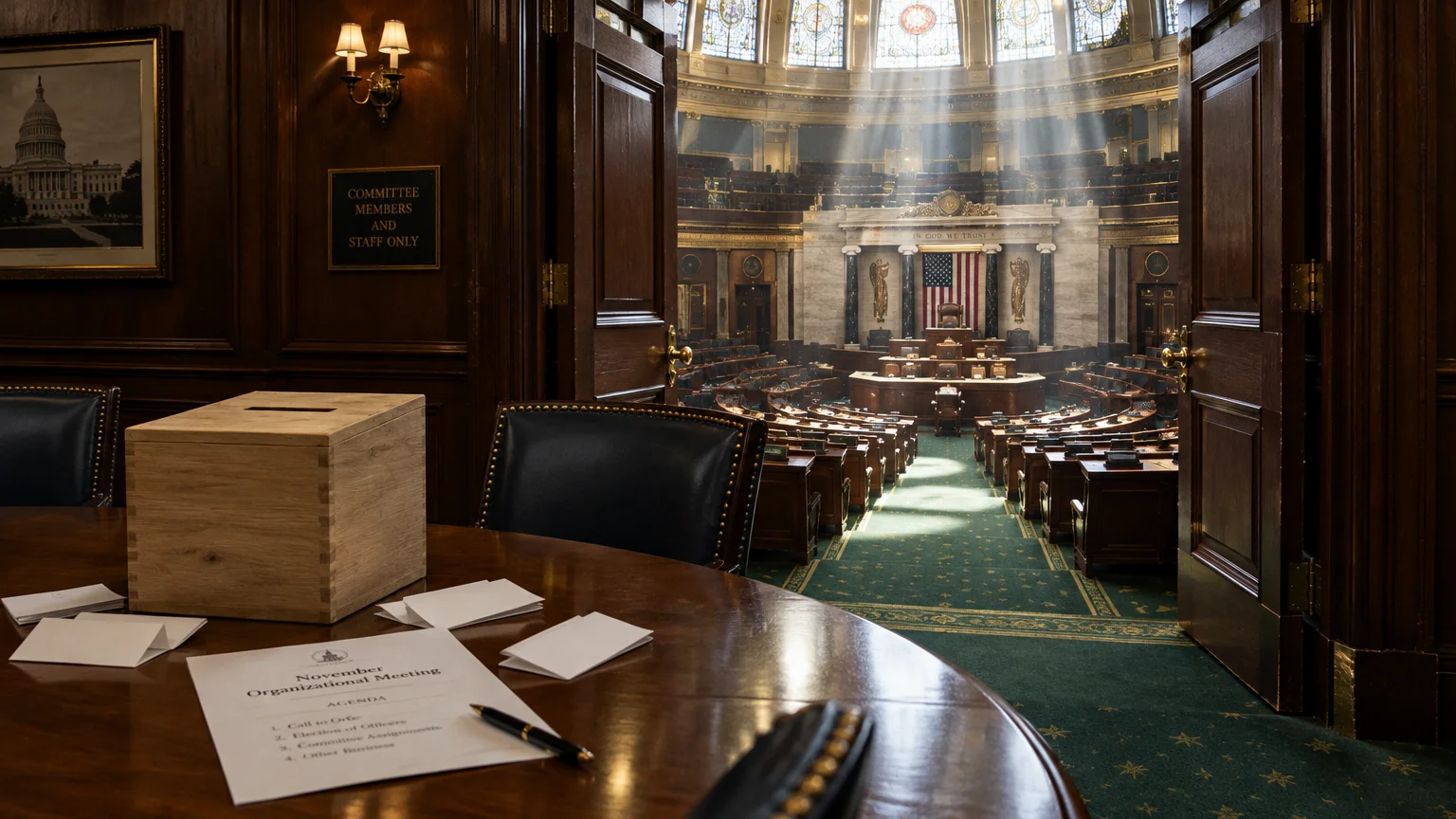
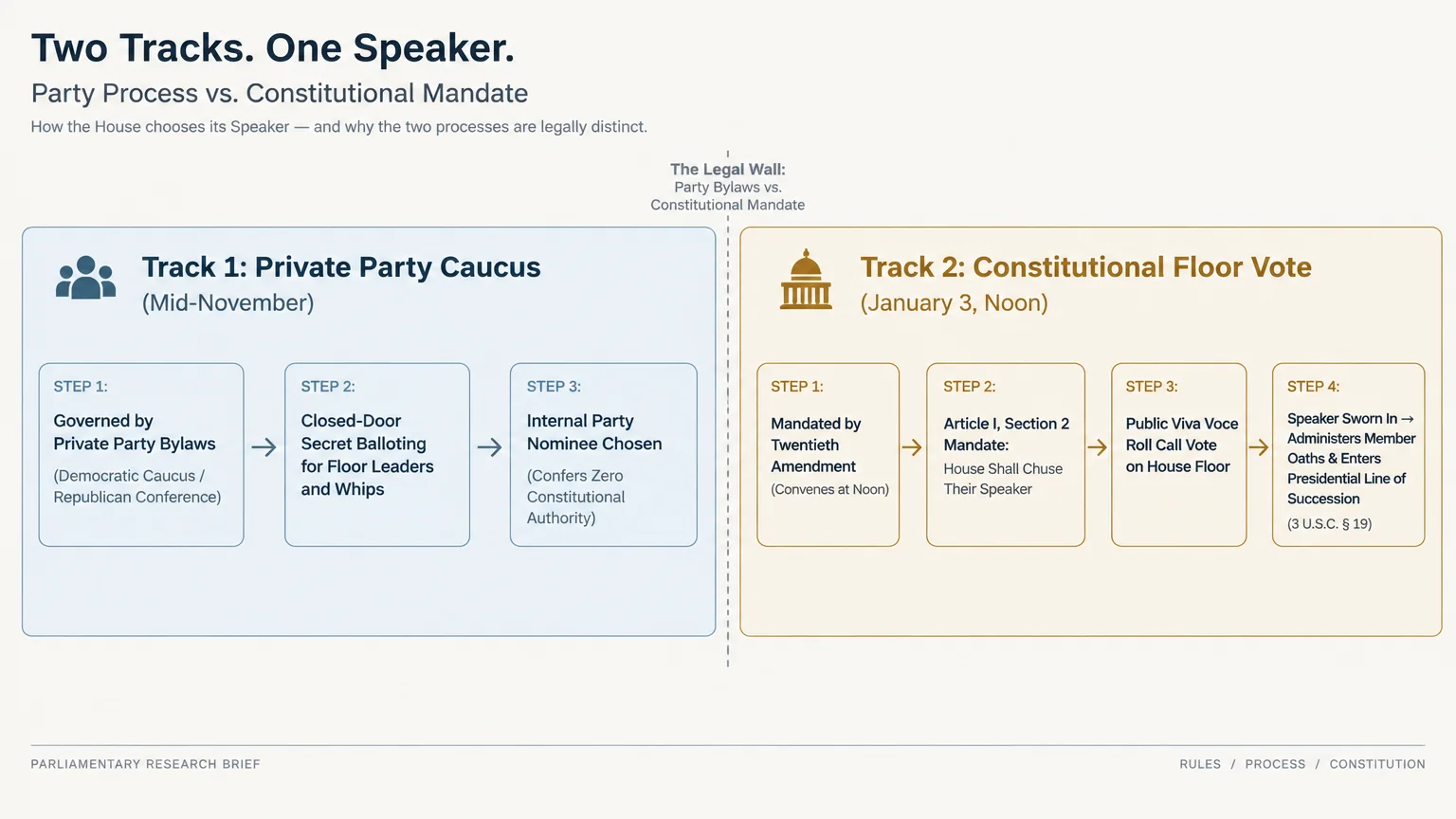
Closed-door party leadership contests held each November do not legally select the Speaker of the House. Internal party votes only choose party nominees and conference leaders for the upcoming legislative term.
Every newly elected House must convene at noon on January 3 to conduct a public, roll-call floor vote. This constitutional election determines who officially holds the gavel, administers the oath of office, and controls the legislative agenda.
Rules, Authority, and the Path from Party Caucus to the Speaker’s Gavel
Every two years, newly elected representatives gather in mid-November as the Democratic Caucus and the House Republican Conference to elect party leaders and nominate a candidate for Speaker under private party bylaws.
Under the Twentieth Amendment and Congressional Research Service analysis on House opening day proceedings, the House cannot swear in members or conduct legislative business until it convenes at noon on January 3 and elects a Speaker on the floor.
This list examines six institutional differences separating November party caucus elections from the January constitutional floor vote. The entries compare legal authority, balloting mechanics, territorial delegate voting rights, majority thresholds, candidate eligibility, and removal rules.
1. Constitutional Mandate Versus Internal Party Creation
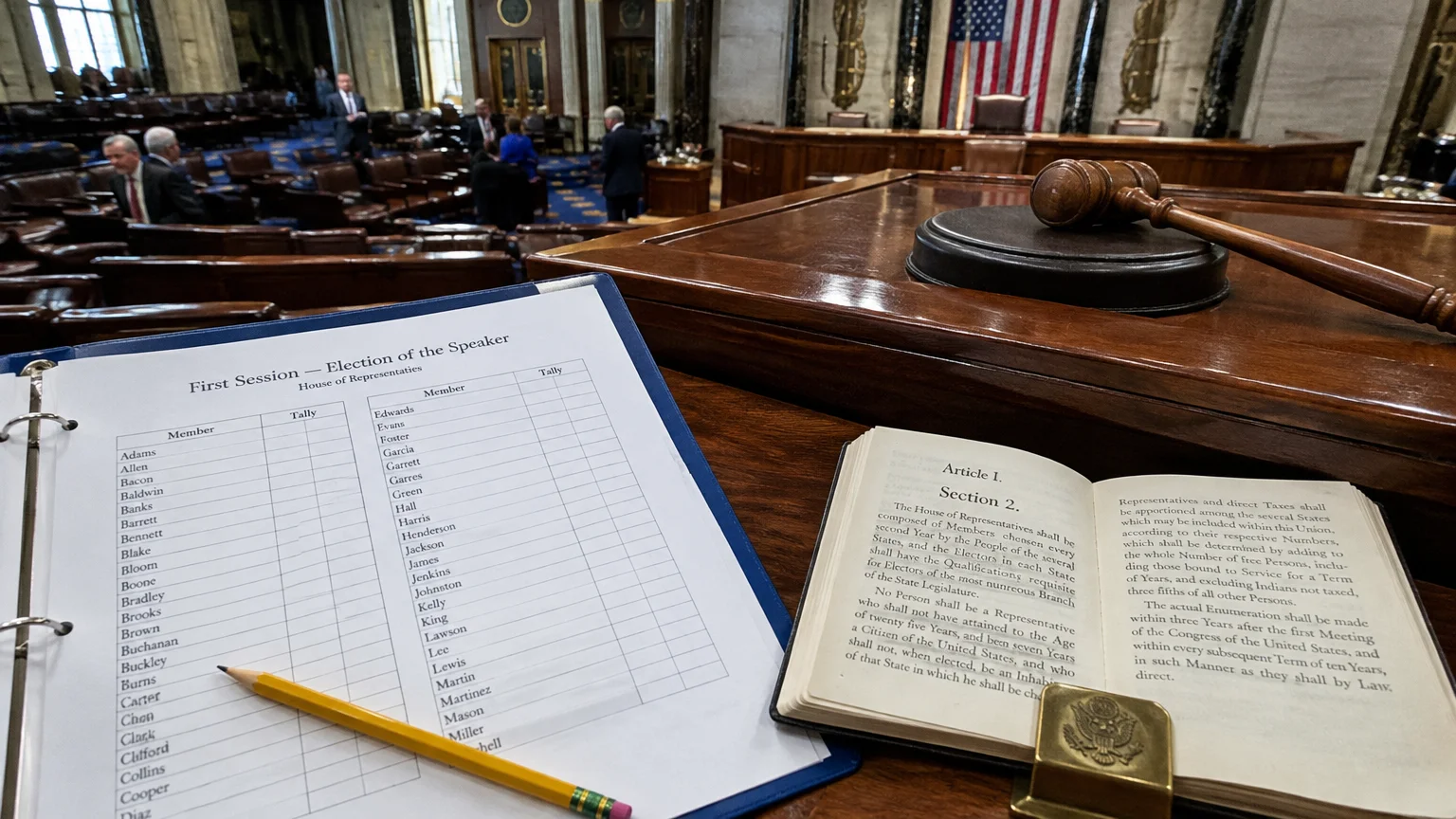
The office of the Speaker derives its authority directly from Article I, Section 2 of the U.S. Constitution, which states that the House “shall chuse their Speaker and other Officers.”
As an institutional officer representing the entire chamber, the Speaker signs enrolled bills, administers the oath of office to members, and exercises broad statutory duties.
Under the Presidential Succession Act of 1947, codified at 3 U.S.C. § 19, the Speaker stands second in the presidential line of succession immediately behind the Vice President. The Speaker also commands institutional offices funded by formal congressional appropriations.
By contrast, positions such as Majority Leader, Minority Leader, Whip, and Caucus Chair do not appear in the Constitution. Political parties created these roles in the late 19th and early 20th centuries to manage floor strategy and party discipline.
The House Republican Conference and the Democratic Caucus operate as voluntary political associations governed by internal rules rather than federal statutes. Neither the Majority Leader nor any other party officer stands in the statutory presidential line of succession.
2. Secret Ballots Versus Public Roll-Call Votes
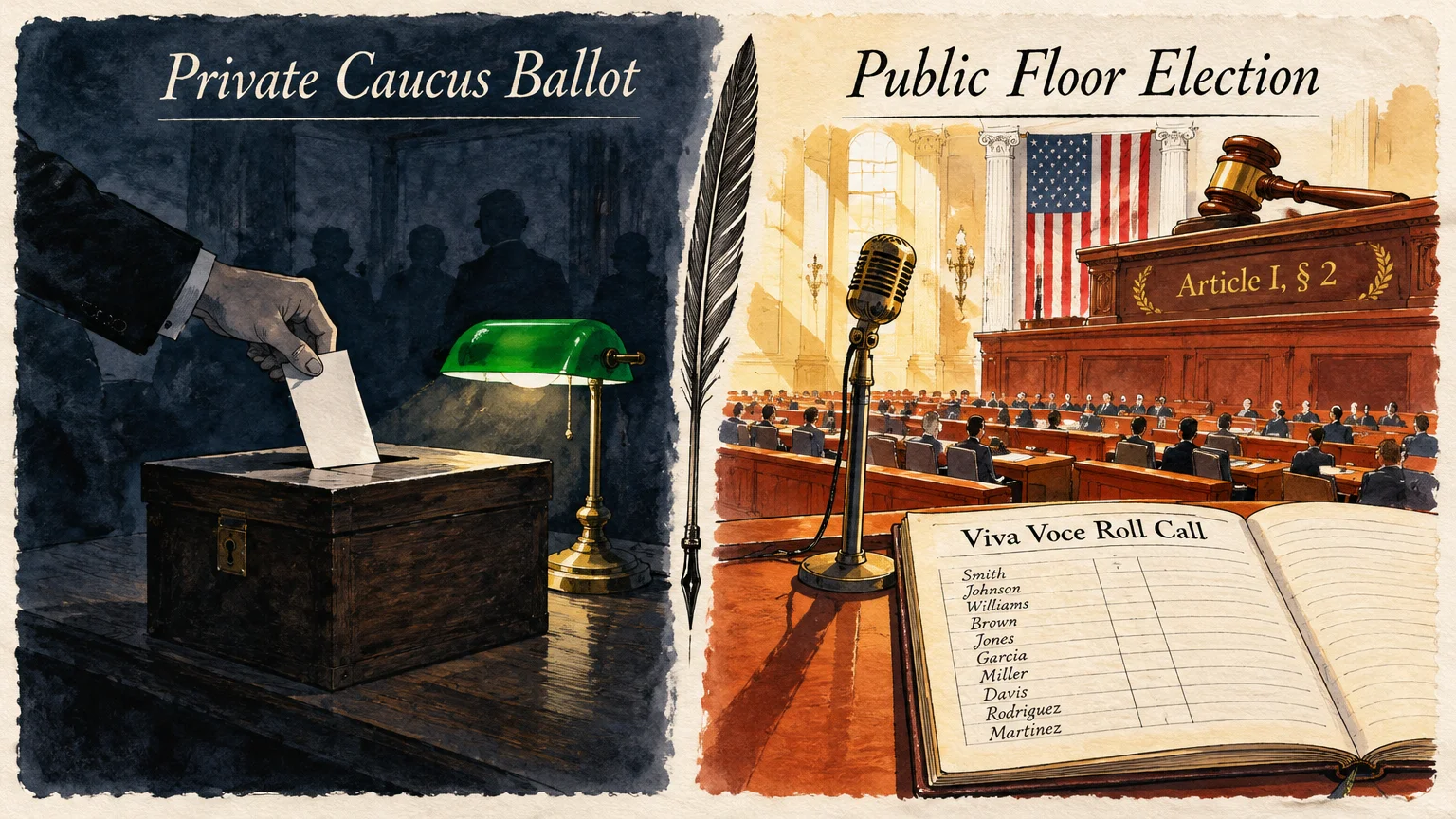
Internal party leadership elections take place behind closed doors away from public observation and television cameras. Both the Democratic Caucus and the Republican Conference conduct these contested organizational votes by secret paper or electronic ballot inside Capitol complex meeting rooms.
Because no public roll call records individual ballots in caucus elections, lawmakers can vote against party incumbents without immediate public scrutiny. Members can challenge party leaders in November without automatically risking committee assignments or campaign support.
Conversely, the official election for Speaker of the House is completely public.
Under House Rule XX, the Clerk of the House calls the roll of members-elect alphabetically for a viva voce (voice) vote, requiring each member to state the surname of their preferred candidate aloud on the floor.
Every response is published in the permanent Congressional Record and cataloged in the Office of the Historian Speaker Election Records going back to 1789.
This public roll call allows small legislative factions to withhold their votes on national television to extract procedural concessions before handing a nominee the gavel.
3. Delegate and Resident Commissioner Voting Rights
The House includes six non-voting members representing American Samoa, the District of Columbia, Guam, the Northern Mariana Islands, the U.S. Virgin Islands, and Puerto Rico. Five serve two-year terms as Delegates, while Puerto Rico’s representative serves a four-year term as Resident Commissioner.
Inside both the Democratic Caucus and the Republican Conference, these six officials hold full party membership rights. Both party rulebooks permit Delegates and the Resident Commissioner to vote in November leadership elections, select committee ranking members, and cast ballots for the party’s Speaker nominee.
When the House convenes on the floor on January 3, Article I of the Constitution restricts the election of House officers to representatives chosen by the people of the several States.
Because territories and the federal district are not States under Article I, the Clerk excludes Delegates and the Resident Commissioner from the roll call for Speaker.
This constitutional restriction limits the floor electorate strictly to the 435 state representatives-elect. A candidate who wins a narrow November caucus nomination using territorial delegate ballots must secure replacement votes from state representatives to win on the floor in January.
4. Majority Threshold Calculations and Floor Math
Winning an internal party nomination generally requires a majority of caucus or conference members present and voting—typically around 110 votes depending on the size of the majority conference.
Winning the Speaker’s gavel on the House floor requires an absolute majority of all members-elect voting for an individual by name.
When all 435 members are present and vote for a named candidate, the winning threshold is 218 votes. Members who vote “present” or abstain are excluded from the denominator of votes cast for named individuals, which lowers the required majority threshold below 218.
During the January 3–7, 2023 election—the longest contest since Nathaniel Banks required 133 ballots in 1855–1856—Kevin McCarthy needed 15 floor ballots to win the gavel.
McCarthy prevailed on the 15th ballot with 216 votes after six Republican colleagues voted “present,” dropping the required majority threshold to 215.
After the House removed McCarthy in October 2023, the Republican Conference nominated Steve Scalise, Jim Jordan, and Tom Emmer in successive closed-door ballots, though only Jordan went to the floor and lost across three roll calls.
On October 25, 2023, fourth nominee Mike Johnson won the speakership on the fourth overall floor ballot with all 220 Republicans present voting for him.
At the opening of the 119th Congress on January 3, 2025, Johnson won re-election on the first ballot with 218 votes to Democratic Leader Hakeem Jeffries’s 215 votes.
Johnson cleared the threshold only after two Republican members switched their floor votes before the Clerk closed the roll.
5. Member Eligibility and Outside Candidate Rules
Democratic Caucus and Republican Conference rules restrict internal leadership offices—such as Majority Leader, Minority Leader, Whip, and Conference Chair—exclusively to sitting members-elect of the House. Outside citizens, former lawmakers, and executive officials cannot run for party conference posts.
By contrast, Article I, Section 2 of the Constitution states simply that the House “shall chuse their Speaker” without explicitly requiring the Speaker to be an elected member of the House.
While constitutional text leaves outside eligibility open in theory, all 56 individuals elected Speaker since 1789 have been sitting House members.
During public floor roll calls, representatives-elect occasionally cast protest votes for non-members. In modern Speaker elections, lawmakers have placed official floor votes for non-members including Colin Powell, John Kasich, and Donald Trump.
The Clerk of the House records every spoken vote for a non-member in the official tally published in the Congressional Record. No non-member candidate has ever approached the majority threshold required to win the office.
6. Removal Procedures and Motion to Vacate Thresholds
Removing an internal party leader such as a Majority Leader or Whip is handled privately under conference or caucus bylaws. Members can petition for a closed-door recall vote without halting floor legislation or creating a statutory record.
Removing a sitting Speaker requires a formal floor vote on a privileged resolution known as a “Motion to Vacate the Chair.”
On October 3, 2023, the House removed a sitting Speaker for the first time in U.S. history when it adopted House Resolution 757 (Roll Call No. 519) by a 216–210 vote, vacating the office held by Kevin McCarthy.
That 2023 vote took place under a 118th Congress rule permitting any single member to offer a privileged motion to vacate, allowing one Republican to force the vote and eight Republicans to join 208 Democrats in passing it.
When organizing the 119th Congress on January 3, 2025, the House amended its rules so that a privileged motion to vacate now requires the joint sponsorship of at least nine members of the majority party.
Federal law also distinguishes the institutional speakership from party leadership posts through statutory pay grades frozen since 2009. As of 2026, the Speaker receives an annual salary of $223,500, while the Majority and Minority Leaders earn $193,400 and rank-and-file representatives receive $174,000.
Comparing Speaker Floor Elections to Party Caucus Ballots
The following table summarizes the constitutional, procedural, and statutory rules separating private party leadership elections from the official floor vote for Speaker of the House.
| Feature | Party Caucus Vote | House Floor Speaker Vote |
|---|---|---|
| Legal Authority | Internal party bylaws | U.S. Constitution (Article I, Section 2) |
| Timing | Mid-November organizational meetings | January 3 at noon (Twentieth Amendment) |
| Ballot Format | Private secret ballot or acclamation | Public viva voce roll-call vote |
| Territorial Delegates | Fully eligible to vote | Constitutionally prohibited from voting |
| Winning Threshold | Simple majority of caucus present | Absolute majority of all votes cast by name |
| Candidate Eligibility | Members-elect only | Not constitutionally restricted to members |
| Removal Mechanism | Internal caucus recall vote | Privileged Motion to Vacate the Chair |
| Presidential Succession | None | Second in line (3 U.S.C. § 19) |
| Statutory Salary | $193,400 (Leaders) / $174,000 (Others) | $223,500 |
Connecting Party Nominations to the Constitutional Floor Mandate
The U.S. Constitution does not mention political parties, establishing the speakership instead as an institutional office elected by the entire House.
When a majority party holds a wide seat margin, the January floor vote typically ratifies the November caucus nominee on the first ballot without incident.
In Congresses with narrow majorities, small factions can withhold floor votes in January to negotiate rules changes and committee assignments.
Because the Speaker presides over the full chamber and stands second in the presidential line of succession, only a public majority vote on the House floor confers constitutional authority.
Frequently Asked Questions About Speaker and Leadership Elections
Why do party conferences hold leadership votes in November if the floor vote is in January?
Parties hold organizational meetings in November so incoming leaders can hire staff, allocate office space, make committee assignments, and draft the House rules package before the term starts.
Selecting party officers early allows the prospective majority to negotiate floor procedures prior to noon on January 3.
Can a member vote for a different Speaker candidate on the floor than they supported in caucus?
Yes. Party caucus rules have no legal force during the constitutional floor election, so a representative who supported one candidate by secret ballot in November can publicly vote for anyone during the January roll call, subject only to internal party discipline.
What happens if no Speaker candidate reaches 218 votes on the first floor ballot?
If no candidate wins an absolute majority of the votes cast for named individuals, the Clerk repeats the roll-call vote until someone clears the threshold.
Under federal law and House precedent, the chamber cannot swear in members, adopt rules, or consider legislation until a Speaker is elected.
Does a Speaker candidate have to be an elected member of the House of Representatives?
Article I, Section 2 of the Constitution does not explicitly require the Speaker to be an elected representative, and members occasionally cast floor protest votes for non-members.
However, all 56 Speakers in U.S. history have been sitting members of the House at the time of their election.