Since the Cold War, private-sector technology executives and defense contractors have shaped federal spending, national security, and regulatory law. Their management systems, proprietary platforms, and lobbying expenditures continually alter how executive agencies operate.
This guide examines seven turning points where corporate leaders and federal contractors redefined U.S. policy. Each entry cites the statutory records, contract disputes, and executive directives that govern these public-private relationships.

Evaluating Public-Private Influence in the Federal Government
This list tracks seven turning points from 1960 through 2026 where private executives and corporate contractors altered federal operations. Entries are drawn from enacted statutes, federal court dockets, executive orders, and procurement records.
Each milestone marks a documented shift in how federal agencies buy technology, manage budgets, or delegate operational authority to commercial vendors. The entries appear in chronological order.
1. Robert McNamara and Systems Analysis in Defense Procurement
On November 9, 1960, Robert McNamara became the first president of Ford Motor Company from outside the Ford family. Five weeks later, President-elect John F.
Kennedy recruited him to serve as Secretary of Defense.
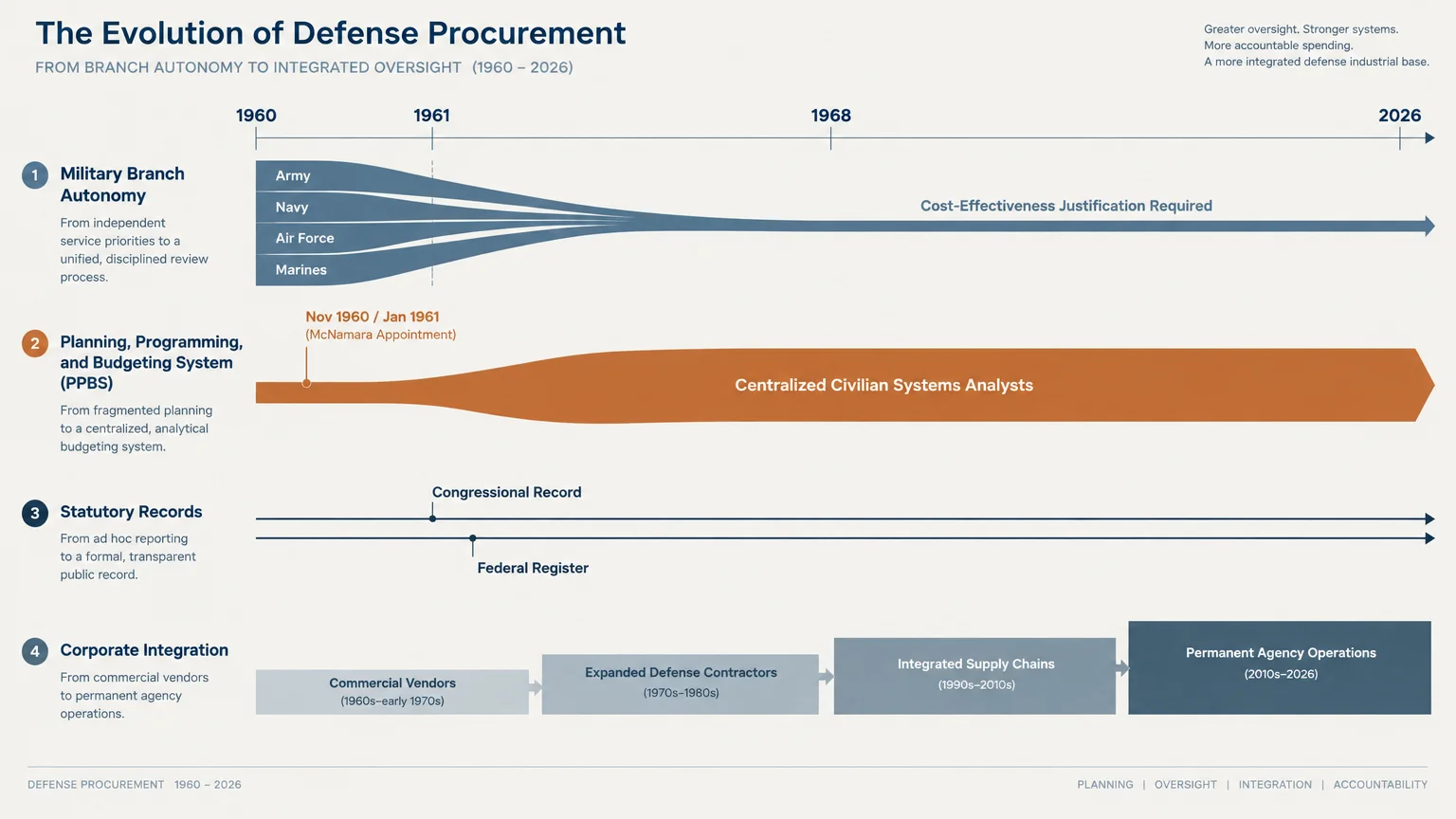
McNamara led the Pentagon from January 1961 to February 1968. He brought corporate statistical control methods into the military establishment to manage budgets and weapon acquisition programs.
Before McNamara’s appointment, individual military branches lobbied Congress independently for duplicate weapon systems. McNamara centralized control under civilian systems analysts, establishing the Planning, Programming, and Budgeting System (PPBS) to evaluate procurement through quantitative metrics.
This framework required military commanders to justify hardware requirements using cost-effectiveness data, concentrating budget authority within civilian secretariats. President Kennedy outlined these defense management reforms in a special message archived at the American Presidency Project.
In August 1965, President Lyndon B. Johnson ordered all federal cabinet departments to adopt McNamara’s PPBS budgeting method.
2. Dwight D. Eisenhower’s Warning on the Scientific-Technological Elite
President Dwight D. Eisenhower delivered his televised farewell address to the nation on January 17, 1961.
The speech established a lasting benchmark for evaluating federal defense and research contracting.
Eisenhower warned against the acquisition of unwarranted influence by the military-industrial complex. He paired that warning with an urgent caution regarding federally funded scientific research and technology.
He observed that the solitary inventor had been overshadowed by task forces of scientists in laboratories and testing fields. Eisenhower warned that public policy could “become the captive of a scientific-technological elite.”
The original transcript and audio recording of the speech are preserved in the National Archives milestone documents collection. Between 1940 and 1960, federal spending on research and development rose from under $100 million to over $8 billion annually.
3. The HealthCare.gov Tech Surge and the U.S. Digital Service
The federal health insurance exchange website, HealthCare.gov, crashed immediately following its public launch on October 1, 2013. The system failure immobilized the signature domestic enrollment portal of the Affordable Care Act.
Traditional federal procurement rules had produced fragmented code across dozens of legacy IT contracting firms. To rescue the exchange, the Obama administration recruited private-sector Silicon Valley engineers and technology executives.
Former Google engineer Mikey Dickerson led the emergency “tech surge” that stabilized the portal by implementing commercial agile development and cloud tools. Following the rescue, the White House institutionalized this model on August 11, 2014, by creating the United States Digital Service (USDS).
The administrative scope of the unit is detailed in the Federal Register notice establishing the USDS. Operating inside the Office of Management and Budget, the USDS placed commercial technology managers directly inside cabinet agencies to overhaul federal software procurement.
4. Commercial Spaceflight Agreements and NASA’s Public-Private Shift
For five decades, NASA relied on cost-plus contracts to develop human spaceflight systems. Under that model, the federal government owned the rockets, while aerospace contractors billed the agency for development costs plus guaranteed fees.
Rising shuttle costs and budget constraints prompted a structural reform under the Commercial Orbital Transportation Services (COTS) and Commercial Crew programs. NASA utilized Space Act Agreements under 51 U.S.C. § 20113(e) to issue fixed-price milestone payments.
Private companies such as SpaceX and Boeing retained ownership of their spacecraft and sold transportation services to the government. Congress codified this public-private partnership framework in the NASA Authorization Act of 2010 (S. 3729 on Congress.gov).
On May 30, 2020, SpaceX’s Demo-2 mission launched NASA astronauts Bob Behnken and Doug Hurley to the International Space Station on the first crewed orbital flight aboard a privately owned spacecraft.
5. The Pentagon Cloud Procurement Battles from JEDI to JWCC
In 2018, the Department of Defense launched the Joint Enterprise Defense Infrastructure (JEDI) program to consolidate military cloud computing. The Pentagon structured JEDI as a single-vendor contract valued at up to $10 billion over ten years.
In October 2019, the Department awarded the sole-source agreement to Microsoft. Amazon Web Services challenged the award in the U.S. Court of Federal Claims under Docket No. 19-1796C, alleging political interference by President Donald Trump against Amazon founder Jeff Bezos.
Oracle also mounted legal and regulatory protests under the Competition in Contracting Act. Facing prolonged litigation, the Pentagon canceled the JEDI contract on July 6, 2021, and abandoned the single-vendor model.
On December 7, 2022, the Department of Defense awarded the replacement Joint Warfighting Cloud Capability (JWCC) contract, splitting a $9 billion ceiling among Amazon Web Services, Microsoft, Google, and Oracle.
6. Federal Subsidies and Supply Chain Directives via the CHIPS and Infrastructure Acts
Global supply chain disruptions in the early 2020s exposed American reliance on foreign semiconductor manufacturing. In response, technology executives backed federal legislation to secure direct industrial subsidies.
President Joe Biden signed the Infrastructure Investment and Jobs Act on November 15, 2021, allocating $65 billion for broadband expansion, including $42.45 billion for the Broadband Equity, Access, and Deployment (BEAD) program. On August 9, 2022, Congress enacted the CHIPS and Science Act (H.R. 4346 on Congress.gov).
The CHIPS Act authorized $52.7 billion in direct subsidies for domestic semiconductor manufacturing and research alongside a 25% advanced manufacturing investment tax credit estimated at $24 billion.
Technology companies spent $85.6 million on federal lobbying in 2024 to shape implementation rules, AI policies, and antitrust oversight, with Meta spending $13.8 million across 86 lobbyists in early 2025.
7. The U.S. DOGE Service Reorganization and Federal Contract Cancellations
During the 2024 presidential campaign, entrepreneur Vivek Ramaswamy and SpaceX and Tesla CEO Elon Musk proposed an outside commission to cut federal spending. President-elect Donald Trump announced the Department of Government Efficiency (DOGE) framework on November 12, 2024.
Ramaswamy left the initiative on January 20, 2025, to run for Governor of Ohio. That same day, President Trump signed Executive Order 14158, restructuring the United States Digital Service into the U.S. DOGE Service within the Executive Office of the President.
Serving as a Senior Advisor without Senate confirmation, Musk oversaw teams that reviewed agency databases, canceled more than 1,400 federal grants and procurement contracts, and initiated workforce reductions across civil service agencies.
Operating under an 18-month sunset clause, as of October 2026, the U.S. DOGE Service formally dissolved on its scheduled charter expiration date of July 4, 2026.
Comparing Key Public-Private Policy Milestones
The table below summarizes the seven milestones where corporate executives, bid protests, and contracting reforms reshaped federal policy. Each entry lists the key figures, governing authority, and administrative outcome.
| Era / Initiative | Key Private or Public Figures | Governing Authority | Major Policy Outcome |
|---|---|---|---|
| Defense Systems Analysis (1961) | Robert McNamara | DOD Directive 5010.8 | Centralized military budgeting under corporate data metrics |
| Farewell Address Warning (1961) | Dwight D. Eisenhower | U.S. Presidential Farewell | Defined public oversight standards for federal defense contracting |
| USDS Tech Surge (2013–2014) | Mikey Dickerson | Executive Order Charter | Embedded commercial agile software engineers inside federal agencies |
| Commercial Spaceflight (2010) | Elon Musk, Gwynne Shotwell | 51 U.S.C. § 20113(e) | Replaced cost-plus rockets with fixed-price private flight services |
| Pentagon Cloud (2018–2022) | Jeff Bezos, Satya Nadella | 41 U.S.C. § 3301 | Forced defense agencies to adopt multi-vendor cloud architectures |
| CHIPS & Broadband (2021–2022) | Tech & Telecom Executives | Public Law 117-167 | Subsidized domestic chip fabrication with $52.7 billion in grants |
| U.S. DOGE Service (2025–2026) | Elon Musk, Vivek Ramaswamy | Executive Order 14158 | Canceled 1,400+ grants and voided contracts prior to July 2026 sunset |

How Tech Procurement Rewrote Federal Governance
Across these seven milestones, the federal government shifted from owning custom-built technical systems to buying commercial services from private firms. In the 1960s, private executives imported statistical management into cabinet agencies while the government retained hardware ownership.
By the 2020s, commercial contractors retained title to the underlying code, cloud servers, and orbital launch vehicles used for federal missions. This transition also altered federal acquisition rules.
Traditional procurement relied on the Federal Acquisition Regulation (FAR) and audited cost-plus accounting to prevent contractor fraud. Technology firms pushed agencies toward flexible pathways, including Other Transaction Authority (OTA) agreements and fixed-price commercial milestones.
These instruments accelerate technology deployment across executive departments while reducing routine congressional line-item oversight. Campaign contributions and lobbying disclosures further document this influence, with corporate political action committee filings searchable through the Federal Election Commission data portal.
Frequently Asked Questions About Private Contractors and Federal Policy
How do federal ethics and conflict-of-interest laws apply to tech executives who advise the president?
Federal ethics standards depend on an individual’s formal employment classification. Full-time civil servants must follow strict financial disclosure and recusal rules under 18 U.S.C. § 208.
However, tech leaders frequently serve on advisory panels or as Special Government Employees (SGEs) appointed for no more than 130 days in a 365-day period.
SGEs face modified restrictions depending on their days worked, while unpaid outside advisors without formal government appointments operate outside standard civil service conflict-of-interest statutes.
What is the difference between a standard federal contract and an Other Transaction Authority agreement?
Standard federal procurement contracts are governed by the Federal Acquisition Regulation (FAR), which requires competitive bidding, audited cost accounting, and standard government intellectual property clauses.
In contrast, Other Transaction Authority (OTA) agreements under statutes such as 10 U.S.C. § 4022 allow defense and space agencies to bypass the FAR when acquiring research and commercial prototypes.
OTAs function like commercial agreements, giving technology companies flexibility to negotiate intellectual property retention, fixed milestone payments, and cost-sharing terms.
Can commercial contractors legally make sovereign policy decisions or manage civil service personnel?
Federal law prohibits private contractors from performing “inherently governmental functions,” as defined by the Federal Activities Inventory Reform Act of 1998 (Public Law 105-270) and OMB Circular A-76.
Inherently governmental functions include determining national defense policy, commanding military forces, obligating federal funds, and hiring or firing civil service employees.
Contractors and outside advisors may analyze agency data, recommend reductions, and operate digital systems, but an authorized government official must formally sign every binding grant termination, regulation, or personnel action.
Where are federal contracting dollars and corporate lobbying disclosures recorded?
Federal contract awards, grants, and direct loans are recorded in the official public database at USAspending.gov, established under the Federal Funding Accountability and Transparency Act of 2006. The platform tracks agency disbursements by vendor name, congressional district, and industry code.
Quarterly lobbying disclosures filed under the Lobbying Disclosure Act of 1995 are maintained by the Senate Office of Public Records and the Clerk of the House, while corporate PAC contributions are published by the Federal Election Commission.