Federal lobbying disclosure laws create a transparent public record that exposes who pays to influence your government. You can use these mandatory filings to track special interest spending and hold your elected officials accountable.
Popular culture often portrays lobbying as suitcases of cash exchanged in smoke-filled rooms. In reality, statutory frameworks, rigid disclosure deadlines, strict gift bans, and heavy civil penalties closely regulate the entire influence industry.
Knowing how these disclosure statutes operate empowers you to separate genuine influence campaigns from common political folklore. Here is how federal statutes actually govern influence peddling in Washington.
How Federal Disclosure Laws Track Influence on Capitol Hill
This guide examines ten persistent misconceptions about federal lobbying by comparing them directly against codified statutes and ethics standards. We inspect the U.S. Code, official congressional rules, and public disclosure databases maintained on Capitol Hill.
Our analysis covers the Lobbying Disclosure Act of 1995, the Honest Leadership and Open Government Act of 2007, and official reporting thresholds adjusted through 2025. We evaluate primary records from the House, Senate, and Government Accountability Office.
Each entry details the governing statute, checkable legal thresholds, and specific forms you can inspect online. You will discover how public reporting enforces transparency and where statutory carve-outs leave significant influence campaigns unmonitored.
Lobbyists Can Legally Hand Cash or Extravagant Gifts to Lawmakers
Congressional ethics rules strictly prohibit lawmakers and staff from accepting gifts of any value from registered lobbyists. You will not find members of Congress legally taking luxury vacations, expensive sporting tickets, or steak dinners from registered advocates.
Congress enacted these prohibitions through the Honest Leadership and Open Government Act (HLOGA) of 2007, codified at Pub. L.
110-81. The Senate passed the measure 83 to 14, and the House approved it by a 411 to 8 vote.
Under House Rule 25 and Senate Rule 35, officials face an absolute gift ban from entities retaining lobbyists. While non-lobbyists may provide gifts under $50, registered advocates cannot buy a lawmaker a $15 lunch.
Violating these gift rules triggers public ethics investigations and civil penalties up to $200,000 for registered lobbyists. Lawmakers must pay fair market value or return prohibited gifts immediately to avoid ethics sanctions.
- Items valued under $10, such as pens, baseball caps, and greeting cards.
- Free admission and nominal meals at widely attended events featuring at least 25 non-congressional attendees.
- Nominal food and refreshments provided outside formal meals, including coffee and continental breakfast items.
Anyone Paid to Influence Federal Policy Must Register as a Lobbyist
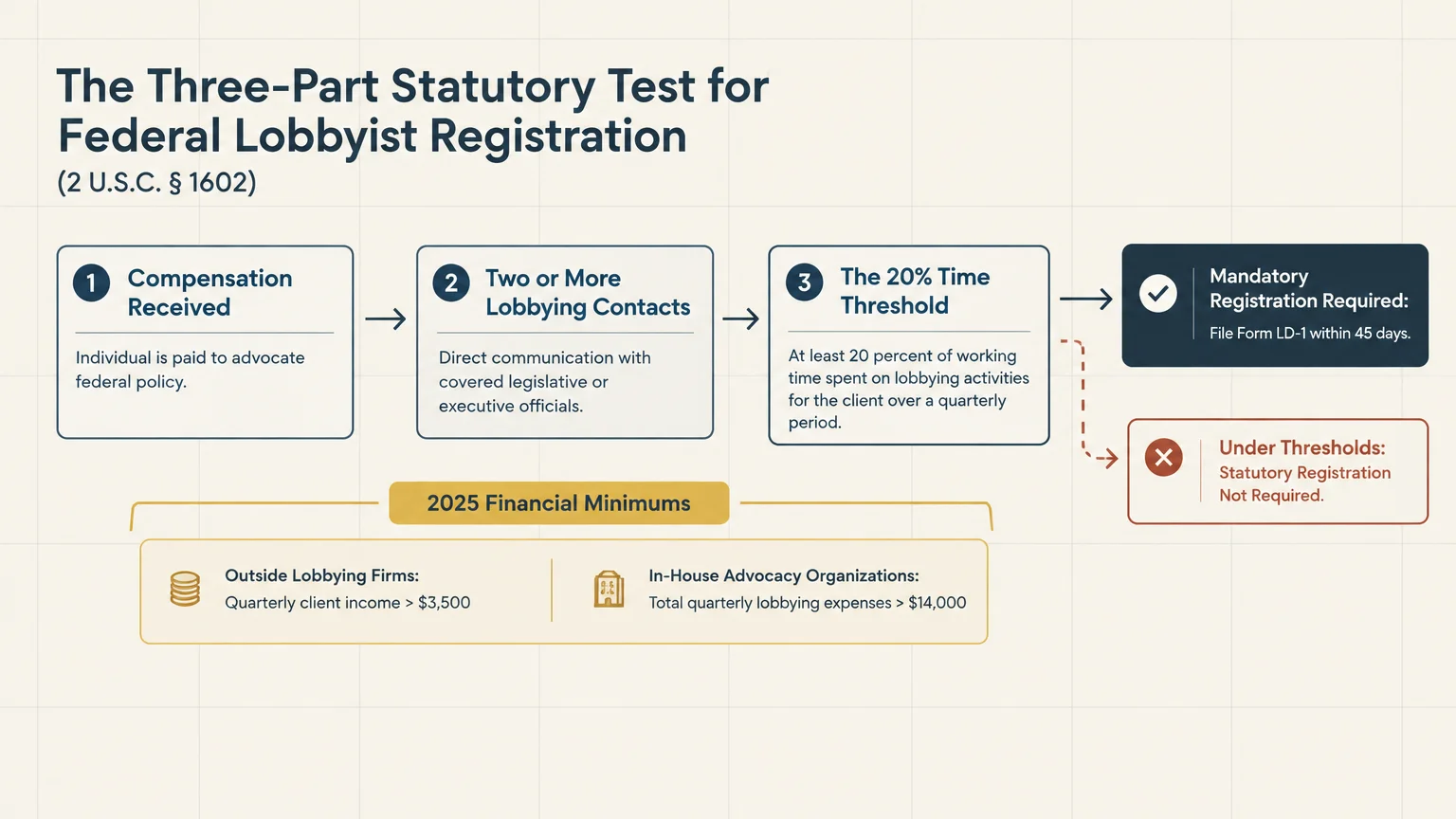
Earning money to shape public policy does not automatically make someone a registered lobbyist under federal law. The Lobbying Disclosure Act of 1995 establishes a rigid three-part statutory test under 2 U.S.C. § 1602.
An individual must receive compensation, make two or more lobbying contacts, and spend at least 20 percent of their working time for that client on lobbying activities over a quarterly period. Advocates under that threshold avoid registration.
Financial minimums also dictate reporting obligations. Effective January 1, 2025, outside lobbying firms must register on Form LD-1 only if quarterly income from a client exceeds $3,500, up from the prior $3,000 threshold.
In-house corporate or non-profit advocacy teams must register only when total organizational lobbying expenses exceed $16,000 within a quarter. Strategic consultants frequently exploit the 20 percent rule to avoid public registration altogether.
- Spending 20 percent or more of compensated time on client lobbying activities.
- Surpassing the $3,500 quarterly revenue threshold for outside lobbying firms.
- Exceeding the $16,000 quarterly internal expense threshold for in-house advocacy organizations.
Lobbying Only Targets Members of Congress
Federal lobbying extends well beyond Capitol Hill hearing rooms and legislative cloakrooms. The Lobbying Disclosure Act explicitly covers communications with executive branch decision-makers under 2 U.S.C. § 1602(3).
Covered executive branch officials include the President, Vice President, Cabinet secretaries, deputy secretaries, and senior agency leaders. Executive Schedule political appointees holding positions under 5 U.S.C. § 5312 through § 5316 trigger identical statutory reporting requirements.
Advocacy firms regularly target regulatory agencies responsible for drafting binding federal administrative rules. Quarterly filings show heavy advocacy directed at the Department of Commerce, the Department of the Treasury, and the Department of Health and Human Services.
You can inspect quarterly Form LD-2 filings to see which specific executive offices an organization contacted during any three-month window. Executive agency rulemakings often draw more corporate lobbying resources than routine congressional floor votes.
- Cabinet secretaries, assistant secretaries, and appointed agency directors.
- White House policy advisors and Executive Office of the President officials.
- Regulatory agency officials drafting administrative rules across the executive branch.
Former Officials Must Wait Forever Before Entering K Street
Federal revolving door restrictions do not permanently bar former officials from working on K Street. The federal criminal code, codified at 18 U.S.C. § 207, establishes strictly limited cooling-off periods rather than lifelong bans.
Under the 2007 HLOGA amendments, former U.S. Senators face a two-year ban on lobbying members or staff of either congressional chamber. Former U.S. Representatives face a one-year statutory restriction on lobbying Capitol Hill.
Senior congressional staff earning at least 75 percent of a member’s salary—set at $130,500 in 2025—face a one-year cooling-off period. Former House staff cannot lobby their former office, while former Senate staff cannot contact any senator.
These statutes restrict direct lobbying contacts but allow former officials to work immediately as strategic corporate advisors. By directing lobbying strategy behind the scenes without making direct contacts, former officials legally monetize their government experience.
- A two-year congressional lobbying ban for former U.S. Senators.
- A one-year lobbying prohibition for former U.S. Representatives.
- A one-year cooling-off restriction for senior congressional staff earning $130,500 or more.
Lobbying Disclosures Hide Who Really Pays for Advocacy
Federal disclosure laws prevent corporate and non-profit interests from hiding their identities behind opaque advocacy coalitions. Under 2 U.S.C. § 1603(b), registrants must publicly disclose any outside organization contributing more than $5,000 toward lobbying efforts.
Lobbying registrants must also identify any affiliated organization that actively participates in planning, directing, or coordinating advocacy activities. Furthermore, filers must disclose foreign entities that own at least 20 percent of the lobbying client.
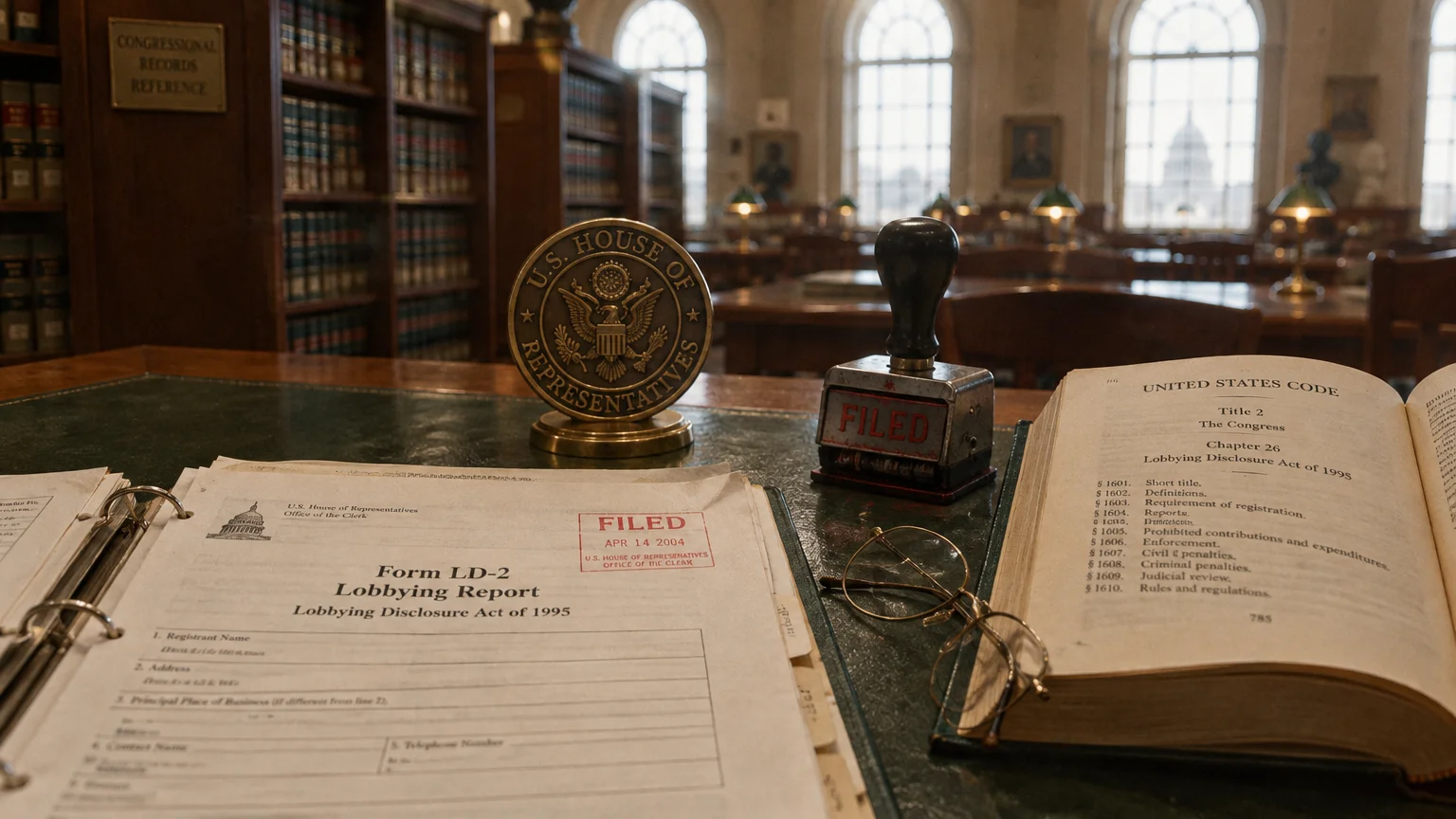
Registered entities report their advocacy revenue and expenses every quarter on Form LD-2 within 20 days after each calendar quarter ends. Filers must itemize specific statutory bill numbers, issue codes, and the names of individual participating lobbyists.
You can inspect these records through the public database maintained by the Clerk of the U.S. House of Representatives. These transparent filings reveal exactly which commercial entities provide financial backing for specific lobbying initiatives.
- Disclosure of outside contributors providing over $5,000 to an advocacy campaign.
- Reporting of foreign entities holding at least a 20 percent ownership stake.
- Itemization of specific legislative bill numbers and executive branch issue codes.
Grassroots Public Pressure Campaigns Face the Same Reporting Rules as Direct Lobbying
Large-scale public mobilization campaigns operate entirely outside federal lobbying disclosure requirements. Under 2 U.S.C. § 1602(8), the Lobbying Disclosure Act explicitly excludes grassroots advocacy efforts from all registration and reporting mandates.
When interest groups spend millions of dollars on television advertisements, social media campaigns, and digital petitions, they file zero lobbying disclosure forms. Federal law regulates direct communications with government officials rather than broad public communications.
Advocacy organizations deliberately pair minimal direct lobbying with massive grassroots public relations budgets to avoid statutory disclosure. This tactical division allows special interests to spend substantial sums shaping public opinion without revealing expenditure ledgers.
Congress considered closing this grassroots reporting exemption during the 2007 HLOGA debate, but lawmakers rejected the provision over First Amendment concerns. As a result, millions of dollars spent on indirect public advocacy remain completely undisclosed.
- Broadcast and cable television advertisements urging constituents to contact Congress.
- Targeted social media issue advertising designed to generate constituent phone calls.
- Automated online form petitions distributed to voters by non-profit advocacy organizations.
Foreign Governments Lobby Washington Through the Same Channels as Domestic Corporations
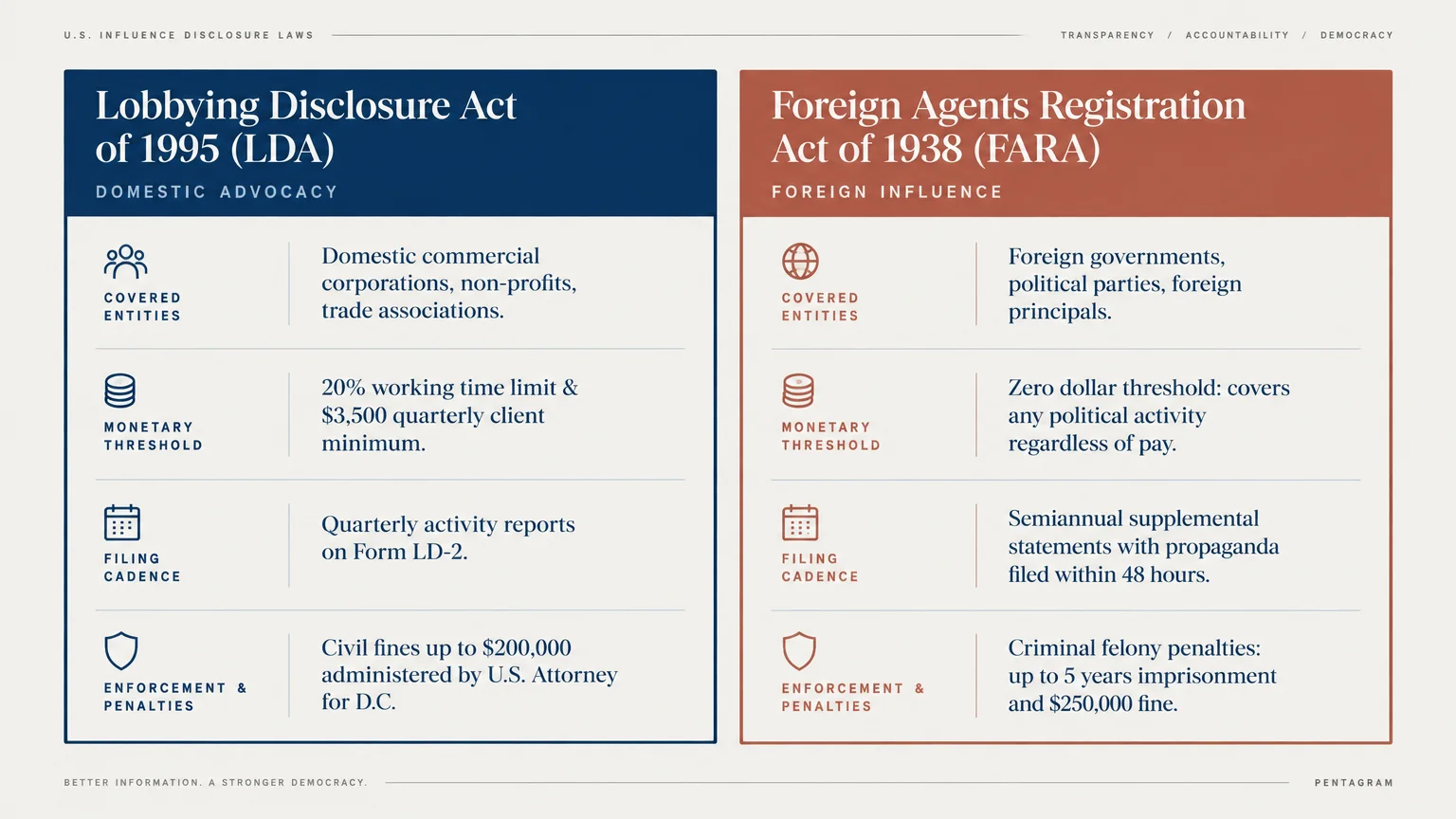
Foreign governments and foreign political parties do not use domestic Lobbying Disclosure Act channels to advocate in Washington. Instead, they must register under the Foreign Agents Registration Act of 1938 (FARA), codified at 22 U.S.C. § 611.
FARA establishes far more demanding transparency standards than domestic lobbying statutes. The law contains no 20 percent time carve-out and no minimum financial threshold, requiring registration within ten days of agreeing to represent a foreign principal.
Foreign agents must submit detailed supplemental disclosure statements every six months to the Department of Justice National Security Division. These public filings record all meetings, telephone calls, compensation receipts, and disbursements made on behalf of the foreign client.
Foreign agents must also label all informational materials distributed to two or more individuals and submit copies to the DOJ. In February 2025, the Justice Department reaffirmed that civil and administrative monitoring of FARA registrants remains actively enforced.
- Mandatory registration with the Department of Justice within ten calendar days.
- Itemized semi-annual supplemental statements disclosing all activities and financial transactions.
- Compulsory labeling and filing of informational advocacy materials distributed to the public.
Lobbying Is an Unregulated Loophole Outside the Constitution
Lobbying is not an extralegal loophole or an accidental oversight in federal law. The First Amendment to the United States Constitution explicitly protects the right of the people to “petition the Government for a redress of grievances.”
Because petitioning is a core constitutional right, Congress cannot ban the lobbying profession or arbitrarily outlaw advocacy. However, the Supreme Court has repeatedly affirmed that lawmakers possess the constitutional authority to mandate public transparency.
In United States v. Harriss, 347 U.S. 612 (1954), the Supreme Court upheld federal lobbying disclosure requirements. The justices held that Congress has a vital interest in knowing who is being hired to influence legislation.
Subsequent rulings, including Eastern Railroad Presidents Conference v. Noerr Motor Freight, Inc., 365 U.S. 127 (1961), protected collective advocacy from antitrust statutes.
These decisions ensure that federal lobbying laws focus on disclosure rather than prohibition.
- The First Amendment constitutional guarantee protecting the right to petition elected officials.
- Supreme Court precedent affirming mandatory disclosure under United States v. Harriss.
- Statutory frameworks designed to illuminate advocacy without infringing upon free speech rights.
Campaign Contributions Buy Direct Quid Pro Quo Floor Votes
Exchanging campaign contributions directly for official legislative acts is a federal felony punishable by lengthy prison sentences. The federal bribery statute, codified at 18 U.S.C. § 201(b), strictly outlaws corrupt agreements between donors and public officials.
In McCormick v. United States, 500 U.S. 257 (1991), the Supreme Court established that campaign contributions violate anti-corruption statutes only when prosecutors prove an explicit, direct quid pro quo exchange.
Vague political access does not constitute statutory bribery.
Lobbyists build influence through lawful access, technical research, and candidate fundraising rather than illegal floor vote trades. Under federal rules, lobbyists must disclose their personal political campaign donations semiannually on Form LD-203 filings.
Federal campaign committees must also report campaign funds collected and delivered by registered lobbyist bundlers. These multi-layered disclosure mechanisms ensure that political fundraising networks remain fully visible to federal watchdogs and the voting public.
- Criminal penalties under 18 U.S.C. § 201 for explicit vote-buying arrangements.
- Semiannual Form LD-203 filings disclosing lobbyist personal political contributions.
- Mandatory Federal Election Commission reporting of lobbyist-bundled campaign donations.
Federal Agencies and Enforcement Bodies Never Audit or Penalize Lobbying Violations
Federal lobbying oversight is not a toothless system relying on self-policing by K Street firms. Under 2 U.S.C. § 1605(a)(8), the Government Accountability Office (GAO) conducts mandatory annual compliance audits of registered lobbyists.
GAO auditors examine a randomized sample of Form LD-2 reports annually, verifying supporting financial records and registered client agreements. When filers fail to document their reports or ignore statutory deadlines, officials refer them for federal investigation.
Under the Honest Leadership and Open Government Act, knowing and willful failure to file carries civil fines up to $200,000. Deliberate disclosure violations also carry criminal penalties of up to five years in federal prison.
The Clerk of the House and Secretary of the Senate refer hundreds of non-compliant filers to the U.S. Attorney’s Office for the District of Columbia each year. Federal prosecutors pursue civil settlements and demand back compliance from delinquent lobbying firms.
- Annual randomized audits conducted by the Government Accountability Office.
- Civil monetary penalties reaching $200,000 for willful statutory non-compliance.
- Criminal prison terms of up to five years for fraudulent disclosure evasions.
Key Differences Across Federal Advocacy Frameworks
To help you navigate these disclosure standards, the following table compares the statutory requirements across different categories of federal advocacy. It highlights the specific thresholds, disclosure forms, and oversight agencies governing Washington influence.
| Advocacy Category | Governing Statute | Statutory Threshold | Primary Filing | Oversight Body |
|---|---|---|---|---|
| Outside Lobbying Firm | Lobbying Disclosure Act (2 U.S.C. § 1602) | Income over $3,500/quarter; 20% time test | Form LD-1 & Form LD-2 | House Clerk & Senate Secretary |
| In-House Organization | Lobbying Disclosure Act (2 U.S.C. § 1602) | Expenses over $16,000/quarter; 20% time test | Form LD-1 & Form LD-2 | House Clerk & Senate Secretary |
| Foreign Principal Agent | Foreign Agents Registration Act (22 U.S.C. § 611) | Compensated foreign advocacy; no dollar floor | FARA Registration & Supplements | DOJ National Security Division |
| Former U.S. Senator | Criminal Code (18 U.S.C. § 207) | 2-year statutory cooling-off period | Direct lobbying prohibited | DOJ & Senate Ethics Committee |
| Former U.S. Representative | Criminal Code (18 U.S.C. § 207) | 1-year statutory cooling-off period | Direct lobbying prohibited | DOJ & House Ethics Committee |
| Lobbyist Political Funds | HLOGA & FECA (2 U.S.C. § 1604(e)) | Semiannual contribution reporting | Form LD-203 & FEC Form 3L | FEC & Congressional Ethics |
What Modern Disclosure Laws Mean for Public Accountability
Federal lobbying disclosure laws do not eliminate corporate or organized interest influence from the halls of power. Instead, they transform private legislative petitioning into an auditable public record that any citizen can review and inspect.
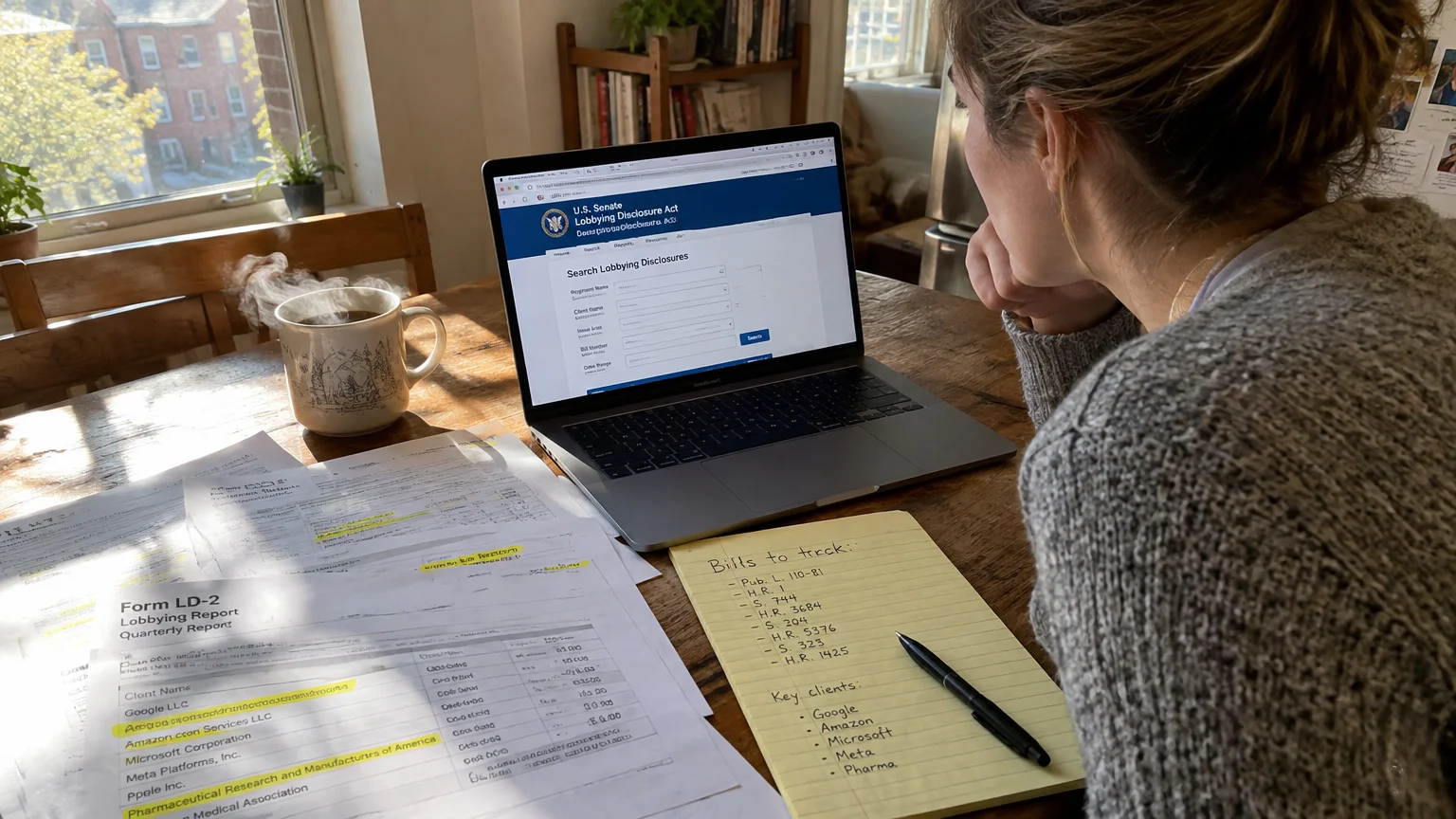
When you know the legal definitions and disclosure forms, you can easily trace the legislative goals of major corporate sectors. Federal filings reveal which bills special interests target, which agencies they lobby, and which individual advocates they deploy.
Significant transparency gaps certainly remain within the federal system, particularly the 20 percent time threshold and the exemption for grassroots campaigns. Strategic consultants and public relations firms utilize these statutory exceptions to shape federal policy without filing reports.
Despite these statutory exemptions, current disclosure requirements provide unprecedented transparency compared to historical eras of unregulated political influence. You can use these public tools to verify corporate lobbying claims and demand direct accountability from your elected representatives.
Frequently Asked Questions About Lobbying Transparency
Where can you search federal lobbying filings online for free?
You can search every filed disclosure through the official public databases maintained by the Clerk of the House and the Secretary of the Senate. These free search tools let you locate filings by lobbyist name, client organization, or bill number.
The online records update automatically as quarterly Form LD-2 reports and semiannual Form LD-203 filings arrive throughout the year. You do not need to register an account or pay subscription fees to inspect these public disclosure files.
How much money do organizations spend on federal lobbying each year?
Total reported federal lobbying spending reached an all-time record of $4.44 billion in 2024. Over 12,000 active registered lobbyists represented thousands of corporate entities, trade associations, and advocacy non-profits across the country.
By sector, pharmaceutical and health product companies consistently report the highest annual lobbying expenditures in Washington. Major trade federations like the U.S. Chamber of Commerce also routinely rank among the top individual organizational spenders.
Can everyday citizens lobby their elected representatives without registering?
Yes, you can petition your elected representatives at any time without filing federal registration paperwork or reporting expenses. The Lobbying Disclosure Act applies strictly to compensated advocates who meet specific financial and activity thresholds.
Your constitutional right to contact congressional offices, sign petitions, and attend town halls remains completely protected and unburdened. Uncompensated citizen advocacy operates entirely outside federal disclosure mandates, ensuring open access to your government.
What is the difference between Form LD-1 and Form LD-2?
Form LD-1 serves as the initial registration document that an advocacy firm or in-house team files when establishing a lobbying relationship. Registrants must submit this form within 45 days of making a qualifying contact or agreeing to provide representation.
Form LD-2 is the quarterly activity report detailing advocacy income, total expenses, targeted legislative bills, and contacted federal agencies. Filers must submit Form LD-2 within 20 days after each calendar quarter concludes.