While modern statistical research shows that running mates usually alter national voter margins by negligible amounts, specific vice presidential picks have repeatedly reversed Electoral College outcomes.
When battleground contests tighten to a few thousand votes, a running mate’s regional influence can secure the decisive electoral bloc.
Certified election returns and historical tallies from National Archives Electoral College records document nine pivotal elections where the vice presidential selection directly decided the national outcome.
Evaluating Vice Presidential Influence on Electoral College Ballots
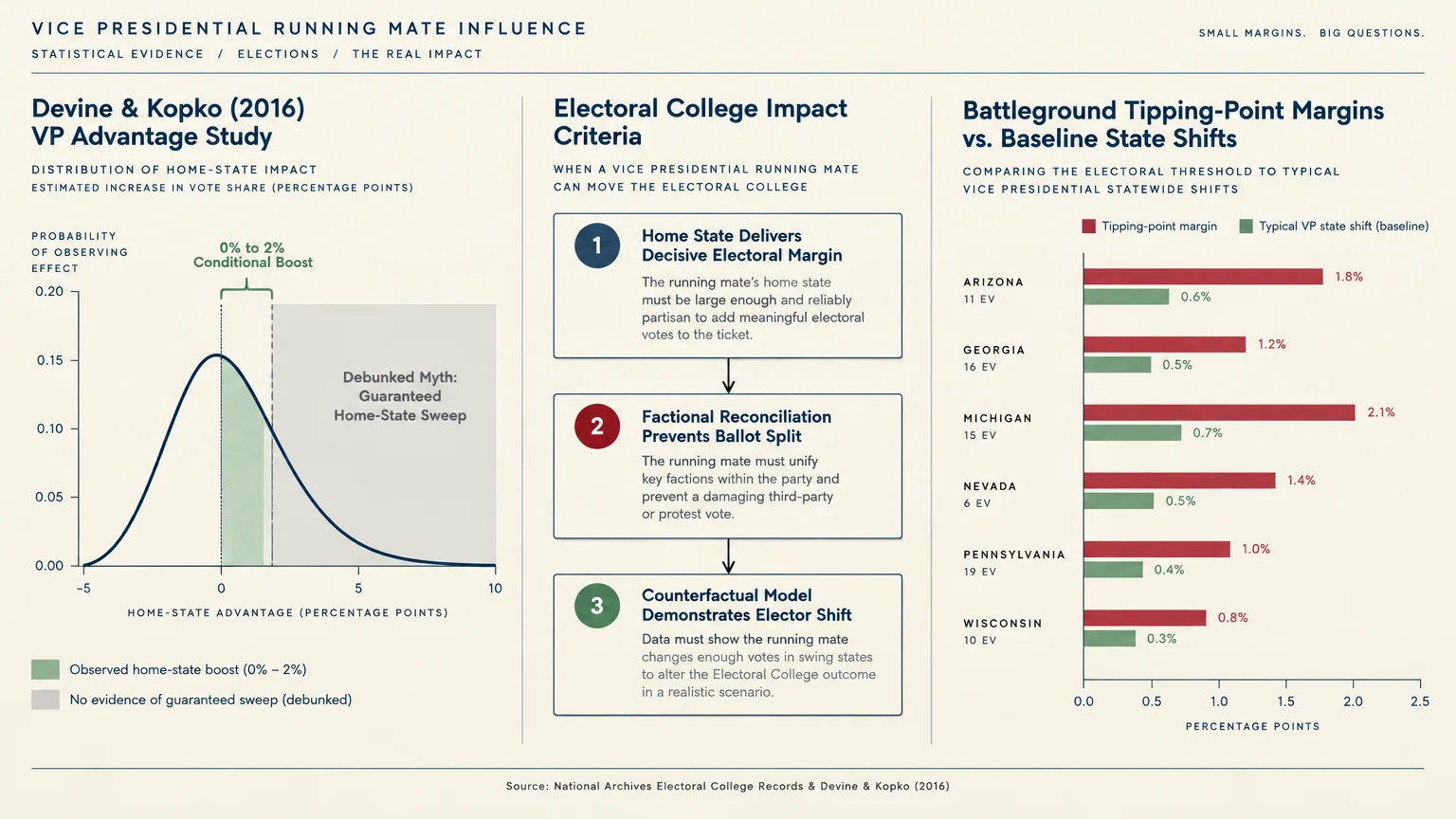
In their 2016 study, The VP Advantage, political scientists Christopher J. Devine and Kyle C.
Kopko analyzed presidential elections from 1884 onward and determined that running mates typically produce a conditional home-state boost of 0% to 2%. This localized advantage alters national outcomes only when tipping-point states are exceptionally close.
This list tracks nine elections from 1800 to 2000 where a vice presidential selection delivered a decisive home-state margin, prevented a fatal factional split, or forfeited pivotal electors according to peer-reviewed statistical models.
Aaron Burr
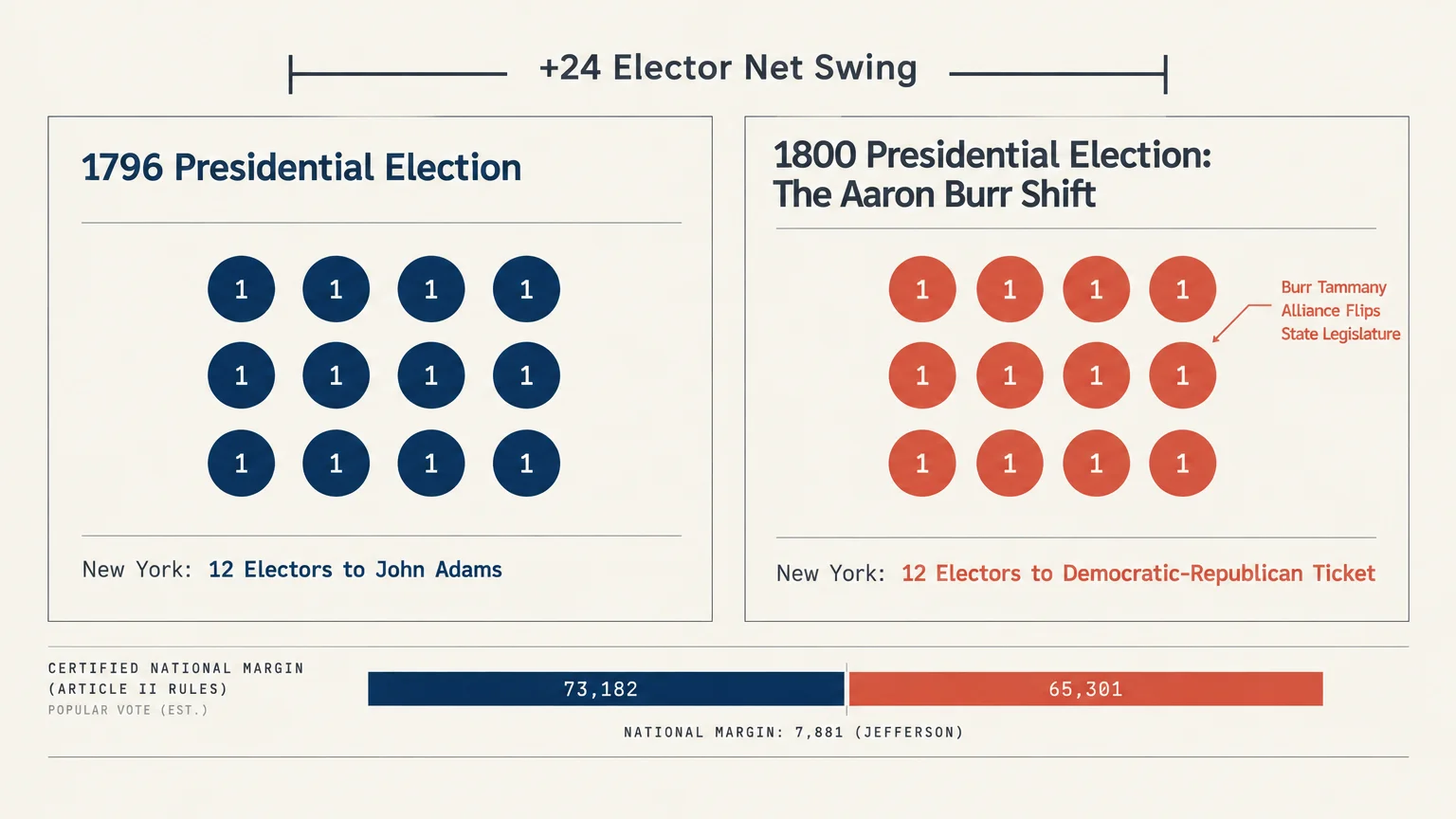
In the 1800 presidential election, Democratic-Republican Thomas Jefferson challenged incumbent Federalist President John Adams. Under the original rules of Article II, each elector voted for two individuals without distinguishing between president and vice president, with the runner-up becoming vice president.
Defeating Adams required breaking the Federalist hold on northern electoral votes, prompting Jefferson to ally with New York political organizer Aaron Burr.
Operating through the Tammany Society in New York City, Burr recruited local candidates who flipped control of the New York State Legislature in April 1800.
Because the state legislature appointed New York’s presidential electors, Burr’s victory shifted all 12 electors from Adams—who had swept them four years earlier—to the Democratic-Republican ticket.
According to the Senate Historical Office biography of Aaron Burr, New York’s 12 electors provided the exact margin needed to unseat Adams.
Jefferson and Burr won 73 electoral votes to Adams’s 65, passing the 70-vote majority threshold; without New York, Adams would have won 77 electoral votes. However, every Democratic-Republican elector voted for both men, creating a 73–73 tie between Jefferson and Burr.
The tie forced a contingent election in the Federalist-controlled House of Representatives under Article II. After Burr refused to step aside, the House required 36 ballots before electing Jefferson on February 17, 1801, prompting Congress to draft and ratify the Twelfth Amendment in 1804.
John Tyler
In 1840, the Whig Party sought to unseat Democratic President Martin Van Buren following the economic depression caused by the Panic of 1837. Whig delegates in Harrisburg, Pennsylvania, nominated frontier military commander William Henry Harrison of Ohio.
To win over southern planters skeptical of northern banking and protective tariffs, party leaders selected former Virginia Senator John Tyler, a states’-rights former Democrat, as Harrison’s running mate.
Campaigning under the slogan “Tippecanoe and Tyler Too,” the ticket neutralized Democratic attacks in the South.
Harrison and Tyler won 234 electoral votes to Van Buren’s 60, carrying 19 of 26 states (148 electoral votes were required to win). They took 52.9% of the popular vote (1,275,390 to 1,128,854) and carried southern battlegrounds including Georgia, North Carolina, Tennessee, Kentucky, and Louisiana.
When President Harrison died of pneumonia on April 4, 1841—31 days after his inauguration—Tyler rejected the title of “Acting President” and claimed the full constitutional powers of the presidency, establishing the succession precedent under Article II.
Chester A. Arthur
The 1880 Republican National Convention in Chicago deadlocked for 35 ballots between former President Ulysses S. Grant and Maine Senator James G.
Blaine before nominating dark-horse candidate James A. Garfield of Ohio on the 36th ballot.
To secure the support of New York Senator Roscoe Conkling’s patronage-focused “Stalwart” faction, Garfield offered the vice presidency to Chester A. Arthur, whom President Rutherford B.
Hayes had removed as Collector of the Port of New York. Arthur accepted the nomination over Conkling’s initial objection and mobilized the New York Republican machine against Democrat Winfield Scott Hancock.
Garfield and Arthur won New York’s 35 electoral votes by 21,033 ballots (555,544 to 534,511, or 50.32% to 48.42%). Garfield won the Electoral College 214 to 155 (185 needed to win); without New York’s 35 electors, Hancock would have won 190 to 179.
Nationwide, Garfield edged Hancock by 1,898 popular votes out of more than 8.8 million cast (0.02%), the closest national popular vote percentage margin in U.S. history. Following Garfield’s assassination in 1881, Arthur signed the Pendleton Civil Service Reform Act of 1883.
Thomas A. Hendricks
In 1884, the Democratic Party nominated anti-corruption New York Governor Grover Cleveland against Republican James G. Blaine of Maine.
Because Cleveland’s reform record appealed to independent “Mugwump” Republicans but alienated New York City’s Tammany Hall machine, party leaders needed a running mate to secure the Midwest.
Delegates selected former Indiana Governor and U.S. Senator Thomas A. Hendricks, who had previously served as Samuel Tilden’s running mate in the disputed 1876 election.
Hendricks commanded strong loyalty among agrarian Democrats across Indiana and the Ohio Valley.
Hendricks delivered Indiana’s 15 electoral votes by a 6,530-vote margin, winning 245,041 ballots to Blaine’s 238,511 (49.5% to 48.1%). Meanwhile, Cleveland carried his home state of New York by just 1,149 votes out of more than one million cast (48.25% to 48.15%).
Cleveland won the Electoral College 219 to 182, with 201 votes required for a majority. Without Hendricks’s 15 Indiana electors, Cleveland’s total would have fallen to 204, leaving him only three electoral votes above the threshold.
Levi P. Morton
In 1888, Republican nominee Benjamin Harrison of Indiana challenged incumbent Democratic President Grover Cleveland. Unseating Cleveland required flipping his home stronghold of New York.
Harrison chose Levi P. Morton—a Manhattan investment banker, former congressman, and former U.S. Minister to France—as his running mate.
Morton raised substantial funds from Wall Street leaders who favored Republican protective tariffs over Cleveland’s proposed tariff reductions and coordinated directly with upstate and New York City Republican committees.
Harrison and Morton flipped New York’s 36 electoral votes by 14,373 ballots, taking 650,338 votes to Cleveland’s 635,965 (49.28% to 48.19%), while Harrison held Indiana by 2,376 votes.
Although Cleveland won the national popular vote by 90,596 ballots (48.6% to 47.8%), Harrison won the Electoral College 233 to 168.
Had Cleveland retained New York’s 36 electoral votes, he would have won reelection in the Electoral College by a margin of 204 to 197.
Charles W. Fairbanks and the Hiram Johnson Snub
In 1916, Republican nominee and former Supreme Court Justice Charles Evans Hughes challenged Democratic President Woodrow Wilson while trying to reunite a Republican Party fractured by the 1912 Progressive (“Bull Moose”) split.
Progressive delegates urged Hughes to pick California Governor Hiram Johnson, who had been Theodore Roosevelt’s 1912 Progressive running mate.
Under pressure from conservative party leaders, Hughes instead chose former Vice President Charles W. Fairbanks of Indiana.
The rift worsened in August 1916 when conservative handlers failed to arrange a meeting between Hughes and Johnson while both men were at the Virginia Hotel in Long Beach, California.
Treating the oversight as a deliberate snub, Johnson withheld active campaign support, and many California progressives backed Wilson’s peace platform. Wilson carried California’s 13 electoral votes by 3,773 ballots out of nearly one million cast (466,289 to 462,516, or 46.65% to 46.27%).
Wilson won the Electoral College 277 to 254 (266 needed to win). Had Hughes selected Johnson and carried California’s 13 electors, Hughes would have won the presidency 267 to 264.
Alben W. Barkley
President Harry S. Truman entered the 1948 election facing an open party split after northern liberals led by Hubert Humphrey added a civil rights plank to the Democratic platform.
Southern dissidents led by South Carolina Governor Strom Thurmond formed the States’ Rights Democratic Party (“Dixiecrats”) to deny Truman an Electoral College majority and force a contingent House election.
To prevent defections across the border states, Truman selected Senate Democratic Leader Alben W. Barkley of Kentucky, who was nominated by acclamation after a unifying convention keynote address.
According to the Senate Historical Office profile of Alben Barkley, his nationwide campaigning prevented widespread agricultural defections across the central border region.
Truman and Barkley carried Kentucky’s 11 electoral votes by 125,546 ballots (56.7% of the state vote). Although Thurmond took 39 electoral votes across Alabama, Louisiana, Mississippi, and South Carolina, Truman defeated Republican Thomas E.
Dewey 303 to 189 in the Electoral College, even carrying California by 17,865 votes against Dewey’s running mate, California Governor Earl Warren.
Lyndon B. Johnson
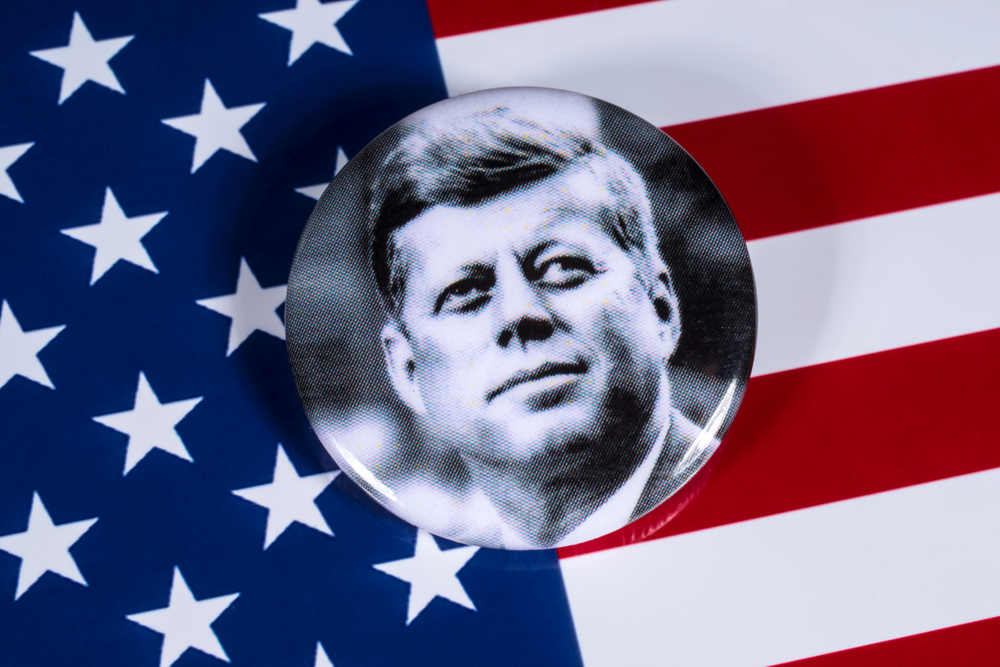
In 1960, Democratic nominee Senator John F. Kennedy of Massachusetts faced stiff resistance in the South due to his northeastern background, civil rights stance, and Roman Catholic faith.
Republican nominee Richard Nixon actively targeted southern states that Dwight D. Eisenhower had carried in the 1950s.
At the Los Angeles convention, Kennedy selected Senate Majority Leader Lyndon B. Johnson of Texas as his running mate.
Aided by a special Texas law allowing him to run simultaneously for vice president and U.S. senator, Johnson deployed his state political network across the South.
Kennedy and Johnson carried Texas’s 24 electoral votes by 46,257 ballots out of 2.3 million cast (50.52% to 48.52% over Nixon and Henry Cabot Lodge Jr.).
According to The American Presidency Project’s 1960 election records, Kennedy won the Electoral College 303 to 219 (269 needed) and the national popular vote by 112,827 ballots (49.7% to 49.5%).
Devine and Kopko credit Johnson’s legislative standing and campaign machinery with delivering Texas as well as narrow Democratic wins in North Carolina, South Carolina, and Louisiana.
Joe Lieberman and the Jeanne Shaheen Counterfactual
In 2000, Democratic nominee Al Gore chose Connecticut Senator Joe Lieberman as his running mate to distance the campaign from Clinton administration scandals. Because Connecticut was already a safe Democratic state—which Gore carried 55.9% to 38.4%—Lieberman added no geographic Electoral College advantage.
Republican George W. Bush defeated Gore 271 to 266 in the Electoral College, clearing the 270-vote threshold by one vote after the 36-day Florida recount was decided by 537 votes.
In New Hampshire, Bush won four electoral votes by 7,211 ballots (48.07% to 46.80%).
Gore’s vetting team had closely considered popular two-term New Hampshire Governor Jeanne Shaheen.
In their statistical modeling of small-population states, Devine and Kopko found that selecting Shaheen would have produced a home-state swing well above Bush’s 7,211-vote margin, flipping New Hampshire’s four electors and giving Gore a 270–267 Electoral College victory without Florida.
Comparing Vice Presidential Picks and Electoral Margins
The table below summarizes each vice presidential selection, the decisive state or region affected, the state vote margin, and the final Electoral College result.
| Year | Nominee | Decisive State | State Margin | Electoral Outcome |
|---|---|---|---|---|
| 1800 | Aaron Burr | New York | Legislative flip | Jefferson won 73–65 |
| 1840 | John Tyler | Southern Region | Coalition sweep | Harrison won 234–60 |
| 1880 | Chester A. Arthur | New York | 21,033 votes (1.90%) | Garfield won 214–155 |
| 1884 | Thomas A. Hendricks | Indiana | 6,530 votes (1.40%) | Cleveland won 219–182 |
| 1888 | Levi P. Morton | New York | 14,373 votes (1.09%) | Harrison won 233–168 |
| 1916 | Charles W. Fairbanks | California (lost) | -3,773 votes (-0.38%) | Wilson won 277–254 |
| 1948 | Alben W. Barkley | Kentucky | 125,546 votes (15.2%) | Truman won 303–189 |
| 1960 | Lyndon B. Johnson | Texas | 46,257 votes (2.00%) | Kennedy won 303–219 |
| 2000 | Joe Lieberman | New Hampshire (lost) | -7,211 votes (-1.27%) | Bush won 271–266 |
Strategic Lessons for Modern Electoral Campaigns
Constitutional rules continue to govern running mate selections. As detailed in the National Archives Twelfth Amendment documentation, electors must cast separate ballots for president and vice president, and at least one candidate on the ticket cannot inhabit the elector’s home state.
In July 2000, this Habitation Clause required Dick Cheney to change his voter registration from Texas to Wyoming so Texas’s 32 electors could legally vote for both George W. Bush and Cheney.
Statistically, Devine and Kopko’s findings show that running mates exert their greatest electoral leverage not in large uncompetitive states, but in smaller, closely divided battlegrounds where established home-state popularity can shift a few thousand votes.
Frequently Asked Questions About Running Mates and the Electoral College
Do vice presidential candidates usually deliver their home states?
No, political scientists Christopher Devine and Kyle Kopko found that the statistical home-state bump typically ranges between 0% and 2%. A running mate delivers a home state only when they are a well-established figure and the state’s baseline partisan margin is already razor-thin.
How does the Twelfth Amendment’s Habitation Clause work?
Article II and the Twelfth Amendment prohibit a state’s electors from voting for two candidates who both reside in that same state.
In July 2000, Dick Cheney switched his legal residency from Texas to Wyoming so Texas’s 32 electors could cast ballots for both George W. Bush and Cheney.
Can an unpopular running mate cost a presidential nominee the election?
Yes, a poorly received choice or factional snub can depress turnout in decisive swing states. In 1916, Charles Evans Hughes bypassed progressive California Governor Hiram Johnson in favor of conservative Charles W.
Fairbanks, contributing to Hughes’s 3,773-vote loss in California and his 277–254 Electoral College defeat.
Why did early American elections experience ties between running mates?
Before the Twelfth Amendment was ratified in 1804, each elector cast two undifferentiated votes for president, with the runner-up becoming vice president.
When every Democratic-Republican elector voted for both Thomas Jefferson and Aaron Burr in 1800, the resulting 73–73 tie forced a 36-ballot contingent election in the House of Representatives.