When you evaluate presidential candidates, state governors offer a proven record of managing executive branch agencies, proposing state budgets, and navigating legislative deadlocks. You can trace this distinct governing playbook directly back across a century of American history.
Seventeen former state chief executives have won the White House, using regional policies as blueprints for national laws. Their statehouses functioned as experimental laboratories where future commanders-in-chief tested economic relief, civil service reform, and regulatory programs.
Examining how these leaders scaled state solutions reveals why voters frequently favor governors over Washington lawmakers. These eight modern executives transformed the institutional presidency by exporting statehouse methods directly to the Oval Office.
Selection Criteria: Identifying the Modern Era Governor-Presidents
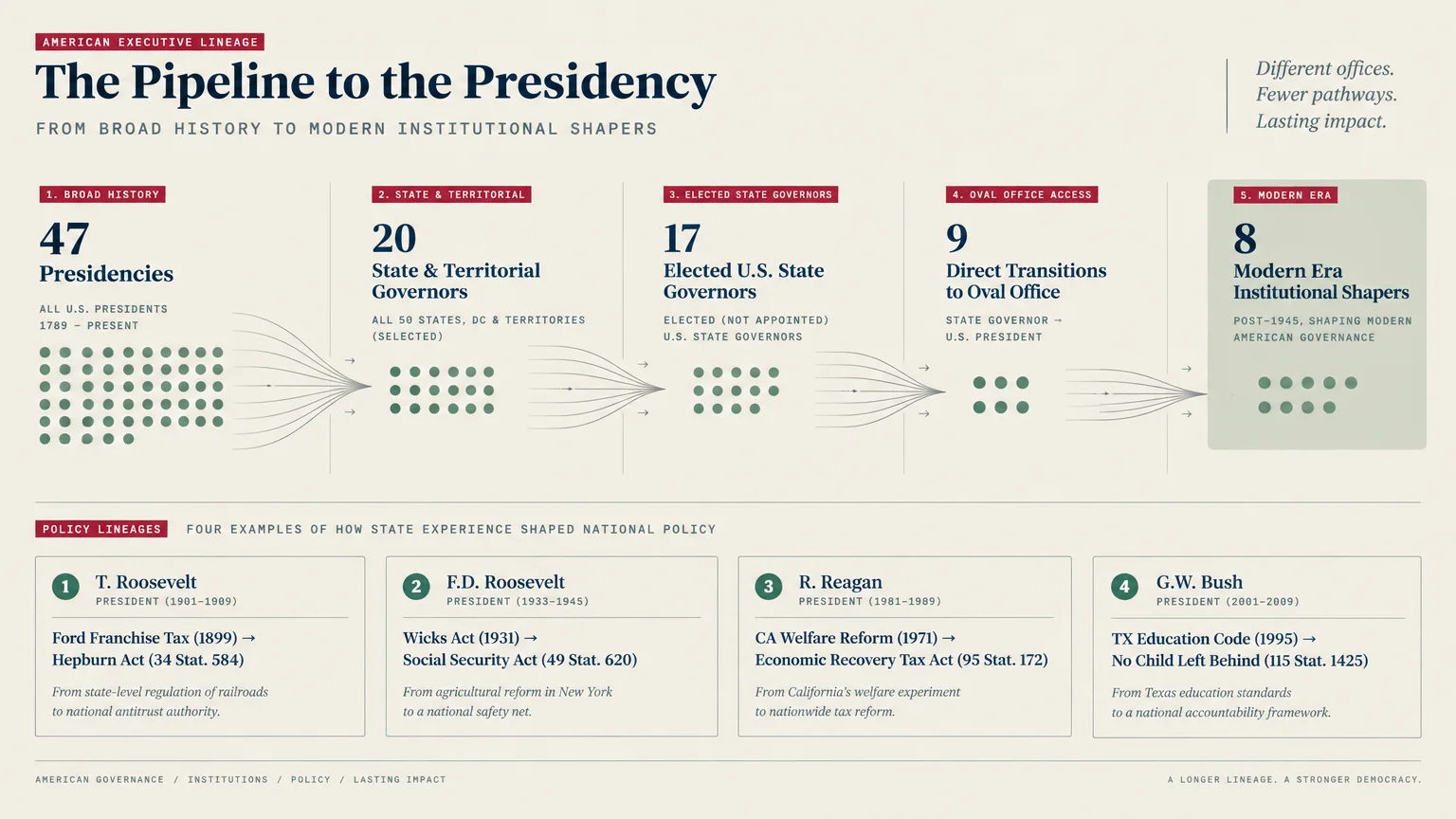
Across forty-seven presidencies, twenty men previously governed states or territories, while seventeen served as elected governors of recognized U.S. states. Nine executives transitioned directly from a governorship into the presidency without holding an intermediate federal post.
This analysis examines the eight governors elected across the twentieth and twenty-first centuries who permanently reshaped executive branch operations. Each entry demonstrates a direct policy lineage linking a statehouse initiative to a signature federal statute or executive order.
To evaluate their impact, you must look beyond campaign rhetoric and analyze documented legislative records. We measure each governor by verifiable statutory roll calls, administrative reorganizations, and sustained alterations to presidential authority.
The historical record reveals a consistent pattern of executive behavior across both political parties. Governors repeatedly import their trusted state personnel, budgetary frameworks, and legislative negotiation tactics straight into the West Wing.
When you review these tenures, you observe how executive decision-making under state constitutions mirrors federal administration. State chief executives manage crises, control executive agencies, and wield veto power long before confronting Congress.
| Governor | State & Tenure | Presidency | Signature State Policy | Signature Federal Milestone |
|---|---|---|---|---|
| Theodore Roosevelt | New York (1899–1900) | 1901–1909 | Ford Franchise Tax Act (1899) | Hepburn Act (34 Stat. 584) |
| Woodrow Wilson | New Jersey (1911–1913) | 1913–1921 | Seven Sisters Corporate Acts (1913) | Federal Reserve Act (38 Stat. 251) |
| Calvin Coolidge | Massachusetts (1919–1921) | 1923–1929 | Boston Police Strike Resolution (1919) | Revenue Act of 1926 (44 Stat. 9) |
| Franklin D. Roosevelt | New York (1929–1932) | 1933–1945 | Wicks Act Relief Administration (1931) | Social Security Act (49 Stat. 620) |
| Jimmy Carter | Georgia (1971–1975) | 1977–1981 | Executive Reorganization Act (1972) | Civil Service Reform Act (92 Stat. 1111) |
| Ronald Reagan | California (1967–1975) | 1981–1989 | California Welfare Reform Act (1971) | Economic Recovery Tax Act (95 Stat. 172) |
| Bill Clinton | Arkansas (1979–81, 1983–92) | 1993–2001 | Quality Education Act (1983) | Welfare Reform Act (110 Stat. 2105) |
| George W. Bush | Texas (1995–2000) | 2001–2009 | Texas Education Code Overhaul (1995) | No Child Left Behind Act (115 Stat. 1425) |
Theodore Roosevelt
Theodore Roosevelt served as the 33rd Governor of New York from January 1, 1899, to December 31, 1900. In Albany, he challenged party bosses by enacting the Ford Franchise Tax Act, Chapter 712 of the Laws of New York (1899).
The statute levied local property taxes on corporate public utility franchises, generating fierce corporate resistance. Roosevelt broke precedent by hosting regular press conferences twice daily, using public communication to pressure reluctant state senators into approving the measure.
When he assumed the presidency on September 14, 1901, Roosevelt applied this confrontational public strategy to national antitrust enforcement. He established the modern administrative state by pushing Congress to pass the Hepburn Act, Pub.L.
59-337 (34 Stat. 584).
The Senate approved the Hepburn Act 71–3 on May 18, 1906, empowering the Interstate Commerce Commission to set maximum railroad shipping rates. He demonstrated how statehouse regulatory battles could expand federal oversight over interstate commerce.
- New York Milestone: Signed Chapter 712 on May 26, 1899, establishing state taxation over public service corporations.
- Federal Action: Signed the Antiquities Act (16 U.S.C. §§ 431–433) on June 8, 1906, protecting historic public lands by executive proclamation.
Woodrow Wilson
Woodrow Wilson governed New Jersey from January 17, 1911, until his resignation on March 1, 1913. As governor, he confronted the state’s dominant party machines by securing passage of the Geran Election Act of 1911, mandating direct primary voting.
Wilson also signed the “Seven Sisters” corporate reform statutes (Chapters 13 through 19 of the Laws of New Jersey, 1913), outlawing price discrimination and holding-company monopolies. These laws turned New Jersey from a corporate haven into a regulatory pioneer.
Taking office as the 28th President on March 4, 1913, Wilson adapted these state-level market interventions for the federal government. On December 23, 1913, he signed the Federal Reserve Act, Pub.L.
63-43 (38 Stat. 251).
The Senate passed the landmark central banking measure by a vote of 43–25 following intense administration lobbying. Wilson also revived the practice of delivering the State of the Union address in person on April 8, 1913.
- New Jersey Milestone: Enacted the Public Utilities Act (Chapter 195) on April 21, 1911, establishing strict state rate regulation.
- Federal Action: Signed the Federal Trade Commission Act (Pub.L. 63-203) on September 26, 1914, creating an independent commercial watchdog.
Calvin Coolidge
Calvin Coolidge served as the 48th Governor of Massachusetts from January 2, 1919, to January 6, 1921. He gained national prominence during the Boston Police Strike of September 1919 by calling out the Massachusetts State Guard to restore civil order.
On September 14, 1919, Coolidge sent his famous telegram to labor leader Samuel Gompers, asserting that no group holds the right to strike against public safety. That decisive action propelled him onto the 1920 national Republican ticket as vice president.
After ascending to the presidency on August 3, 1923, Coolidge translated his austere state budgeting philosophy into federal policy. Working with Budget Director Herbert Lord, Coolidge enforced aggressive expenditure reductions under the Budget and Accounting Act of 1921.
Coolidge signed the Revenue Act of 1926, Pub.L. 69-20 (44 Stat.
9), on February 26, 1926, after the Senate approved it 58–9. The statute lowered the maximum individual surtax rate to 20 percent and repealed federal gift taxes.
- Massachusetts Milestone: Reorganized over 100 state boards into 20 administrative departments under Chapter 350 of the Acts of 1919.
- Federal Action: Enacted the World War Foreign Debts Act amendments (43 Stat. 763) on January 21, 1925, managing allied repayments.
Franklin D. Roosevelt
Franklin D. Roosevelt served as the 44th Governor of New York from January 1, 1929, to December 31, 1932.
When the Great Depression hit, Roosevelt established the Temporary Emergency Relief Administration through the Wicks Act (Chapter 798, Laws of 1931).
Roosevelt appointed social worker Harry Hopkins to direct the relief agency, which distributed direct cash assistance to over ten percent of New York families. The program demonstrated that public assistance could operate efficiently through centralized state administration.
Upon entering the White House on March 4, 1933, Roosevelt used his New York relief model to draft immediate New Deal legislation. The Franklin D. Roosevelt Presidential Library and Museum archives show he replicated the agency federally within two months.
On May 12, 1933, Roosevelt signed the Federal Emergency Relief Act of 1933, Pub.L. 73-15 (48 Stat.
55), again placing Hopkins in charge. Two years later, the Senate approved his Social Security Act (49 Stat.
620) by a 77–6 vote.
- New York Milestone: Allocated $20 million in emergency relief bonds under the Wicks Act on September 23, 1931.
- Federal Action: Signed the Social Security Act (Pub.L. 74-271) on August 14, 1935, creating old-age benefits and unemployment insurance.
Jimmy Carter
Jimmy Carter served as the 76th Governor of Georgia from January 12, 1971, to January 14, 1975. Taking office, Carter declared that the era of racial discrimination had ended, and he quickly tackled Georgia’s fragmented bureaucracy.
Under Georgia Act 1489, passed on April 6, 1972, Carter reorganized 300 state agencies, commissions, and boards into 22 unified departments. He introduced zero-base budgeting across state government, requiring agency heads to justify every tax dollar annually from scratch.
Winning the presidency in 1976 as a reformer, Carter transferred his statehouse reorganization principles directly into federal statute. He signed the Civil Service Reform Act of 1978, Pub.L.
95-454 (92 Stat. 1111), on October 13, 1978.
The Senate passed the civil service measure 87–1 on August 24, 1978, splitting the outdated Civil Service Commission into separate administrative and appeals bodies. Carter passed away on December 29, 2024, leaving a lasting legacy of executive restructuring.
- Georgia Milestone: Enacted zero-base budgeting statewide through Georgia Act 1066 on March 29, 1972.
- Federal Action: Signed the Department of Energy Organization Act (Pub.L. 95-91, 91 Stat. 565) on August 4, 1977, consolidating energy agencies.
Ronald Reagan
Ronald Reagan served two terms as the 33rd Governor of California from January 2, 1967, to January 6, 1975. His eight years in Sacramento made him the second-longest-serving state governor to reach the presidency.
In 1971, Reagan negotiated the California Welfare Reform Act (Senate Bill 796, Chapter 578) with Democratic Assembly Speaker Bob Moretti. The statute instituted mandatory work requirements for able-bodied recipients, shrinking state welfare rolls by more than 250,000 cases over three years.
Reagan applied his California economic framework nationwide after inaugurating his presidency on January 20, 1981. According to historical records at the Ronald Reagan Presidential Library and Museum, he championed supply-side tax reform from his earliest days in office.
On August 13, 1981, Reagan signed the Economic Recovery Tax Act of 1981, Pub.L. 97-34 (95 Stat.
172), which passed the Senate 67–8. His administration subsequently enacted the Family Support Act of 1988, Pub.L.
100-485, creating nationwide welfare-to-work rules.
- California Milestone: Signed SB 796 on August 13, 1971, restructuring state public assistance rules.
- Federal Action: Signed the Tax Reform Act of 1986 (Pub.L. 99-514, 100 Stat. 2085) on October 22, 1986, establishing two individual tax brackets.
Bill Clinton
Bill Clinton served as Governor of Arkansas from 1979 to 1981 and again from 1983 to 1992. Amassing nearly twelve years in the governor’s mansion, Clinton brought more state executive experience to the presidency than any chief executive in American history.
In 1983, Clinton convened a special legislative session that enacted the Arkansas Quality Education Act (Act 44 of 1983). The legislation mandated statewide teacher competency testing and standardized testing for students, financed by a one-cent increase in the state sales tax.
In the White House, Clinton adapted his Arkansas governing strategy to navigate a Republican-controlled Congress. On August 22, 1996, he signed Public Law 104-193 (110 Stat.
2105), the Personal Responsibility and Work Opportunity Reconciliation Act.
The Senate approved the welfare overhaul by a 78–21 roll call on August 1, 1996, replacing open-ended federal entitlement payments with block grants. The law mirrored Clinton’s Arkansas approach by imposing lifetime limits and strict work mandates on assistance recipients.
- Arkansas Milestone: Signed Act 44 on November 10, 1983, establishing statewide educational accountability standards.
- Federal Action: Signed the Omnibus Budget Reconciliation Act of 1993 (Pub.L. 103-66, 107 Stat. 312), which passed the Senate 51–50.
George W. Bush
George W. Bush served as the 46th Governor of Texas from January 17, 1995, to December 21, 2000.
Collaborating with Democratic Lieutenant Governor Bob Bullock, Bush prioritized statewide educational accountability and corporate liability restrictions.
Bush signed Texas Senate Bill 1 on May 30, 1995, overhauling the state education code and holding local public schools accountable using statewide standardized testing results. The measure allowed the state to intervene directly in persistently underperforming local school districts.
Following his election as the 43rd President, Bush converted his Texas accountability framework into federal law. On January 8, 2002, he signed Public Law 107-110 (115 Stat.
1425), known as the No Child Left Behind Act.
The Senate had passed the landmark education bill 87–10 on December 18, 2001, conditioning Title I federal funding on annual student assessment metrics. Later in 2002, Bush directed the largest federal executive reorganization since 1947 by signing the Homeland Security Act.
- Texas Milestone: Signed tort reform legislation (Texas Senate Bill 25) on April 20, 1995, capping punitive damages in civil lawsuits.
- Federal Action: Signed the Homeland Security Act of 2002 (Pub.L. 107-296, 116 Stat. 2135) on November 25, 2002, creating a cabinet-level agency.
Institutional Patterns: How State Capitols Train Commanders-in-Chief
When you examine how governors govern compared to federal lawmakers, the operational contrast centers on administrative command. Governors direct cabinet secretaries, manage statewide law enforcement agencies, and execute existing budgets under rigid fiscal constraints.
Unlike senators, who spend their careers debating legislation within committees, governors must sign executive orders, issue emergency declarations, and resolve strikes. This direct management background prepares future presidents for the daily operational crises confronting the White House.
State capitols also serve as policy incubators where controversial ideas face practical field testing before emerging nationally. FDR developed emergency economic relief in Albany before unveiling the New Deal, just as Ronald Reagan tested welfare restrictions in Sacramento.
Gubernatorial experience also changes how presidents negotiate with Capitol Hill. Executives like Bill Clinton and George W.
Bush arrived in Washington accustomed to striking cross-party bargains with adversarial state legislatures.
However, the path from the governor’s mansion to the White House has narrowed significantly over the past two decades. No former state governor has occupied the Oval Office since George W.
Bush completed his second presidential term on January 20, 2009.
This twenty-five-year drought represents a major shift in American presidential politics. Modern twenty-four-hour cable news cycles and digital fundraising ecosystems frequently reward prominent congressional figures and media celebrities over state executives focused on local management.
Furthermore, state governors must manage constitutionally balanced budget mandates that can alienate partisan primary voters during economic downturns. Federal lawmakers, by contrast, cast votes on broad national ideological battles without assuming personal administrative blame for agency operational failures.
When foreign policy crises dominate voter priorities, gubernatorial candidates frequently face skepticism regarding their international experience. Yet history demonstrates that once elected, former state executives wield federal executive orders and administrative reorganization powers with exceptional institutional efficiency.
If you evaluate presidential capacity through an institutional lens, executive seasoning remains an unmatched training ground. The skills required to balance a state budget and manage thousands of civil servants transfer directly to federal administration.
Frequently Asked Questions About Governors Who Became President
How many total U.S. presidents previously served as state governors?
Seventeen individuals served as governors of recognized U.S. states prior to winning the presidency. If you include territorial and military governors—specifically William Henry Harrison, Andrew Jackson, and William Howard Taft—the total count reaches twenty executives.
Nine presidents won election to the White House while serving as sitting governors. This group includes Grover Cleveland, Woodrow Wilson, Franklin D.
Roosevelt, Bill Clinton, and George W. Bush.
Which former governor served the longest in state office before entering the White House?
Bill Clinton holds the record for the most gubernatorial experience of any president, serving nearly twelve total years across two non-consecutive tenures in Arkansas. He held office from 1979 to 1981 and again from 1983 to 1992.
Ronald Reagan ranks second in the modern era, having completed two full four-year terms as California’s governor between 1967 and 1975. Both men leveraged their lengthy statehouse tenures to project executive competence during their national campaigns.
Why has no governor served as president since 2009?
George W. Bush was the last former state governor to occupy the Oval Office, leaving office on January 20, 2009.
Since that election cycle, voters have elevated senators, vice presidents, and private business figures to the presidency.
Modern primary elections emphasize viral communication and daily appearances on national cable news, environments where Washington politicians hold distinct advantages. Governors remain tied to their state capitols managing complex legislative sessions and natural disaster responses.
How do gubernatorial campaign dynamics differ from congressional presidential bids?
When sitting governors campaign for president, they cannot simply skip roll-call votes the way members of Congress routinely do. State constitutions typically transfer executive authority to the lieutenant governor whenever the chief executive crosses state borders.
Conversely, governors possess an established administrative record that lets them present themselves as executive problem-solvers rather than partisan debaters. This operational positioning historically helped them attract moderate swing voters during general elections.