Texas operates under a foundational charter shaped by frontier defense, individual autonomy, and deep distrust of centralized authority. While internet lists frequently repeat debunked urban legends about outdated local ordinances, the real statutory record contains stranger mandates.
These active provisions govern everything from street duels and legislative brawls to theological tests and emergency evacuations. Here are eight unusual provisions from the Texas Constitution and current state statutes, along with the historical disputes that produced them.
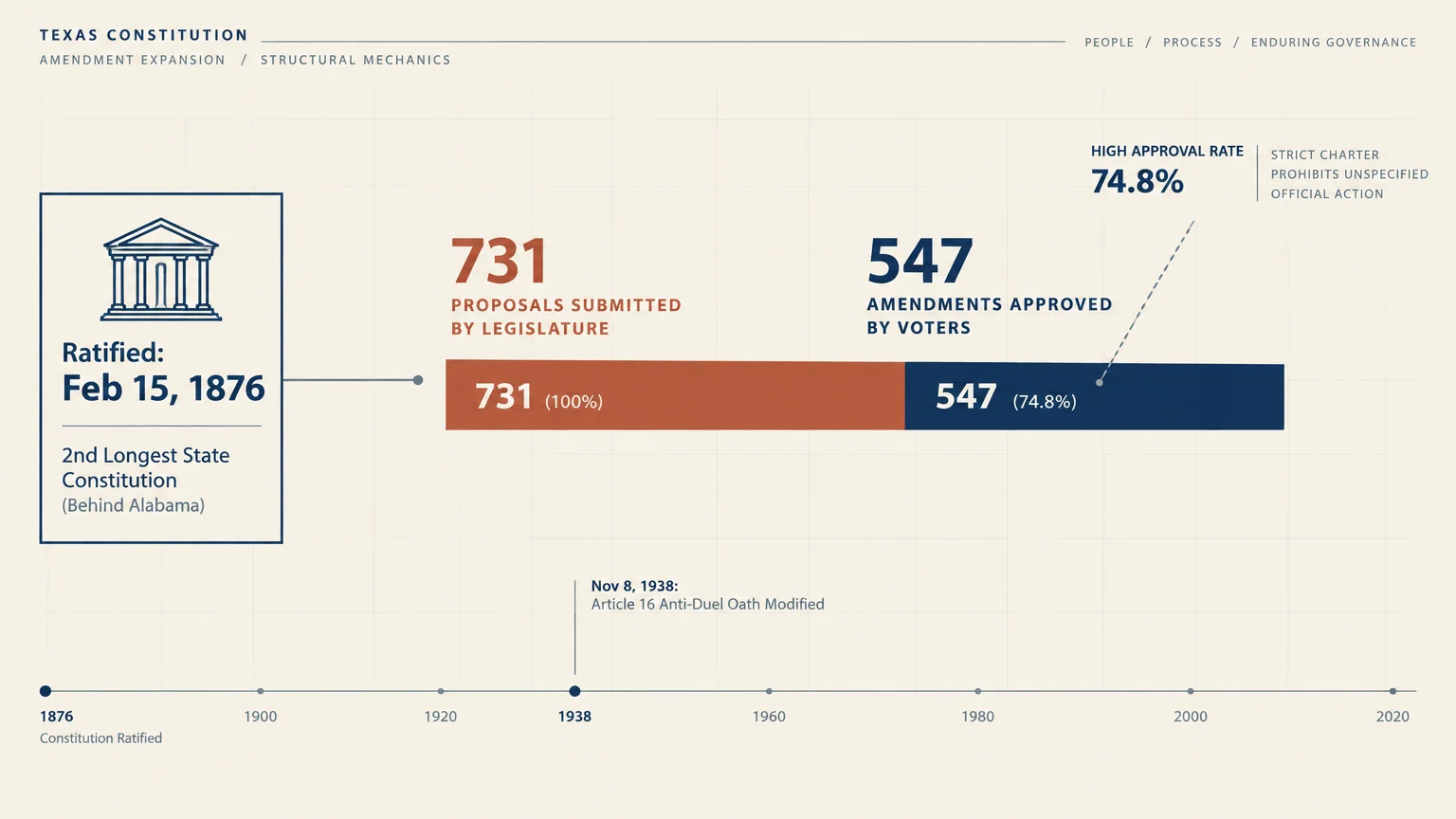
How the Texas Legal Framework Built These Idiosyncratic Mandates
Ratified on February 15, 1876, in reaction to Reconstruction Governor Edmund J. Davis’s centralized administration, the Texas Constitution is the nation’s second-longest behind Alabama’s.
Because the charter embeds hyper-specific administrative rules rather than broad grants of authority, Texas voters have approved 547 of 731 proposed constitutional amendments as of our October 2026 update, following the November 4, 2025 election.
This list counts eight operative or textually surviving provisions from the Texas Constitution and Texas Statutory Code, excluding repealed trivia and local ordinances. Each entry was selected to illustrate a documented historical crisis, frontier constraint, or institutional safeguard that lawmakers wrote into state law.
Permanent Disqualification from Office for Dueling
Under Article 16, Section 4 of the Texas Constitution, any citizen who participates in a duel faces permanent political disenfranchisement.
Early Texas leaders like Sam Houston navigating multiple governorships frequently clashed in high-stakes political rivalries that occasionally flirted with duels.
The provision strips the right to hold public office or vote from anyone who fights with deadly weapons, sends or accepts a challenge, or acts as a second.
Texas framers wrote this prohibition into the 1845 statehood constitution and reaffirmed it in 1876. During the 19th century, Southern honor culture frequently compelled politicians and military officers to settle grievances through lethal shootouts.
A similar anti-dueling movement swept the federal government after a fatal confrontation between members of Congress. According to the Office of the Historian for the U.S. House of Representatives, Congress outlawed dueling in Washington, D.C., in 1839.
State leaders recognized that dueling depleted leadership and undermined civil courts. By stripping voting rights and political careers, the Texas constitutional convention created a permanent deterrent against violent honor disputes.
On November 8, 1938, Texas voters approved an amendment to Article 16, Section 1, removing the mandatory anti-dueling oath recited by incoming officials. However, voters never repealed Section 4 itself, leaving the substantive disqualification as active constitutional text enforceable through a quo warranto proceeding.
Requirement to Acknowledge a Supreme Being
Article 1, Section 4 of the Texas Constitution contains an internal contradiction regarding religious liberty. It declares that no religious test shall ever disqualify a citizen from holding public office, provided the official acknowledges the existence of a Supreme Being.
The framers adopted this clause in 1876 to guarantee equality among competing Christian denominations. At the same time, the convention intentionally excluded non-believers and polytheists from participating in state governance.
This religious prerequisite is unenforceable under binding federal constitutional law. In the 1961 ruling Torcaso v. Watkins, the U.S. Supreme Court struck down Maryland’s identical religious test under the First and Fourteenth Amendments.
During the 1980s, Texas entered a federal consent decree acknowledging that Article 1, Section 4 violates federal civil rights and barring religious affirmations on candidate applications.
Because erasing the text requires a two-thirds legislative vote and statewide voter approval, the unrepealed clause remains printed in the Texas Constitution.
The $600 Monthly Legislative Salary and 140-Day Limit
Texas State Senators and Representatives operate under one of the strictest compensation and scheduling caps in the nation. Article 3, Section 24(a) locks legislative base pay at $600 per month, or $7,200 annually—a figure last updated by voters in 1975.
In addition to minimal pay, Article 3, Section 5 limits regular legislative sessions to 140 calendar days. The Legislature meets only in odd-numbered years, unless the Governor orders a 30-day special session.
The 1876 constitutional convention, dominated by the agrarian Texas Grange, designed this part-time model deliberately. Delegates believed that full-time politicians raised taxes and expanded bureaucracy, so they used low pay and biennial sessions to keep lawmakers working private jobs at home.
A report by the Congressional Research Service notes that state legislative compensation designs create stark differences in institutional capacity nationwide.
To offset the $7,200 base salary during active sessions, the Texas Ethics Commission sets a constitutionally authorized per diem of $221 per session day for the 2025–2026 biennium.
Ban on Special Laws Changing Names of People or Places
Under Article 3, Section 56(a)(3) of the Texas Constitution, state lawmakers cannot pass local or special laws changing the names of individuals or places. The Legislature is barred from altering the legal name of any citizen or geographic municipality by special statute.
During the mid-19th century, state legislatures nationwide routinely processed private name-change bills for adoptions, divorces, or debt evasion. Rival frontier land speculators also lobbied representatives to rename towns and counties to inflate property values, choking legislative dockets with private petitions.
The 1876 framers halted this practice by inserting comprehensive restrictions against special legislation. They forced lawmakers to address uniform public policy rather than personal favors for constituents.
Individual name changes now require formal civil court petitions, fingerprinted background checks, and judicial orders under Texas Family Code § 45.101. Municipal name changes are handled outside the Capitol through local city council ordinances, charter amendments, or local referendums.
Legislative Power to Imprison Disruptive Citizens for 48 Hours
Article 3, Section 15 of the Texas Constitution gives each chamber direct detention authority over private citizens. The Senate or House may imprison any non-member who disrupts legislative proceedings through disrespectful or disorderly conduct committed in the chamber’s presence.
Lawmakers cannot order this legislative imprisonment to exceed 48 hours for any single offense. The framers wrote this provision in 1876 to guarantee legislative autonomy when frontier galleries attracted boisterous crowds, armed partisans, and aggressive lobbyists.
Rather than waiting for municipal police or county courts to file disorderly conduct charges, lawmakers granted themselves summary authority.
Under this provision, the House Speaker or Lieutenant Governor can direct the Sergeant-at-Arms to arrest disruptors and hold them in local detention facilities without a grand jury indictment.
Emergency Capitol Evacuation for Public Enemies and Epidemics
Article 4, Section 8(a) of the Texas Constitution outlines emergency relocation protocols for the state executive. The Governor may convene the Legislature at a location outside Austin if the capital is occupied by a public enemy or infected with contagious disease.
The provision reflects military trauma experienced by Texas leaders throughout the 19th century. In 1842, the Mexican Army launched surprise invasions capturing San Antonio, and Union forces blockaded the coast and seized Galveston during the Civil War.
Records preserved by the National Archives document the volatile military landscape of early Texas governance. Recurring yellow fever and cholera epidemics also paralyzed Austin throughout the 1800s, making crowded legislative sessions a public health hazard.
While modern governors manage crises under the Texas Disaster Act of 1975, Article 4, Section 8(a) remains active constitutional law. It gives the Governor explicit constitutional authority to relocate the seat of government anywhere in Texas during an invasion or biological outbreak.
Consent Defense for Mutual Combat
Under Texas Penal Code § 22.06, entering a consensual physical altercation provides a valid legal defense against assault charges.
Known as the mutual combat doctrine, the statute applies when the victim gave effective consent or when the conduct was a reasonably foreseeable hazard of a joint activity.
Lawmakers codified this defense during the 1973 overhaul of the Texas Penal Code, which took effect on January 1, 1974. While primarily intended to protect athletes in collision sports like football and boxing, its broad common-law phrasing also covers consenting adults in a fistfight.
The defense does not apply if the altercation inflicts or threatens serious bodily injury—defined as a substantial risk of death, permanent disfigurement, or protracted organ impairment.
It is also unavailable if the fight breaches the peace in a public place, which still exposes participants to disorderly conduct arrests.
Legal collections at the Library of Congress illustrate how early state codes adapted English common-law defenses. In Texas, Penal Code § 22.06(b) explicitly bars the consent defense whenever the assault is a condition of joining or remaining in a criminal street gang.
Statutory Informal Marriage Without a Waiting Period
Texas formally recognizes informal marriage, commonly known as common-law marriage, under Texas Family Code § 2.401. Contrary to popular belief that couples must cohabit for seven years, Texas law imposes no minimum duration requirement.
Under § 2.401(a)(2), an informal marriage is legally established the moment a couple satisfies three concurrent statutory criteria:
- The parties agree to be married.
- They live together in Texas as spouses after the agreement.
- They represent to others in Texas that they are married.
This public representation—known legally as “holding out”—includes actions like filing joint federal tax returns, signing leases as spouses, or introducing one another as husband or wife.
Frontier courts recognized these unions in the 1830s and 1840s because ordained ministers and circuit judges rarely reached remote ranches, and the Legislature retained the doctrine when recodifying the Family Code in 1997.
Under Texas Family Code § 2.401(b), if a couple separates and neither party files a proceeding to prove the marriage within two years, the law presumes they never agreed to marry.
Once established, however, an informal marriage carries full community-property rights and can only be dissolved through a formal district court divorce or death.
| Provision | Legal Citation | Year Adopted | Current Enforcement Status |
|---|---|---|---|
| Dueling Ban | Tex. Const. art. XVI, § 4 | 1876 | Active constitutional text |
| Supreme Being Clause | Tex. Const. art. I, § 4 | 1876 | Unenforceable via federal ruling |
| Legislative Pay Cap | Tex. Const. art. III, § 24(a) | 1975 | Active ($600/month base) |
| Special Name Laws Ban | Tex. Const. art. III, § 56(a)(3) | 1876 | Active constitutional ban |
| 48-Hour Contempt Jail | Tex. Const. art. III, § 15 | 1876 | Active legislative power |
| Capitol Evacuation | Tex. Const. art. IV, § 8(a) | 1876 | Active executive power |
| Mutual Combat Defense | Tex. Penal Code § 22.06 | 1974 | Active statutory defense |
| Informal Marriage | Tex. Fam. Code § 2.401 | 1997 | Active family law doctrine |

Structural Patterns Behind the Texas Legal Framework
Taken together, these eight provisions reflect a consistent institutional design built to restrain state power, preserve local autonomy, and accommodate frontier conditions. Meeting after Reconstruction, the 1876 delegates distrusted executive discretion and professional politicians, embedding detailed statutory restrictions directly into constitutional text.
This choice produced a foundational charter that functions like a regulatory code, requiring statewide ballot amendments to adjust routine policy. Meanwhile, the penal and family codes preserved frontier pragmatism by codifying community practices like mutual combat and informal marriage.
These laws also highlight the boundary between state constitutional text and federal judicial supremacy.
Even when federal courts render clauses like the Article 1 religious test unenforceable, the text remains on the books until two-thirds of the Legislature and a majority of Texas voters formally repeal it.
Frequently Asked Questions About Texas Constitutional Law
Why has the Texas Constitution been amended more than 500 times?
The Texas Constitution contains detailed statutory limits rather than flexible administrative grants, requiring constitutional amendments to authorize routine policy changes.
Following a two-thirds legislative vote, voters must ratify every proposal; after the November 2025 election, voters have approved 547 amendments since 1876.
Can police arrest you under unenforceable Texas constitutional provisions?
No, state and local officials cannot enforce provisions that federal courts have declared unconstitutional under the Supremacy Clause of the U.S. Constitution. While provisions like the religious test in Article 1, Section 4 remain printed in the state constitution, they are legally inoperable.
Did Texas actually outlaw milking another person’s cow?
Texas enacted a specific statute in 1866 criminalizing milking another person’s cow without permission, which carried over into the 1925 Penal Code to deter cattle rustlers.
The Legislature repealed that specific provision during the 1973 Penal Code revision, leaving unauthorized milking covered by general theft statutes.
Is it legal to sell human blood and organs in Texas?
Under Texas Penal Code § 48.02, knowingly buying or selling human organs—including kidneys, livers, hearts, lungs, eyes, bones, and skin—is a Class A misdemeanor. However, the statute explicitly exempts human blood and hair, allowing Texans to receive compensation for blood plasma and hair donations.