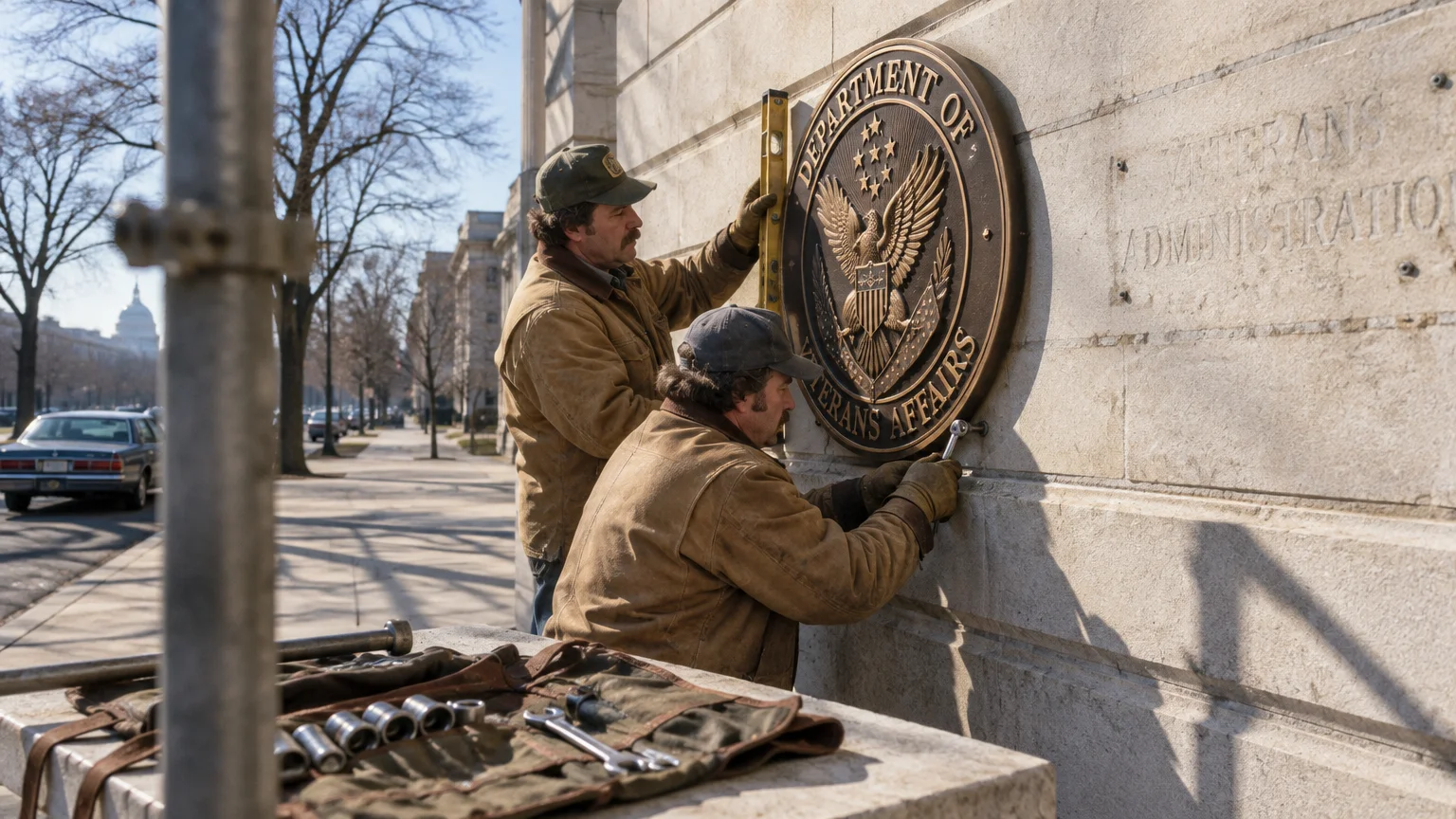
Every November 11, Americans recognize the millions of service members who wore the nation’s uniform in peace and war.
The holiday’s temporary shift to October in the 1970s and the Veterans Administration’s path to the presidential Cabinet both stemmed from specific acts of Congress.
Seven congressional statutes and executive actions between 1926 and 1988 transformed localized World War I armistice commemorations into a permanent federal holiday and a Cabinet-level executive department. Here is how lawmakers built the modern holiday and administrative framework.
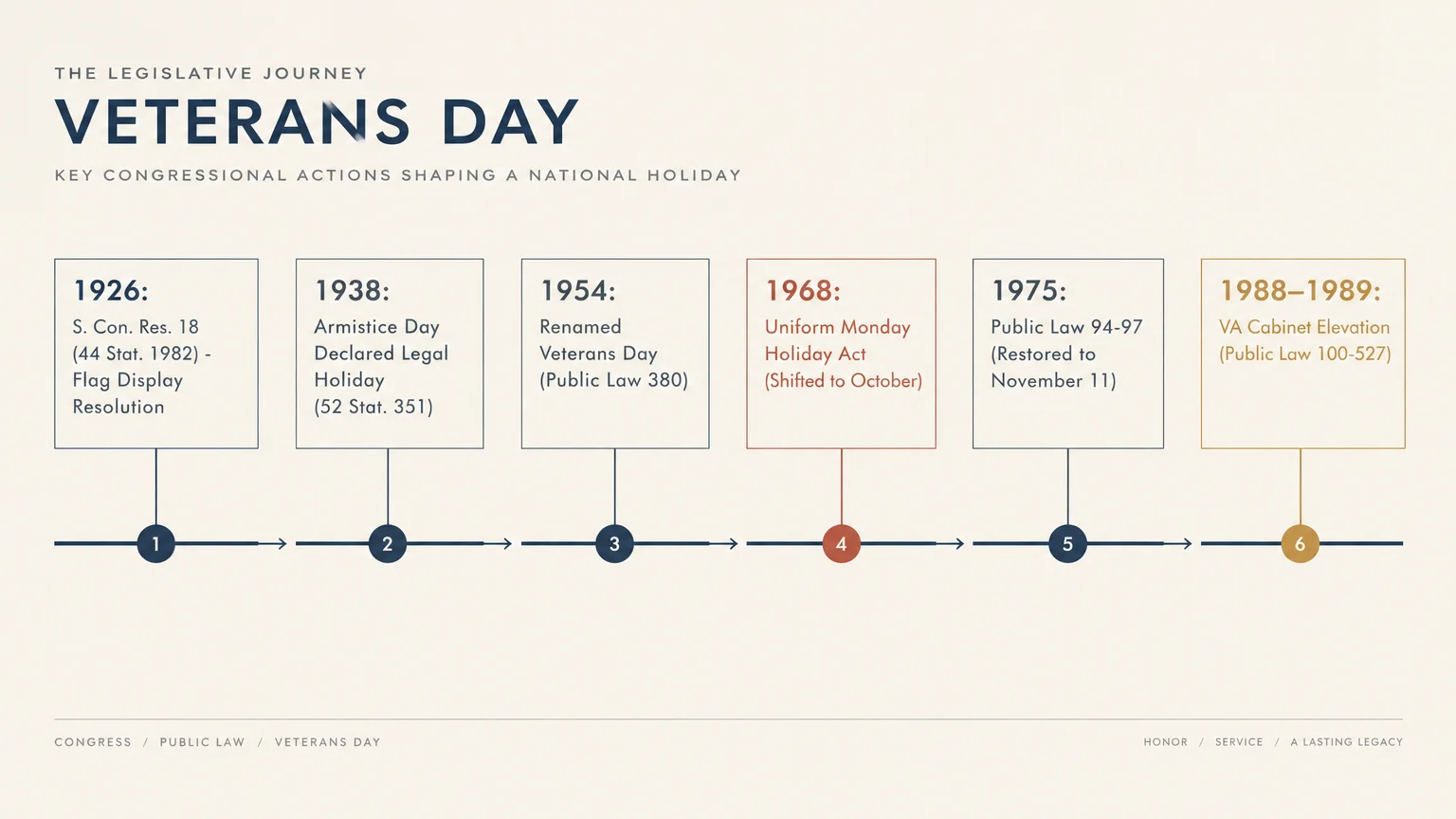
The Legislative Path of Veterans Day and Cabinet Reorganization
This list tracks seven decisive enactments between 1926 and 1988 that established, altered, and elevated federal veterans policy. Each entry was chosen because it enacted a binding statutory or executive change to the national holiday calendar or the institutional authority of federal veterans agencies.
The entries follow chronological order from a 1926 concurrent resolution honoring World War I veterans to the 1988 statute elevating the Veterans Administration to the Cabinet.
Each section records the enacting Congress, vote margins, legislative sponsors, and formal citations in the United States Statutes at Large.
Senate Concurrent Resolution 18 of 1926
Congress formally recognized the end of World War I hostilities on June 4, 1926, by passing Senate Concurrent Resolution 18 (44 Stat. 1982).
This resolution requested that the president issue an annual proclamation ordering flags displayed on federal buildings every November 11.
While President Woodrow Wilson issued a widely quoted message marking the first Armistice Day on November 11, 1919, it was an informal presidential statement rather than a proclamation in the U.S. Statutes at Large.
By the time federal lawmakers acted in 1926, 27 state legislatures had already declared November 11 an official state holiday. President Calvin Coolidge fulfilled the congressional directive by signing Proclamation 1789 on November 3, 1926, establishing national recognition while leaving workplace closures under state jurisdiction.
The Act of July 3, 1930, and Executive Order 5398
Before 1930, veterans navigated three separate federal entities to access military benefits and medical care. Congress ended this fragmentation on July 3, 1930, by passing Public Law 71-536 (46 Stat.
1016), authorizing the president to consolidate federal veterans programs.
President Herbert Hoover exercised this statutory authority on July 21, 1930, by signing Executive Order 5398. The directive merged the Veterans’ Bureau, the Bureau of Pensions, and the National Home for Disabled Volunteer Soldiers into the independent Veterans Administration.
The newly consolidated agency immediately oversaw 54 hospitals and 31,600 employees serving 4.7 million living veterans. Brigadier General Frank T.
Hines assumed leadership as the first Administrator of Veterans Affairs, centralizing hospital operations and pension processing under one roof.
The Armistice Day Act of 1938
Congress converted the annual November 11 observance into a legal federal holiday on May 13, 1938. President Franklin D.
Roosevelt signed Public Law 75-510 (52 Stat. 351) following unanimous voice votes in both legislative chambers.
The statute officially designated November 11 as “Armistice Day” and dedicated the date to world peace and World War I veterans. Federal employees received paid leave, and federal offices closed across the nation.
As noted in the Congressional Research Service analysis of federal holidays, federal holiday laws directly govern only federal agencies and the District of Columbia.
State legislatures used this federal standard to enact matching public holidays within their borders before World War II began in September 1939.
The Veterans Day Act of 1954
The mobilization of 16 million Americans in World War II and 5.7 million in the Korean War prompted calls to expand the 1938 holiday. Emporia, Kansas shoe store owner Alvin J.
King organized local campaigns urging Congress to honor service members from all conflicts.
Representative Edward H. Rees of Kansas introduced H.R.
7786, which amended the 1938 statute by striking the word “Armistice” and inserting “Veterans.” Both chambers of the 83rd Congress passed the bill without a roll-call division.
President Dwight D. Eisenhower signed Public Law 83-380 (68 Stat.
168) on June 1, 1954. On October 8, 1954, Eisenhower issued Presidential Proclamation 3071, creating the Veterans Day National Committee chaired by the Administrator of Veterans Affairs to oversee ceremonies at Arlington National Cemetery.
The Uniform Monday Holiday Act of 1968
In 1968, Congress altered the federal calendar to create predictable three-day weekends for federal employees and businesses. President Lyndon B.
Johnson signed Public Law 90-363 (82 Stat. 250) on June 28, 1968.
The statute relocated four national holidays to designated Mondays, moving Veterans Day from November 11 to the fourth Monday in October. Congress delayed the effective date until January 1, 1971, to allow commercial and state planning.
The House approved the legislation on May 9, 1968, by a vote of 212 to 83, according to House historical records, and the Senate passed it by voice vote.
When the first October observance arrived on October 25, 1971, veterans service organizations protested severing the holiday from its historic November 11 date.
Public Law 94-97 (The 1975 Date Restoration)
State legislatures rejected the federal government’s October holiday schedule between 1971 and 1975. By early 1975, 46 states had enacted statutes keeping or returning state-level observances on November 11.
This split schedule created scheduling conflicts for schools, banks, and interstate transportation networks. Facing public pressure from veterans groups, the 94th Congress considered S.
331 to restore the traditional date.
The House passed S. 331 by a 410 to 6 roll-call tally on September 9, 1975, after the Senate passed it by voice vote.
President Gerald R. Ford signed Public Law 94-97 (89 Stat.
479) on September 18, 1975, restoring Veterans Day to November 11 under 5 U.S.C. § 6103 effective January 1, 1978.
The Department of Veterans Affairs Act of 1988
Despite administering the nation’s largest public medical system, the Veterans Administration operated for nearly six decades as an independent agency outside the Cabinet. Representative Jack Brooks of Texas introduced H.R. 3471 in the 100th Congress to elevate the agency to an executive department.
The bill passed the House 399 to 17 on December 8, 1987, and the Senate 84 to 12 on July 12, 1988. President Ronald Reagan signed the Department of Veterans Affairs Act, Public Law 100-527 (102 Stat.
2635), on October 25, 1988, establishing the 14th Cabinet-level executive department.
Congress set the effective date for March 15, 1989, when former Representative Edward J. Derwinski took office following unanimous Senate confirmation as the first Secretary of Veterans Affairs.
The renamed department retained its “VA” initialism while gaining direct Cabinet representation alongside the Departments of Defense and State.
| Year | Statutory Milestone | Congressional / Executive Action | Core Historical Outcome |
|---|---|---|---|
| 1926 | S. Con. Res. 18 (44 Stat. 1982) | Passed 69th Congress; Proclamation 1789 signed | First official federal recognition of Armistice Day. |
| 1930 | P.L. 71-536 & Executive Order 5398 | Enacted July 3, 1930; signed by President Hoover | Consolidated three agencies into the independent VA. |
| 1938 | P.L. 75-510 (52 Stat. 351) | Approved by voice vote; signed by President Roosevelt | Created a permanent legal public holiday on November 11. |
| 1954 | P.L. 83-380 (68 Stat. 168) | Passed 83rd Congress; signed by President Eisenhower | Renamed Armistice Day to Veterans Day for all wars. |
| 1968 | P.L. 90-363 (82 Stat. 250) | House passed 212–83; signed by President Johnson | Moved Veterans Day to fourth Monday in October (1971–1977). |
| 1975 | P.L. 94-97 (89 Stat. 479) | House passed 410–6; signed by President Ford | Restored federal observance permanently to November 11. |
| 1988 | P.L. 100-527 (102 Stat. 2635) | House 399–17; Senate 84–12; signed by President Reagan | Elevated the VA to the 14th Cabinet executive department. |
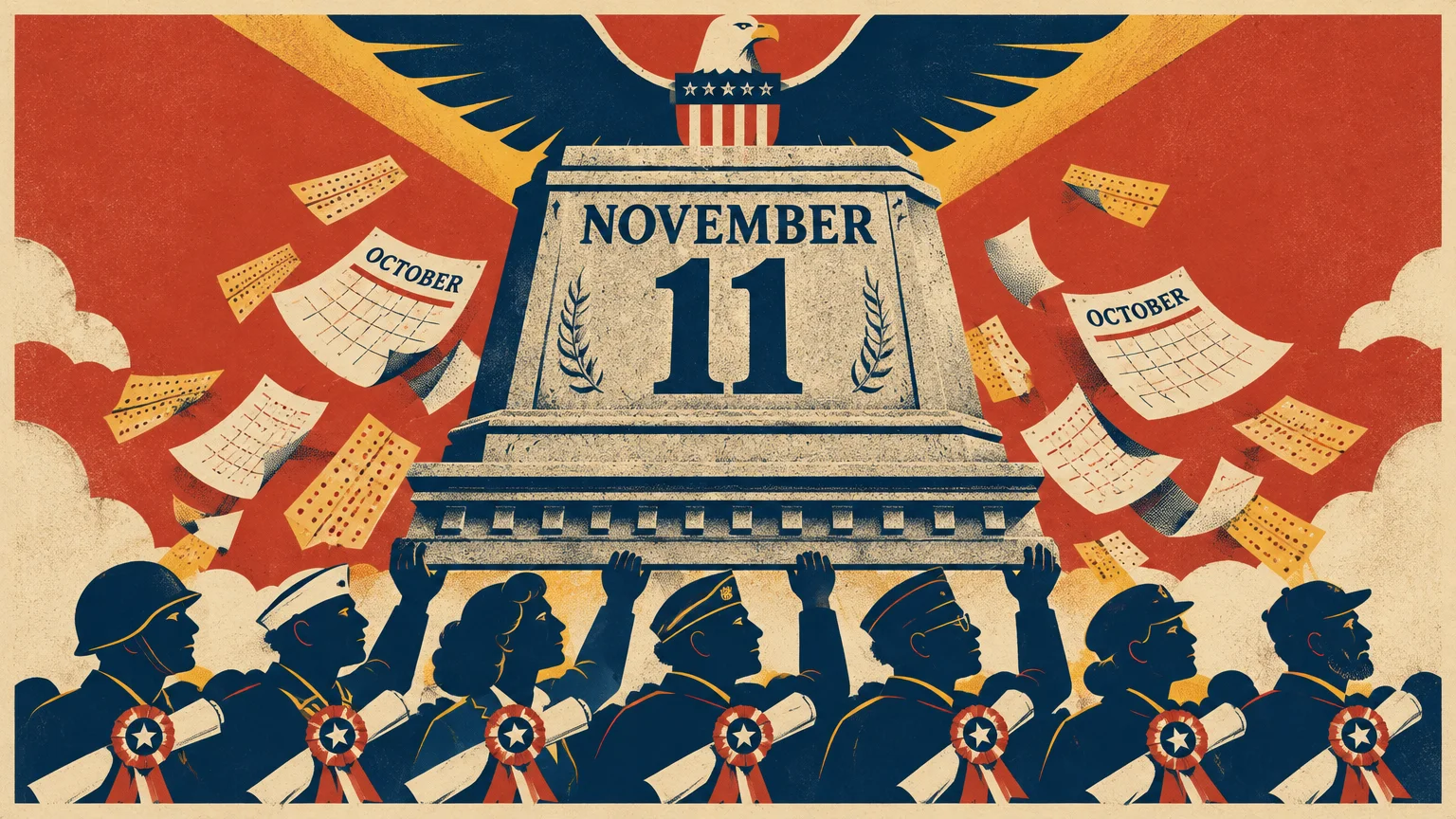
How Seven Decades of Legislation Reshaped Modern Veterans Policy
The legislative path from the 1926 concurrent resolution to the 1988 Cabinet act followed major wartime mobilizations and direct lobbying by veterans service organizations.
When Congress moved the holiday to October under the 1968 Uniform Monday Holiday Act, state resistance and veteran petitions forced a statutory reversal within seven years.
The 1988 Cabinet elevation reorganized federal veterans programs into three statutory administrations within the Department of Veterans Affairs.
The Veterans Health Administration, the Veterans Benefits Administration, and the National Cemetery Administration manage 1,255 health care facilities serving over 9 million enrolled veterans and more than 150 national cemeteries.
Under the Presidential Succession Act (3 U.S.C. § 19), the Secretary of Veterans Affairs sits seventeenth in the presidential line of succession.
Douglas A. “Doug” Collins serves as the 12th Secretary of Veterans Affairs after winning Senate confirmation by a 77–23 vote on February 4, 2025.
Frequently Asked Questions About Veterans Day and the VA
Why does Veterans Day contain no apostrophe?
According to the Department of Veterans Affairs, the statutory holiday title contains no apostrophe. It is spelled “Veterans Day” rather than “Veteran’s Day” or “Veterans’ Day” because the day does not belong to one veteran or group.
In federal law, “Veterans” functions as an attributive noun modifying “Day” to mark a public holiday honoring all who served. This spelling is codified in 5 U.S.C. § 6103 and used across the Congressional Record.
What happens when November 11 falls on a weekend?
Federal law codified at 5 U.S.C. § 6103 sets the rules for weekend federal holiday observances. When November 11 falls on a Saturday, most federal employees observe the holiday on the preceding Friday; when it lands on a Sunday, offices close on the following Monday.
Because November 11, 2026, falls on a Wednesday, federal offices close on that date. Substitute in-lieu-of holidays apply strictly to federal agencies, while state governments, school districts, and private employers set their own schedules.
Where does the Secretary of Veterans Affairs rank in the line of succession?
The Secretary of Veterans Affairs stands seventeenth in the presidential line of succession under 3 U.S.C. § 19. Cabinet order follows the chronological creation date of each executive department.
Because Congress established the department in 1988, only the Secretary of Homeland Security (created in 2002) ranks lower in Cabinet precedence. Any officer in the line must meet the Constitution’s age, residency, and natural-born citizenship requirements to serve as acting president.
Can a president move Veterans Day by executive order?
A president cannot move the legal date of Veterans Day by executive order or presidential proclamation. Congress establishes the federal holiday calendar exclusively by statute under Title 5 of the U.S. Code.
Changing the date requires an act of Congress signed by the president or enacted over a veto, as occurred in 1968 and 1975. Annual presidential proclamations are ceremonial directives that cannot override statutory holiday dates.