Nearly every federal environmental safeguard governing American air, tap water, and wildlife traces back to an eight-year burst of bipartisan lawmaking in Washington. Between 1969 and 1977, divided Congresses and Republican presidents enacted landmark conservation statutes with overwhelming roll-call majorities.
Party leaders routinely set aside ideological rivalries to build durable, veto-proof coalitions that reshaped the federal administrative state. These negotiations produced detailed statutory mandates and strict regulatory deadlines under divided government.
Here is the legislative record behind the roll calls, statutory compromises, and executive actions that built the foundation of American environmental law.
Selection Criteria and the Mechanics of 1970s Legislative Consensus
This list tracks eight major federal environmental statutes and executive reorganizations enacted between January 1970 and August 1977 under the 91st through 95th Congresses.
Democratic majorities controlled both chambers throughout this period, while Republican presidents Richard Nixon and Gerald Ford and Democrat Jimmy Carter occupied the White House.
Our editorial team selected these eight milestones based on their nationwide statutory reach and recorded bipartisan roll-call majorities. Every entry established binding national standards, created novel federal enforcement frameworks, or overcame a presidential veto through supermajority congressional votes.
National Environmental Policy Act of 1969
Senator Henry “Scoop” Jackson (D-WA) introduced the National Environmental Policy Act (NEPA) on February 18, 1969, establishing an overarching federal charter for environmental protection. The Santa Barbara oil spill weeks earlier had galvanized public demand for federal oversight.
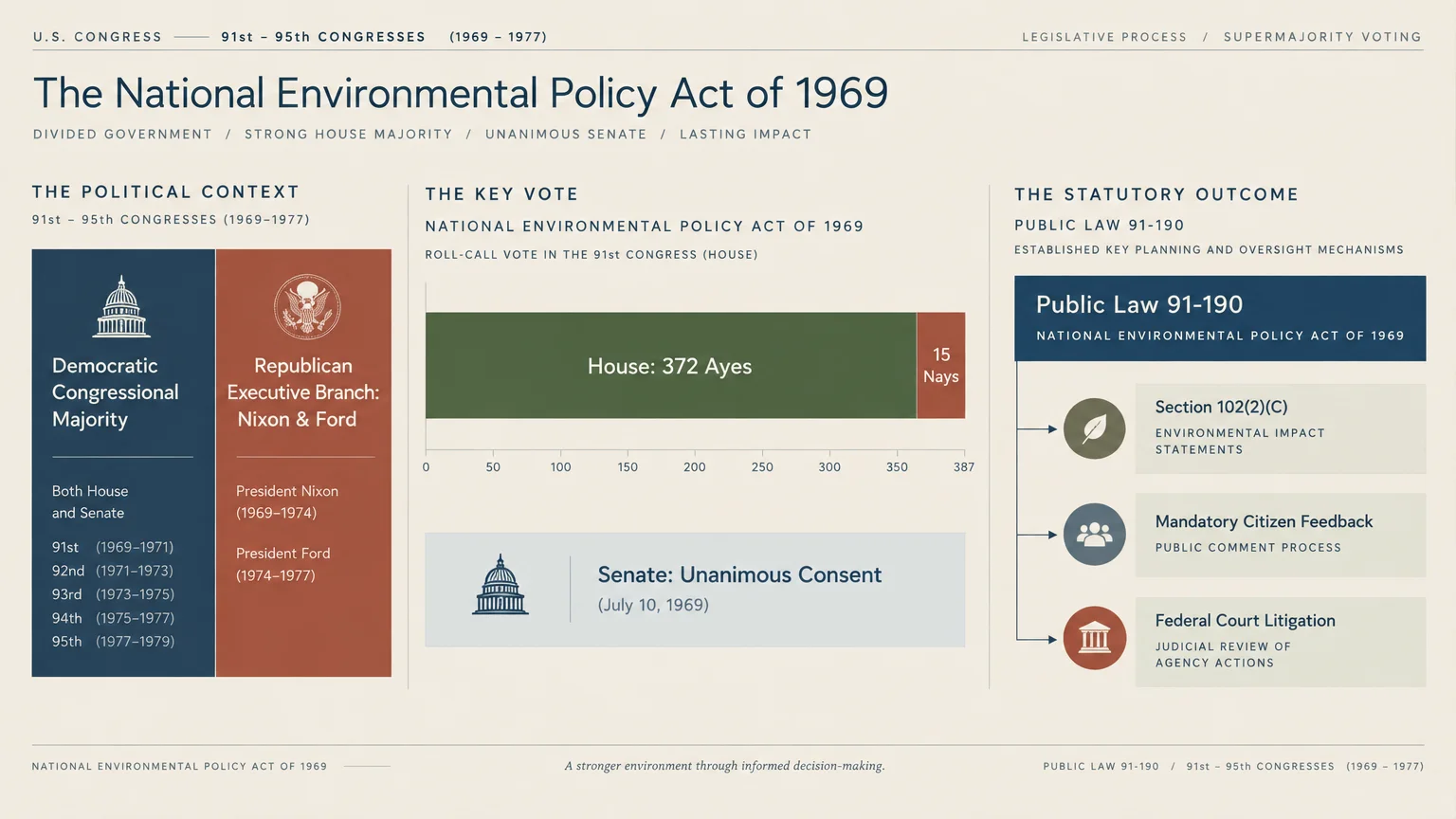
The Senate approved the bill by unanimous consent on July 10, 1969, and the House passed it 372–15 on September 23, 1969. President Richard Nixon signed Public Law 91-190 on January 1, 1970.
Nixon chose the signing as his first official act of the new decade to signal White House engagement on ecological policy. The statute enacted Section 102(2)(C), requiring federal agencies to prepare formal Environmental Impact Statements (EIS).
The law mandates interagency environmental assessments and formal public comment periods before major federal actions proceed. Citizens and local governments can challenge the adequacy of those reviews through federal district court litigation before construction begins on highways, dams, or energy projects.
Reorganization Plan No. 3 of 1970
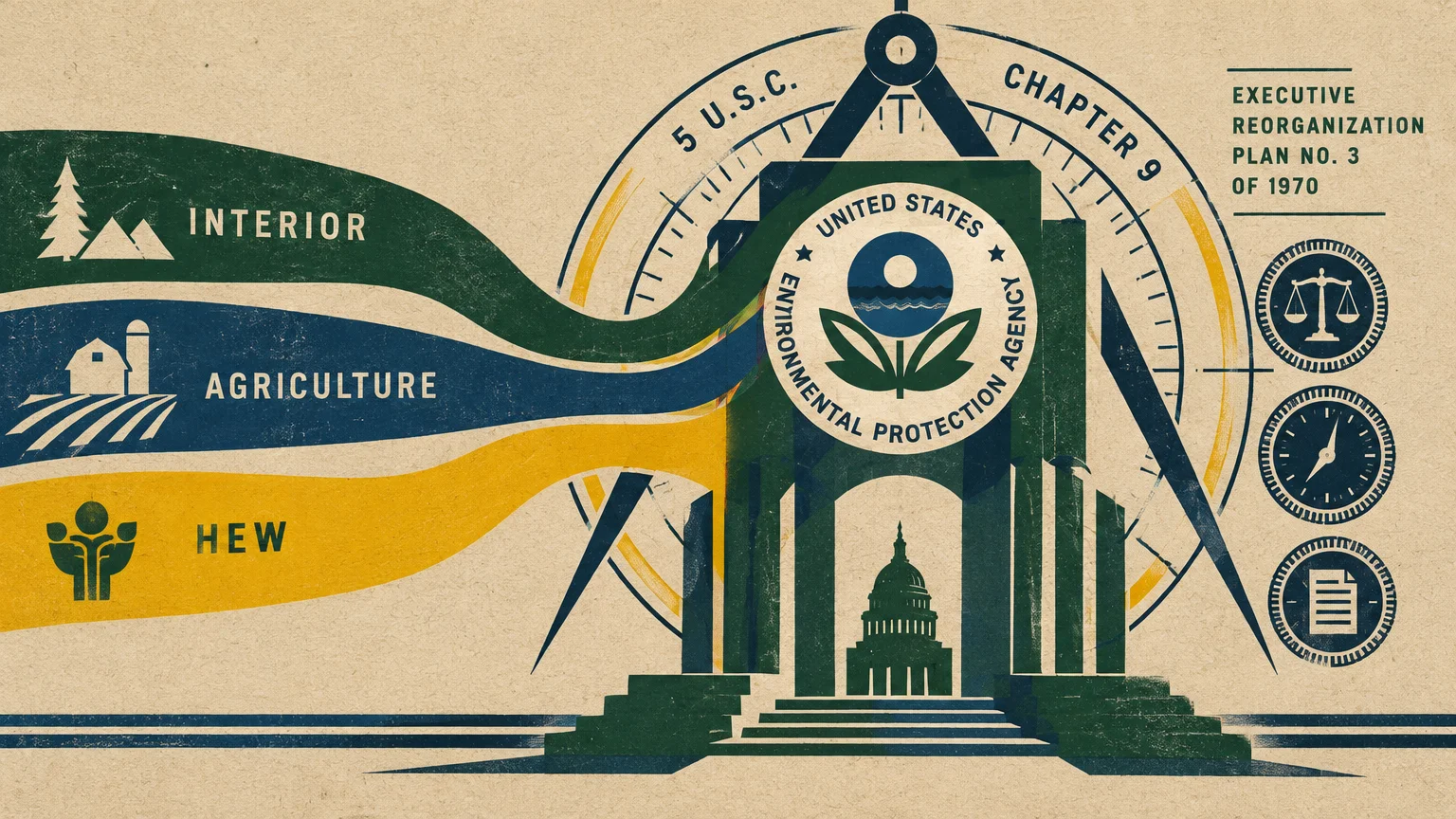
Rather than awaiting enabling legislation from congressional committees, President Nixon used executive reorganization authority under 5 U.S.C. Chapter 9 to overhaul federal oversight.
On July 9, 1970, Nixon formally transmitted Reorganization Plan No. 3 to Congress.
The plan consolidated scattered pollution programs into a single independent regulatory body: the Environmental Protection Agency (EPA). According to the EPA History Office, the reorganization merged fifteen components from five cabinet departments and independent boards.
The new agency absorbed the Federal Water Quality Administration from Interior, pesticide research from Agriculture, and air pollution control from Health, Education, and Welfare. The House defeated a resolution of disapproval on September 28, 1970, clearing the plan to take effect.
This structure insulated technical rulemakers from cabinet departments tasked with promoting commercial agriculture or resource extraction. The EPA formally began operations on December 2, 1970, under its first Senate-confirmed administrator, William Ruckelshaus.
Clean Air Act Amendments of 1970
Electoral competition between President Nixon and Senator Edmund Muskie (D-ME) propelled the Clean Air Act Amendments of 1970 through Congress. Both leaders recognized that millions of Earth Day participants represented an influential, bipartisan voting bloc ahead of the 1972 presidential race.
The House passed initial amendments 375–1 on June 10, 1970, and Muskie’s subcommittee countered with a stricter bill. As recorded by the U.S. Senate Historical Office, the Senate passed Muskie’s measure 73–0 on September 22, 1970.
Both chambers approved the final conference report by voice vote on December 18, 1970. Nixon signed Public Law 91-604 on December 31, 1970, establishing National Ambient Air Quality Standards while excluding Muskie from the signing ceremony.
The statute mandated a 90% reduction in automotive hydrocarbon and carbon monoxide tailpipe emissions and created Section 304, authorizing citizen enforcement suits against polluters. Between 1970 and 2017, aggregate emissions of the six common air pollutants dropped by 73%.
Federal Water Pollution Control Act Amendments of 1972
Congress drafted the Federal Water Pollution Control Act Amendments of 1972 (S. 2770) to replace fragmented state-level water quality standards.
Lawmakers concluded that state regulators hesitated to penalize local industrial facilities for fear of losing commercial investment.
The final conference report cleared the Senate 74–0 and the House 366–11 on October 4, 1972. President Nixon vetoed the bill on October 17, 1972, calling its $24 billion authorization—including $18 billion for municipal wastewater treatment grants—fiscally inflationary.
Congressional leaders acted within hours. As documented by House Historical Highlights, the Senate voted 52–12 and the House voted 247–23 on October 18, 1972, overriding the veto to enact Public Law 92-500.
The law outlawed unpermitted point-source pollutant discharges into navigable waters by establishing the National Pollutant Discharge Elimination System under Section 402. It also restricted the unregulated dredging and filling of wetlands under Section 404 oversight.
Endangered Species Act of 1973
President Nixon called for stronger federal wildlife legislation during his environmental message to Congress in February 1972. Senator Harrison A.
Williams (D-NJ) introduced Senate bill S. 1983 in June 1973 to protect imperiled species and their habitats.
The Senate passed the bill 92–0 on July 24, 1973, and the House approved its version 390–12 on September 18, 1973. Following conference negotiations, the House adopted the final report 355–4, and Nixon signed Public Law 93-205 on December 28, 1973.
Section 7 of the statute bars federal agencies from authorizing, funding, or carrying out actions that jeopardize listed species or destroy designated critical habitats. Section 9 prohibits the unauthorized taking, harming, or commercial trafficking of endangered wildlife.
The law also enacted Section 11, authorizing citizen petitions and civil suits to compel federal listing evaluations and enforce statutory recovery plans. Federal protections under the act later supported the recovery and delisting of the American bald eagle in 2007.
Safe Drinking Water Act of 1974
Reports of synthetic chemical contamination in municipal water supplies prompted Congress to take up comprehensive drinking water legislation in 1973 and 1974. Federal studies of the lower Mississippi River had detected carcinogenic industrial compounds passing untreated through conventional municipal filtration plants.
Senator Warren Magnuson (D-WA) steered the initial bill through the Senate by voice vote on June 22, 1973. The House passed a modified version 296–84 on November 19, 1974, leading to a rapid bicameral agreement.
White House budget advisers urged President Gerald Ford to veto the bill over federal costs and regulatory burdens on local utilities. Ford signed Public Law 93-523 on December 16, 1974, establishing nationwide drinking water standards.
The statute directs the EPA to enforce National Primary Drinking Water Regulations and Maximum Contaminant Levels for public systems serving at least twenty-five people. It also established federal underground injection control programs to protect drinking water aquifers and mandated public notices after contaminant violations.
Resource Conservation and Recovery Act of 1976
By the mid-1970s, lawmakers recognized that stricter air and water rules had prompted industrial facilities to dispose of hazardous sludges on open land. Congress drafted the Resource Conservation and Recovery Act (RCRA) to close this terrestrial disposal loophole.
The Senate passed the bill 88–3 on June 30, 1976, and the House approved its version 367–8 on September 27, 1976. President Ford signed Public Law 94-580 on October 21, 1976.
Ten days earlier, Ford had also signed the Toxic Substances Control Act (TSCA) into law as Public Law 94-469. Together, the two statutes authorized federal tracking of commercial chemicals from initial manufacture through final disposal.
RCRA Subtitle C created a cradle-to-grave manifest system for hazardous industrial waste and imposed technical standards on treatment, storage, and disposal facilities. Subtitle D banned unregulated open dumping and set national engineering criteria for municipal solid waste landfills.
Surface Mining Control and Reclamation Act of 1977
Federal efforts to regulate strip mining produced sharp clashes between Congress and the White House during the mid-1970s. President Ford vetoed strip-mining bills in December 1974 and May 1975, arguing that reclamation mandates would cut domestic coal production.
The 95th Congress revived the measure after the 1976 election. The House passed the bill 265–160 on April 29, 1977, and the Senate passed its version 57–8 on May 20, 1977.
President Jimmy Carter signed Public Law 95-87 on August 3, 1977, and days later signed bipartisan amendments strengthening the Clean Air and Clean Water Acts. The surface mining statute created the Office of Surface Mining Reclamation and Enforcement within the Department of the Interior.
The law requires coal operators to post reclamation performance bonds before mining and restore excavated land to its approximate original contour. It also levies per-ton fees on active coal production to finance the Abandoned Mine Land reclamation fund.
| Statute or Action | Year | House Vote | Senate Vote | Presidential Action |
|---|---|---|---|---|
| National Environmental Policy Act | 1970 | 372–15 | Voice Vote | Signed (Nixon) |
| Reorganization Plan No. 3 (EPA) | 1970 | Disapproval Rejected | Plan Upheld | Transmitted (Nixon) |
| Clean Air Act Amendments | 1970 | 375–1 | 73–0 | Signed (Nixon) |
| Clean Water Act Amendments | 1972 | 247–23 (Override) | 52–12 (Override) | Veto Overridden (Nixon) |
| Endangered Species Act | 1973 | 355–4 | Voice Vote (92–0 Initial) | Signed (Nixon) |
| Safe Drinking Water Act | 1974 | 296–84 | Voice Vote | Signed (Ford) |
| Resource Conservation & Recovery Act | 1976 | 367–8 | 88–3 | Signed (Ford) |
| Surface Mining Control & Reclamation Act | 1977 | 265–160 | 57–8 | Signed (Carter) |
Institutional Dynamics and the Evolution of Modern Administrative Power
Three institutional forces drove this eight-year legislative wave. First, lawmakers responded to broad public pressure after high-profile ecological crises, including the 1969 Santa Barbara oil spill and the June 1969 Cuyahoga River fire in Cleveland.
When an estimated 20 million Americans rallied for the first Earth Day on April 22, 1970, Congress adjourned for the afternoon so members could attend local events. Second, Democratic committee chairs worked closely with moderate Republicans to draft technical statutes that commanded veto-proof majorities.
Third, presidential campaign incentives accelerated legislative action. Both President Nixon and Democratic contenders like Senator Edmund Muskie sought electoral credit for enacting national environmental protections ahead of the 1972 campaign.
In the 2020s, Congress and the U.S. Supreme Court narrowed several of these 1970s statutory frameworks. On May 25, 2023, the Supreme Court held in Sackett v. EPA that Clean Water Act jurisdiction covers only wetlands with a continuous surface connection to navigable waters.
Days later, Congress amended NEPA through the Fiscal Responsibility Act of 2023, imposing statutory page limits and one-to-two-year review deadlines on environmental impact statements.
In May 2025, an 8–0 Supreme Court ruled in Seven County Infrastructure Coalition v. Eagle County that NEPA does not require agencies to study indirect environmental effects outside their regulatory authority.
On June 28, 2024, the Supreme Court issued its ruling in Loper Bright Enterprises v. Raimondo, overturning the forty-year-old Chevron deference doctrine that had originated from a 1984 dispute over the Clean Air Act.
Federal courts now exercise independent judgment when deciding whether agency rules match the statutory boundaries enacted by Congress.
Frequently Asked Questions About 1970s Environmental Lawmaking
Why did Republican presidents Nixon and Ford sign so many expansive regulatory statutes?
Presidents Nixon and Ford faced huge bipartisan majorities in Congress capable of overriding vetoes, as demonstrated by the 1972 Clean Water Act override. Nixon also sought to win suburban swing voters ahead of the 1972 election and neutralize Senator Edmund Muskie’s appeal.
In addition, several national industrial trade associations favored uniform federal standards. Multistate corporations often preferred a single federal baseline over a patchwork of conflicting state and municipal pollution laws.
Why did the Clean Air Act of 1970 pass the Senate without recorded opposition?
Senator Edmund Muskie used his chairmanship of the Senate Public Works Subcommittee on Air and Water Pollution to build a unanimous bipartisan coalition. He framed ambient air quality standards around measurable public health thresholds rather than partisan ideology.
Following the massive turnout for Earth Day in April 1970, automotive and industrial lobbyists could not muster enough Senate votes to weaken the bill’s tailpipe mandates. The Senate passed the measure 73–0 on September 22, 1970.
Why was the Clean Water Act enacted over a presidential veto?
President Nixon vetoed the 1972 Federal Water Pollution Control Act Amendments over its $24 billion authorization, objecting specifically to $18 billion in federal construction grants for municipal sewage treatment plants. Nixon argued that the spending would fuel inflation and expand the federal deficit.
Members of both parties rejected the veto because municipal sewer grants funded infrastructure projects in nearly every congressional district. The Senate overrode the veto 52–12 and the House followed 247–23 on October 18, 1972.
How does the end of Chevron deference affect these 1970s statutes?
The Supreme Court’s June 2024 decision in Loper Bright Enterprises v. Raimondo ended judicial deference to federal agencies’ interpretations of ambiguous statutory language. Federal judges now determine the best reading of a statute independently under the Administrative Procedure Act.
Because several 1970s environmental laws use broad phrasing to address emerging pollutants, EPA and Interior Department rules face stricter judicial scrutiny. Agencies must show that new regulations fall squarely within the text enacted by Congress.