You can track how foreign policy experience shapes domestic lawmaking by examining politicians who represented the country abroad before entering Congress. Most presidential appointees complete their public careers overseas, but a select group runs for legislative office afterward.
These lawmakers brought direct negotiating experience with foreign powers directly into Senate committee rooms and the House chamber. Their background gave them unique leverage over statutory oversight, international trade treaties, and national security funding debates.
Reviewing their diplomatic records reveals how overseas service alters legislative priorities on Capitol Hill. Here are seven prominent officials who served as ambassadors before winning election to the United States Congress.
Constitutional Standards and Selection Criteria for Diplomatic Lawmakers
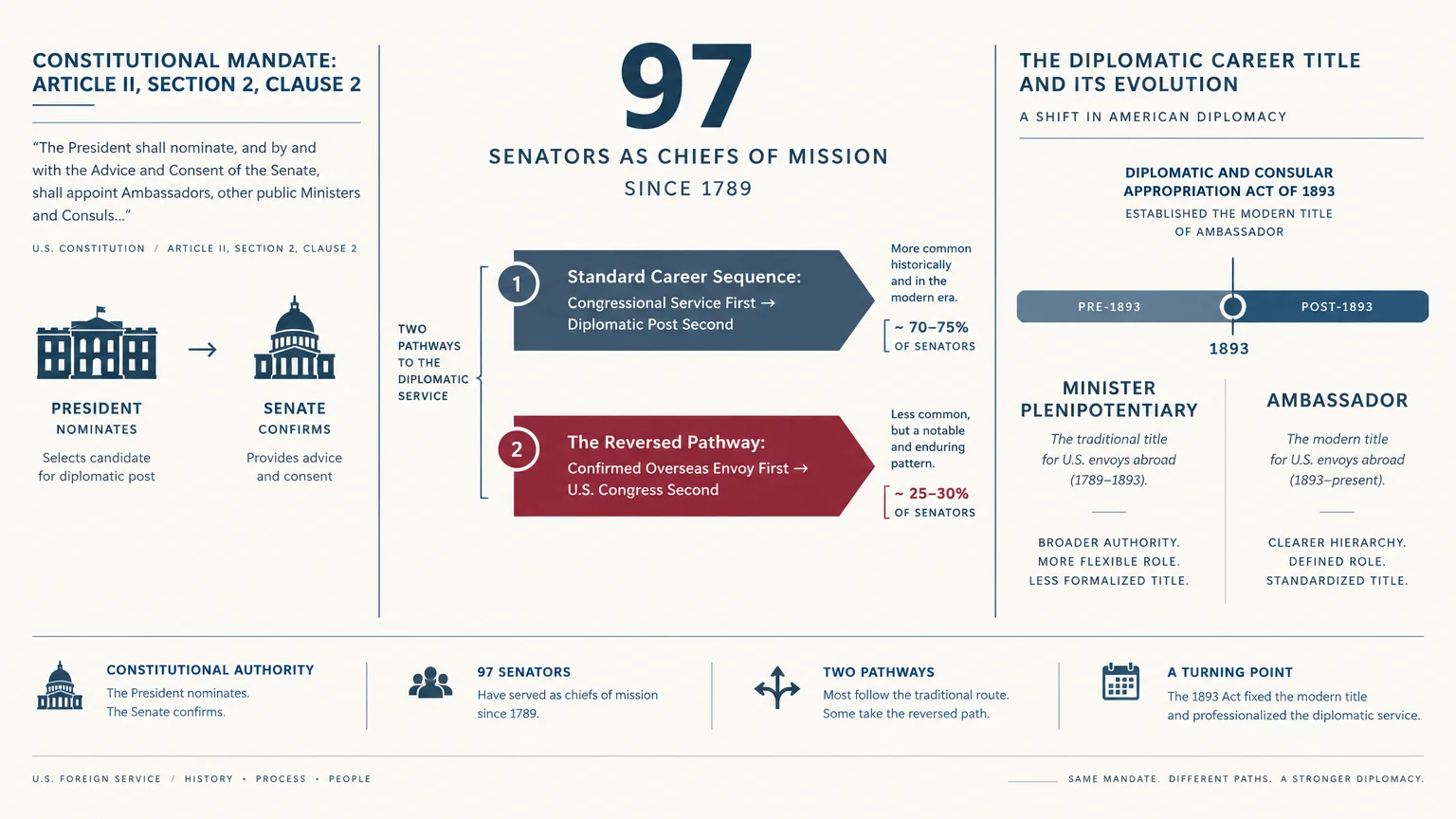
Article II, Section 2, Clause 2 of the U.S. Constitution requires presidential nominees for ambassadorial posts to win Senate confirmation. This advice and consent mechanism ensures that foreign envoys undergo rigorous legislative scrutiny before departing for overseas missions.
Historical data from the U.S. Senate Historical Office reveals that 97 senators have served as diplomatic chiefs of mission since 1789. Most of those individuals, however, accepted their diplomatic credentials after completing their congressional service.
This analysis highlights the rarer group of political figures who reversed that career trajectory. We focus exclusively on leaders who completed confirmed overseas diplomatic tours before winning election to the Senate or the House.
You should recognize an important historical shift regarding diplomatic titles across different eras of American history. Before March 1893, American envoys did not carry the formal title of ambassador.
Early administrations avoided monarchical titles, instead commissioning representatives as ministers plenipotentiary, ministers resident, or charges d’affaires. Congress officially established the rank of ambassador through the Diplomatic and Consular Appropriation Act of 1893.
For our historical selections, we treat confirmed ministers plenipotentiary as the legal and functional equivalents of modern ambassadors. Both categories held formal credentials as chiefs of mission representing American sovereignty abroad.
To evaluate each lawmaker’s career, our editorial team examined primary documents from executive archives and congressional records. We verified confirmation roll calls, treaty negotiations, and major committee assignments for every entry.
These profiles demonstrate how direct exposure to foreign heads of state, intelligence networks, and embassy administration shapes domestic statutory priorities. Understanding this pathway helps you assess the foreign policy credentials of contemporary congressional candidates.
Bill Hagerty
Bill Hagerty served as the 30th U.S. Ambassador to Japan from July 27, 2017, until July 2019 under President Donald Trump. The Senate confirmed his diplomatic nomination by an 86–12 roll-call vote on July 13, 2017.
In Tokyo, Hagerty oversaw bilateral security arrangements and participated in preliminary negotiations for the U.S.-Japan Trade Agreement. He managed an embassy compound responsible for coordinating defense cooperation alongside roughly 54,000 forward-deployed American military personnel.
Hagerty resigned his ambassadorship in July 2019 to return home and launch a federal campaign in Tennessee. He campaigned to succeed retiring Senator Lamar Alexander, winning the November 2020 general election with over 62 percent of the vote.
Taking office on January 3, 2021, Hagerty secured assignments on the Senate Foreign Relations Committee and Banking Committee. You can track his sponsored measures and roll-call votes directly on Congress.gov.
- Diplomatic post: U.S. Ambassador to Japan (confirmed July 13, 2017; served 2017–2019).
- Subsequent office: U.S. Senator from Tennessee (assumed office January 3, 2021).
- Legislative focus: Indo-Pacific trade oversight, critical supply-chain security, and foreign direct investment scrutiny.
Francis Rooney
Francis Rooney served as the seventh U.S. Ambassador to the Holy See between November 12, 2005, and January 10, 2008. President George W.
Bush nominated the Florida business executive, whom the Senate confirmed by voice vote in October 2005.
Stationed at the Vatican, Rooney coordinated diplomatic initiatives regarding global religious freedom, humanitarian assistance, and conflict mitigation in the Middle East. He engaged regularly with the Secretariat of State to align bilateral diplomatic positions.
Rooney returned to domestic business endeavors before entering electoral politics nearly a decade later. In November 2016, he won election to represent Florida’s 19th congressional district, taking office on January 3, 2017.
During his two terms in the House, Rooney served as vice chair of the Foreign Affairs Committee. He utilized his diplomatic background to advocate for international maritime conservation and bilateral agreements across the Western Hemisphere.
- Diplomatic post: U.S. Ambassador to the Holy See (confirmed October 2005; served 2005–2008).
- Subsequent office: U.S. Representative from Florida’s 19th District (served 2017–2021).
- Legislative focus: Western Hemisphere diplomatic strategy, human trafficking interdiction, and international environmental compacts.
Dan Coats
Dan Coats served as the U.S. Ambassador to Germany from August 15, 2001, to February 28, 2005. President George W.
Bush nominated him, and the Senate confirmed the posting by voice vote on August 1, 2001.
Coats arrived in Berlin just days before the September 11 terrorist attacks reshaped transatlantic security policy. He directed embassy operations to coordinate military overflight rights and bilateral counterterrorism intelligence sharing across Western Europe.
Although Coats had served in Congress during the 1980s and 1990s, he launched a political comeback in 2010. Indiana voters elected him back to the U.S. Senate, where he served a second tenure from 2011 to 2017.
Upon returning to the Senate, Coats used his diplomatic experience while serving on the Select Committee on Intelligence. His mastery of European defense policy later positioned him to serve as Director of National Intelligence from 2017 to 2019.
- Diplomatic post: U.S. Ambassador to Germany (confirmed August 1, 2001; served 2001–2005).
- Subsequent office: U.S. Senator from Indiana (second tenure, served 2011–2017).
- Legislative focus: Transatlantic intelligence sharing, NATO force integration, and federal budget oversight.
Daniel Patrick Moynihan
Daniel Patrick Moynihan served as U.S. Ambassador to India from February 1973 until January 1975 under President Richard Nixon. Moynihan resolved an intractable multi-billion-rupee debt dispute stemming from American agricultural loans granted under Public Law 480.
In June 1975, President Gerald Ford appointed Moynihan as the U.S. Permanent Representative to the United Nations. Moynihan earned national acclaim for aggressively defending Western democratic allies against discriminatory resolutions within the UN General Assembly.
Moynihan converted his foreign policy prominence into an electoral victory in New York’s 1976 Senate race. He entered the chamber on January 3, 1977, and served four full terms ending on January 3, 2001.
You can examine his extensive archival profile through the Biographical Directory of the United States Congress. As chairman of the Senate Finance Committee, Moynihan applied his international expertise to global customs legislation and multilateral trade negotiations.
- Diplomatic post: Ambassador to India (1973–1975); Ambassador to the United Nations (1975–1976).
- Subsequent office: U.S. Senator from New York (served 1977–2001).
- Legislative focus: International trade agreements, government secrecy reform, and social welfare statutory structure.
Chester B. Bowles
Chester B. Bowles served as U.S. Ambassador to India and Nepal between October 10, 1951, and March 21, 1953.
President Harry S. Truman appointed Bowles to establish productive relations with newly independent democratic nations across South Asia.
Bowles championed direct economic development, public health initiatives, and agrarian reform over military alliances. His diplomatic mission established lasting frameworks for American civilian assistance programs throughout the developing world.
Bowles returned to Connecticut and won election to the U.S. House of Representatives in November 1958. He represented Connecticut’s 2nd congressional district during the 86th Congress from January 3, 1959, to January 3, 1961.
On Capitol Hill, Bowles served on the House Foreign Affairs Committee, authoring legislative proposals for international economic partnerships. President John F.
Kennedy later reappointed him as ambassador to India, where he served again from 1963 to 1969.
- Diplomatic post: U.S. Ambassador to India and Nepal (served 1951–1953; reappointed 1963–1969).
- Subsequent office: U.S. Representative from Connecticut’s 2nd District (served 1959–1961).
- Legislative focus: International development funding, non-military foreign aid, and diplomatic corps modernization.
John Sherman Cooper
John Sherman Cooper served as the fifth U.S. Ambassador to India and Envoy to Nepal from February 1955 to April 1956. President Dwight D.
Eisenhower selected the moderate Kentucky Republican to strengthen diplomatic channels with New Delhi.
Eisenhower praised Cooper’s effectiveness in official communications published by the Office of the Historian, U.S. Department of State. Cooper negotiated vital emergency grain agreements that stabilized regional food supplies and strengthened bilateral trust.
Cooper resigned his ambassadorship in April 1956 to contest a special Senate election following the death of Senator Alben Barkley. Cooper won the election and served in the Senate continuously from November 7, 1956, to January 3, 1973.
During his legislative tenure, Cooper emerged as a leading voice on the Senate Foreign Relations Committee. He co-authored the Church-Cooper Amendment of 1970, which placed statutory limits on presidential military authority in Cambodia.
- Diplomatic post: U.S. Ambassador to India and Nepal (served 1955–1956).
- Subsequent office: U.S. Senator from Kentucky (served 1956–1973; earlier service 1946–1949, 1952–1955).
- Legislative focus: Bipartisan foreign policy consensus, statutory war powers limits, and civil rights legislation.
John Quincy Adams
John Quincy Adams began his diplomatic career when President George Washington appointed him U.S. Minister to the Netherlands in May 1794. President John Adams subsequently commissioned him Minister to Prussia, where he completed a major commercial treaty in 1799.
Adams returned to Massachusetts and won election to the U.S. Senate, taking his seat on March 4, 1803. He displayed fierce legislative independence, frequently crossing party lines until resigning his seat in June 1808.
Adams later served as Minister to Russia, negotiated the Treaty of Ghent, served as Secretary of State, and won the presidency. In 1830, Massachusetts voters elected the former president to the U.S. House of Representatives.
Adams served in the House from 1831 until his death on February 23, 1848. He used his constitutional expertise to fight the pro-slavery House “gag rule,” defending the right of petition across seventeen turbulent legislative years.
- Diplomatic post: Minister to the Netherlands (1794–1797) and Prussia (1797–1801).
- Subsequent office: U.S. Senator (1803–1808) and U.S. Representative (1831–1848).
- Legislative focus: Freedom of speech and petition, neutral maritime rights, and opposition to slavery expansion.
| Lawmaker | Chamber | Diplomatic Post | Senate Confirmation | Key Legislative Impact |
|---|---|---|---|---|
| Bill Hagerty | U.S. Senate (TN) | Ambassador to Japan (2017–2019) | Roll call (86–12), 2017 | Supply-chain security, trade oversight |
| Francis Rooney | U.S. House (FL) | Ambassador to Holy See (2005–2008) | Voice vote, 2005 | Foreign Affairs vice chair, ocean policy |
| Dan Coats | U.S. Senate (IN) | Ambassador to Germany (2001–2005) | Voice vote, 2001 | Intelligence Committee, NATO oversight |
| Daniel Patrick Moynihan | U.S. Senate (NY) | Ambassador to India / UN (1973–1976) | Voice vote, 1973 / 1975 | Finance chairman, trade pact tariffs |
| Chester B. Bowles | U.S. House (CT) | Ambassador to India (1951–1953) | Voice vote, 1951 | Non-military foreign assistance reform |
| John Sherman Cooper | U.S. Senate (KY) | Ambassador to India (1955–1956) | Voice vote, 1955 | Church-Cooper war powers amendment |
| John Quincy Adams | Senate / House (MA) | Minister to Netherlands / Prussia | Confirmed, 1794 / 1797 | Anti-gag rule defense, commercial pacts |
How Prior Diplomatic Experience Shapes Congressional Lawmaking
Lawmakers who served as chiefs of mission abroad bring unique practical competencies to the legislative branch. They understand how foreign chancelleries interpret statutory language passed by Congress, preventing costly miscalculations in international affairs.
Under Article I, Section 8 of the Constitution, Congress holds the exclusive power to regulate foreign commerce and declare war. Members with prior ambassadorial experience often lead efforts to define the statutory scope of those constitutional responsibilities.
You can see this influence most clearly in congressional oversight of executive branch operations. Former ambassadors understand the bureaucratic friction between the Department of State, the Department of Defense, and the intelligence community.
This insider perspective makes them formidable inquisitors during annual authorization hearings and State Department budget reviews. They scrutinize diplomatic security allocations, foreign assistance delivery mechanisms, and embassy staffing levels with technical precision.
Historical records preserved by History, Art & Archives of the U.S. House indicate that diplomatic experience fosters cross-party cooperation. Lawmakers who represented the entire nation abroad often resist hyper-partisan posturing on critical national security votes.
Furthermore, former diplomats demonstrate elevated skepticism toward open-ended executive war authorizations. John Sherman Cooper’s work on the Church-Cooper Amendment illustrates how diplomatic service reinforces congressional authority under the War Powers Resolution framework.
Modern trade policy also reflects this specialized background. Senators like Daniel Patrick Moynihan and Bill Hagerty translated their bilateral economic negotiations into targeted tariff reforms and supply-chain protection measures.
These lawmakers understand that trade pacts require delicate domestic concessions paired with enforceable dispute-resolution mechanisms. Their committee contributions ensure that international agreements advance domestic economic objectives without triggering retaliatory trade barriers.
Finally, former ambassadors defend the institutional prerogatives of career foreign service officers. Having managed country teams overseas, they consistently advocate for merit-based promotions and rigorous language training within the diplomatic corps.
When you evaluate congressional debates over foreign policy, pay close attention to lawmakers with overseas credentials. Their statutory proposals often provide the blueprint for durable, bipartisan foreign policy consensus.
Frequently Asked Questions About Ambassadorial Service and Congress
Why do so few U.S. ambassadors transition into congressional seats?
Most presidential appointees view an overseas ambassadorship as the ultimate honor of their public career. Transitioning to Congress requires launching grueling fundraising campaigns, building local precinct operations, and defending partisan platforms.
In addition, chiefs of mission spend years living outside their home states and congressional districts. This extended physical absence can weaken their domestic political coalitions and expose them to charges of detachment from local constituent needs.
As a result, only a tiny fraction of confirmed ambassadors possess the domestic political machinery needed to mount a successful congressional run upon returning stateside.
Does the Constitution prohibit serving as an ambassador and a member of Congress simultaneously?
Yes, the Ineligibility Clause in Article I, Section 6, Clause 2 of the Constitution explicitly prohibits concurrent dual officeholding. The clause dictates that no person holding any executive office under the United States may simultaneously serve in Congress.
Consequently, an ambassador must formally resign their diplomatic commission before taking the congressional oath of office. Bill Hagerty, for example, stepped down from his Tokyo post in 2019 before launching his 2020 Senate campaign.
Likewise, sitting lawmakers who accept ambassadorial appointments must formally vacate their legislative seats before receiving their diplomatic commissions from the president.
Which congressional committees benefit most from former ambassadors?
Former diplomats overwhelmingly secure seats on the Senate Foreign Relations Committee and the House Foreign Affairs Committee. These panels review diplomatic nominations, foreign assistance legislation, and international treaty ratifications.
Lawmakers with overseas experience also gravitate toward the Select Intelligence and Armed Services committees. Their firsthand familiarity with overseas defense infrastructure and intelligence sharing informs critical decisions regarding defense appropriations and counterterrorism operations.
Their practical experience allows these committees to conduct rigorous oversight rather than relying entirely on executive branch briefings.
How did 19th-century diplomatic titles differ from modern ambassadorships?
During the 18th and 19th centuries, the United States avoided using the title of ambassador. Early American leaders viewed ambassadorships as monarchical ranks associated with personal representatives of European kings.
Instead, American chiefs of mission held commissions as envoys extraordinary, ministers plenipotentiary, or charges d’affaires. Congress formally created the diplomatic grade of ambassador in 1893 to give American diplomats equal diplomatic standing in European capitals.
Despite the different formal title, early American ministers carried identical legal responsibilities as modern chiefs of mission under international law.