Supreme Court precedents strictly govern how law enforcement officers conduct street stops, property searches, and custodial interrogations across the United States. These binding judicial decisions enforce standards established by the Fourth, Fifth, and Sixth Amendments.
These procedural protections originate from the drafting of the original Bill of Rights, which sought to restrain federal power in criminal proceedings.
The following non-partisan record reviews eleven constitutional rules established by the nation’s highest court. This article provides historical and legal information for educational purposes and does not constitute legal advice.
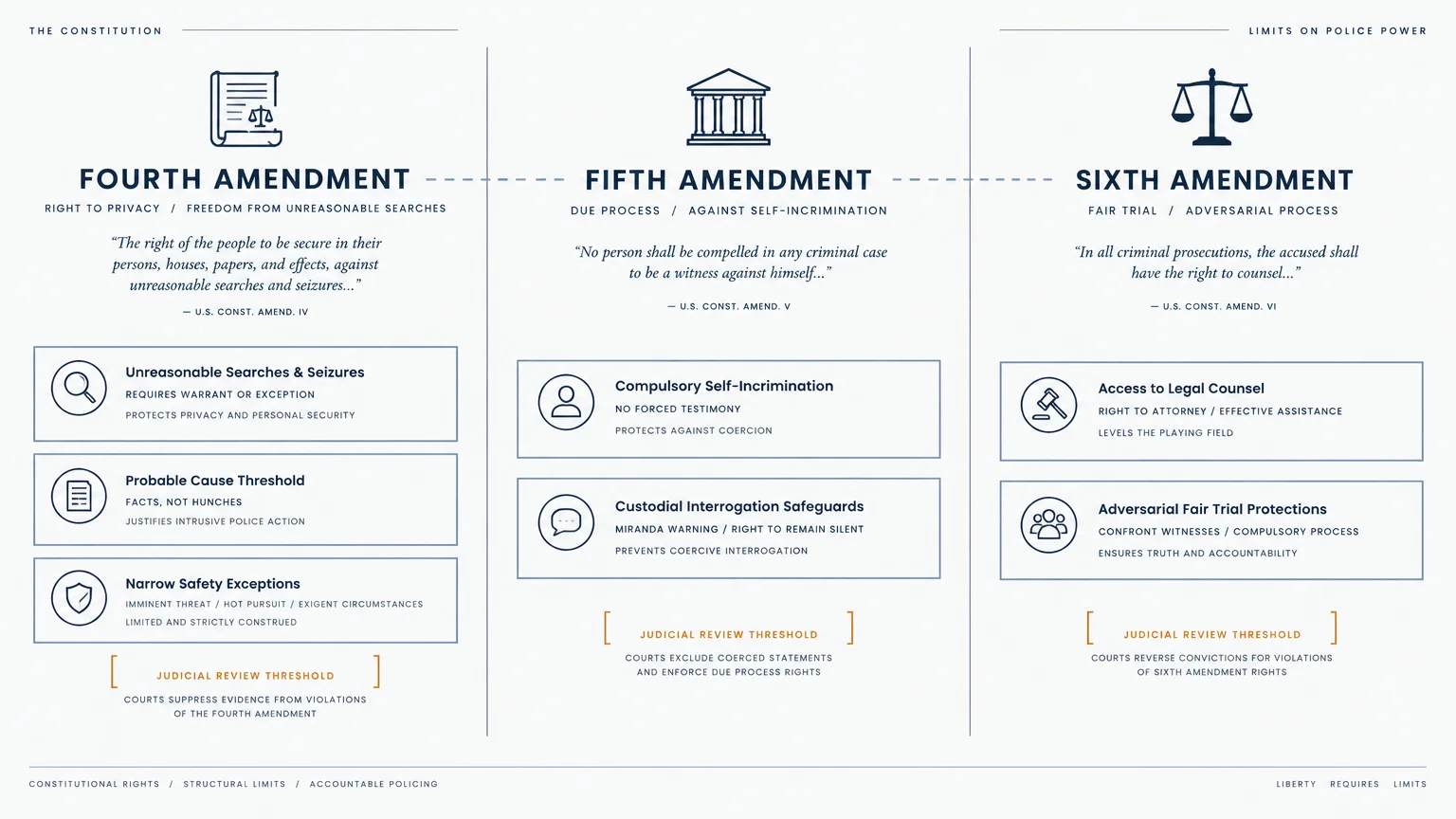
The Constitutional Framework Governing Searches and Interrogations
This list counts eleven binding Supreme Court decisions governing police authority under the Fourth, Fifth, and Sixth Amendments. The entries span foundational mid-twentieth-century rulings through opinions issued through 2025.
Much like other landmark Supreme Court decisions that defined individual rights, these criminal procedure cases continuously shape how constitutional limits operate in daily encounters.
Entries were selected for their direct application to street encounters, vehicle stops, digital surveillance, and stationhouse questioning. Each ruling establishes a nationwide constitutional baseline applied by state and federal courts.
Reasonable Suspicion for Street Stops and Frisks
In Terry v. Ohio, decided on June 10, 1968, the Supreme Court ruled 8–1 that police may briefly detain individuals on public streets without probable cause. Chief Justice Earl Warren delivered the landmark opinion.
To initiate a stop, an officer must possess reasonable, articulable suspicion that criminal conduct has occurred, is underway, or is imminent. An unparticularized suspicion or subjective hunch violates the Fourth Amendment standard.
If an officer also reasonably suspects a detained person is armed and dangerous, the officer may conduct a pat-down frisk of outer garments. The Court limited this frisk strictly to weapon detection for officer safety rather than general evidence collection.
The Exclusionary Rule for Unconstitutional Evidence
In Mapp v. Ohio, decided on June 19, 1961, the Supreme Court ruled 6–3 to apply the Fourth Amendment exclusionary rule to state criminal trials. Justice Tom C.
Clark authored the majority decision.
The decision established that state courts must exclude evidence gathered through unreasonable searches and seizures. The Supreme Court had previously applied the exclusionary principle only to federal law enforcement in Weeks v.
United States (1914).
Evidence discovered as a direct or indirect result of an unlawful search also falls under the fruit of the poisonous tree doctrine. Under Mapp, state and local officers face the same Fourth Amendment evidentiary prohibitions that constrain federal agents.
Warrant Requirements for Digital Cell Phone Data
In Riley v. California, decided on June 25, 2014, the Supreme Court ruled 9–0 that police must obtain a warrant before searching an arrested suspect’s cell phone. Chief Justice John Roberts delivered the unanimous opinion.
Under earlier precedent in Chimel v. California (1969), officers may warrantlessly search physical objects found on an arrestee’s person.
In Riley, the Court declined to extend that search-incident-to-arrest exception to digital data stored on mobile devices.
Chief Justice Roberts wrote that modern cell phones hold comprehensive digital records of private communications, medical histories, financial data, and geographic movements. Consequently, officers must secure a judicial warrant before inspecting digital contents on a seized phone, absent specific exigent circumstances.
Limitations on Warrantless Vehicle Searches Incident to Arrest
In Arizona v. Gant, decided on April 21, 2009, the Supreme Court ruled 5–4 that police face strict limits when searching vehicle passenger compartments after an arrest.
Justice John Paul Stevens authored the majority opinion.
Police may search a vehicle’s cabin incident to arrest only if the arrestee remains unsecured and within reaching distance of the passenger compartment.
Alternatively, officers may search the interior if it is reasonable to believe the car contains evidence of the specific offense of arrest.
When an officer arrests a driver for a routine traffic offense such as driving with a suspended license, the offense-related evidentiary basis does not apply. Unless officers establish independent probable cause under the separate automobile exception, a warrant is required.
Constitutional Limits on Historical Cell-Site Location Records
In Carpenter v. United States, 585 U.S. 296, decided on June 22, 2018, the Supreme Court ruled 5–4 that government acquisition of historical cell-site location information constitutes a Fourth Amendment search.
Chief Justice John Roberts authored the majority opinion.
Cell phones automatically connect to nearby radio antennas, generating time-stamped location records maintained by wireless carriers. Federal investigators in Carpenter obtained 127 days of the defendant’s movement records using a statutory court order rather than a probable-cause warrant.
The Court rejected arguments that users forfeit Fourth Amendment privacy in physical movements simply by carrying cell phones that share data with wireless providers.
Under Carpenter, law enforcement must generally obtain a warrant supported by probable cause before compelling carriers to turn over historical cell-site records.
The Emergency-Aid Exception to Home Search Warrants
In Brigham City v. Stuart, 547 U.S. 398, decided on May 22, 2006, the Supreme Court ruled 9–0 to clarify the emergency-aid exception to the Fourth Amendment warrant requirement.
Chief Justice John Roberts delivered the unanimous opinion.
The Court held that law enforcement officers may enter a home without a warrant when they have an objectively reasonable basis to believe an occupant is seriously injured or imminently threatened with such injury.
In Brigham City, officers entered a residence after witnessing a physical altercation through a screen door.
The unanimous Court ruled that an officer’s subjective motivation is irrelevant under the Fourth Amendment so long as the circumstances objectively justify the emergency entry. Once inside, officers must confine their actions strictly to addressing the immediate safety exigency.
The Totality Standard for Use-of-Force Seizures
In Barnes v. Felix, decided on May 15, 2025, the Supreme Court ruled 9–0 that courts evaluating Fourth Amendment use-of-force claims must consider all relevant events leading up to the force.
Justice Elena Kagan authored the unanimous opinion.
Any application of physical or deadly force by law enforcement constitutes a seizure governed by the Fourth Amendment reasonableness standard. Several lower federal appellate courts had previously applied a “moment-of-threat” rule that examined only the exact split second when an officer used force.
The Supreme Court rejected the moment-of-threat restriction, holding that chronological blinders conflict with the totality-of-the-circumstances inquiry established in Graham v. Connor (1989).
Reviewing courts must consider earlier events and pre-shooting circumstances when determining whether a seizure was objectively reasonable.
The Custodial Interrogation Warning Rule
In Miranda v. Arizona, decided on June 13, 1966, the Supreme Court ruled 5–4 that police must provide procedural warnings before conducting a custodial interrogation. Chief Justice Earl Warren delivered the majority opinion.
To enforce the Fifth Amendment privilege against compelled self-incrimination, officers must inform suspects in custody of the right to remain silent and that any statements may be used in court.
Suspects must also be informed of the right to consult an attorney and to have counsel appointed if indigent.
The constitutional requirement applies only when a suspect is both in custody and subjected to express questioning or its functional equivalent. If investigators interrogate a detained suspect without delivering these warnings, the prosecution generally cannot use the resulting statements in its case-in-chief.
Vocal Invocation of the Right to Silence
In Berghuis v. Thompkins, decided on June 1, 2010, the Supreme Court held 5–4 that remaining silent during questioning does not by itself invoke the Fifth Amendment right to silence.
Justice Anthony Kennedy authored the majority opinion.
The suspect in Thompkins remained largely silent through nearly three hours of police interrogation before giving an incriminating response. The Court ruled that mere silence is ambiguous and does not obligate officers to terminate an interrogation.
Under Thompkins, a suspect must unambiguously and verbally state an intention to remain silent to cut off questioning. Similarly, under Davis v.
United States (1994), a suspect must make an unambiguous request for counsel to halt interrogation until an attorney is present.
Evidentiary Use of Pre-Arrest Silence
In Salinas v. Texas, decided on June 17, 2013, the Supreme Court ruled 5–4 that a suspect’s silence during voluntary, non-custodial questioning can be used as evidence of guilt at trial. Justice Samuel Alito announced the judgment in a three-justice plurality opinion.
The petitioner voluntarily answered questions at a police station without being placed under arrest, then fell silent when asked whether shotgun shells found at a crime scene would match his weapon. At trial, prosecutors cited his silence and physical reaction as evidence of guilt.
The plurality concluded that the Fifth Amendment privilege against self-incrimination is not self-executing during voluntary interviews. Because the petitioner never expressly invoked the Fifth Amendment in response to the officer’s question, the prosecution did not violate the Constitution by commenting on his silence.
Civil Immunity for Procedural Warning Omissions
In Vega v. Tekoh, decided on June 23, 2022, the Supreme Court ruled 6–3 that a failure to provide Miranda warnings does not provide a basis for a federal civil damages lawsuit. Justice Samuel Alito authored the majority opinion.
The plaintiff brought a civil suit under 42 U.S.C. Section 1983 after a sheriff’s deputy questioned him without reading Miranda warnings and prosecutors introduced his statement at trial.
After being acquitted, the plaintiff sought monetary damages from the deputy for violating his constitutional rights.
The Court held that Miranda established prophylactic constitutional rules rather than a standalone substantive right enforceable under Section 1983. Consequently, the legal remedy for an un-Mirandized statement is the exclusion of the statement at a criminal trial, not civil damages against the questioning officer.
| Landmark Case | Decision Date | Vote Count | Primary Amendment | Binding Constitutional Rule |
|---|---|---|---|---|
| Terry v. Ohio | June 10, 1968 | 8–1 | Fourth Amendment | Reasonable suspicion required for street stops and weapon frisks. |
| Mapp v. Ohio | June 19, 1961 | 6–3 | Fourth Amendment | Exclusionary rule bars illegally seized evidence in state courts. |
| Riley v. California | June 25, 2014 | 9–0 | Fourth Amendment | Warrant required to search digital data on cell phones incident to arrest. |
| Arizona v. Gant | April 21, 2009 | 5–4 | Fourth Amendment | Vehicle searches incident to arrest limited to reaching distance or offense evidence. |
| Carpenter v. United States | June 22, 2018 | 5–4 | Fourth Amendment | Warrant generally required to obtain historical cell-site location records. |
| Brigham City v. Stuart | May 22, 2006 | 9–0 | Fourth Amendment | Objective basis of imminent injury permits warrantless emergency home entry. |
| Barnes v. Felix | May 15, 2025 | 9–0 | Fourth Amendment | Totality of circumstances, including prior events, governs use-of-force seizures. |
| Miranda v. Arizona | June 13, 1966 | 5–4 | Fifth & Sixth | Procedural warnings required before custodial interrogation can begin. |
| Berghuis v. Thompkins | June 1, 2010 | 5–4 | Fifth Amendment | Suspects must unambiguously speak to invoke the right to silence. |
| Salinas v. Texas | June 17, 2013 | 5–4 | Fifth Amendment | Pre-arrest voluntary silence usable at trial unless Fifth Amendment is expressly invoked. |
| Vega v. Tekoh | June 23, 2022 | 6–3 | Fifth Amendment | No civil Section 1983 damages against officers for failing to give Miranda warnings. |
Scope and Application of Constitutional Safeguards
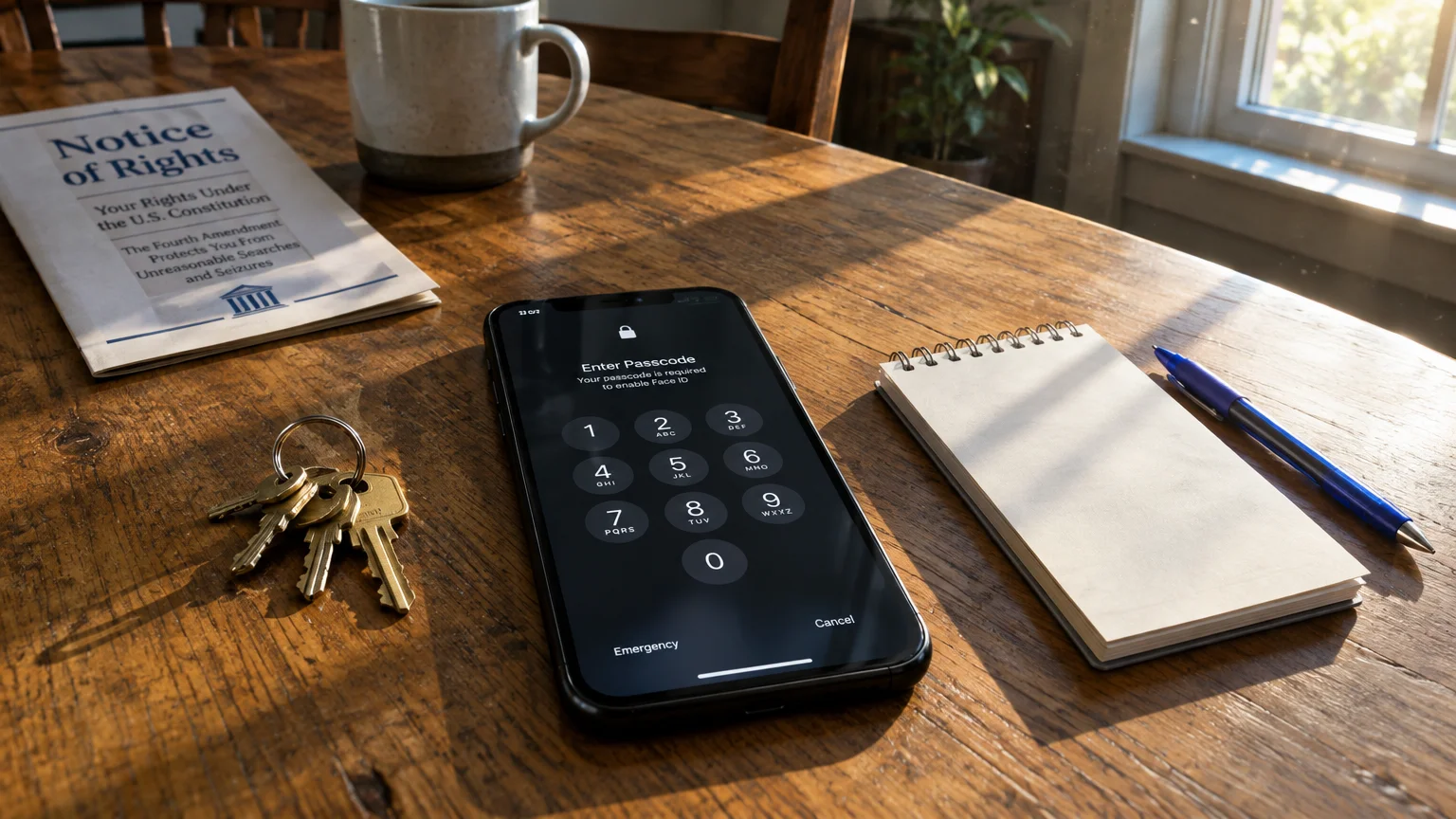
Supreme Court jurisprudence distinguishes between digital data and physical spaces when enforcing Fourth Amendment warrant requirements. Decisions in Riley and Carpenter restrict warrantless access to cell phones and historical location tracking, while Gant and Brigham City define specific physical exceptions for officer safety and emergencies.
Under the Fifth Amendment, rulings in Thompkins and Salinas require individuals to expressly state their invocation of the right against self-incrimination. Meanwhile, Vega limits the remedy for Miranda omissions to the suppression of evidence in criminal trials rather than civil damages.
Because the Fourth, Fifth, and Sixth Amendments protect “the people” and “any person” rather than only citizens, these investigative rules apply to all persons within the United States regardless of citizenship or immigration status.
However, while indigent defendants are guaranteed court-appointed counsel in criminal prosecutions under Gideon v. Wainwright (1963), removal proceedings in immigration court are civil matters where the government does not provide free appointed counsel.
Frequently Asked Questions About Police Authority and Constitutional Rights
Are police required to read Miranda warnings immediately upon arrest?
Law enforcement officers are not required to recite Miranda warnings simply because they place an individual under arrest. The constitutional requirement applies only when a suspect is both in official custody and subjected to investigative questioning.
If officers arrest a person and ask no investigative questions, no Miranda warnings are required. Furthermore, spontaneous statements volunteered by a detainee without police prompting remain admissible at trial even if warnings were never administered.
Can police search a vehicle during a routine traffic stop?
Police cannot search a vehicle during a routine traffic stop without a judicial warrant, voluntary consent, or probable cause. Under Arizona v.
Gant, arresting a driver does not automatically authorize a search of the passenger compartment.
Officers may search the cabin incident to arrest only if the arrestee is unsecured within reaching distance of the interior or if the car reasonably holds evidence of the arresting offense.
Separately, if an officer observes illegal contraband through a window under the plain-view doctrine, that observation can establish probable cause to search.
How does a suspect legally invoke the right to remain silent?
Under Berghuis v. Thompkins and Salinas v.
Texas, a suspect must make a clear, unambiguous verbal statement to invoke the Fifth Amendment privilege against self-incrimination. Simply remaining silent during police questioning does not legally obligate investigators to stop an interview.
Under Davis v. United States, an unambiguous request for an attorney similarly requires officers to cease custodial interrogation immediately.
Once counsel is requested, police cannot resume questioning until the suspect’s attorney is present or the suspect initiates further communication.
Can an officer frisk clothing during any casual street encounter?
An officer cannot lawfully conduct a pat-down frisk during a consensual street conversation without specific justification. Under Terry v.
Ohio, an officer must possess reasonable, articulable suspicion both that criminal activity is afoot and that the detained individual is armed and dangerous.
The frisk must remain limited to a pat-down of outer clothing to detect weapons. Under Minnesota v.
Dickerson (1993), an officer may seize non-weapon contraband during a Terry frisk only if its unlawful identity is immediately apparent by plain feel without further manipulation.